Norco is a rare achievement, balancing the legacy of adventure games and multiple movements of American literature. There are pops of Pynchon in product names and comical nobodies, broken by a culture that has no gods, visions of Vonnegut and P.K. Dick in science fiction absurdity, and yet still the lineage of material reality borrowed from Faulkner and Wright. These pair as neighbors to Kojima’s Snatcher and the backrooms of Wadjeteye’s modern adventures games like Unavowed and The Shivah.
The city of Norco is doomed. The cyberdystopian capitalists at Shield have failed to protect the people who work their oil refineries from floods, drugs, and gangs that have started to resemble cults. Your first player character, Kay, knows this before the game begins, and it’s why she left town. However, she’s returned after the passing of her mother, Catherine, and quickly wanders into a mystery. Kay’s brother has gone missing, and Catherine was investigating something Shield representatives took from the house without asking. When you play as Catherine, you quickly see that the client she’s working for, an online app contractor known as “Superduck,” is far, far more than she ever meant to meet.
We live in an age of “the narrative banger,” and Norco is pretty well read as these things go. Largely, it’s written in genuinely funny, conversational dialogue with people like your local scuzzy private detective or Pawpaw the Ditch Man, who believes Catherine and Kay to be direct descendants of Christ’s bloodline. In Catherine’s storyline, she meets the Garretts, a gang of pseudofascists who crack a lot of jokes about social media, porn, drugs, and the like who are being made to share a name by their leader John. This stuff is balanced against the introspective narration of a game like Disco Elysium, with extended (though infrequent) passages of beautiful prose. One great moment early on involves Kay remembering the three floods that have washed through the family’s home in Norco over the years, ending with a projection into the future of a fourth flood that will be the end of the homestead for good.
All this is joined with a strong pixel-art design, full of expressive faces, painterly horizons, and funny, simple animation. It’s really thoughtfully handled and sets the tone for a place that feels lived in, only for the horrors of technology to make mystic overbearance. Norco is a pretty darn good adventure game, with fun environments to explore, fun puzzles, great pacing. It makes this favorites list on the strength of its composition. Its understanding that black comedic satire and thoughtful poetic spirituality can be married, its purposeful use of moody chiptune grooves and pixel art that feels genuinely grimy, its considered politics and political incorrectness.
Higurashi: When They Cry Ryukishi 07 + 07th Expansion 2008-2022 (it’s a long story) PC
The memories I have of playing Higurashi: When They Cry involve the nighttime dog walks after a session just as much as the experience sitting in front of my computer. The idea of the “mystery game” has existed almost as long as games themselves. Ken and Roberta Williams created the murder mystery adventure game Mystery House in 1980, the start of their storied careers. But many of those mysteries have fatal flaws. Sometimes, they are too easy to deduce, with plot beats that land as thudding “WE KNOW ALREADY” moments. Other times, they’re impossible to deduce, either because the reality is far too implausible or because the game actively lies to create tension (maybe never more infamously disappointing than David Cage’s Heavy Rain.)
Higurashi: When They Cry is a mystery that trades on familiarity. A “sound novel,” or a visual novel with an emphasis on atmosphere in its storytelling, perhaps its most famous signature sound is the cry of the titular “higurashi,” summer cicadas. It’s a sound I grew up hearing in my midwestern suburb, not as lushly textured as the sound of Hinamizawa’s forests and fauna. I grew up with similar anime, too – a protagonist-attituded teenage boy, Keiichi Maebara, moves to a new town and meets a high-energy cast of teenage girls. After getting friendly with them and beginning to develop relationships, he participates in the town’s summer Watanagashi festival, a local tradition with carnival games and sweet rituals. After this festival, however, bodies turn up – an unfortunate recent event is the annual deaths on the night of the festival. Keiichi has been friendly with these victims, too – and, unfortunately, it may have associated him with the grudge that took their lives. Now, Keiichi must do his best to navigate a network of suspicion, often suspecting even the friends who took him in of the violence he fears may come his way next.
I say “often” because Higurashi’s storytelling structure is fairly unconventional. The game is divided into eight “chapters,” each separate executables, and a newly released (June 2022) epilogue. Each of these chapters is not sequential with one another. Rather, they offer alternate scenarios – the first four scenarios, the “Question” Arcs, portray alternate versions of the Watanagashi Festival and the violence that ensues. Different characters may appear, different decisions get made, and, ultimately, different unfortunate misunderstandings set friend against friend. The latter four scenarios are the “Answer” Arcs, and they offer different perspectives on the events of the Question Arcs – and, as a result, often far more information about the ultimate cause of this violent ritual.
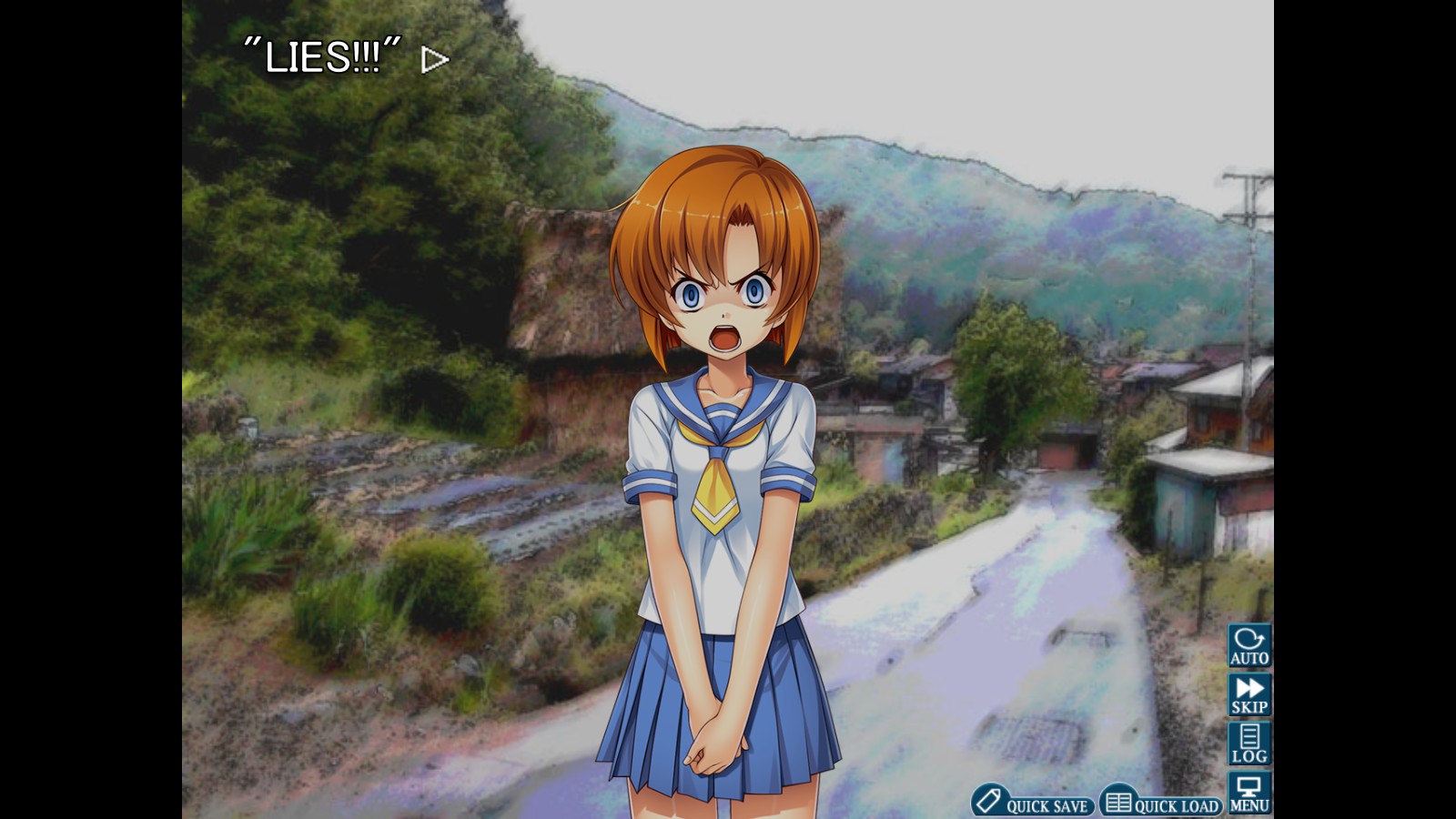
The Steam release of Higurashi. Rena confronts Keiichi about underlying tensions in Ch. 1 – Onikakushi, free on Steam.
Each chapter plays out with a fairly regular structure – the first half plays out as a slice of life anime, really dedicated to fleshing out the characters and building affection for their friendships. I can’t stress enough that if you don’t have much tolerance for 2000s anime comedy, this is probably gonna be a tough sit for you. It’s worth noting that sexuality is never explicit in Higurashi (valuable in a series about literal teenagers!) but it does lean into tropes about Keiichi sexualizing his classmates, “RANDOM!!!” humor, and meta gags. In high school, this was the stuff I ate up with an appetite – shows like Lucky Star, Azumanga Daioh, and The Melancholy of Haruhi Suzumiya were my favorites. That last one owes a massive debt to Higurashi – I doubt it would have been received the same way without a loyal Higurashi fanbase, if it were written the same way at all without its predecessor.
After the laughter, dread sets in – the Watanagashi Festival has arrived. After the first chapter, you’ve come to learn what this will mean. And you know that shortly after this last gasp of friendship, the despair comes soon to follow. The thriller sequences of Higurashi are among the more terrifying horror novels I’ve read in a long time. The violence isn’t necessarily excessive, thankfully. The quality of the writing allows for genuine dread to instill, and the sound novel aspect allows it to really punctuate horrific moments.
Every Arc is, in my opinion, quite satisfying. The first is very much an introduction to the world, and it plays out in ways that might feel somewhat predictable to fans of the genre. But its primary suspect for Keiichi, a disturbed version of the girl next door, Rena Ryuuga, has a handful of moments that are chilling. And, even better, there’s elements you can’t explain right away. For one thing, it wouldn’t seem like she’s acting alone, but no explanation of her behavior can account for how she’d have accomplices. For another, one cause of death – seemingly self-inflicted lacerations, which merit more detail but I don’t want to spoil – can’t clearly align with anything you’ve seen. You’re left piecing together what you can.
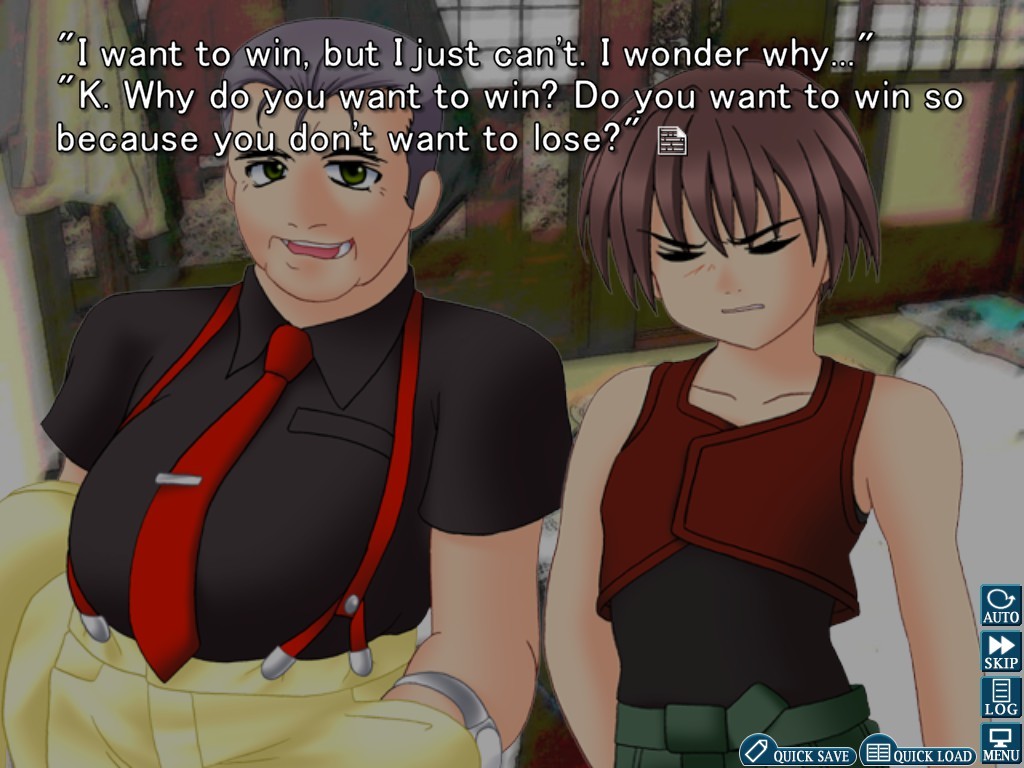
The original Higurashi – When They Cry art. A local cop browbeats Keiichi for his competitive nature and lack of skill.
Those nightly reflections on my Higurashi readings are so memorable precisely because I really was able to piece together a good amount of information I hadn’t previously been told without ever giving the whole mystery away. I’d walk around, asking myself what I’d learned that night, trying to piece together the ultimate mystery. I’d think about these characters throughout my day, remembering my favorite moments, both happy and sad, scary and funny. I really grew to love them, and so solving the layered, quite complex mystery was my full hobby for almost a month as I binged the game.
I’ve often said that the runtime approach to games is totally skewed. Sure, I played the PS3 game Journey for three hours. But when I thought about it for a decade afterward, listened to the soundtrack repeatedly, and acknowledge it altered the way I thought about the transcendental – did I only get “three hours of value” out of the game? Higurashi, even just in terms of screentime, is a long game – I made liberal use of the game’s fast-forward button to get all the text on screen at once, and Steam says it still took me 50 hours to complete. If you use the popular 07th Mod to add voice acting and actually listen to all of it, you’d probably hit 120 hours of game time easily.
It took me three weeks to read, and it honestly wasn’t long enough. Higurashi is easily one of my favorite games ever, and has made me rethink my relationship to games. The novel originally released over five years, the first chapter releasing in 2002 and the eighth in 2006, and then released in the US between 2008 and 2010. It’s expanded into anime, live action films, anime sequels, spinoff games, and, of course, the maybe even more popular spiritual successor, Umineko: When They Cry. I’m giving myself time to live with Higurashi as the end of the story for now – but it’s partly that I know there’s more to discover, more time to live in the world of its writer, Ryukishi07. Compared to certain other recent mystery games (*cough*Immortality*cough) I can only just barely wait to fall back into this world.
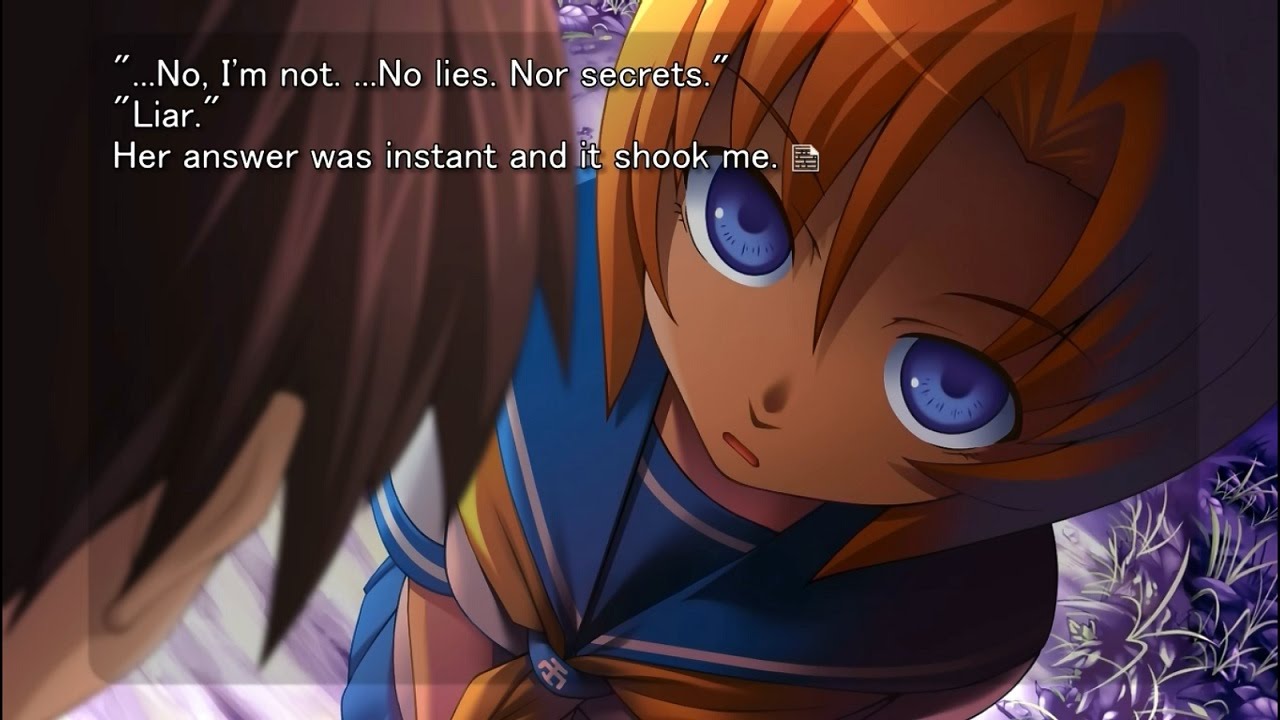
A screenshot from the popular 07th mod. Rena confronts Keiichi again in Ch. 1 – Onikakushi.
Additional notes – the Type07th Expansion mod, and the “original” art. The Steam version of Higurashi, released between 2015 and 2016, allows you to switch between the art you’ll see on the new Steam page and the original art, the conversation you can see between Keiichi and a local cop. I am not going to argue for anyone to play with the original art unless they really want to – it definitely has a lot of personality, but, uh, it’s obviously a lot harder to take seriously. I did not install the popular Type07th Expansion mod, which adds voice acting and the art from the PS2 release- you’ll see it in the image above this paragraph. Most diehards swear by the Type07th Expansion mod. I didn’t install it. I personally preferred to play without voice acting, which allowed more ambiguity in a lot of the line readings, and the Steam remaster art is totally acceptable IMO. But I figured I’d make you aware of it, because many other diehard fans would cuss me out for not making you aware that you could play this game with what, from what I’ve seen on YouTube, is excellent voice acting!
I can’t remember how exactly I wound up playing Rollercoaster Tycoon, the independently developed first entry aimed at Scholastic Book Sales and cereal boxes – if it came into the house through the intended method, or if my dad (who was a PC gamer unlike me) had read about it and decided to take a crack at it himself. I loved Disneyland at that age but hadn’t been old or tall enough to really ride rollercoasters or most rides scarier than Dumbo. When I finally did get a season pass to Six Flags about four years later, I was terrified of each impending step up the rollercoaster intensity ladder. My motivation to keep going came from a love of the damn rides (I’m thankful I still enjoy them now!) and memories of playing so much RollerCoaster Tycoon 1 & 2 as a kid.
I came back to the management sim as an adult after picking up RollerCoaster Tycoon 2 in a Steam sale during the pandemic. I often struggle with sim games and creativity canvas games – RollerCoaster Tycoon combines the two. Each park template comes with a scenario goal, such as attracting a target number of guests before a certain date, or to achieve a certain park value in fixed assets built into the park. As a kid, I found many of the more difficult goals arcane, unbelievably high, too distant to achieve. Now, the goals are almost ancillary to just designing a park I’d enjoy spending time at for a day.
While the game’s many “flat rides” (here meaning rides without tracks, such as a ferris wheel, merry-go-round, or swinging ship) offer some prefab parts you can slot together to get started, designing a fun, profitable park involves building some damn roller coasters. When I’m designing a ride, I spend time mentally imagining how it would feel to ride. I have enough sense memory of certain top speeds and G-forces to be able to consider (even if probably not 100% accurately) how the turns, rattles, airtime, and inclines are for the passengers. The game’s evaluation of whether or not a ride is fun is pretty smart, but I’m only really satisfied when I make something that I think I’d enjoy.
I follow a couple of different YouTube channels that produce really high quality RollerCoaster Tycoon content to this day. The first, Deurklink, is focused on using in-game scenery, rides, and shops to create beautiful, detailed parks, the way people build scale model backdrops for their model railroad kits. The second, Marcel Vos, is an expert of the game’s programming and design, testing the absolute limits of what the game can simulate – rides that last simulated eons, theme parks with no rides that can attract thousands of guests, parks that occupy two in-game squares. This degree of expertise partly comes out of the fan-made OpenRCT2 app, which basically operates as an enhanced version of RollerCoaster Tycoon 2 you can only run with a proper installation of the game. RCT2 has an extremely dedicated fanbase I’d been unaware of for twenty years, and I’m blown away by all the work they’ve done and continue to do.
I remember listening to the Idle Thumbs podcast, a show run by game developers, discussing the intentional “game design” of theme parks. They talked about visiting Disneyland with a lot of attention toward “the intended experience.” This is, to some extent, true of all architecture, but unlike more purely functional landscapes or buildings, the theme park is meant to provoke the broadest, most directly accessible form of “fun.” Unlike Disneyland, RCT2 is at its most fun when you honor the natural landscape to guide the design experience rather than flattening everything to match your design, so simulating the economics only better facilitates the play.
I imagine most people learning the game focus first on just learning the mechanics of making a profitable park which can complete the game’s goals. But you don’t have to become a wizard at exploiting the game mechanics to reach the point where it’s more rewarding to turn the game into a canvas. I haven’t been able to get into more abstract creative games like Minecraft or SimCity – it helps me a lot to have the sound of a roller coaster chain lift, the screams of joy from guests getting soaked on a log flume, imagining adolescent summers where I learned to conquer the Raging Bull’s 208 foot drop.
Two duelists meet in the battleground. Sometimes it’s a castle – sometimes a waterfall – sometimes Valhalla. They jab, deflect, jump, dodge, and spar until death does them part. This is the “normal” part of Nidhogg. Then they run.
Nidhogg is fencing football. The player who’s most recently won in a duel takes possession of the screen and sprints toward the opponent’s goal. Whoever makes it there first is swallowed by the titular world-devouring serpent for an audience of cheering fans. The other player will be reborn every few seconds to make a valiant defense and stop them, and if they win, they take possession and start running.
This ends up making for some of the most frantic twitch gameplay I’ve ever seen. It’s easy to pick up and play for two people who have never played before, but it’s also full of details that make it difficult to master. The duelist can hold the sword at three different elevations – holding your rapier at the same height as your opponent’s thrust can block attacks, but raising or lowering your blade over the opponent’s sword can knock it from their hands. Holding the sword up above your head leaves you defenseless, but it also allows you to throw the sword at your opponent. After deflection or a throw, you can run faster, but your only defense is a smartly timed kick.
All of this is rendered in crazy pixel graphics. Your technicolor duelist bleeds their color all over the battlefield, leaving a paintball arena of battle spoils as you run back and forth over the course of a match. The animation is so precise and well-animated that each action feels snappy and responsive while also feeling expressive and surprisingly violent. The music by indie musician and producer Daedelus is synchronized to player action, so every game has its own unique soundtrack. It’s a simple game that’s easy to read – playing with friends makes for a great pass and play game.
Video games are so cool, man. I play the sequel, Nidhogg II, at I/O Arcade Bar every time I go – in the sequel, your dudes are nastier, the game offers a bunch of different weapons, and there are even more crazy stages to fight on. I still prefer the simplicity of the original game at home, but the madcap experience of playing with friends hasn’t gotten old a decade later.
A great, impending doom is coming – when the season ends, The Yawhg will come, bringing untold death and destruction. The players each choose a character and, by choosing where to spend their time when, they tell a story of the last season before the great change comes. Each turn involves reading a short story prompt, making a choice, and then seeing the consequences. After everyone’s taken enough turns, the game ends, and you see how your characters lived.
This story is told with a sense of humor. There are vampires, drinking contests, streetwise burglars and vigilantes, potions gone wrong. While there is occasionally peril, your character is not going to die before The Yawhg arrives. The game luxuriates in strange, non sequitur experiences, like meeting an old man who asks you to stand against the sun and provide him some shade for a nap. Moments like these keep the game light and award all kinds of play. Tell your story – and tell it again differently next time.
The Yawhg released into a climate experiencing an independent multiplayer boom scattered across tabletop RPGs, board games, and video games, and it combines elements of all three. The branching narratives of The Yawhg invoke the Twine interactive fiction boom and matches games like Johann Sebastian Joust or Spaceteam. Its beautifully drawn art by Emily Carroll and its short playtime (a four person game of The Yawhg takes about 30-45 minutes) remind me of games like Tokaido and Agricola.
But the game The Yawhg reminds me most of is the tabletop RPG The Quiet Year, a map-drawing game where players take turns in a fantastic settlement drawing random events from a deck and, ultimately, facing down impending doom, the arrival of The Frost Giants at the end of the year. The two games are similar in their concept of offering more life in the settlement than just preparation for the End of Days. The taking of turns, drawing of cards as random events, and building of a collaborative story are kismet – the two games released at roughly the same time and appealed to many of the same people.
But what differentiates The Yawhg and The Quiet Year, apart from The Yawhg automating the process and taking about a quarter of the play time, is that The Yawhg centers on its characters whereas The Quiet Year is built around the community. The Quiet Year actually makes specific rules around not picking particular characters for each player – while you’re allowed to return to pet themes and storylines, The Quiet Year positions the players as responsible for both introducing the characters and creating the friction in their lives. The Yawhg uses its perspective within the characters’ shoes to automate that narrative friction and let the players imagine personalities without feeling responsible for eventually tearing them down.
The two games make beautiful companions for one another. Between them, I see a powerful understanding of the possibilities in the medium. Understanding the two next to one another creates dialogue about intention in design and tone management. I understand this reason for loving these games sounds so niche and dorky. I really appreciate having two variations on this idea, one aimed at the highest level of RPG players ready to create a story world together and take seriously its politics, economy, and characters, and one aimed at all levels of roleplay designed to laugh, look at some beautiful art, and relish in someone else’s great work.
THE LEGEND OF ZELDA: TEARS OF THE KINGDOM Nintendo 2023 Nintendo Switch
Tears of the Kingdom’s greatest strengths are in its use of mystery to drive plot, in lost time to create pathos, and its incredible mechanical depth to enhance the gameplay of Breath of the Wild. I found the eventual storyline regarding Princess Zelda to be quite moving, and the dungeons at the centerpiece of this game’s five major temples are clever and concisely designed. Songs like “Lookout Landing,”“Water Temple,” and the new “Main Theme” prove Manaka Kataoka (who got her start writing the iconic “7 P.M.” theme from Animal Crossing: New Leaf will be one of the greatest composers in gaming history. Rather than share the same sort of post I typically do regarding Tears of the Kingdom, an enormous and gorgeous game which could merit an entire playthrough diary and a book’s worth of criticism, I’ve decided to share the diary I wrote during my first days with the game.
5/14/2023
I’ve decided to start keeping a diary of my sessions playing The Legend of Zelda: Tears of the Kingdom. There are a number of root causes, but the primary is pretty simple – I want to track my own understanding of the game’s world and lore, exploring the narrative empty space the game offers. It wouldn’t be the first time that I started expanding on a narrative throughline and had it collapse by game’s end. Skyward Sword’s Groose, in a heroic sacrifice, seals Demise within himself and becomes the Demon King Ganondorf, destined to battle his friend Link generationally and lose every time, maybe intentionally. Or…not. But that empty space I filled in still feels thematically relevant and possible, informing how I think about the game’s text. Maybe that misdirection was always in place.
Tears is full of empty space, literally and figuratively, for the player to try to piece together a mystery. A being what look like Zelda keeps being spotted throughout Hyrule, only she doesn’t really behave like Zelda and seems capable of some kind of teleportation or projection. My theory, right now, is that this is The First Zelda, Queen of Hyrule, the Sage of Time (so named by the Sage of Wind) who has projected forward to aid (or threaten) Hyrule’s people. Documented so far, I’ve spotted her:
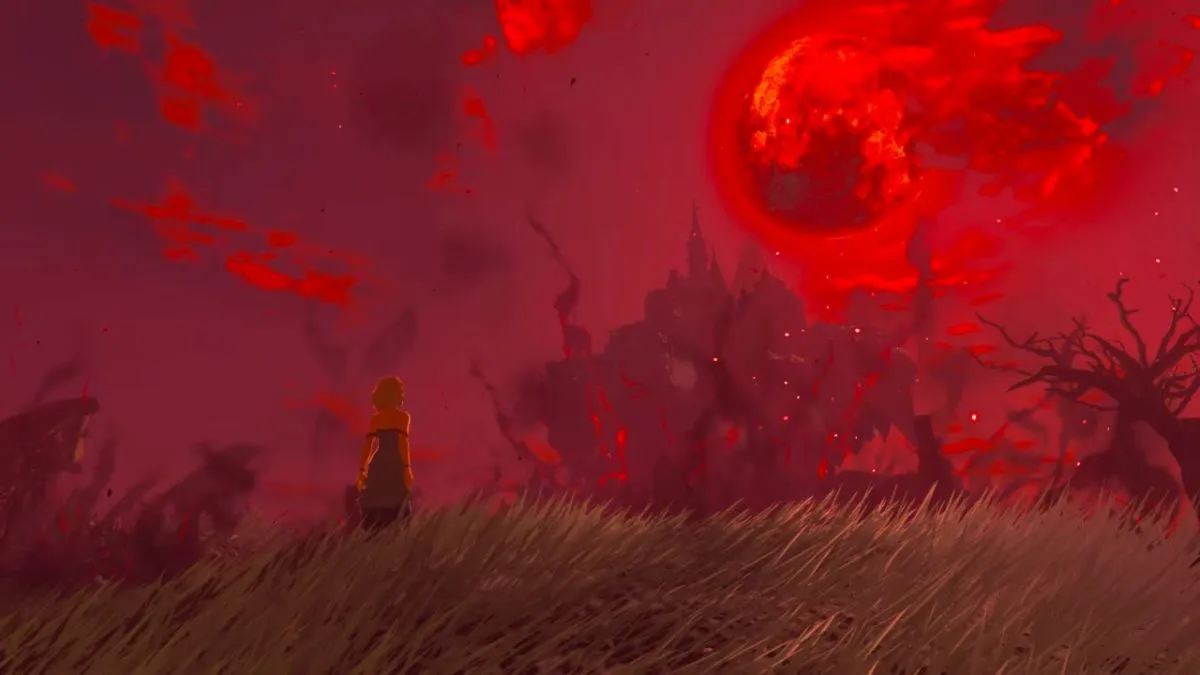
-Silently blessing Link’s arm with Recall, in the body of a Golden Tear. -Receiving the Master Sword from Link, presumably back in the past. -Standing on Hyrule Castle’s ruins before floating away in golden light. -The Blood Moon rises, with new, more confident, slightly fear-inspiring dialogue. -*REPORTED*: Zelda came to Kakariko Village after the Upheaval dropped the Ring Ruins. After inspection, she told Purah and her team to stay away from one particular floating ruin. (I can’t airdrop onto it – maybe an angle where pictures can help?) -Spotted in Rito Village, though no mention of her doing anything but floating away. -Spotted on Stormbringer Ark, just walked forward and disappeared (no floating.) -Seen in Memory of the Sage of Wind, where she’s called “The Sage of Time” and in which she predicted Link’s quest.
Zelda in front of the Blood Moon.
Any of these appearances could hypothetically be “Our Zelda” (would like to come up with a name for her. The Archeologist?) or The Sage of Time, or even any Zelda in between those two. So far, none of the Zeldas I’ve seen since separating in the Tomb Depths acts like our Zelda. She’s more direct, mostly, with the rest being on the marginalia. Our Zelda is prone to tangents, repetition – she’s a little nerd and we like that for her. She’s also much more timid. I believe these are appearances by The Sage of Time, and Our Zelda is still somewhere else.
The Stormbringer Ark legend is a curious one. Why did the Rito return to Hyrule? Did they first reach the Stormbringer during The Demon King’s first invasion? The memory of the Sage of Wind indicates so. No other reference to an upheaval is mentioned during the Sky Temple. Did the Rito people simply not participate in the Imprisoning War? Was the Stormbringer (armed with cannons) used as the lead battleship in an aerial fleet? Many questions still to answer. Winter has thawed with Colgera defeated. I’m a little melancholy to have fully reset the region so quickly, but I don’t actually love snow areas in these games, so I’m more likely to dig deeper.
Other threads to pull on in the next sessions:
-Kakariko Village’s Ring Ruins. Still don’t know what these are. One story about the six sages found so far. Might have to make a priority here. -Hateno Village’s Mayoral Election. The fashion lady is obnoxious. I’m helping Reese. I do really like the hat she designed, though. -Lurelin Village’s pirate invaders. They’ve taken over my favorite town in the whole game. I’ll have them longshanks. I wonder if you’ll have to go around and find all the citizens who’ve left, or if word will travel for you. -How long has it been since BOTW? Seemingly, at least a few years. Zelda built a school in Hateno and took over Link’s house. Tulin has come of age, from childhood to becoming a warrior. Paya is now a young adult. -Impa’s pilgrimage. She left with someone and put Paya in charge to search for something. I wonder if we’ll find her out there. -The Chasms and Sky Archipelagos. If there is some broader narrative to explore above or below, I haven’t found it yet. No quests are really sending me up or down to explore yet. I know the Yiga Clan is in the depths somewhere, though. I need to hunt for some sky quests. Maybe then I’ll be able to upgrade my power supply. -The Lucky Clover Gazette. Stable questline. Maybe the first thing I’ll do is warp around to different stables and progress those questlines ASAP. Give myself some more direction. -Lookout Village. Haven’t really dug deeper into the castle or what’s going on in the village. Supposedly, after the first Temple is completed, stuff opens up in Lookout. I’ll have to stop back. -Bubblefrog Caves. No idea who to trade the snowflakes to. Satori gave me a clue to look for caves. I wonder if that’s still online, or if it’s been long enough that I’d need to return to the mountain to extend the blessing. -Din’s dragon. I’ve seen Farrosh and Lanayru. No sign of the red dragon yet. I haven’t been north of the castle except for the Rito questline.
I’ve visited three of the major towns and activated their warps. That leaves five more, right? -Tarrey Town -Gerudo Town -Death Mountain Town -Zora’s Domain -Lurelin Village
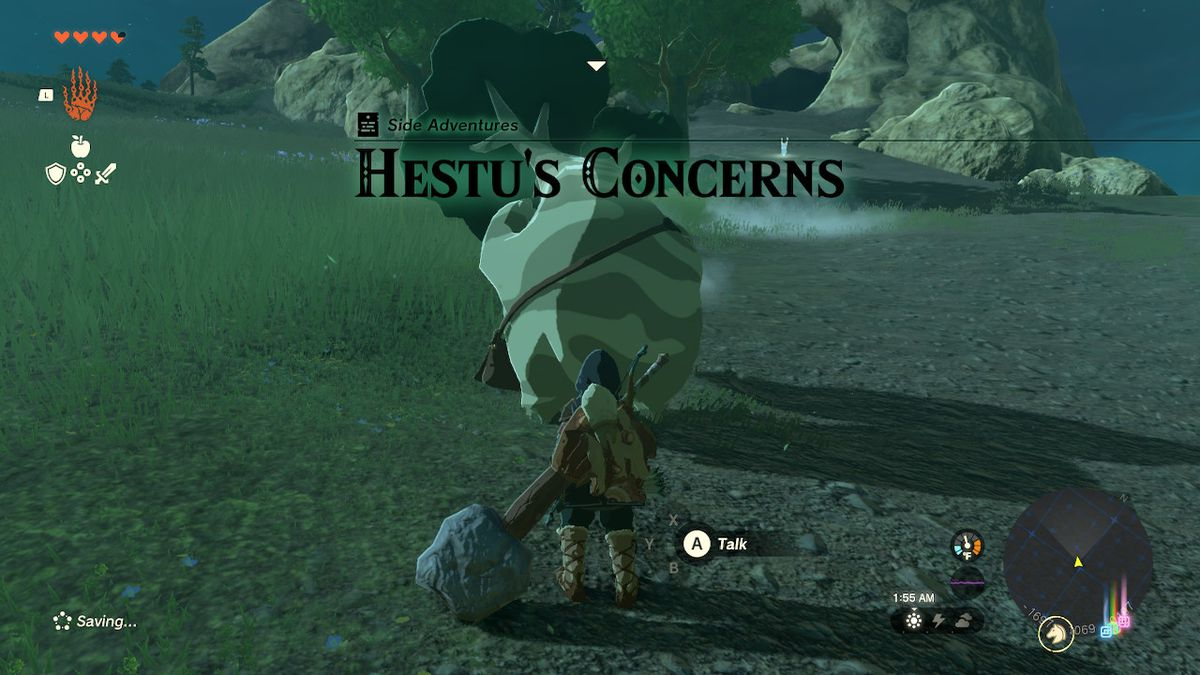
Lurelin is next. After that, I’ll have to start poking around. I did see that Hestu is apparently northeast of Lookout Village, so I’ll head that way in the hopes of expanding my inventory.
Hestu in Tears of the Kingdom.
5/15
Okay, I made very little lateral progress (just getting east of Lookout slightly) but I made a ton of progress on many of these questions. It’s crazy how much of this game is just laying about in open fields to surprise.
-Bubblefrog Caves. I’m headed for Woodland Stable to meet the “old couple” there who collect Bubblefrog medals.
-Lookout – Things didn’t open up *that* much after the temple. Hestu’s arrived, thankfully. The hidden passage under the castle has a Demon Statue and a little loot down there, but until I can break black blocks, I’m not getting any deeper. (Diamond weapons? Eldin power of summoning?) I’ve unlocked the next phase of Josha’s Chasm questing, to find an underground temple and get a power there (Auto-Build?)
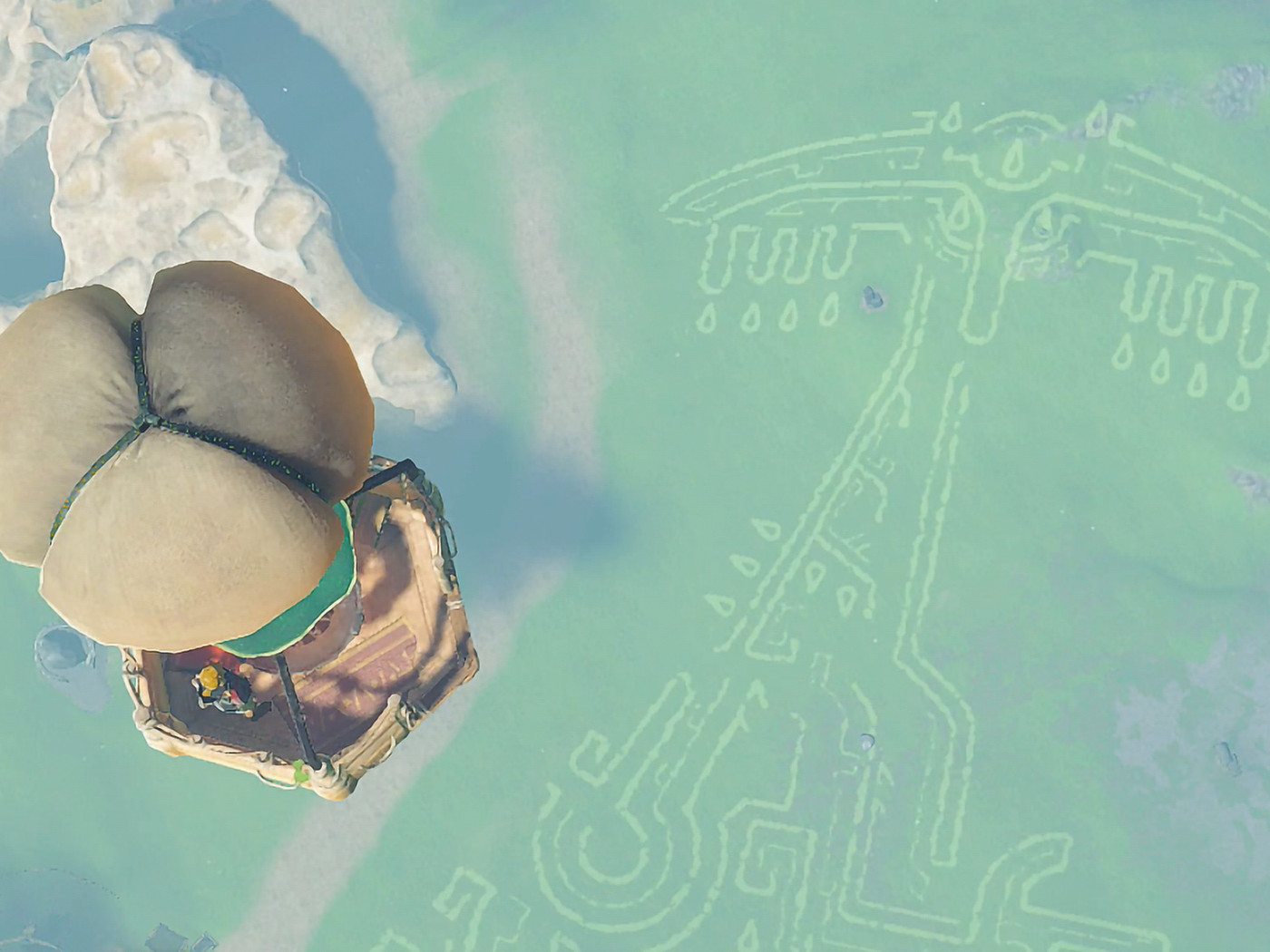
-Impa’s pilgrimage. Sure enough, she was right on the path from Lookout to Rito, investigating the Geoglyphs. This was probably the most impactful bit of lore I got all session – the Geoglyphs each carry one of the Dragon’s Tears, which unlock a memory of Our Zelda’s experience on the other side of her time jump. She definitely is operating in the past! And it seems I was wrong about The First Zelda. If the Sage of Time is not Our Zelda, then she’s also not the First Queen of Hyrule. The First Queen of Hyrule, Rauru’s wife, is a Hylian named Sonia. Each Geoglyph has a memory (found in a small water pool on the design). The next phase of Impa’s quest, where I can presumably find the locations of all the designs and add them to my map, is in a cave in the Hebra trench.
-Lurelin Village’s pirate invaders. Zonai Monster Control have been sent to contest the pirates. I’m headed that way next *for sure* after the Woodland Stable (lol).
-Ancient Hylian text crashed down into the Lookout, sending Wortsworth the Lore Expert to Kakariko Village. Maybe this will allow the questline to progress?
-A construct merchant crashed just north of Lookout, offering a trade of 100 crystallized ore (or whatever currency) for 1 energy cell. Thankful I’ve got that all sorted now!
-Found some brightcap hunters and shield surfers all headed toward the Hebra region. And a cave with a “white bird’s treasure” north in Hebra. If I need to make some cash and find new weapons, I should probably explore northern Hebra.
-Hit 8 hearts, so I’m headed for my first stamina ring. Will switch back to hearts till at least 16 i think after that?
-The Lucky Clover Gazette questline seems to have pointed me toward a vision of Zelda riding some great beast. The images look unfamiliar – maybe this game’s interpretation of Dodongo, but otherwise not recognizable to me. (Dodongo are one of the Zelda 1 enemies still not interpreted in this game, so they’d make sense! There are too many not included to list, though, and they certainly won’t add all of them.)
Main quest stuff: I’m surprised, but returning to Lookout has definitely pointed me toward Eldin next. They’re battling a Gloom crisis on Death Mountain, turning Gorons hostile, but the land is temperate and the need for fire-resistant armor is temporarily eliminated. I’m sure once I clear the Gloom it’ll be back in full swing, though…maybe will buy the armor before I complete that questline.
Lurelin calls, though.
Impa’s blimp overlooking the Geoglyph.
5/16
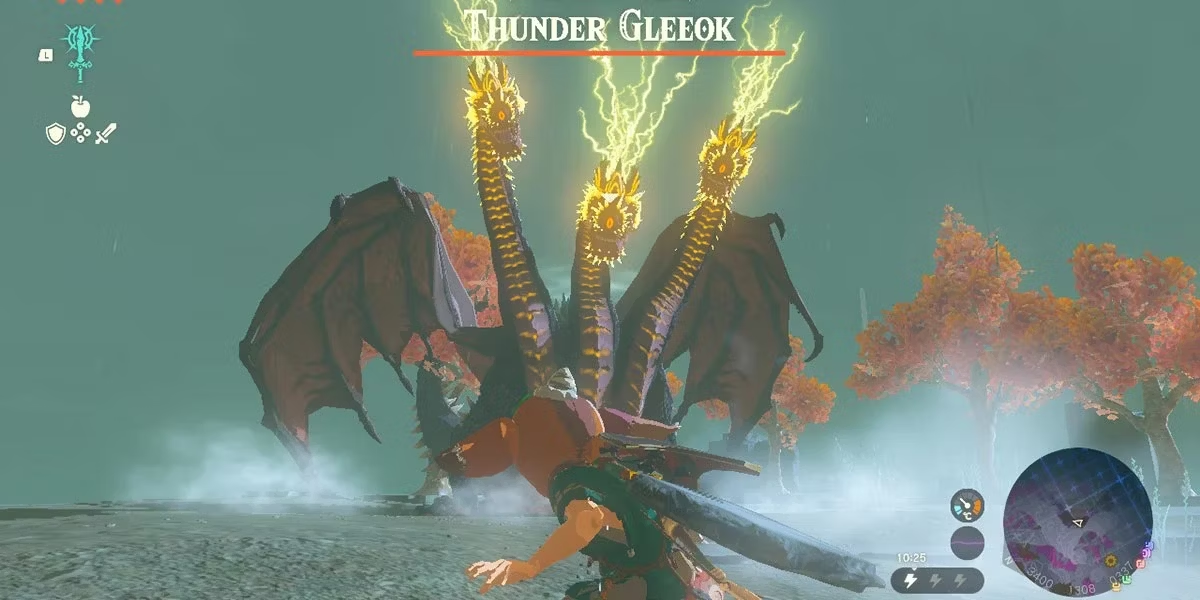
Lurelin draws even nearer! I’m overlooking the swamp now, with an awful Thunder Gleeok visible overlooking the path into Lurelin. I found a pirate ship on the coast as well, so I know I’m getting close. (Unfortunately, given every enemy appears to be a black or blue foe, I may be here waaaaay too early.) Some headway on other questlines as well.
-The “odd couple” collecting bubbulfrog medals is Kilton and his brother. I never really interacted with Kilton in BOTW, and it feels like he’s got a different vibe.
-We are close enough in time to the Upheaval that a sidequest where borrowing farming tools from a stable is close enough to be a misunderstanding. Maybe a few months.
-Found my first Gloom monsters east of the castle. That was…terrifying oh my god!!!! They can take a lot of damage!
-The Yiga Clan have set up shop on the Great Plateau. I got a Yiga mask after setting free a designer. They also outlined on a map three other locales – they’ve kept their primary base in the desert, but also set up north of the castle in Hebra and even further east of Death Mountain in Akkala.
-The Great Plateau also had by far the most powerful shield I’ve found so far.
-I’ve found the musicians and the first Great Fairy! The others are marked on the map, and they’ll require musicians of their own. You can meet the musicians outside of the band’s tour, you just have to figure out where they went. The drummer is somewhere north of Kakariko, the flutist is at the Horse God’s old stomping ground stable.
-Speaking of the Horse God, a nap revealed that it can be found at a stable in Akkala. People looking for the Horse God think they can find the White Stallion.
-The journalism questline so far has been fairly relaxed, but hasn’t helped me find much of anything about Zelda. The Great Fairy seems to think the blonde figure who looks like Zelda isn’t her.
I also found another couple memories. The first was mostly just showing Rauru’s sage power – big fire of lasers, but also saw Ganondorf’s Gerudo forces (and his summoning of the molduga.) The second was more important – it depicts Sonia’s grave (the mural in the intro also depicts Ganon taking the Secret Stone from Sonia, presumably killing her) and Zelda confronting Rauru about their demise. He mentions “his hubris” leading them to that point. His hubris…maybe Ganon came looking to make a pact? Or maybe just peaceful conquering.
Almost to my goal. Almost rescued my friend from pirates.
The south Thunder Gleeok.
5/17/2023
LURELIN IS SAVED!
That’s really the only major event in this session that I saved. Bolson is there and is going to help rebuild the time – 15 logs and 20 hylian rice. That was one long fucking fight.
I also did fight my way through the black bricks in the Hyrule Castle-bunker passage. It was a fun run! It leads basically into the bottom of the castle, what’s left after you shoop half the castle into the sky. I did one more major event. I leapt under the chasm under Hyrule Castle…and, yeah, unsurprisingly, that leads into the endgame. It’s a long series of tunnels, full of black horriblins, shock like likes, shock keese, ice varietals of both of those, and a white lynel. All of the above are covered in gloom. And then you eventually make it back to the tomb from the beginning. The mural – it reveals that using the monster sword, they can summon a great dragon to battle Ganon back. Past that, you jump down into the heart of the gloom, where a cutscene plays and you fight a full horde of Ganon’s army alongside any sages you’ve gotten secret stones. Since the spoilers abound (I already know too much about the dragon being summoned, for example) I figured I’d find this out sooner rather than later anyway, and thankfully now I know how difficult it is to accidentally stumble into the endgame. (How many people accidentally found themselves battling Calamity Ganon in BOTW? This is way more obvious and requires way more intentional travel. Though…maybe there’s a shortcut I haven’t found.)
Fez is the first video game I had to start keeping a notebook to complete. On the surface, Fez is a classic pixel art puzzle platformer with a twist – all of its 2D environments actually exist in 3D, and by hitting the controller triggers, you can rotate the world to another perspective and see a new part of the level. The primary action is jumping around collecting golden cubes (or, for extra challenge, the purple anti-cubes.) Collect all of them and ascend into the monolithic hypercube for a light show akin to Beyond the Infinite from 2001: A Space Odyssey.
The world of Fez is a brightly colored collection of floating islands, the primary sensibility being comic. In the town where your avatar Gomez lives, his neighbors largely deny the presence of a third dimension, living a life unaware of a world beyond home (the door is on the back of the 3D island.) There is a factory zone where little billboards in some sort of cube language are accompanied by portraits of Gomez’s Doughboy-like kinsmen. Little pixel frogs ribbit and little pixel gulls caw. The animals, little machines, and bouncy mushrooms are all animated with the kind of charm that rewards attention to small details.
But whatever is Beyond the Infinite is encroaching on this world. Breaking into the third dimension seems to have broken something – as you continue to explore, more and more of the world crumbles into what seem to be black holes, tears in the fabric of reality that Gomez can disappear into. (The game is very forgiving with respawns, finding whatever solid ground you last set foot on and quickly depositing Gomez back to where he can stand passively.) The majority of the sense of peril in this game stems from the early career score by John Carpenter synth descendant Disasterpeace (It Follows, Mini Metro,Under the Silver Lake.) Some tracks are peaceful, others majestic, others energizing – but when he aims for horror, the sense of dread that envelops everything still chills me.
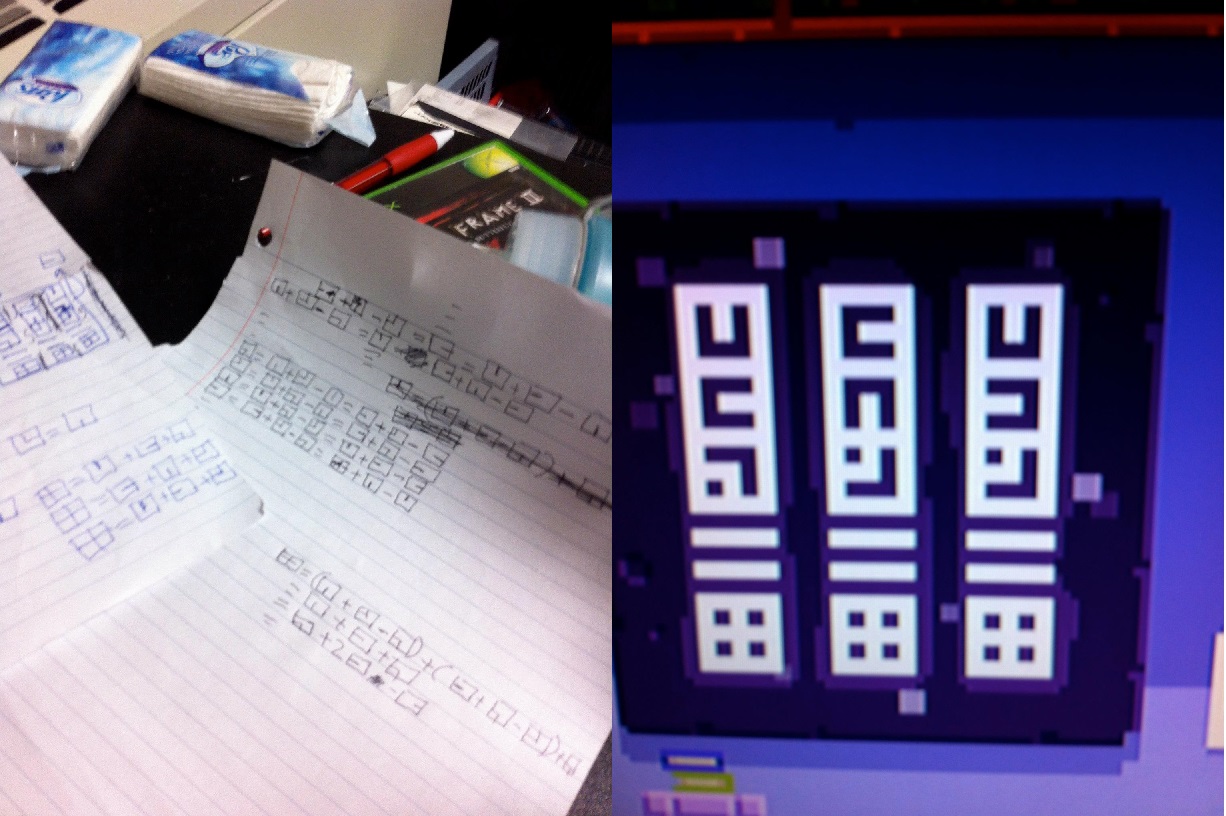
Math class.
After the credits, Fez loops back into a “new game plus” that offers a new first-person perspective and new rewards for earning all 32 golden cubes and all 32 anti-cubes. Doing so involves ascending into Fez’s true difficulty. Fez is not, at its core, a puzzle platformer. The game transcends into a game about archeology. It involves looking for ciphers and decoding ancient language. It involves reading ancient star maps to understand how ancestors looked to the stars. It involves, well, taking notes. The obvious comparison point for games critics in 2012 was Myst. But I haven’t played more than a half hour of Myst – when indie games center on this kind of meta-puzzle, like the brilliant Outer Wilds or this year’s Animal Well, I compare them to Fez.
There is something so immensely rewarding to me about this kind of language game. I’m bad at learning languages in real life – I think in English. I recognize our language’s many, many faults and confusions, but it is the system I understand. While Fez does have a literal language cipher (one that conforms to English directly) it also offers other, less linguistic symbols. Fez doesn’t just challenge the player to solve puzzles – it challenges the player to learn How To Learn. It invites you into a game world with very limited information, gives you everything you need to solve it and hands you the reins to pursue as much knowledge as you care to collect.
The maddening thing about a cipher game is that it is a one-and-done experience. I cannot un-ring the bell. Walking through Fez’s world, the solutions that were once obscure and required meticulous attention to detail are immediately obvious. Being in Fez’s game world is pleasant, listening to Disasterpeace’s score. Some of its platforming challenges are rewarding in the same way replaying a Mario game can be. There are moments of knowing I’ve solved something before but not remembering the exact solution. I used to consider Fez the greatest game I’d ever played. Not being able to recapture that experience will sort of always crystallize it as the best game I played when I was 20 years old.
Fez was a five year passion project, and one of the early examples of a breakout indie game. Unfortunately, Fez ended up being the end of a sentence for its developers rather than the beginning. Even before release, lead designer Phil Fish was considered by entitled gamers to be a blowhard who would never release his game. Then, Fez came out and was extremely buggy, resulting in dismissal from would-be fans (the game works great now.) And then Fish became one of the few male voices standing up to #GamerGate’s bigotry, eventually resulting in him exiting the game industry. Fish will likely never make a game again. The spirit of Fez lives on, but how quickly we silence our own luminaries.
Depression Quest is a twenty minute narrative game that exists in text, a few scanned polaroids, and some sparse music. You read an account of living with debilitating mental illness and select responses the way you do at the end of a page in a choose your own adventure book. The development software, Twine, simplifies the process of flipping to page 94 by keeping all the threads invisible to the player. It’s very easy to work with, to the point where I’ve developed a couple of very short games in the system (none of which are currently online.)
The game’s primary innovation in the interactive fiction space is crossing out and making inaccessible some of the “healthier” responses to stressors or anxieties of daily life. It communicates very effectively the cognitive dissonance mental illness sometimes creates, where you know it would be better to call and cancel plans but conflict avoidance results in you just lying in bed until you get the “dude wtf” text. It would be better to take a shower and make a meal that actually has some real nutrition, but drinking too much beer is a lot more accessible right now.
There are other, equally brilliant games in the Twine space. One of my favorites, my father’s long long legs, is a fun horror short story similar in tone to some of Stephen King’s best. Another, With Those We Love Alive, combines folklore and fantasy storytelling to aim for a more literary direction. I spend a lot of time on itch.io, playing the free games that float to the top of their recommendations. Most are just fun little mechanics explored in a small game, and occasionally there’s some really wonderful narrative play happening.
A world outside of commercial video games used to be a lot more exciting. Just before the fall, it was chronicled in Anna Anthropy’s Rise of the Video Game Zinesters, a narrative of queer and feminist indie game developers creating new and exciting small games that cannot exist with the purpose of generating profit and appealing to the masses. Both Anna Anthropy and the author of With Those We Love Alive have since been credibly accused of abuse. The Video Game Zinesters are maybe the most fractured creative art scene I’ve ever followed. Most retreated from the public gaming sphere entirely when #Gamergate set its ire against them pretty directly, the movement stemming from a positive write-up of Depression Quest on Kotaku.
These small games I love are still being made, but the effort it takes to get people to play them is growing every year. The rise of gaming blockbusters like The Last of Us, God of War, Alan Wake, and my beloved Like a Dragon games have led to games as narrative artistry looking more like soap opera TV and cinema. Even some of the people who grew out of this scene, like Sam Barlow of Immortality and the post-Telltale effort of Campo Santo, have moved bigger and farther away from mechanics first storytelling. It’s not that I want these specific people back making the games again. But replaying Depression Quest is a reminder of a time where the future of games looked unpredictable because the possibilities were endless rather than because the arms race of the mass market was simply unsustainable.
Game designers Zach Gage and Jack Schlesinger’s (Good Sudoku, Spelltower) greatest game is Knotwords, their take on crosswords. Unlike the New York Times crossword (or most cryptic crosswords you’ll find), the game does not rely on definition clues or puns to give you the word. What Knotwords uses to clue players toward solutions is zoned areas – outlined sections of anywhere between two and six squares, and a clue showing what letters will be used in that section. The clue also clarifies any doubles you might need – you might get a three-letter clue that spells “OFO,” for example, and those three letters might contribute to spelling “FOOD.” The zones are divorced from the actual puzzle solutions, meaning the actual solving feels quite a bit like a standard crossword. It’s how you get to that solution that things change.
Anyone who does traditional cryptic crosswords will tell you is that most crosswords you’ll find in a magazine or newspaper are actually trivia games first and word puzzles second. If you are familiar with, say, all of the pop culture and historical references in your average NYT crossword, it’ll be solved almost as quickly as you can enter the letters. If you don’t know the last name of “Figure skater Katarina” or “Castle in ‘Hamlet’,” you may be sunk. Add in NYT’s adoration of theme puzzles and you may be trapped in by obscure puzzle logic, multiple puzzles tied to one piece of trivia you don’t know, or, worst of all, the dreaded rebus.
Knotwords does away with all of that – your only required knowledge is the words you hypothetically can spell with a set of letters. If you happen to be unfamiliar with the word in question (the game uses wiktionary, which doesn’t include proper nouns but does include several exotic boats or shrubberies) you can also ask for a hint, offering the definition as well. But because the game also offers all the letters you need, you can also often solve your way into unfamiliar words just as often as you do in a regular crossword.
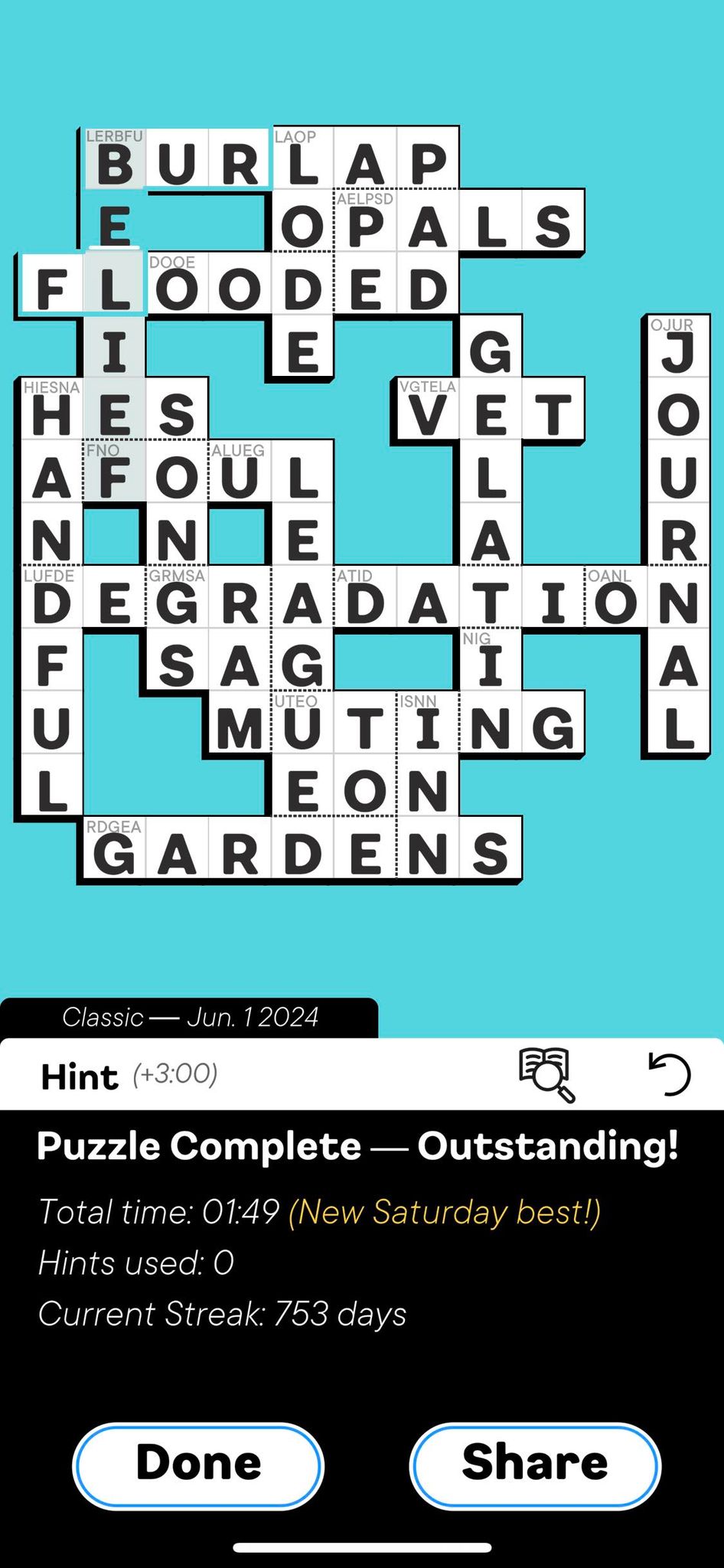
Our most recent screenshot of a Best New Time! We’ve kept our streak since public release.
Playing the game for free, you’ll have access to the daily puzzles – these grow in difficulty from Monday to Sunday in a way familiar to most daily puzzle players. On average, doing the daily mini and daily classic puzzle takes my wife and I about five to fifteen minutes before bed. We also have bought in for the “puzzle packs,” which are monthly and include some lightly themed puzzles (still less trivia oriented than any crossword, but puzzles themed around food, flowers, or “no big words” can be fun changes of pace) about on par with the standard puzzles.
By comparison to Good Sudoku, their last game, Knotwords is not a game you can readily binge. It’s also stripped away Good Sudoku’s leaderboards, which I find a huge help here. The app has kept Good Sudoku’s perfect visual design and user interface, however, with great colors, beautiful, big blocky letters, and jaunty music that remains peaceful. The letters thunk down satisfyingly, and after solving a puzzle, you’re greeted by the Rabbit, who makes the most satisfying sounds imaginable. According to Schlesinger, “The bunny SFX were created and implemented within the last 12 hours before we submitted the builds – partially because there was so much to do, but partially because [Zach] and I just both completely knew exactly what it would sound like!”
Some might say this game’s modest ambition is not worthy of a “favorite game.” Maintaining a 761-day streak of playing, I can’t help but disagree. How many games can honestly say their design truly rivals the crossword itself? I think its answers to the classic problems of crosswords constitute brilliant game design – no longer being asked “Carly ___ Jepsen” as the most boring of crossword fills and instead just engaging with the language itself alone let me delete the NYT crossword from my phone. And, on top of that, it offers enough meat to the daily experience that it outclasses the endless Wordle-alikes, only meant to hold your attention for a minute or so. With the games Gage and Schlesinger make, there is perfection in simplicity and elegance in presentation. A game that so respects its players’ time and intelligence is one that has the potential to last in our hearts for years.
NIER REPLICANT Yoko Taro, PlatinumGames 2021 Xbox, Playstation 4
“Weiss, you dumbass! Start making sense, you rotten book, or you’re gonna be sorry! Maybe I’ll rip your pages out one by one, or maybe I’ll put you in the goddamn furnace! How could someone with such a big, smart brain get hypnotized like a little bitch, huh? ‘Oh, Shadowlord, I love you, Shadowlord, come over here and give Weiss a big sloppy kiss, Shadowlord.’ Now pull your head out of your goddamn ass and start fucking helping us!”
These words greeted players eleven years ago every time they booted Cavia’s NieR Gestalt, released in the United States as NieR, an action RPG largely dubbed an interesting failure with a great soundtrack. Yoko Taro’s name at the time was completely unknown. That he has managed to transform NieR into a juggernaut uttered in whispered tones alongside Hollow Knight, Persona, and the like is the sort of project every game hopes to endure. Working with PlatinumGames, Taro remade NieR Replicant, the Japanese version of NieR, from the ground up, with rerecorded voice acting and music, new graphics and gameplay, and a new ending. He titled the remake NieR Replicant ver.1.22474487139… – I will be referring to the remake as NieR Replicant and the broad collection of games as NieR from here on.
NieR takes place in a fallen world. Whatever security existed before has succumbed to an encroaching plague known as the Black Scrawl and the progressive incursion of monsters the people call Shades. Our protagonist (named by the player, known by fans as Nier) searches for a cure to the Black Scrawl for his sister, Yonah, who lives in a village led by two twins, Devola and Popola. The Black Scrawl leaves Yonah an outcast, as no one knows how the plague spreads. When Yonah finds a rumor of a cure known as a Lunar Tear, she sets out to forbidden, dangerous ruins, where Nier rescues her and encounters a magical tome. The book speaks, informing Nier that his magic may be able to combat the Black Scrawl, and their adventure begins.
NieR adventures with gameplay in shocking and delightful ways. Without giving anything away, it references the history of adventure games and horror in surprising, funny moments that take the gameplay off-model. The remake, Replicant, has taken the moment-to-moment action gameplay outside those setpieces and transformed it into a modern, high quality Stylish Action Game, similar to a Bayonetta or Devil May Cry, but with so many accessibility options to remove as much difficulty as you like. If you find yourself frustrated by the combat, NieR Replicant is incredibly accommodating in letting you focus on the story. I think more games should offer experiences like this one, which don’t change the core experience on-screen and instead offer options to make it easier to see it through.
The NieR franchise, or the Greater Yoko Taro Project, is largely contextualized by repetition. Players of the breakout sequel NieR Automata will be familiar with his recurring approach involving replaying portions of the same game with minor variation that lead to different narrative outcomes. Players of any two Yoko Taro games in the NieR or Drakengard franchise will recognize his recurring tropes, themes, interconnections, and affection for his characters and lore. And, yes, to see NieR through to endings D and E, you will need to play through NieR roughly two and a half times. I love this fact – it remains one of the most powerful ways to build familiarity with characters and heighten the inevitability of its high highs and low lows.
The protagonist starts the game loving his sick sister, Yonah – he will come to love his ragtag party. From the foulmouthed Kaine, to the snobbish animate tome Grimoire Weiss, to the strange chipper child Emil, this found family comes together to care for one another so deeply that it will change the fate of the world. NieR Automata takes a science fiction approach to relationships, beginning from programmed remove and showing where emotion causes things to break down. NieR Replicant is an epic fantasy. Instead, its emotions are operatic from the very beginning. It uses that passion to focus on how everyone is capable of violent, world-changing love.
NieR Replicant is also a dark fantasy. The protagonist loves Yonah, but over time, we also come to understand how he resents her illness and wishes he could have a normal adolescent life. Kaine and Emil undergo incredible trauma in their assistance to Nier, facing incredible sacrifices in the face of an immature, egocentric brat – a brat they love. The answers they find about the Shades, the Black Scrawl, and the world they live in are horrifying and raise existential questions about everyone they’ve ever known. NieR Replicant is special because it finds a way to marry intense, sincere kindnesses and awful, melodramatic tragedy.
Even if games aren’t for you, I have to recommend Keiichi Okabe’s music for the game. His style marries emphasis on acoustic instruments (strings, guitar, harp, piano) and women’s harmonized vocals. All of the vocal music in NieR Replicant is performed in the game’s fictional language, a language that sometimes sounds like Japanese, sometimes like German, sometimes French. Okabe’s musical themes communicate the emotional heft of its characters’ decisions and devotions. The soundtrack’s melodic drive, intense control of arrangement and orchestration, and willingness to vary between the familiar and the subversive reflects the game’s own mission.




 All My Friends