ANIMAL WELL

Animal Well
Billy Basso
NS, PS5, XSX, PC

The insular popularity of Fez, your favorite game designer’s favorite game, has haunted me for twelve years. Designed primarily by infamous director Phil Fish and Renaud Bedard, the puzzle platforming of Fez dominates the cosmos of Animal Well, which trades Fez’s tone of post-Vonnegut observational comedy for a lonely, haunted malevolence. Instead of the hypercube tearing the cosmos into black holes, instead some dark, spiritual energy sends malevolence into the already carnivorous world of Animal Well. Your little blob darts into the remains of somewhere obviously forgotten.

Structurally, Animal Well has much in common with Metroid or Zelda, though it lacks either of their focus on combat. A 2D exploration platformer with a map so dense you’ll eventually fill all but the barest walls, your simple leap helps traverse abstract non-places filled with creatures and critters dangerous and benign. You navigate puzzles across four animal kingdoms, collecting tools which help you delve deeper into these mazes. My favorites of these are the yo-yo, which can hit switches down pits and around corners as it rolls on its string, and the thrown disc, which is sometimes a frisbee you throw or ride and other times a distraction for dogs and wolves quite a lot larger than yourself.

Animal Well has become known for its multiple layers of completeness – anything past the first makes Symphony of the Night’s inverted castle look like Porky Pig’s Haunted Holiday. The game contains 64 (or more?) eggs (like easter egg, get it?) which are the currency required to reach the game’s second ending and some of these fuckers are devious. Anything past the second layer requires Getting Online And Getting Help (or, at least, there’s one solution that factually requires that.)
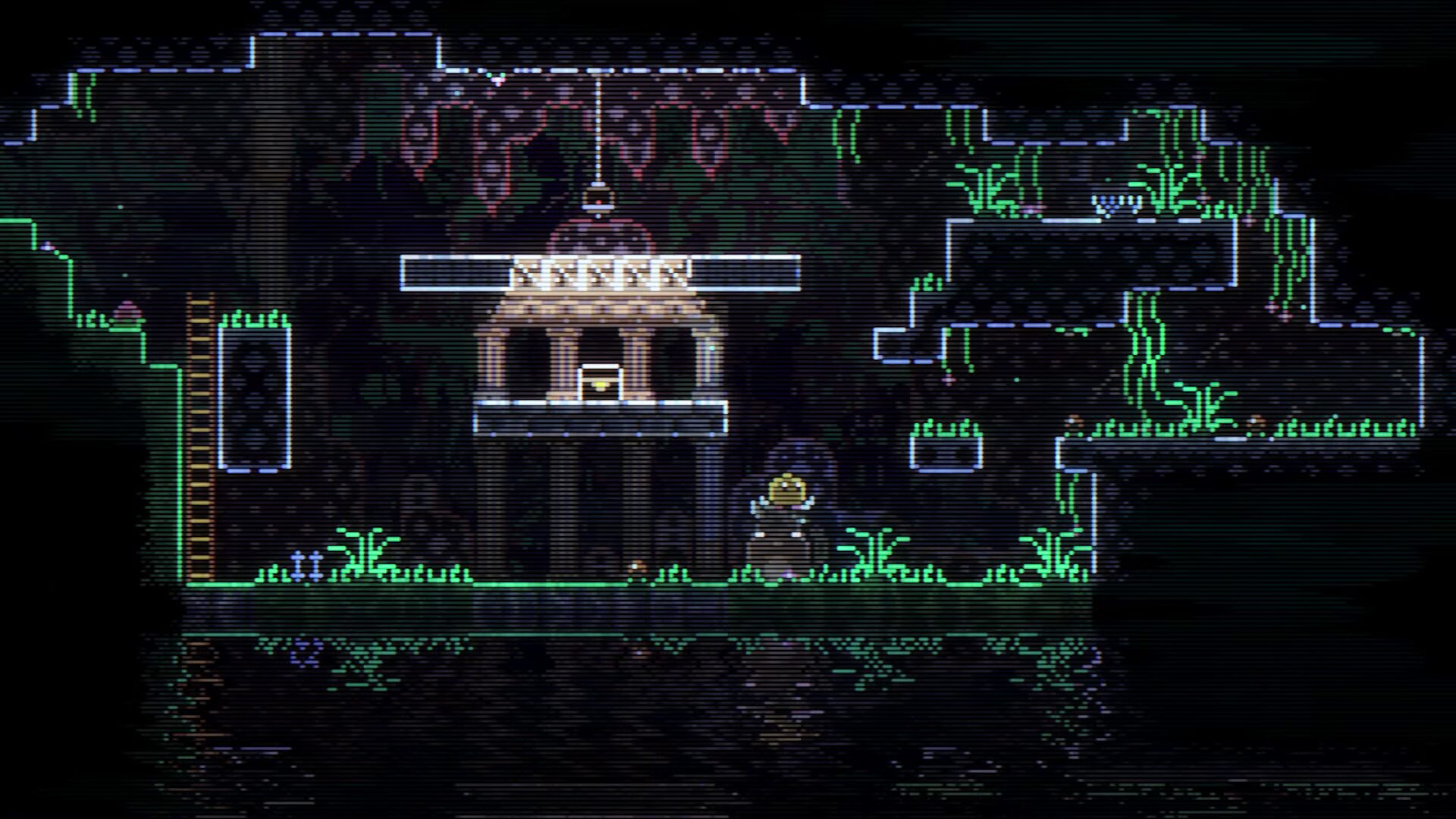
An early puzzle room in Animal Well.

I’ll be honest – I watched FuryForged’s explainer videos for the later secrets of Animal Well, which I found too frustrating and minute to track. I have no interest in this kind of map combing, especially without the additional hint of at least highlighting where more secrets lie. Especially compared to Fish’s Fez, which this game owes so much debt it grants Gomez a cameo, this game went past my patience. The secrets started to be less about having insight into how the game works and more about willingness to poke and prod every corner or wall of the map. In my opinion, you should stick to the core conceit – find the four flames, each buried within an animal kingdom, and collect as many eggs as you can find. The game’s core puzzles really reward explorative play, with the items you find allowing for creative play without requiring the hyper-athleticism of a game like Super Metroid. There are sequences which encourage reactive thinking, sequential logic thinking, intuitive and deductive reasoning, simple navigation, and pretty successful platforming.

But for my money, Animal Well’s real triumph is the aesthetic. There are so many delightfully rendered pixel art animals in here. They make so many good noises and have such charming animations. They are shaded so damned well. Some are adorable and others are very threatening. And yet, despite the population of critters around, this game feels very lonely. The user interface stays out of your way and immerses you in this place’s darkness. Even compared to a game like Hollow Knight, there’s a sense that this well was something more. I admire the achievement of this game’s nonverbal narrative, its evocation of a world that once stood.
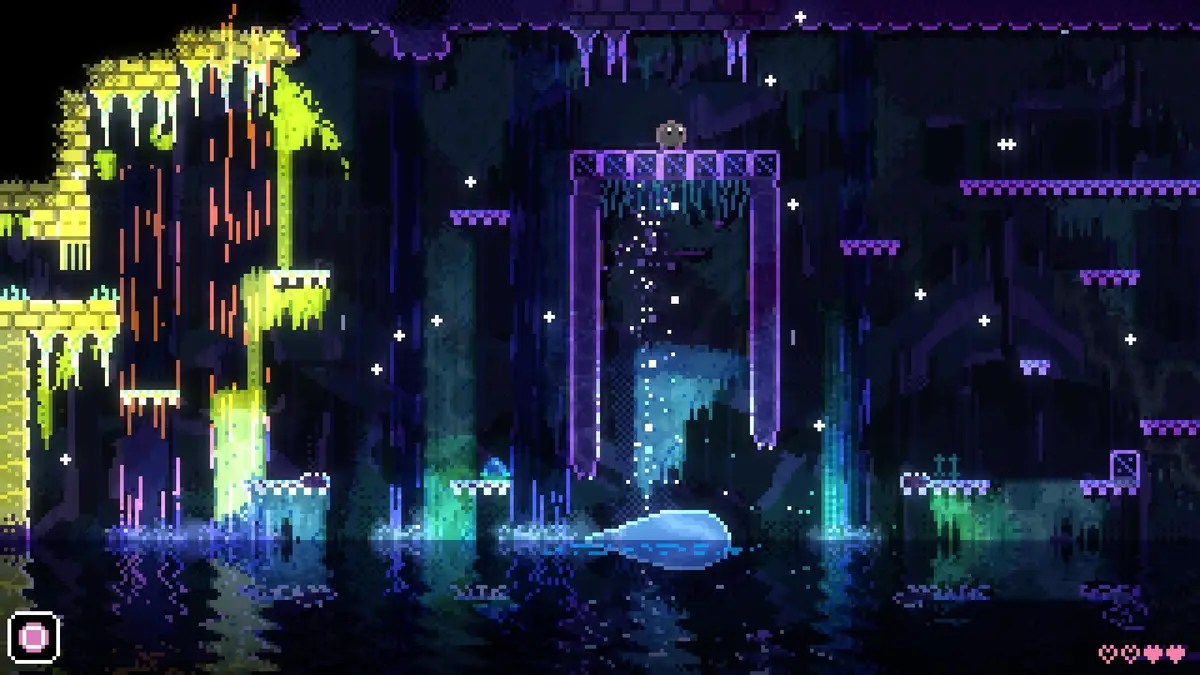
A whale!

There’s also wonderful sound design in here. There’s a lot of rushing water and machinery, but the highlight is the number of creative animal sounds. Occasionally, something like the flapping of wings is produced more faithfully, but the vocalizations of animals are typically synth bloops very similar to Pokemon cries. However, unlike that game series structuring those cries as musical jingles, Animal Well tends toward short, evocative noises, like the gulp of a chameleon or the brief chitter as a squirrel shuffles away. A lonely cooing sounds off in the distance every so often, and finding its source is immensely satisfying.

Animal Well communicates everything it wants to say nonverbally. It occasionally will prompt you with a button to interact with something, but there are not text boxes explaining how to use your frisbee disc. That isn’t to say it’s entirely shy of language – there are pictograms, there’s musical notation, there’s gates associated with specific switches and keys. But unlike some puzzle games, Animal Well celebrates the notion of discovery as play by cutting out that form of communication. That it does it pretty intuitively, especially in those first two layers of play, is pretty impressive to me.

People smarter than me, like Balatro developer LocalThunk (who unsurprisingly will make an appearance later in this series), have declared Animal Well the Game of the Year. I say they are smarter than me partly because this game did not surpass the realm of solvable in their eyes and also because they have made some works I am awestruck by. I both wonder if I’ve had my eyebrows blown off by my one experience with Fez and just don’t care to get out the pen and paper again and wonder if I’m just not programmer-brained enough for this particular puzzle logic. But even not being able to go the full distance and embrace Animal Well as a masterpiece like they have, I still find the game to be quite memorable, affecting, and creative, in ways that make it an easy recommendation for my friends who love to stare at a game screen and wonder aloud if they’re stupid and know the answer is “probably.”
ASTRO BOT

Team Asobi
2024
PS5

Astro Bot has been a Game of the Year finalist just about everywhere you can look, including taking home the prize at Geoff Keighley’s The Game Awards. The successor to PlayStation 5 pack-in game Astro’s Playroom, Astro Bot takes that game’s high-polish 3D platforming and blows it out to a full game, each level a fun, playful celebration of motion. In the way that Wicked or Dune Part Two is the film of the year, Astro Bot represents the peak of industry investment. It is everything your expensive game console wants to be able to do without any of the open world cruft, microtransactions, or cinematic storytelling. This is a celebration of video games as video games rather than as an alternate vehicle for an HBO miniseries or a pure capitalist skinnerbox.

It’s pretty good!

Even compared to some Mario games, Astro Bot’s jump, speed, and responsiveness to its environment is really satisfying. If you have love for running around in this kind of space and bonking orb-shaped baddies, this game has it in spades. When you land on the ice, rather than taking on that somewhat frustrating slippery-foot feeling Ocarina of Time players know all too well, Astro Bot starts ice skating, giving you propulsive forward motion but also a fine degree of control. The air hover allows for precise landings in a way the Super Mario Sunshine F.L.U.D.D. dreams of doing.

There are nine different upgrades you can find midway through a level, and each of them gives you a new way to experience the platforming and exploration of the game. Some are fairly simple – there’s a rocket boost, a racing charge forward, a boxing glove that lets you punch harder and farther. But they also have surprising uses – the boxing gloves also let you grab onto certain objects and swing farther. One highlight is a shrinking device that lets you get through small holes and navigate new spaces – it lets you get real small and see the levels in entirely new ways. About half of them feel directly ripped from Super Mario Sunshine or Galaxy, but they are all perfectly well implemented.

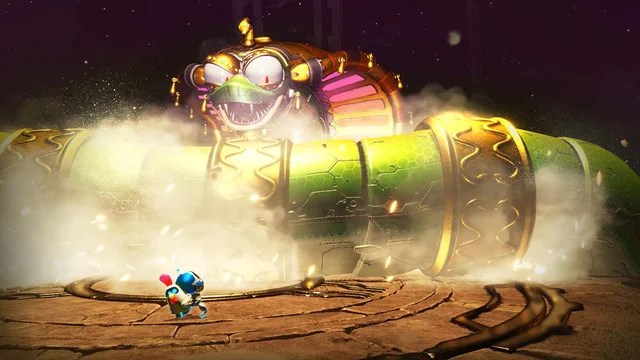
One of Astro Bot’s bosses, which are generally fairly standard pattern repetition bosses with some charming animation and a sense of large scale.

These upgrades help diversify the game’s many levels, each about five minutes in length and containing somewhere between 8-12 hidden secrets to obtain. Sometimes, like in Super Mario World before it, there are secret exits that unlock new levels. Sometimes, navigating the overworld map menu in your little spaceship gives you a chance to unlock new challenge “meteorite” levels. All of these are largely really well designed platforming levels, and if you’re someone like me who laments the fact that open world games often contain kind of haphazard play spaces where you’re meant to “find the fun,” Astro Bot rejects the idea that connective tissue is what helps attach you to a video game.

In fact, it basically rejects any kind of connective tissue. Astro Bot is constantly ping-ponging between different visual pastiches on its little planetoids. You’ll play a desert tomb level – a jungle level – a tundra level – and there’s no real effort made to try to sell these as places rather than video game levels. The enemies rarely receive any more personality, meant to be pretty interchangeable between levels.

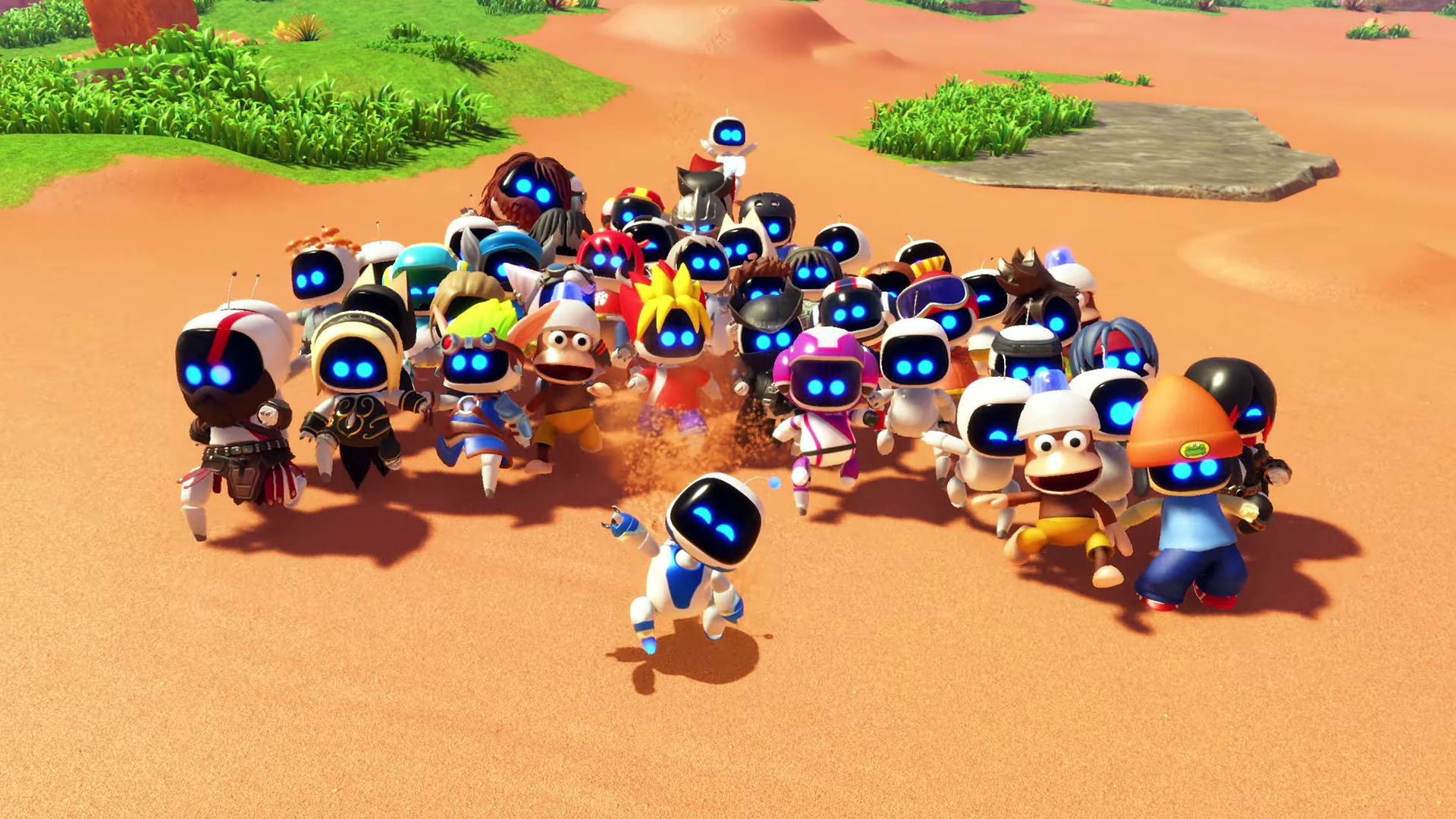
The only real sense of cohesion comes from the PlayStation brand. In every level, between one and three of the rescuable fellow bots will be costumed as a character from a different PlayStation game. It starts with you rescuing Ratchet and Rivet from the Ratchet & Clank games. Then, it’s Solid Snake, Psycho Mantis, and Gray Fox from Metal Gear Solid. This experience does not exclusively contain cameos from games as beloved as these or as distant in the past. When you complete a world, you end up playing an entire level based on one of these properties. Some of these game series have been dead for decades – others feel so new that it’s a little giving Poochie.

A host of bot cameos, including Parappa the Rapper, Kratos from God of War, The Hunter from Bloodborne, and many more.

All along the way, there is a nonstop chattering of these bots. They are constantly chirping, whining, woo-hooing. It is a lot like watching the Minions from Despicable Me. I find them completely exhausting. I started to get a headache. Despite the game having a pretty good soundtrack, I had to turn the sound off entirely after an hour to shut these damn bots up.

As curmudgeonly as I know I sound, I want to give some generosity to “loving the brand.” Not because I think it’s virtuous, to be clear, but because I remember being a child. I remember playing Super Smash Bros. for the first time, encountering Ness, and being fascinated by the concept of Earthbound, a game I would eventually play and fall in love with. I remember booting up Super Smash Bros. Melee and just wanting to hang out in its non-worlds to listen to the music and experience more of these games. I remember my dad declaring war against Banjo-Kazooie because of the non-stop squawking every time you took a step in Talon Trot.

I did not want to spend more time puttering around with the (quite intricate) physics simulations in Astro Bot’s world. I was not filled with wonder playing a level inspired by LocoRoco, a game somewhat unimaginable under modern Sony leadership where their games are either live service megaliths that are too big to fail (or will be shut down the moment they do) or are better suited to an HBO TV series. I did not enjoy seeing Kat from Gravity Rush, whose developer Sony Japan was gutted, the remainder forming Team Asobi and making Astro Bot. I can only imagine what a game without all these cameos might be like, given more space to develop its own identity like Shadow of the Colossus or Okami. And yet Nintendo never released another Mother game in the US – hell, it took decades to even get Earthbound available again on the Wii U or Switch. F-Zero and Kid Icarus were given one more chance before being resigned to ports of classic games. That didn’t stop me from chasing them down.

But there is a new Okami coming out! A new game from Shadow of the Colossus developer Fumito Ueda! The Gravity Rush director, Silent Hill creator Keiichiro Toyama, came out with a new game this year, a reimagining of Siren called Slitterhead. Slitterhead, dude! Whatever problems the game industry might have – and there are many – Astro Bot is not responsible for them. I hope it inspires young players to seek out these old classics, and I hope it inspires Sony and its colleagues to make those classics readily available.

INDIANA JONES AND THE GREAT CIRCLE

MachineGames
2024
Xbox Series, PC (PlayStation 5 Spring 2025)

At times, Indiana Jones and the Great Circle follows in its publisher Bethesda’s lineage as the year’s best “turn your brain off and follow these waypoints” game of the year. With three major open world hubs, major sequences of your playtime will likely be dedicated to opening your questlog, heading to a section of the map, knocking unconscious every fascist guard in sight, and picking up whatever quest item you need to bring back to the quest giver to unlock another segment of your health bar. I cannot stress enough that unless you enjoy this kind of play, the game does not require it, and in fact the gameplay may even get worse by your process of unlocking overpowered disguises, upgrades to your health and ammo, and having explored cool locations before the main story intends you to do so.

This stuff is here because it allows the game to function as a mystery. Indiana Jones and the Great Circle takes place somewhere between Raiders of the Lost Ark (barring an incredibly misguided intro where you play that film’s opening) and the Last Crusade, the Nazis still spreading influence throughout the world but not quite openly at war, Marion Ravenwood having dumped Dr. Jones. A giant played admirably by the now-deceased Tony Todd (not quite his final screen appearance thanks to this year’s upcoming Final Destination: Bloodlines) ransacks Marshall College and sets Indiana on a globetrotting trip to uncover a classic fascist plot to weaponize one of history’s great artifacts.

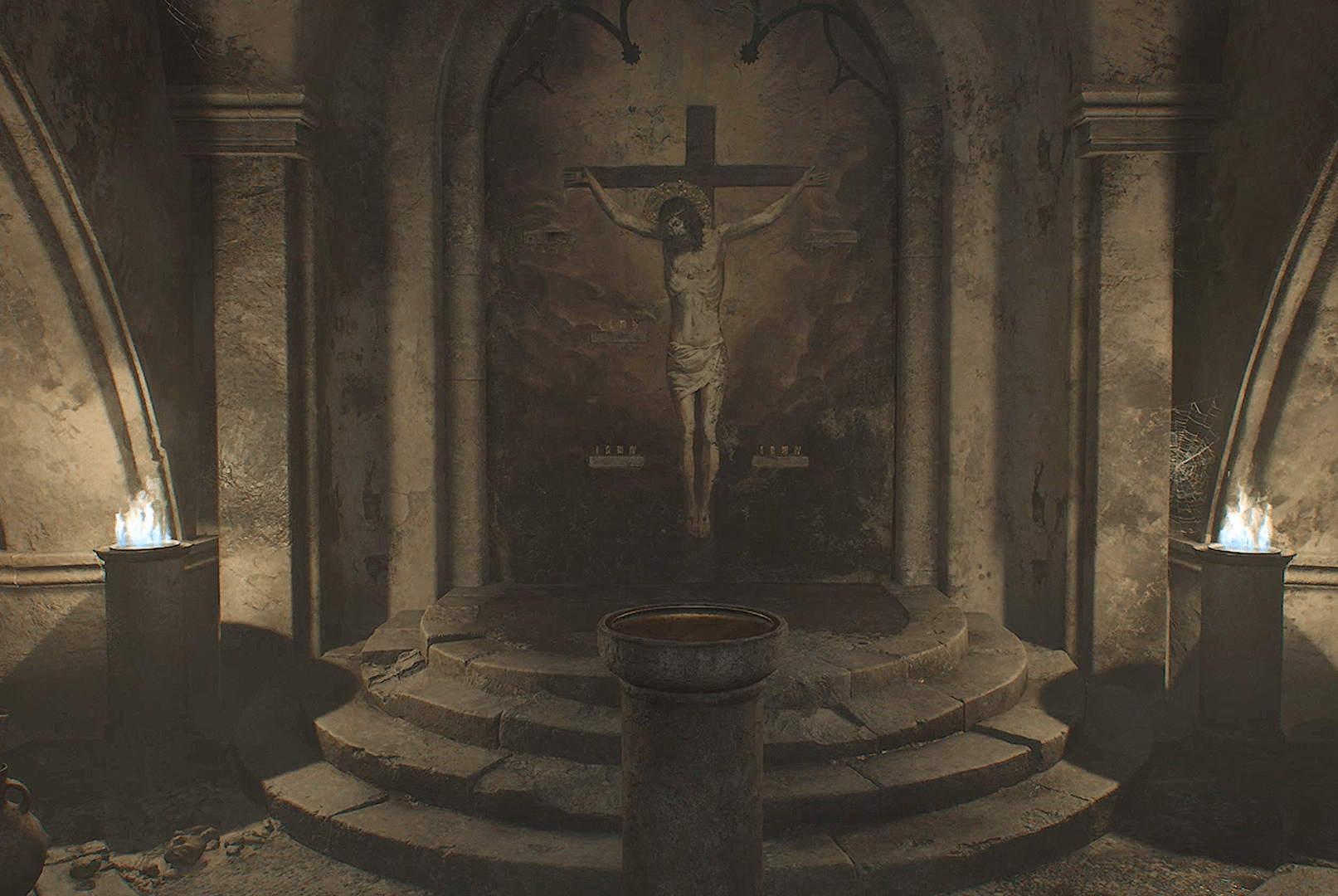
One of the puzzles found somewhere in the Vatican City.

Ultimately, while you spend a lot of this game knocking out or killing fascists (the game is not shy about identifying Blackshirts, Nazis, or the Empire of Japan) the game is more about exploring the environments, solving puzzles, and trying to figure out what the overarching mystery is going to be before the game gives away its own story. (Yes, it involves Jim Alison’s obscure Great Circle conspiracy.) The game gives Indy a sounding board in journalist Gina Lombardi, a nemesis in Nazi archeologist Emmerich Voss, and a collection of local friends more knowledgeable about what’s going on in their city (think Sallah.) It’s propulsive enough to dollop information to you regularly, and in the early running of the game, solving puzzles captures some of that staff of Ra feeling. It’s very satisfying, and the game’s lack of emphasis on combat and gunplay helps keep things feeling like the better movies in the series.

I also think the little worlds MachineGames (who are previously known for their Wolfenstein reboot) has built for Jones to explore are quite compelling. For one thing, while they make use of negative space at the ground level for wide streets, gardens, and open deserts, the maps are very thoughtfully vertical in design. There are tunnels under, roofs over, and so much scaffolding set up alongside buildings. When you’re infiltrating enemy camps, there are often watchtowers, multi-floor buildings, tunnels underneath, and ziplines between parts of the camp. It creates a running tension of always having reasons to look for pathways, and then the game still manages to surprise you when a secret was right under your feet the whole time.

I also think this game is notable as a really impressive use of a limited scope. While the budget obviously hasn’t been reported, I think it’s evident playing the game that MachineGames largely knew where to invest the highest fidelity graphics and where to use fairly limited character animation. There are some effects that are less impressive than others, like when you burn a cobweb or when waves splash against a boat. And yet this game still often feels huge, that promise of “next generation” feels achieved, even where a game like Cyberpunk 2077 still feels “more expensive.” The way sunlight hits in this game is pretty consistently incredible.

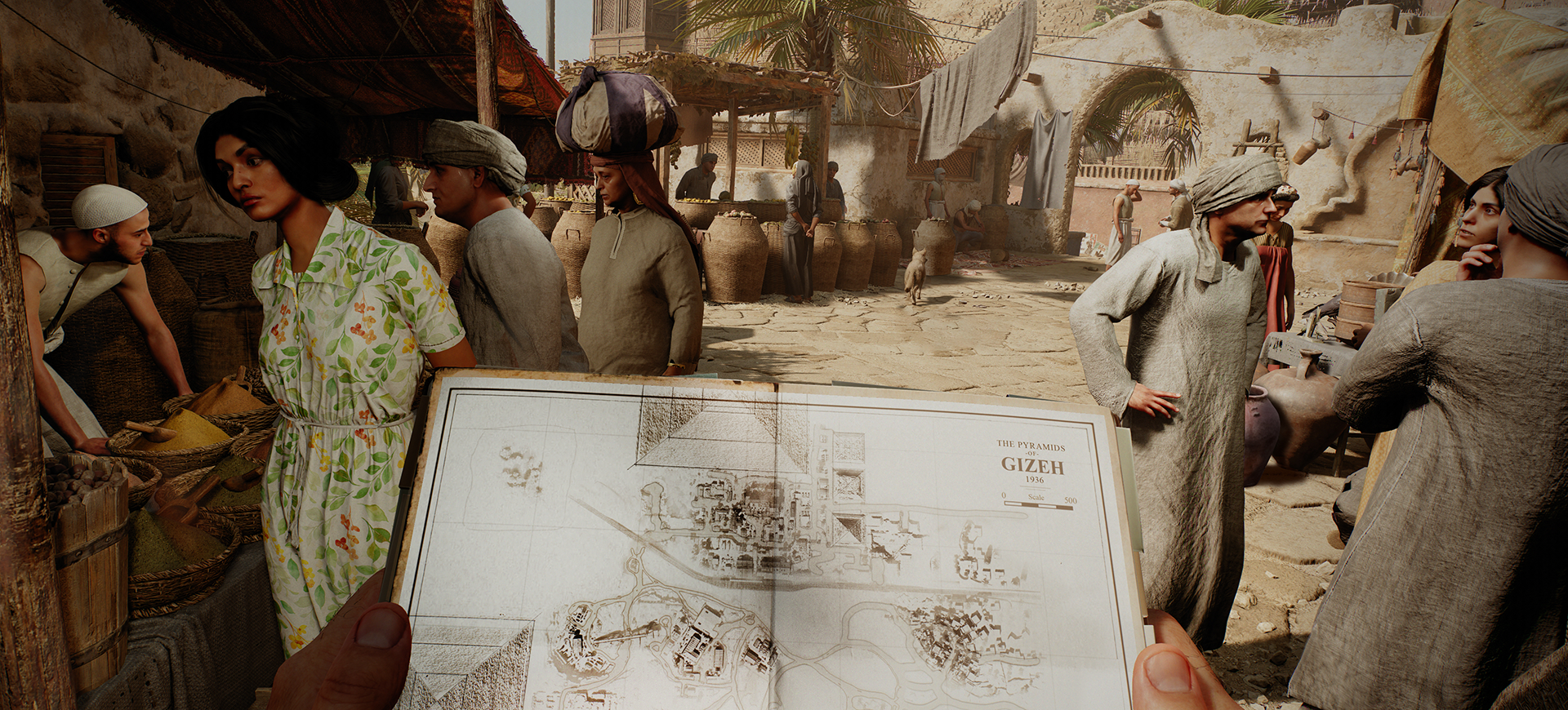
The game’s maps exist as an item Indy pulls out, and you’ll often find your nose deep in them walking past the citizens.

Jones is played pretty admirably by Troy Baker (among other credits, Booker DeWitt from BioShock Infinite and Joel Miller from The Last of Us) who does a fairly impressive Harrison Ford impression without being afraid to sound like himself at Jones’s louder cries of pain or distress. I admit, as much as I love Raiders and Last Crusade, as people discuss rebooting Indiana Jones I’ve lamented that he’s a pretty thin character without Ford’s charisma to anchor the role. I’d say MachineGames landed on an interesting characterization – they’ve made him a little more of a cad, slightly flanderized his fear of snakes, and they settled on a refusal to face his personal problems as part of the call to adventure.

If I hesitate to put this game higher, it’s because the game’s back half really drops the ball. While the actual spectacle gets way higher – this link is to a MASSIVE spoiler, but it’s the coolest goddamned image in the game – the gameplay gets messy. The third hub forces you to pilot a boat that’s unpleasant to control. A late temple gives you a really noxious enemy to escape and sneak around by trial and error. The characterizations the game has been emphasizing don’t quite come to satisfying conclusions. And the climactic cutscene, while narratively communicating enormous stakes, really drops the ball in terms of the game’s visual effects and cinematic storytelling. I like the denouement pretty well, and while the actual grand mystery was perfectly acceptable, I wish it maintained the quality of what had come before. The Great Circle does not stick the landing, but I was hoodwinked enough to finish the game – and, well, I also like to run around a hub and knock out guards, sue me!

The Best Games of 2024

25 games, not all of which I played!

Hi, gang!

I’m doing a Game of the Year write-up again!

It’s been four years since my last one, but I just feel like getting writing. I already had done drafts for a bunch of these games, but I figured, what the hell, lemme just get these out now. Unlike in 2020, I don’t have them combined into themes. I’ll be doing twelve write-ups in total, one per day, through February 1. I’ll tell you now, the top 3 of this list are interchangeable, and all of the games I wrote up are very much worth your time, so don’t fret too much about placement please.

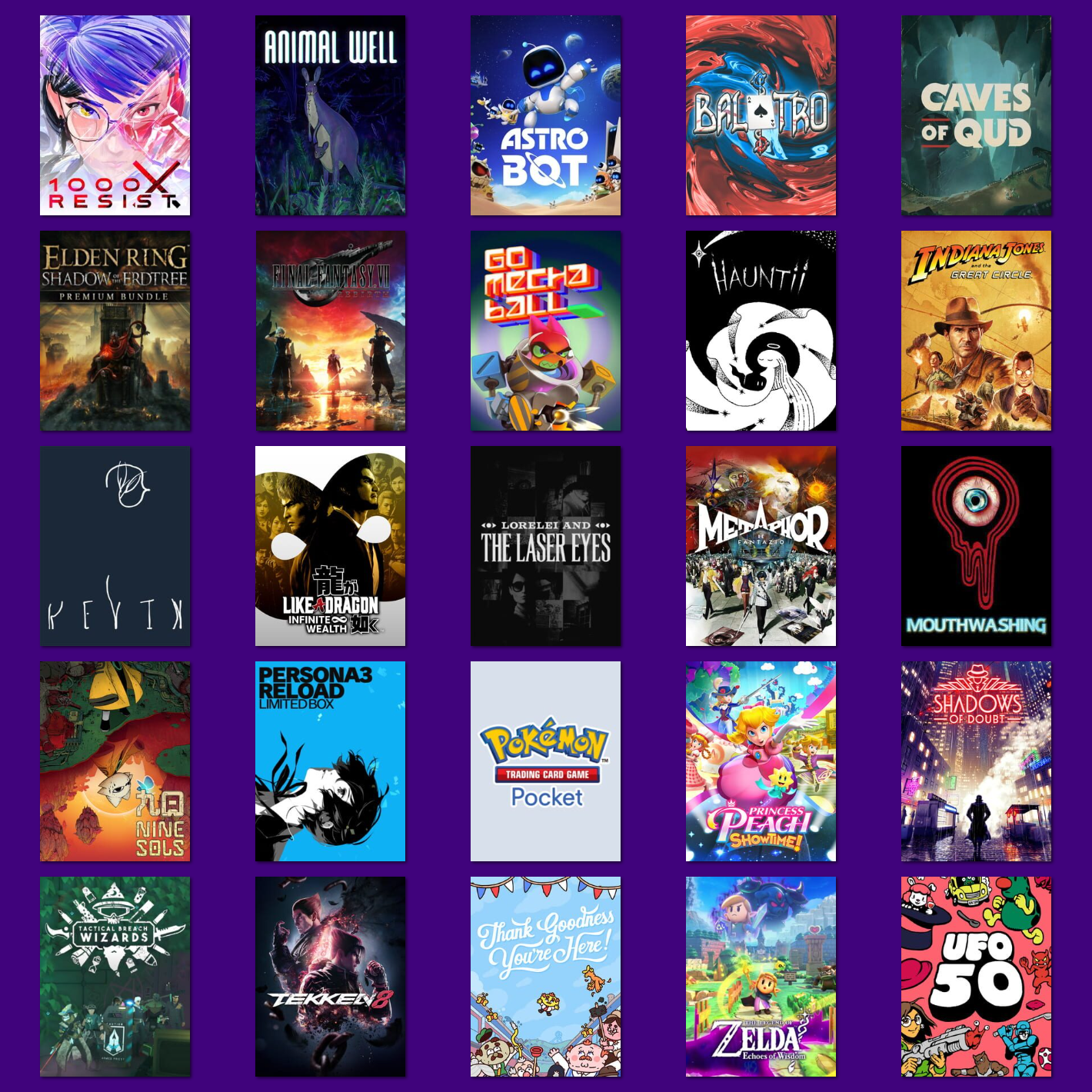
It’s a weird, transitional year for games, but I also fully admit I delayed on a bunch of games that are extremely up my alley. A hearty “play you later” to Final Fantasy VII Rebirth, Elden Ring: Shadow of the Erdtree, Metaphor Re:Fantazio, Alan Wake II: Night Springs, Arco, CLICKOLDING, Crow Country, Cryptmaster, Dead Rising Deluxe Remaster, Dragon’s Dogma 2, Duck Detective: The Secret Salami, Fate/stay Night, Indika, Infinity Nikki, Kunitsu-Gami: Path of the Goddess, Nightmare Kart, Open Roads, Penny’s Big Breakaway, Satisfactory, Shadows of Doubt, Silent Hill Short Message, Slitterhead, Splatoon 3 Side Order, Stalker 2: Heart of Chornobyl, The Rise of the Golden Idol, Thrasher, and Unicorn Overlord.

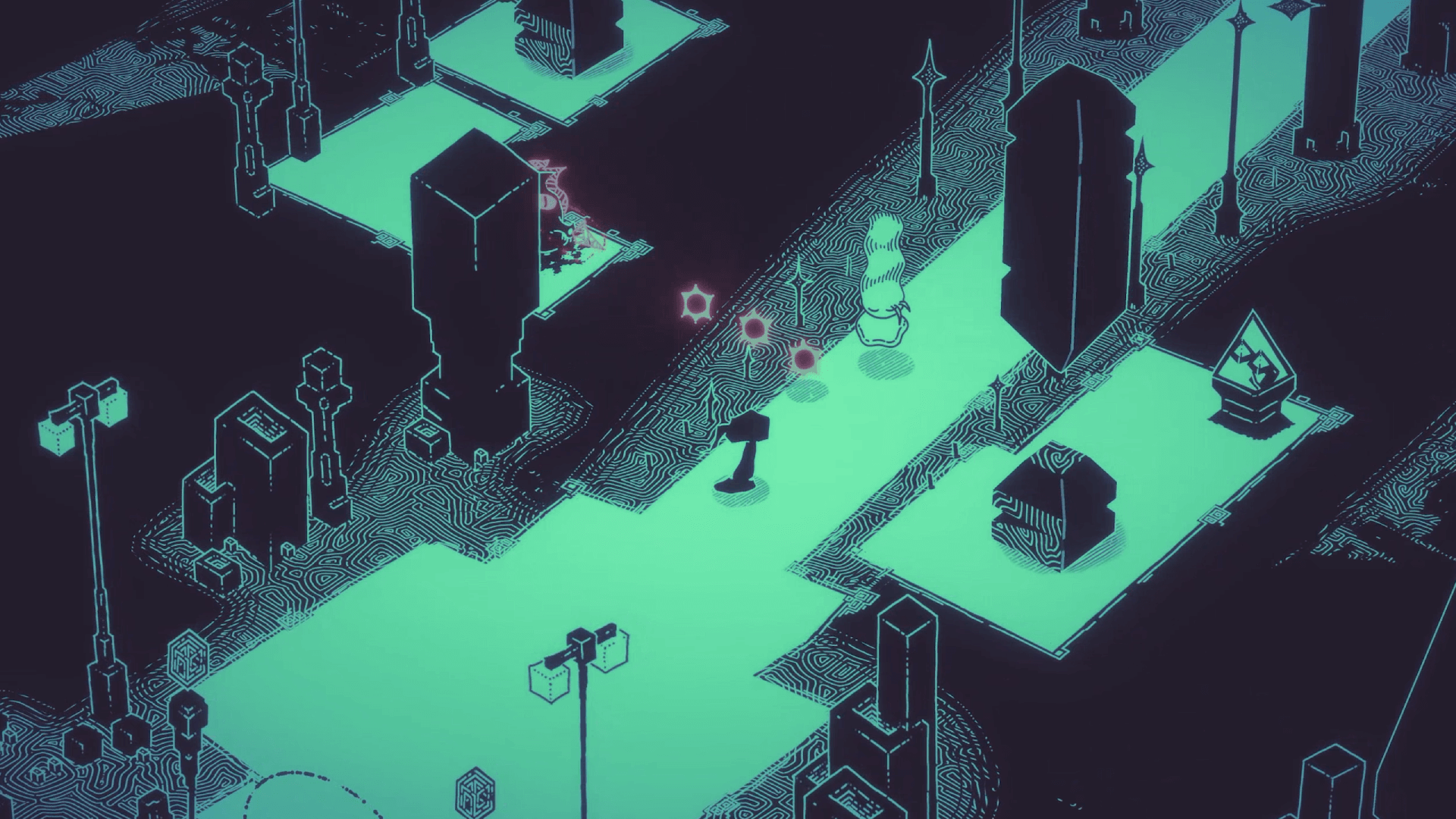
Hauntii.

SOME BULLETPOINT GAMES I LIKED AND WANTED TO SAY SOMETHING ABOUT

  • Go Mecha Ball: The first new game I played in 2024, it’s a roguelike where you play as a mech that can turn into a ball. It feels really good! The mechanics and animations are really high quality, too. I did not end up digging that deep into this game, but I’m surprised it’s gone so completely unremarked upon.
  • Hauntii: This game’s art style really is the best thing going for it. An adventure game with a sweet tone, I have a hard time believing I’ll go back to it, but I was immediately charmed by the look.
  • Home Safety Hotline: I actually can’t stress enough how impressed I am with the user interface and the quality of everything that’s in Home Safety Hotline, a game where you assist customers with problems they’re having in their home that quickly veer into the supernatural. The voice performances of some of these customers, especially if you fail to address their problems and they call back, are some of the best in any independent game. I honestly think if this had some sort of remixed/endless/community content function, it would easily be on this list, as I find the core gameplay loop and the basic diagnostic project so entertaining. As it is, I found it just a little short.
  • The Legend of Zelda: Echoes of Wisdom: This game is really cute! We finally get to play as Zelda, and it’s in a full-blown 2D style Zelda! I played the first dungeon and a half before getting distracted and playing other games. I think this game will be looked back on as quite underrated, and I keep meaning to go back and play more.
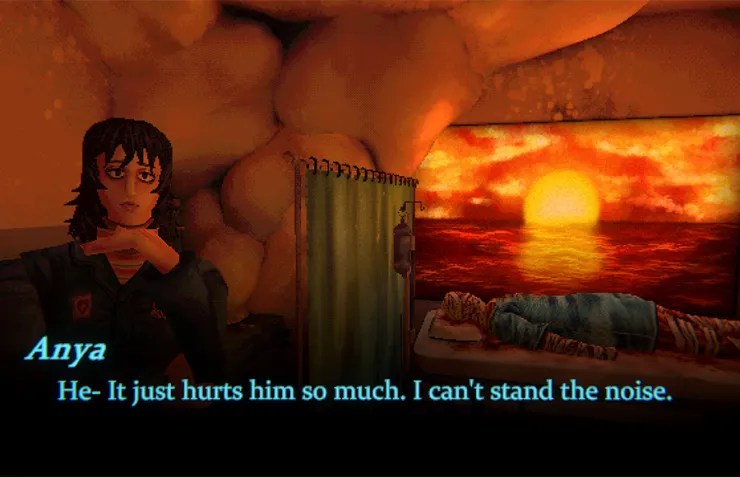
  • Mouthwashing: Mouthwashing tells the story of a space trucker delivery gone wrong, with the crew of five getting cabin fever and finding out that the circumstances of their crash are worse than they seem. I really like the things this game does with perspective and jump cuts – at times, it is using filmic editing techniques in real time gameplay to poignant effect. I also think, in terms of story, that it’s a worthwhile, adult game with literary story concerns, and its characterization is strong for such a short few hours. I just also think it’s more in the camp of “the best sci-fi story in this monthly magazine” than “one of the best stories of the year.” Look forward to seeing their next project!
  • Persona 3 Reload: I’m farther than I’ve ever gotten in any version of Persona 3, but I’m still too early to really write up what makes Persona 3 great outside of “it’s a Persona game.” I’ll probably circle back to this one, but I think they’ve made a lot of smart quality of life improvements that make Persona 3 a lot more approachable. I maybe prefer the rigid weirdness of the PS2 game, and I definitely prefer the original game’s soundtrack, which has been re-recorded for Reload with almost universally weaker vocals. Look forward to catching up with Metaphor sometime, too!
Mouthwashing.
  • Pokemon TCG Pocket: I want to give props to simplifying the Pokemon Trading Card Game, and I want to give props to the fact that just by logging in every day and playing through the single-player content I’ve managed to collect the vast majority of the cards in the game so far. I get happy whenever I see a Pokemon card from my childhood – some of the new art is really good, too! I wish the game balance was at all fun for multiplayer, but anyone playing this can tell you immediately about the three decks that only got stronger with the new expansion. Still, fulfilling my ever-present Fartstone needs.
  • Princess Peach: Showtime!: The second of Nintendo’s princess game experiments of 2024, I think this is a really admirable sampler platter for game mechanics and design. Peach participates in a number of stage shows inspired by different genres, and each show plays differently enough to keep things fresh. If someone said “I want to get into video games but I don’t know where to start,” this is a pretty good entry point, and based on their favorite of these shows, you could make recommendations for what to play next. Probably a lot more fun if you’re relatively new to video games than if you’ve been a gamer for decades.
  • Shadows of Doubt: This procedural indie mystery game, where you play a private detective and collect clues and evidence to find murder suspects for cold cases, is a fascinating work of design. It unfortunately just runs like crap on my computer and every streamer I’ve ever seen try to play it is a combination of impatient and incompetent. Can’t wait to have a device where I can play this myself!
  • Tekken 8: I played like two hours of the campaign and a little online play when I borrowed this from the library and it rocks, dude. I love fighting games but haven’t ever really invested time into Tekken game. In a world where I got to play way more of this, I can imagine it being toward the top of my list.
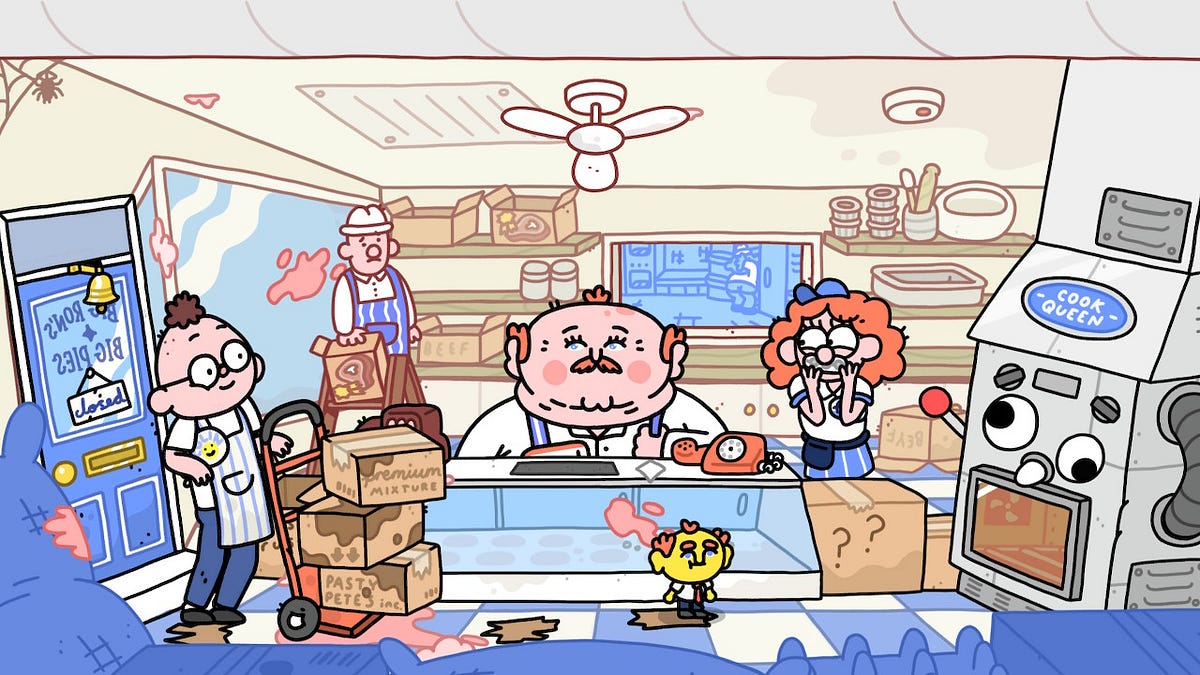
  • Thank Goodness You’re Here!: Maybe wish I’d played this myself rather than watch a bunch of someone streaming it, because the jokes are the appeal of this game! Thank Goodness You’re Here! is basically a “touch everything for a laugh” game, sort of comparable to Untitled Goose Game, except with pretty gorgeous hand animated cartooning and a hundred times more British. There’s a running joke about your weird little gremlin going down a poor guy’s chimney that really took me out.
Thank Goodness You’re Here!

AND THEN, MY LIST:

#12: Kevin (1997-2077)
#11: Indiana Jones and the Great Circle
#10: Astro Bot
#9: Animal Well
#8: Tactical Breach Wizards
#7: Like a Dragon: Infinite Wealth
#6: Nine Sols
#5: Lorelei and the Laser Eyes
#4: Caves of Qud

#1a: Balatro
#1b: UFO 50
#1c: 1000xResist

KEVIN (1997-2077)

Kevin Du
2024
PC

A friend messaged me to ask about an IGF finalist they’d not heard about prior – nominated for the Nuovo Award, Kevin (1997-2077) released to the public on February 2 and otherwise dropped off the face of the earth. We were both intrigued by the premise – a translation cipher game which lacks the clean, concrete solution logic of games like Chants of Sennaar. However, it was impossible to gauge the game’s difficulty or quality from the outside, so we waited for a review or stream – to no avail. Apart from one gamedeveloper.com interview and some non-English streams on YouTube, this game remains almost entirely uncovered in public visibility.

I bit the bullet and decided to investigate, the game’s low price point and unique presentation pulling me in. My first experience was overwhelming – I am not good at language learning, so I bounced off some of the syntax rules Kevin lays forward in the early part of the game. Furthermore, the game offers no advice in the way of navigation, simply offering you a map without boundaries to scroll for ciphers. This is not a game for those who demand a ten minute hook – your first real experience needs to be with a preparation to embed.

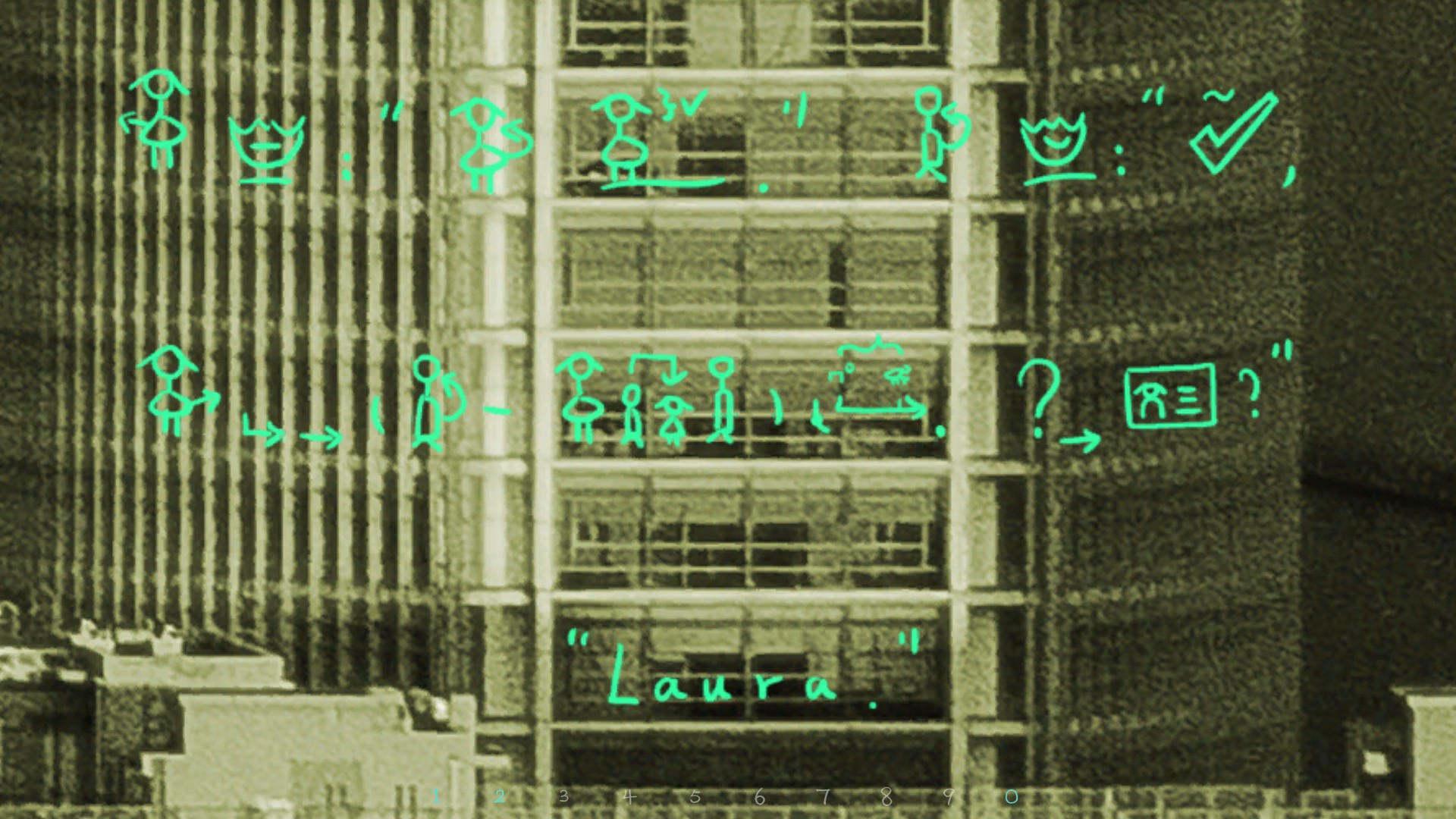
An untranslated story in Kevin (1997-2077.)

The play experience is relatively simple. Using the arrow keys or your mouse, you can scroll the “map” (in early areas, literally topographical maps – in others, photographs in collage) for written short stories or letters, always in pictographic cipher. You are given a pencil (which you can change to many colors and erase) to write your annotated translation. There are occasionally small markers of spots named “friends” you can open which combine a new visual collage element and more letters. Over time, you get a sense of the “story” told in some of these letters, and eventually the story of developer Kevin Du and the people in his life.

The game offers what amounts to an introductory workbook (including short love stories, a story about a dog bite, and more standard “i you they/he she them” grammatical lessons,) and it also offers the ability to create fast travel points and return to that opening lesson at any time. After a brief attempt to translate the early lessons, I scrolled over to the broader map and decided to learn what exactly we’re translating. At first blush, most of these stories are about encounters with fellow academics, coworkers, or potential romantic interests. Even before completing the “tutorial,” it’s possible to get the gist that Kevin’s telling a story about an awkward encounter getting coffee with an old girlfriend, or a boss asking about his vacation.

In both the Steam page and the gamedeveloper.com interview, Kevin Du expresses that he is sharing deeply intimate, sometimes uncomfortable feelings and stories in this game, but he wants to see the players put in the work if they’re going to try to understand him. The mechanics also embody this hedgehog’s dilemma – unlike other cipher games, there is no automatic translation possible. Like in English, symbols change meaning depending on context – “feel” and “body” share a symbol. In addition, your ability to zoom in and out is limited to very specific areas, meaning it can be difficult to see an entire story at once. You don’t have an in-game scratch pad, either, so any ideas you want to carry between stories have to be written in a real-life notebook.

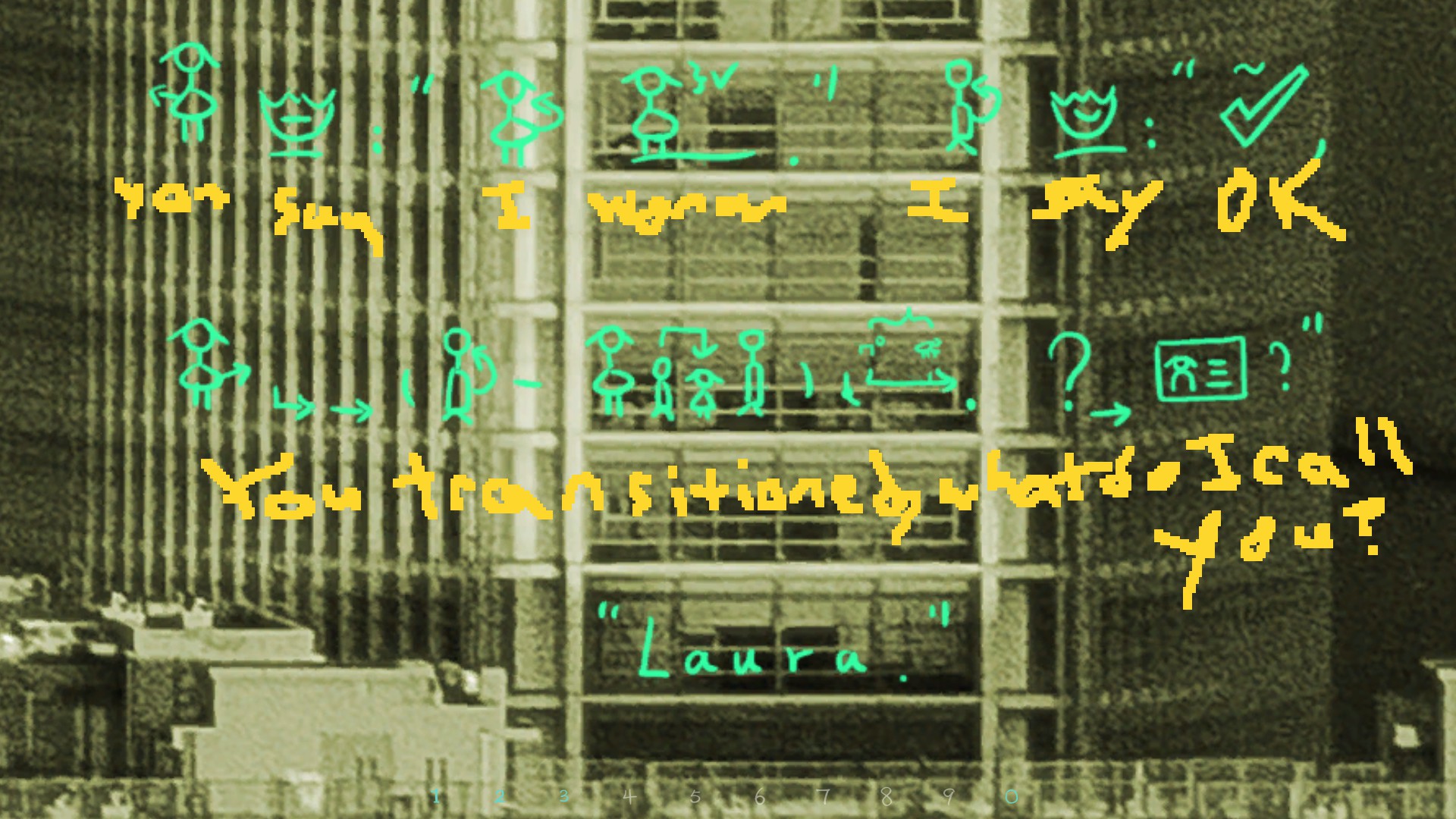
My attempt to translate the above story. How do you think I did?

However, the experience this game most evokes for me is Yume Nikki. At first, the lack of direction and inscrutability seems openly hostile, defying the player to just go ahead and close the game rather than engage any further. But adopting a more patient perspective, choosing to simply enjoy being in the game’s space rather than automatically assume control of the situation, and picking up little bits as you see patterns creates a sense of melancholy connection. Unlike Yume Nikki, someone who masters this language is going to have a relatively concrete idea of each of these stories’ meanings, and this game is expressly a memoir, so its final interpretation is not likely to shock the player. But from the sheer density of the game (the Steam page cites “200+ friends to meet,” but there’s also loads of text just on the overworld) it will take months if not years to beat.

I will almost certainly not be the player who ends up solving Kevin (1997-2077.) I very nearly flunked out of Latin 2, and didn’t fare much better in Spanish 3. I still plan to poke my head in every so often and see if I can grasp at a new story. I am confident in saying this game’s design is brilliant and sound – right now, it is beyond me to advocate for its quality as a work of memoir literature. From this year’s games, I’m not sure I can point to a game throwing down the gauntlet more openly. Indie loving game academics like myself have clamored for a text this dense, literary, and open to player rejection. I worry gamers only want language learning games if they have the dopamine rush of Duolingo.

SPELUNKY

SPELUNKY
Mossmouth
2012

As much as I believe in the infinite potential of video games, the emotional range and experimental play I’ve seen in the medium, I will betray all those values for the belief in running around as a funny little guy. For the past decade, I’ve pretty faithfully answered “What’s your favorite video game?” with the HD version of Spelunky. The first time I played the shareware version of Spelunky was the night before the HD version dropped in 2012 – I played until sunrise, when the HD game released, bought it, and then played for another two hours before falling asleep. It was the Fourth of July.

In Spelunky, you play as a little explorer who runs and jumps sort of like Mario. You explore short levels and collect useful items (like extra bombs, spiky boots, a jetpack!) and treasure while dodging creatures and traps. It’s all very Indiana Jones, complete with your primary weapon being a whip, and fighting off snakes and spiders feeds later into yetis and man-eating plants. Every time you play, the levels are randomly generated using the best random level generation algorithm I’ve ever seen. They combine small, familiar handcrafted elements with enough care that every game feels unique and yet still thoughtful and intentional with each experience.

The randomness is partly so rewarding because the game is so damn hard. To beat a standard game of Spelunky, you only need to complete sixteen levels, each with a loose time limit of two minutes and thirty seconds before an unkillable lethal ghost will chase you out of them. For your first hundred plays, you might not make it out of the first four-level zone, the caves. It’s not that Spelunky is unfair – once you learn the game’s rules, you can almost always tell when you’re at risk of taking a hit. But the margin for error is just so slim, with only four hearts of health and (without a lot of game knowledge) the inability to gain more than one heart back per level. You will blow yourself up, jump into arrow traps, walk into bats, throw a pot under your feet and run into the snake inside it expecting gold.

One of the funniest things about Spelunky is a good death. You have so much direct control of your character in Spelunky, and so deaths always feel like something you’ve done. The game’s physics engine has such clear rules that you’ll find yourself shot by an arrow, bounced around the level by its momentum, falling into a pond with piranhas and being eaten alive. The game keeps a camera on your corpse even on the Game Over screen summarizing your run, fully aware that a good death only motivates the player more. This same spirit is at the heart of the love for games like Dark Souls and Elden Ring. Rather than being frustrated at the end of a good run, you simply have to laugh.

I have to admit that for my favorite game of all time, I think it’s pretty ugly. The game’s visual language is incredibly legible, with pretty instant recognition of every creature or trap the game throws at you. But it’s a hodgepodge of adventure movie pastiche, with giant scorpions and a big evil Anubis and thoughtless visual references to tiki, Hinduism, and tribal cultures. I love Spelunky – Spelunky could be better. I still appreciate that it’s colorful and easy to read, but I can imagine a version of this game that didn’t play in an intentionally retrograde milieu.

A dangerous moment in the Ice Caves, death likely on the horizon.

Retrograde doesn’t apply to all retro, though – the game’s soundtrack by Eirik Surhke is one of my all-time favorites. Its heavy use of the Yamaha DX7 creates a direct throughline to the Sega Genesis Yamaha YM2612 soundchip, iconic for its warm bouncy bass. However, using a proper DX7 gives the game a sonic clarity a lot of those high compression Genesis games lacked – it allows the game to sound like the best version of a contemporary to Streets of Rage or Sonic the Hedgehog. The compositions vary wildly between midtempo jazz, vibey synth soundscapes, and the intense prog anxiety of Jungle B. The fact that I still admire a lot of this music after so much playtime speaks to its generally high quality.

In 2020, Mossmouth released Spelunky 2, a lovingly made game I’ve never been able to connect to. Something about the game language and aesthetic went beyond my relationship to Spelunky. It feels to me like a game designed for speedrunners and challenge runners of the original game. I never became that player – even with all my time spent playing Spelunky, I still only eke out a win one in every three or four plays, and that’s satisfying enough for me. Part of my relationship with games will probably always be reaching the top 15% or so of the player population and never progressing to the point where I need to conquer the absolute peak of mastery to prove myself. I like the stage where I’m being resourceful, scrappy. The first Spelunky has kept me on my toes for over a decade. I hope that feeling never ends.

SIGNALIS

SIGNALIS
Rose-engine Games
2021
All Platforms

In Signalis, you play as Elster, a Replika android searching for her Gestalt coworker Ariane to fulfill a promise made during their working relationship. Elster arrives at a largely derelict mining facility on the planet Rotfront, where she quickly discovers that a horrific illness is corrupting and consuming the surviving Replika workers. Intermittent visions of half-remembered horrors haunt the Replika whose consciousness remains – however, Elster remains stalwart, sworn to her purpose.

These themes play out with a presentation that evokes Neon Genesis Evangelion, Shaft’s anime adaptation of Monogatari, Yoko Taro’s NieR, John Carpenter’s Apocalypse Trilogy (and a little bit of The Fog, too), and Silent Hill. There are occasionally pulsing mounds of flesh. Real world art such as Arnold Bocklin’s Isle of the Dead, or literature like Robert William Chambers’ The King in Yellow and H.P. Lovecraft’s The Festival, is thoughtfully inserted into surrealistic montage. There’s a brief high school AU where one character tries to go to the library with their friend.

And yet the dominant influence on this game is pretty undeniable – this is, at its heart, a classic Resident Evil game, with tank controls swapped for pretty strong third person avatar play. The combat, puzzles, and exploration in this game are simply top notch. The puzzles never become too obscure to solve but require a little clever lateral thinking. There’s always the tension of wanting one more inventory slot as you realize you need to carry Owl and Hummingbird keys AND some health toward an objective. The guns get just the right amount of ammo to cycle through them as you play, and your weaker guns never “stop doing enough damage,” making it exciting to plan your loadout as you head into unknown territory. I found it hugely fun throughout, a great modernization of a classic genre, which I honestly had not expected from a horror game with this quality of art and narrative.

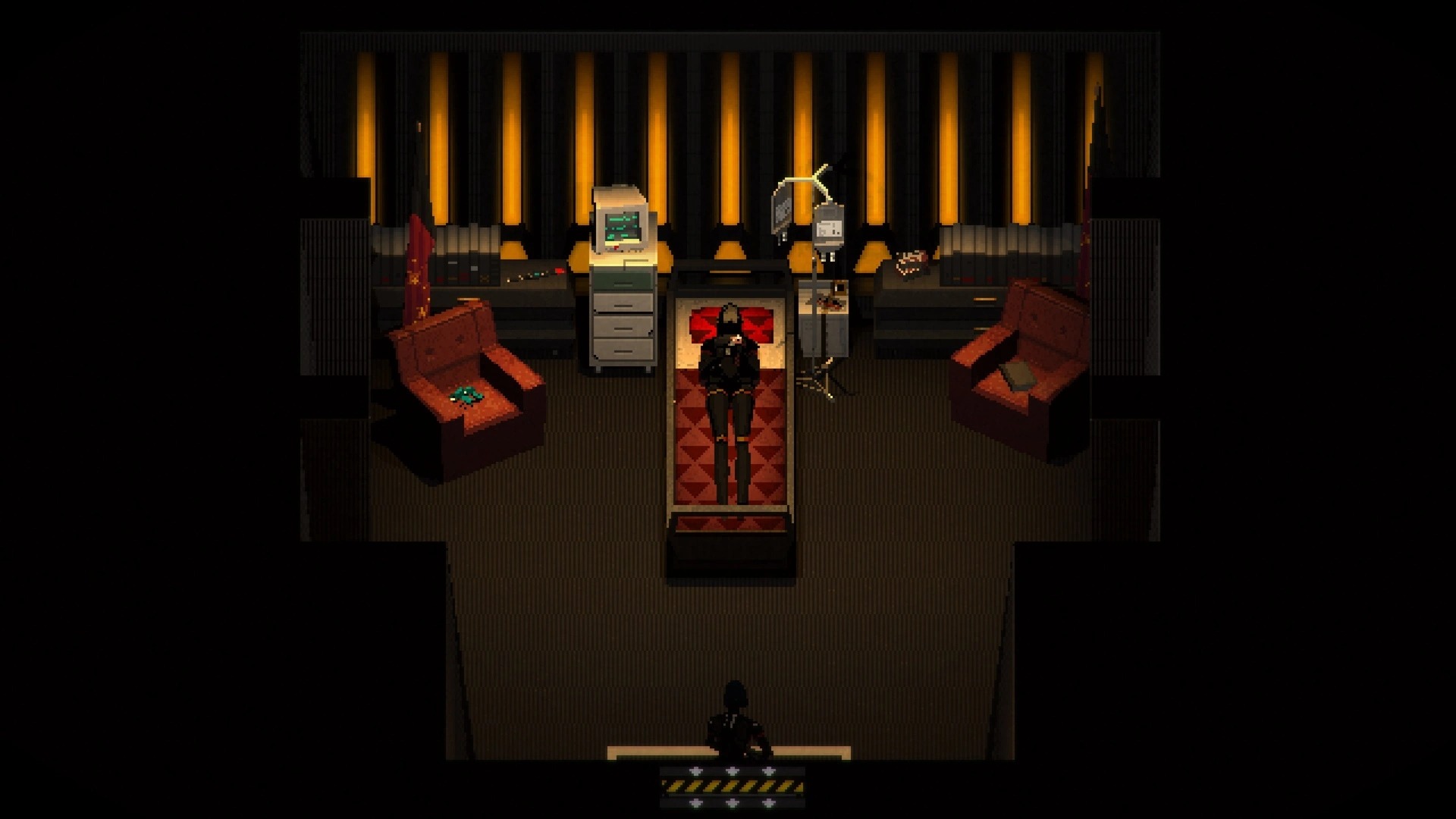
Elster looks on at a comatose commander.

What elevates Signalis, though, is the discovery of its plot, its horrors, its unspoken sadness. To borrow a comparison made in the pretty excellent piece by Elijah Gonzales in Paste, “I can’t help but compare it against something like the influential psychological horror film Jacob’s Ladder, which is excellent until its dunderheaded final minute provides an overly straightforward answer that undermines the complicated web of ideas that came before. By contrast, Signalis manages the difficult task of using multiple conclusions to amplify its main ideas while leaving ample room for interpretation, its unanswered questions and evocative answers buzzing in my mind long after the credits rolled.”

Because I like some game critics who love horror games, I end up seeing a lot of horror game Let’s Plays. It’s a genre that occasionally seems stale and like everything has been done. Signalis points toward a way forward into the new. This is a very considerate game that pokes at systemic cruelty, personal joy, and how terror can distort our vision of reality. Using cinematic techniques and misdirection, Signalis is capable of making the player second-guess what they’re seeing, and not in the silly Eternal Darkness “memory card corrupted” way. What elevates Signalis is the respect with which it treats its audience and the intelligence of its narrative. 

HEARTHSTONE: HEROES OF WARCRAFT

Hearthstone: Heroes of WarCraft
Blizzard Entertainment
2014
PC, Mobile

Of all the games I’m writing about this month, Hearthstone is the one I’m most embarrassed to have given so much of my time and energy. A quick-play, simplified rerun of Magic: The Gathering, Hearthstone is ugly, unbalanced, and largely based on lore I don’t care about at all. I loved WarCraft III when it came out, but I never made the jump to World of WarCraft, so the vast majority of card references are totally lost on me here.

The basic premise is very familiar to Magic players. You and your opponent have 30 card custom built decks of creatures, spells, and weapons. Each turn, you get energy in the form of mana to play cards that can attack your opponent’s creatures or their life total directly. Every turn, you get more mana, so you slowly ramp up from early jabs into colossal game-defining uppercuts until you or your opponent is defeated. The game is in building your deck to be as consistent at winning as possible and defend itself from your opponents’ strategies.

The thing it took me so many years to stop admiring about Hearthstone is its dedication to using the tactility of a collectible card game, which I’ve loved since the Pokemon TCG I grew up playing and collecting, and combining that with its digital format to do things that were completely impossible (or, at least, immensely inconvenient) in a tabletop card game. One of the simplest, “Discover,” gives you an opportunity to add one of three randomly generated cards to your hand. In real life, this would require both players having a semi-unlimited number of every printed card to function – digitally, you can just give someone the opportunity to use this card they might not own for a single game.

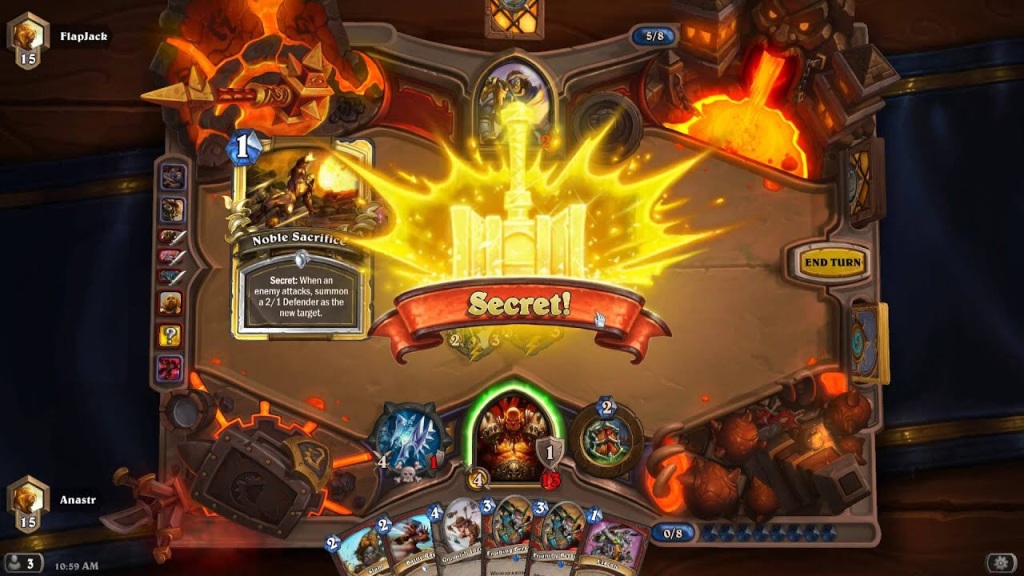
like cmon man this is so garish garrosh

There are mechanics that reward having only odd or even cost cards in your deck, mechanics that shuffle five random super-rare cards into your deck, mechanics that require players to only have one of each selected card in your deck (rather than the typical max of two) to get access to a special effect. These mechanics could maybe be achieved by registering with a judge before a given game or by owning a massive library of cards to play with, but they’d be onerous to track at best.

Hearthstone is at its best when it takes advantage of its digital format. Its single player adventures take advantage of asynchronous gameplay to create memorable puzzle-card gameplay. But, over five or so years, the number of mechanics forced a power creep and level of investment that made the game completely inaccessible to newcomers. I think many of its best mechanics have been lifted into other digital card games like Slay the Spire, Inscryption, and Balatro. The game’s last gasp for me was its Battlegrounds mode, a direct riff on the DOTA AutoChess mod that never quite offered anything on top of that formula other than “more money.” I haven’t played in years, and probably never will again, but I’ll always appreciate the excitement Hearthstone showed toward combining tabletop and digital card games and pushing that genre into a new era.

OUTER WILDS

OUTER WILDS
Mobius Digital
2019
Xbox, Playstation, PC, Switch

Time loop games tend to operate in one of two models. There’s the time loop that serves as a justification for clockwork gameplay mechanisms, encouraging the player to master the sequence events and execute on the “perfect run.” In some cases, this functions about the same as a quick retry button, but the narrative justification allows for a little more exploration of alternate consequences. There’s also time loops that serve as branching path narratives – if you create one chance meeting on day one and pursue that story, what’s the butterfly effect to day three when everyone else is still on script?

Outer Wilds is not quite either, though there are certainly consequential events and precise timings rewarding attention to detail. You play as a space explorer who, on the day they’re to take their little ship into the solar system, gets locked into a time loop which ends each day with supernova and armageddon. You have 22 minutes to advance from your home of Timber Hearth into the alien landscapes and prehistoric ruins of planets settled by the ancient (?) Nomai civilization. Your primary goal is to investigate the mysteries of the supernova, the Nomai’s demise, and the current status of the other Hearthian explorers. The game tracks this in a convenient journal on your ship and pins questions to your idea map, but it never offers obvious waypoints or quest markers.

The time loop primarily controls the solar system’s simulation. Weather on the oceanic planet Giant’s Deep operates on a storm cycle you can learn and, eventually, use to explore the planet’s truth. A portion of the planet Brittle Hollow breaks off at the same time each cycle and falls into a black hole that has opened at its core – to see that part of the planet, you’ll either need to arrive quickly or figure out how to navigate to it within the black hole itself. The Interloper is an icy comet that travels on the same portion of its orbit with each time cycle – that orbit affects the temperature on the comet’s surface, altering the ice pattern and your ability to navigate the surface.

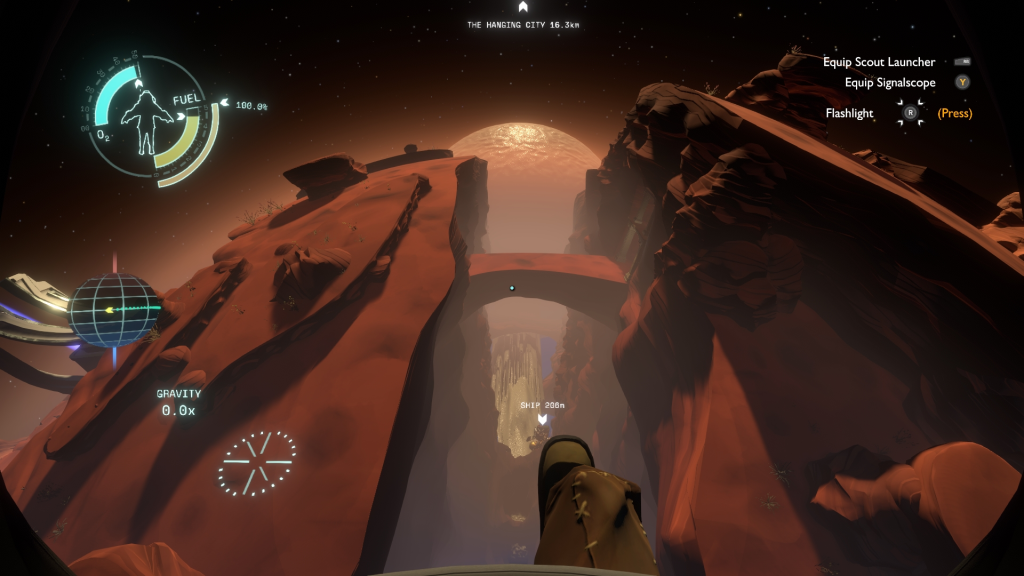
Floating through the canyons on the Hourglass Twins, a pair of connected mini-planetoids which trade a desert’s worth of sand over the time loop.

You, too, exist as a part of this physics simulation. Gravity varies wildly based on your location, and your fragile little body is easy to send into the abyss and back through the loop if you’re not careful. The spaceship controls a little like the classic arcade game Lunar Lander – your body inverts the standard video game jump so that hitting the button bends your knees and releasing causes you to jump however high your body goes based on the gravitational forces near you. Learning this mobility is, for a lot of players, the brick wall that prevents interest in seeing this mystery through to its conclusion. For me, it took some practice but in the end felt natural – I was able to pick up these controls again quickly upon playing the DLC expansion Echoes of the Eye, a new mystery that builds nicely into the game’s story.

And it is that story which I think makes the game so special. The time loop, physics simulation of the game is delightful, but it is the natural science and archaeology that are so rewarding. Ultimately, Outer Wilds is a story about the end of the world – some Nomai predicted an eventual demise, others built into eternal denial. The eventual answers to the mysteries of the Outer Wilds both confront the player with futility and peace. The game’s true ending, without delving into spoilers, is a celebration of life and its ending. It’s a moving, emotional sequence that both offers outrageous spectacle and aesthetic quiet.

Special notice must be given to the game’s fantastic soundtrack. Composed by Andrew Prahlow, the score is a combination of campfire acoustica and synth majesty. It combines the Hearthian’s forest fire architecture with the unknowable mystery out in the stars. The “Main Title” and “Travelers” are songs I listen to frequently. The synth line that begins to play near the end of a loop is catchy and unmistakable without being trite or dreadful. I hope to hear more scores from him someday soon.

RHYTHM HEAVEN FEVER

RHYTHM HEAVEN FEVER
Nintendo SPD
2012
Wii

I love rhythm games, and I think it’s fascinating the way they create challenging gameplay. For most listeners, music is not inherently interesting because it’s hard to perform. Yngwie Malmsteen is not a more popular guitarist than Jack White – Art Tatum isn’t inherently more beloved than Dave Brubeck. Games based on pop music run into this problem pretty fast, with the highest difficulties basically always being occupied by blast beat metal or hardcore techno. The ceiling is a combination of speed and variable notes that make for a pretty niche listening experience. At some point, it represents difficulty for difficulty’s sake. Guitar rhythm games require being able to powerslide and fingerpick through borderline illegible solos – dance rhythm games have so many notes flying at the screen their order has to be memorized in slow motion.

Nintendo’s Rhythm Heaven franchise is pretty notoriously difficult despite stripping out a lot of that complexity. In Rhythm Heaven Fever, the franchise’s best game before the pivot to “greatest hits” collections from the first three games, there are only two commands. You either press the A button, or you press the A and B button at the same time. The speed also never gets especially high, either, largely set around 130 BPM. Where Rhythm Heaven Fever derives its difficulty is precision – the game requires on-beat hits without the sloppiness of some more forgiving rhythm games, and its pass/fail criteria can create brick walls if you’re really struggling to get the rhythm down.

The music itself is just delightful, veering wildly in genre from city pop to bossa nova to hard rock. Because the difficulty is only tied to the rhythm itself, the game’s later stages are able to vary far more in terms of genre, with the game’s later levels including hip-hop, 80s power pop, video game chiptunes, hard rock – it’s much more feasible to play with an interesting rhythmic challenge in a typical genre than to introduce difficult notation.

The game pairs every minigame with a unique, fantastical cartoon that the music is soundtracking. The mascot monkeys that appear here and there throughout the game might be playing golf or operating a watch – Karate Joe needs to land his punches on beat to keep in shape – a cat and dog are keeping a badminton volley going while piloting biplanes. The visuals are absurd, full of jokes and color, and are themselves such an aesthetic treat for playing well. Sometimes they can be so engaging that it’s actually better to just close your eyes and feel the music, but learning the visual cues can also help mark your place in the song itself.

At a time when the odd side of Nintendo’s magic has somewhat waned in favor of iterative sequels and huge, complex games like Super Mario Odyssey, The Legend of Zelda: Breath of the Wild, and Super Smash Bros. Ultimate, a game as simple as Rhythm Heaven Fever seems especially far away. Nintendo has chosen to grow alongside its players, creating experiences that are deeply appealing to people who either already intimately know how deep video games can be or who have a child’s time to learn. Even getting into a game of Mario Kart 8 requires building a vehicle, one that has stats, and engaging with that system without attention can result in creating a kart that’s no fun to play. I admire Rhythm Heaven Fever because it takes only two or three sentences to explain the controls you’ll use throughout, and each individual rhythm game contains tutorials to ensure the player knows how to interact before beginning. And yet, without any fear, Rhythm Heaven Fever also throws those players directly into the deep end, demanding that internal metronome be more precise than a lot of the rock legends of the 60s and 70s. It’s a wonderful dynamic that creates a sense of humor in play, matched by the cartooning you see on screen. It’s Nintendo embracing absurdity, and I hope it’s not the last we see of those funky monkeys.