UFO 50
Mossmouth
PC
From a pure passion perspective, no game burned its way onto my heart like UFO 50 did this year. Mossmouth, the developer behind Spelunky, expanded to a team of 6 to create 50 games over the course of eight years – framed as the creations of fictional game developers who worked in the 1980s. There’s maybe never been as generous a package in game history, as the sheer scope of each of these games is enormous. There are some shorter titles, which might only take twenty minutes to complete if you manage to avoid a game over – however, others represent several hours of gameplay, and that’s not even accounting for the full length JRPG.
But beyond the scope, it’s the quality control that’s even more impressive. UFO 50’s fifty games are almost all genuinely very good games, and on top of that they’re very inventive games. There are action games, but there’s no “Megaman-like.” The game that feels the most like classic Capcom is probably Rakshasa, which emulates elements of Ghouls N Ghosts, but gives the player unlimited lives – provided they can survive the post-death minigame that gets harder with each death and resurrect themselves. There are two golf games, one of which combines golf and pinball (I’m so bad at this one) and one that is a sort of Zelda-like where you play as a sentient golf ball. It gets weird fast!
There are a few sequels mixed into the pack – to not do sequels would be dishonest – but the majority of those are wildly different from their originals. Take, for example, Mortol, a platformer where your little soldiers stay on the map when they die. By using their sacrificial rituals, you can build paths through the level. By playing smart, you can collect more lives and actually end up with a life profit when each level ends. The first is arguably the closest thing in UFO 50 to Mario, with its primary twist being that persistence of death. When you get to Mortol II: The Confederacy of Nilpis, the entire game structure has changed – now, you only get 100 lives to start, the entire game is one giant open world puzzle, and you start with five classes of soldier, each with their own weapon and ritual. The Sega Genesis collection on Nintendo Online may have 47 games, but a comparison of those Shinobi or Golden Axe games reveals quite a lot more in common. Nintendo themselves only made 51 games for the NES, and that’s including Mahjong, an edutainment spinoff of their Popeye game, and Donkey Kong Jr. Math.
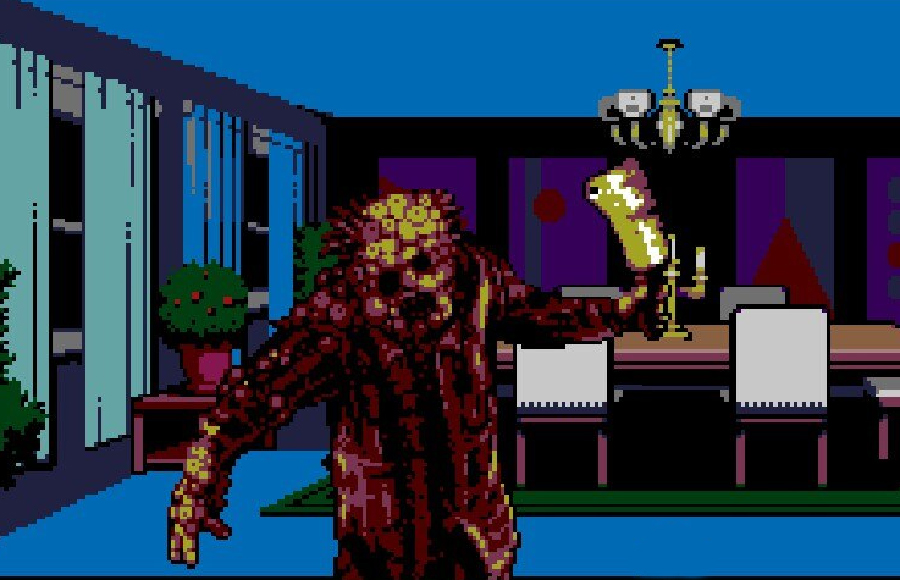
By packaging them together, these games gain so much in terms of thematic resonance, comparison of play, and the joy of discovery. The package of UFO 50 includes very little context for a given game – usually just a year, a very basic control description, a one-sentence tagline, and a piece of trivia about the game’s fictional development history. There is a sense of discovery to playing these games, discovering what makes them tick, going from “huh that’s neat” to “no, wait, hold on. I could get into this.” I have had some of the best conversations I’ve ever had about games discussing these games with people who otherwise would never have given them a shot – the package of fifty leads you to play games you otherwise might skip. I’ve also been thrilled to get to play them in multiplayer, which is an experience that immediately leads to competitive play and laughter.
UFO 50 contains layers of metanarrative, both about the fictional developers at UFO Soft who worked in the 1980s, the creation of the UFO 50 software, and offscreen as you notice themes persist across games. A terminal on the main menu taunts the player from the moment you boot it up, hinting at some grander scheme, and the scavenger hunt to uncover UFO 50’s deepest secrets is quite fun. But when I say that UFO 50’s narrative is remarkable, I think it’s less because of this metadata-based metafiction and more because of the way it forces the player to consider the people who make video games as characters, characters who have an intent and who are expressing something and exploring ideas with their work.
If there is one game in the pack I will try to convince you is a Game of the Year contender on its own, it is Mooncat. The thirteenth game in the collection, released in March of 1985, Mooncat’s description encourages you to “Jump and dash through forests, caves and mountains, in search of the egg.” Mooncat forces the player to relearn to control a platformer, with the left side of the controller (meaning all four d-pad inputs) moving your character left and the right side of the controller (meaning A/B/X/Y) moving you right. Combining these buttons allows you to jump, dash, dive, and slam your little character, who is…some kind of creature, probably a Mooncat? While the core experience is alien, the music and creature designs are comforting. Mooncat is a wonderful rewiring of the brain, reminding the player what it first feels like to pick up a controller. It is “unintuitive” if you are a longtime gamer, but it makes its own kind of sense. The half hour I spent discovering this game in multiplayer with my friend Joey is probably the single best half hour I spent playing a game all year.
But Mooncat is itself connected to the whole package. The fun fact for Mooncat reads as follows: “Conceived as a spiritual sequel to Barbuta, Thorson Petter spent nearly two years perfecting it.” Barbuta, the first game in the collection chronologically, is an adventure game somewhat akin to Metroid or La Mulana, set on an open world and full of unlockable secrets – however, its sense of humor and extremely devilish sense of tricks are almost more similar to Zork. Barbuta is so obtuse, and because of the fictional chronology, its lack of glam causes many players to immediately bounce off it. But the two games themselves are in many ways very different – Mooncat is far more focused on reflex-based platforming for a first completion, whereas Barbuta is more about poking the walls and finding secrets. To really see everything Mooncat has to offer, you have to take that lesson and start poking around to see secrets you might have missed before.
Even if you just glance off the surface at all the secret hunting, UFO 50 is a delightful collection of colorful games with great sprites, fun mechanics, and wonderful music. As much as I enjoy that “game design brain” side of UFO 50, I enjoy just as much figuring out the best unit lineup for arcade strategy game Attactics, driving around in absurd Crazy Taxi riff Onion Delivery, blasting my way to the top of platforming shooter Velgress. You don’t need to be a game designer or a lore hunter to get so much out of UFO 50 – you just have to be willing to hang out for fifteen minutes to learn how to play forever.
 All My Friends