Kevin Du
2024
PC
A friend messaged me to ask about an IGF finalist they’d not heard about prior – nominated for the Nuovo Award, Kevin (1997-2077) released to the public on February 2 and otherwise dropped off the face of the earth. We were both intrigued by the premise – a translation cipher game which lacks the clean, concrete solution logic of games like Chants of Sennaar. However, it was impossible to gauge the game’s difficulty or quality from the outside, so we waited for a review or stream – to no avail. Apart from one gamedeveloper.com interview and some non-English streams on YouTube, this game remains almost entirely uncovered in public visibility.
I bit the bullet and decided to investigate, the game’s low price point and unique presentation pulling me in. My first experience was overwhelming – I am not good at language learning, so I bounced off some of the syntax rules Kevin lays forward in the early part of the game. Furthermore, the game offers no advice in the way of navigation, simply offering you a map without boundaries to scroll for ciphers. This is not a game for those who demand a ten minute hook – your first real experience needs to be with a preparation to embed.

The play experience is relatively simple. Using the arrow keys or your mouse, you can scroll the “map” (in early areas, literally topographical maps – in others, photographs in collage) for written short stories or letters, always in pictographic cipher. You are given a pencil (which you can change to many colors and erase) to write your annotated translation. There are occasionally small markers of spots named “friends” you can open which combine a new visual collage element and more letters. Over time, you get a sense of the “story” told in some of these letters, and eventually the story of developer Kevin Du and the people in his life.
The game offers what amounts to an introductory workbook (including short love stories, a story about a dog bite, and more standard “i you they/he she them” grammatical lessons,) and it also offers the ability to create fast travel points and return to that opening lesson at any time. After a brief attempt to translate the early lessons, I scrolled over to the broader map and decided to learn what exactly we’re translating. At first blush, most of these stories are about encounters with fellow academics, coworkers, or potential romantic interests. Even before completing the “tutorial,” it’s possible to get the gist that Kevin’s telling a story about an awkward encounter getting coffee with an old girlfriend, or a boss asking about his vacation.
In both the Steam page and the gamedeveloper.com interview, Kevin Du expresses that he is sharing deeply intimate, sometimes uncomfortable feelings and stories in this game, but he wants to see the players put in the work if they’re going to try to understand him. The mechanics also embody this hedgehog’s dilemma – unlike other cipher games, there is no automatic translation possible. Like in English, symbols change meaning depending on context – “feel” and “body” share a symbol. In addition, your ability to zoom in and out is limited to very specific areas, meaning it can be difficult to see an entire story at once. You don’t have an in-game scratch pad, either, so any ideas you want to carry between stories have to be written in a real-life notebook.
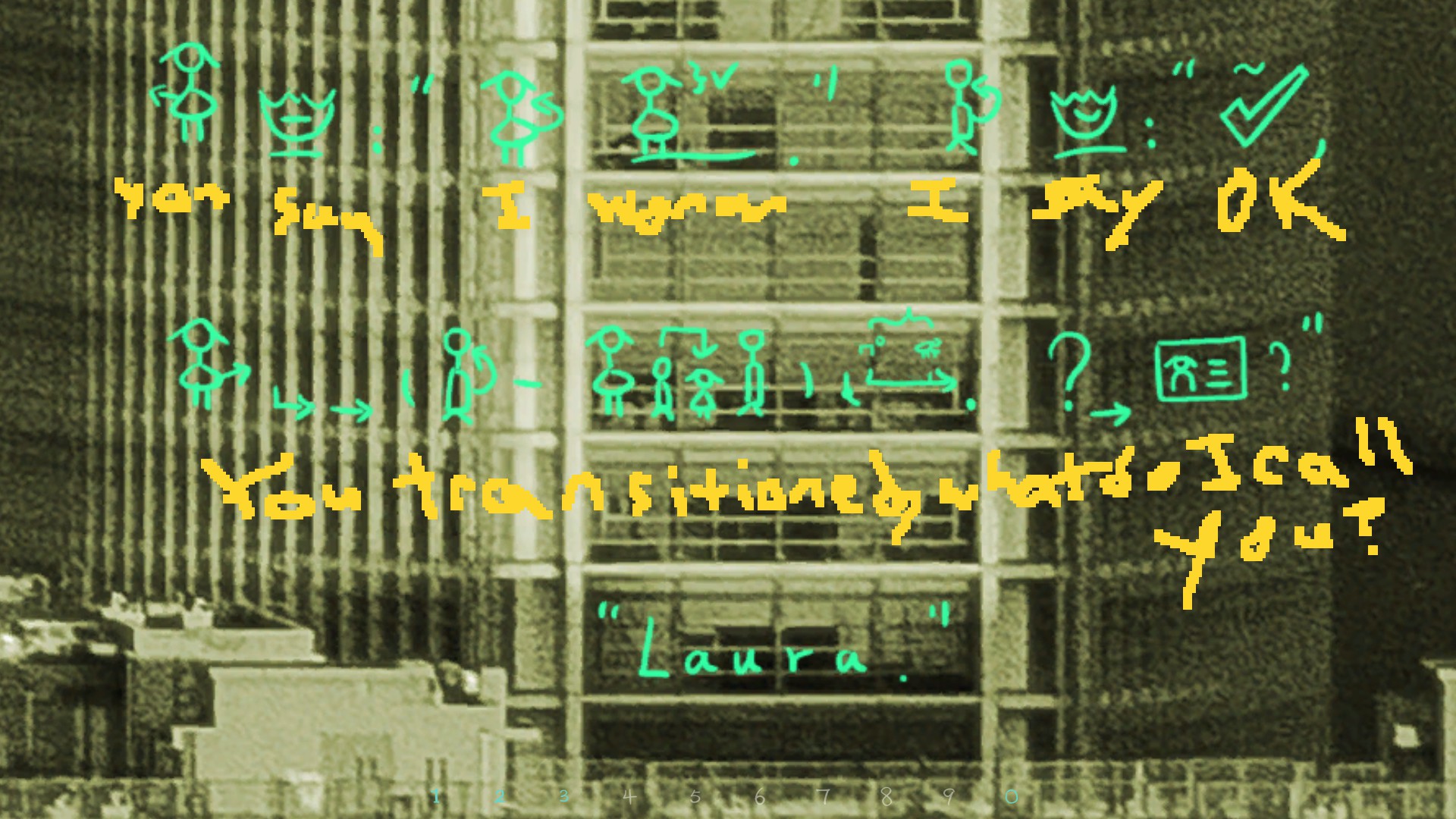
However, the experience this game most evokes for me is Yume Nikki. At first, the lack of direction and inscrutability seems openly hostile, defying the player to just go ahead and close the game rather than engage any further. But adopting a more patient perspective, choosing to simply enjoy being in the game’s space rather than automatically assume control of the situation, and picking up little bits as you see patterns creates a sense of melancholy connection. Unlike Yume Nikki, someone who masters this language is going to have a relatively concrete idea of each of these stories’ meanings, and this game is expressly a memoir, so its final interpretation is not likely to shock the player. But from the sheer density of the game (the Steam page cites “200+ friends to meet,” but there’s also loads of text just on the overworld) it will take months if not years to beat.
I will almost certainly not be the player who ends up solving Kevin (1997-2077.) I very nearly flunked out of Latin 2, and didn’t fare much better in Spanish 3. I still plan to poke my head in every so often and see if I can grasp at a new story. I am confident in saying this game’s design is brilliant and sound – right now, it is beyond me to advocate for its quality as a work of memoir literature. From this year’s games, I’m not sure I can point to a game throwing down the gauntlet more openly. Indie loving game academics like myself have clamored for a text this dense, literary, and open to player rejection. I worry gamers only want language learning games if they have the dopamine rush of Duolingo.
 All My Friends