1000xRESIST

Sunset Visitor
2024
Nintendo Switch, PC

I really struggle with comparison hyperbole in the games space. It breaks my heart to see games critics, people who are smart enough to know better, say that a game’s story is “as good as any book,” that a video game performance is “Oscar worthy,” that anything is “the Citizen Kane of video games.” The reason for this is twofold – one is that it is almost always transparently false to anyone who actually participates in a balance of art across media. But the second reason is the reason for the first – it misunderstands what games are capable of doing to assume parity on parallel lines rather than understand what makes them powerfully different.

1000xResist is, on its surface, a game that is “light on gameplay.” It is a sprawling science fiction story about faith, authority, memory, generational trauma, and many more things – the gameplay consists largely of walking around spaces and talking to other characters to progress the story. The developers at Sunset Visitor, an art and theatrical troupe, began development of 1000xResist during COVID quarantine, when the group could not tour dance or theater – this is their first ever game project. But 1000xResist would not be “just as good” if it were a stage performance – rather, I believe one of many things that makes 1000xResist so special is that Sunset Visitor seems to have seriously considered what kind of story could only be told as a video game. In that way, it reminds me of Shinya Tsukamoto’s Tetsuo: The Iron Man, the first feature film by his experimental theater troupe Kaiju Shiata, and the way that outsider perspective often leads to evolution in the medium. So far, unlike Tetsuo, the band at Sunset Visitor still seems happily together after finishing their game.

Here is my attempt to offer a relatively spoiler-free synopsis of 1000xResist’s premise that will not rob you of the game’s many discoveries. A post-apocalyptic society of clones survives in a religious enclave worshipping the ALLMOTHER, their genetic originator and the last human survivor of a worldwide pandemic. You play as Watcher, one of the leaders of this clone society, whose role is to witness and record the behavior and story of her sisters. Watcher also has access to a memory technology called “communion” – in communion, Watcher and one of her sisters can observe a memory passed down from the ALLMOTHER, who we come to know also a Canadian girl named Iris Kwan, who was difficult to the people around her before the apocalypse.

Iris (left) talking to Jiao (offscreen) while Watcher (right) looks on.

The first thing we see in the game is Watcher murdering the ALLMOTHER. The next several hours are spent working through the time before this heresy was performed so that we might understand what drove Watcher to act. We see her say goodbye to Fixer, her girlfriend, as she goes to join the ALLMOTHER on “the other side.” Shortly afterward, we see Watcher’s status quo in The Orchard begin to fracture as she begins to engage in these communions.

In a communion, if the host (Watcher) is participating in a scene, she is seen by other people in the memory as the ALLMOTHER. So we walk around as Watcher, through these memory spaces, occasionally moving forward and backward to see if we can navigate new scenes. But in communion, she is always addressed as Iris – though, sometimes, too, there is an Iris that we see from outside. When we play in these spaces, are we recreating Iris’s actual actions, or is this some sort of simulation shaped by things Iris remembers? Iris, too, seems so different from the ALLMOTHER Watcher knows now – but, of course, she’s also never actually met her, so who does she know? Early on, during a communion, we also shift out of Iris’s perspective entirely, and are suddenly seeing things Iris wasn’t around for through Iris’s mother’s perspective. How did she come upon this memory? Is this something she imagines happened? Is this magical technology capable of filling in gaps in ways we don’t understand yet?

This muddying of perspective is invaluable to the story 1000xResist is telling. When we play the game, we are attaching ourselves to multiple perspectives at once. The player’s identity is not always clear, and we are not always in control of when we’re shifting. The game’s relatively simple challenge is essential to maintaining this disembodiment – a combination with precise action reflexes or challenging puzzles that dissolve the pacing would shatter that character relationship. And this disorientation is precisely something that can only be achieved this way through gameplay – even a similarly revolutionary approach in RaMell Ross’s Nickel Boys, which immerses viewpoint and uses changing perspective to disorient the viewer, cannot have the viewer embody all those characters as “me.” Watcher becomes Iris becomes ALLMOTHER becomes Iris’s mother becomes etc. – and if someone asked “who’s that on the screen?,” the player’s instinctive response is “that’s me!”
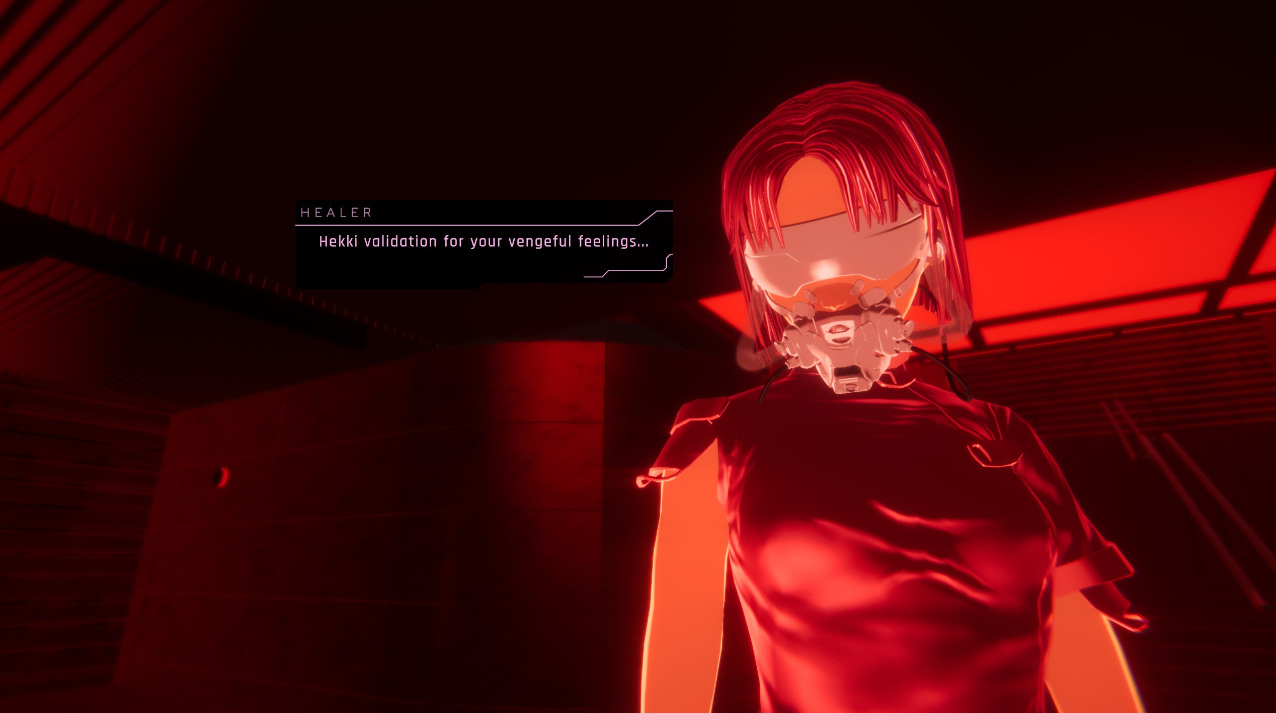
Healer soothing in a moment of crisis.

The game’s themes embody this throughout the story. Unsurprisingly, a story about clones is a story about the signifier vs. the signified – a game about a clone religion worshipping the “origin point” is engaging with questions about the self vs. the collective – a game about sharing memories engages with questions about where self-image and real, lived identity break down and diverge. This is a game that wants to talk about collective action, and one that directly references the Hong Kong protests of 2019. This is a game that wants to talk about how to maintain values in an institution without religion.

This, notably, is also a game about doomed lesbians, about knock knock jokes, about “songs to make it through the fighting.” It’s a game where one of the developers typoed “hello grace” as “hekki grace” in the work groupchat and so hekki becomes both “hello” and “amen” in the game. I love so many of these characters. Iris’s father is perhaps the most grounded, optimistic character you meet, and while his insistence that “the family that eats together stays together” sometimes feels naive, there’s truth in everything he does. That includes the truth in his pain, which is so well observed and honest to the life they wrote him. Watcher’s sisters Healer, Bang Bang Fire, and Knower have such immediate and distinct personalities, ones which have a relationship with their plotlines without becoming stereotypical or boring. Hell, I’d welcome all those characters into the cast of the next Like a Dragon game – when the story ended, I was very satisfied with its conclusion, but I was so sad I didn’t get to spend more time with these characters I love.

Bang Bang Fire reflecting on the nature of sisterhood.

Sunset Visitor understands well how to weaponize its strengths and its challenges as a first time developer. Animation is difficult, and facial animation is worse – but if 90% of the characters are clones, then they can all have the same face, and the apocalypse has led to the characters always wearing masks, meaning they usually don’t have visible mouths that have to move. But as actors and dancers, they do understand performance, and the performances in 1000xResist are remarkable. Most of the cast has a very subdued approach to performance, with emotion repressed and occasional snide awkwardness leaping forward rather than affection. When that affection really surfaces, though, it’s all the sweeter for the contrast. They understand cinema, too, and the way the camera places itself in the game’s more dynamic cutscenes is striking and affecting. Maybe one of my favorite moments is the stage play setup we get for the Communion with Healer, which makes use of a diorama view to dramatically work through the origin of The Ancient Sin, for which the sisters fell from ALLMOTHER’s grace.

1000xResist is the Game of the Year for all the reasons I can’t say outside of a spoiler piece at a later date. It is a game so dense with storytelling, presentation, and perspective decisions that it tells itself faster than I can recap it. Even if I were simply communing with my fellow sisters who have beaten the game, it would be too difficult to capture everything this game triumphs at without becoming a Norton Critical Reader and going line by line.

I love 1000xResist, but I maybe don’t love it as much as my wife, who wrote this when we finished it.

““we are speaking their language now. is that not a form of death?”

it’s 1000XRESIST. it’s the best game of 2024. it’s about cultural assimilation. it’s about daughters as the revenge of the mother’s mother. it’s about high school lesbians. it’s about a pandemic. it’s about being the first-gen child of immigrant parents. it’s about survival and who gets to survive and who can be forgiven for transgressions made in the name of survival. it’s about a weave that can be unpicked. it’s about a you that remains and remains and remains. it’s about a choice, and we will not make it.

hekki grace.”
UFO 50

UFO 50
Mossmouth
PC

From a pure passion perspective, no game burned its way onto my heart like UFO 50 did this year. Mossmouth, the developer behind Spelunky, expanded to a team of 6 to create 50 games over the course of eight years – framed as the creations of fictional game developers who worked in the 1980s. There’s maybe never been as generous a package in game history, as the sheer scope of each of these games is enormous. There are some shorter titles, which might only take twenty minutes to complete if you manage to avoid a game over – however, others represent several hours of gameplay, and that’s not even accounting for the full length JRPG.

But beyond the scope, it’s the quality control that’s even more impressive. UFO 50’s fifty games are almost all genuinely very good games, and on top of that they’re very inventive games. There are action games, but there’s no “Megaman-like.” The game that feels the most like classic Capcom is probably Rakshasa, which emulates elements of Ghouls N Ghosts, but gives the player unlimited lives – provided they can survive the post-death minigame that gets harder with each death and resurrect themselves. There are two golf games, one of which combines golf and pinball (I’m so bad at this one) and one that is a sort of Zelda-like where you play as a sentient golf ball. It gets weird fast!

There are a few sequels mixed into the pack – to not do sequels would be dishonest – but the majority of those are wildly different from their originals. Take, for example, Mortol, a platformer where your little soldiers stay on the map when they die. By using their sacrificial rituals, you can build paths through the level. By playing smart, you can collect more lives and actually end up with a life profit when each level ends. The first is arguably the closest thing in UFO 50 to Mario, with its primary twist being that persistence of death. When you get to Mortol II: The Confederacy of Nilpis, the entire game structure has changed – now, you only get 100 lives to start, the entire game is one giant open world puzzle, and you start with five classes of soldier, each with their own weapon and ritual. The Sega Genesis collection on Nintendo Online may have 47 games, but a comparison of those Shinobi or Golden Axe games reveals quite a lot more in common. Nintendo themselves only made 51 games for the NES, and that’s including Mahjong, an edutainment spinoff of their Popeye game, and Donkey Kong Jr. Math.

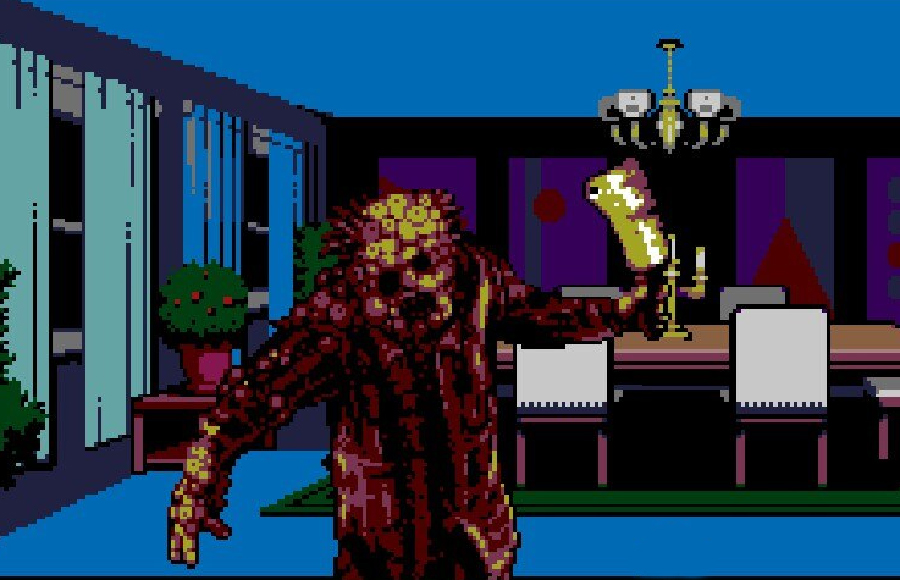
A screenshot from Night Manor, a horror adventure game late in the game’s chronological lineup.

By packaging them together, these games gain so much in terms of thematic resonance, comparison of play, and the joy of discovery. The package of UFO 50 includes very little context for a given game – usually just a year, a very basic control description, a one-sentence tagline, and a piece of trivia about the game’s fictional development history. There is a sense of discovery to playing these games, discovering what makes them tick, going from “huh that’s neat” to “no, wait, hold on. I could get into this.” I have had some of the best conversations I’ve ever had about games discussing these games with people who otherwise would never have given them a shot – the package of fifty leads you to play games you otherwise might skip. I’ve also been thrilled to get to play them in multiplayer, which is an experience that immediately leads to competitive play and laughter.

UFO 50 contains layers of metanarrative, both about the fictional developers at UFO Soft who worked in the 1980s, the creation of the UFO 50 software, and offscreen as you notice themes persist across games. A terminal on the main menu taunts the player from the moment you boot it up, hinting at some grander scheme, and the scavenger hunt to uncover UFO 50’s deepest secrets is quite fun. But when I say that UFO 50’s narrative is remarkable, I think it’s less because of this metadata-based metafiction and more because of the way it forces the player to consider the people who make video games as characters, characters who have an intent and who are expressing something and exploring ideas with their work.

If there is one game in the pack I will try to convince you is a Game of the Year contender on its own, it is Mooncat. The thirteenth game in the collection, released in March of 1985, Mooncat’s description encourages you to “Jump and dash through forests, caves and mountains, in search of the egg.” Mooncat forces the player to relearn to control a platformer, with the left side of the controller (meaning all four d-pad inputs) moving your character left and the right side of the controller (meaning A/B/X/Y) moving you right. Combining these buttons allows you to jump, dash, dive, and slam your little character, who is…some kind of creature, probably a Mooncat? While the core experience is alien, the music and creature designs are comforting. Mooncat is a wonderful rewiring of the brain, reminding the player what it first feels like to pick up a controller. It is “unintuitive” if you are a longtime gamer, but it makes its own kind of sense. The half hour I spent discovering this game in multiplayer with my friend Joey is probably the single best half hour I spent playing a game all year.

Gameplay of Mooncat’s first layer from a fellow Mooncat adorer. (Not actually a complete playthrough!)

But Mooncat is itself connected to the whole package. The fun fact for Mooncat reads as follows: “Conceived as a spiritual sequel to Barbuta, Thorson Petter spent nearly two years perfecting it.” Barbuta, the first game in the collection chronologically, is an adventure game somewhat akin to Metroid or La Mulana, set on an open world and full of unlockable secrets – however, its sense of humor and extremely devilish sense of tricks are almost more similar to Zork. Barbuta is so obtuse, and because of the fictional chronology, its lack of glam causes many players to immediately bounce off it. But the two games themselves are in many ways very different – Mooncat is far more focused on reflex-based platforming for a first completion, whereas Barbuta is more about poking the walls and finding secrets. To really see everything Mooncat has to offer, you have to take that lesson and start poking around to see secrets you might have missed before.

Even if you just glance off the surface at all the secret hunting, UFO 50 is a delightful collection of colorful games with great sprites, fun mechanics, and wonderful music. As much as I enjoy that “game design brain” side of UFO 50, I enjoy just as much figuring out the best unit lineup for arcade strategy game Attactics, driving around in absurd Crazy Taxi riff Onion Delivery, blasting my way to the top of platforming shooter Velgress. You don’t need to be a game designer or a lore hunter to get so much out of UFO 50 – you just have to be willing to hang out for fifteen minutes to learn how to play forever.

BALATRO

BALATRO
LocalThunk
PC, Switch, PS5, Phone

Balatro has swindled a lot of people into believing it is a simple game. In Balatro, you are given a deck of playing cards, draw a hand of eight, and are tasked with making five card poker hands to score points. Score enough points before you run out of hands, and you move on to the next round, which requires even more points. Between each round, you get access to the shop – the shop is where the game of Balatro is truly played. With the money you earn by playing well and quickly, you can level up your played hands (for example, buying the Uranus card will increase the number of points you get for playing two pair), enhance your cards so that they give more points (or more cash), and buy Jokers, which provide various special effects to score more, enhance more, or earn more cash.

The game genre of “deck building,” where players turn a modest starting deck into a monster of superpowered cards and special synergies, has its roots in collectible trading card games like Magic the Gathering or Pokemon. But deckbuilding games as their own, contained genre, which give access to all four players a shared pool of cards to buy up and trick out, equalize the playing field by only insisting on static, non-randomized purchases, and if you’ve ever played Dominion, Ascension, or Dune: Imperium, you’ve likely been inducted into the thinking that drives the best Balatro players. Video games have hit a wave of deckbuilders themselves after the popularity of Slay the Spire, and most video games in the genre have imitated that game’s focus on RPG combat.

By eschewing these combat oriented aesthetics, Balatro is capable of refocusing its collection of Jokers and enhancements on simply making the most efficient deck imaginable. You are not buying cards to heal your character or gain armor – you are buying a Lucky King of Spades, which synergizes with the jokers you bought that double your multiplier when you play a face card and add three mult when you play a spades card. The fact that it’s Lucky means there’s a 1 in 5 chance for it to give you more points and a 1 in 20 chance it gives you more cash.

Almost everything you do feeds back into the points, the cards themselves, your cash, or giving you better odds of finding the cards you need in the shop. It’s that intense focus that allows for so many fine tuned opportunities for crafting a deck that blows away all of the possibility you’ve ever imagined for the game. You start the game scoring 100, 200 points per hand, and yet the numbers eventually go so high that they’re printed in scientific notation. And this isn’t pinball scores – you really did create a machine that is that kind of efficient!

My first ever score that went exponential. I lost the very next round.

While using poker as its basis, Balatro resists both gambling and casino aesthetics. It avoids flashing lights, slot sounds, a mountain of coins and chips pushed as appetizing. There is randomness in drawing cards from a deck, and some jokers (or enhancements like the Lucky cards) have a random chance of triggering. But except for those circumstances, the math you submit for your scores is perfect math – you have the information in front of you to determine whether or not you’re going to score enough points to proceed.

And even though the game is avoiding its Vegas level of addictive aesthetics, the sound of the shuffling cards, the rising tone as your points go up, and the synthwave grooves are so pleasurable to experience. The aesthetics are charming, too, with lots of great art for the jokers, snappy movement of the in-game cards, and an always exciting effect when your points light on fire when you score enough points to win in a single hand. Hell, if you play on mobile, the haptic feedback even gives you a little rumble every time you shuffle the deck.

The thing about Balatro is that from the outside, it sounds obtuse, but to spend time playing or watching someone play Balatro very quickly unfolds its pleasures. When Balatro was announced for Geoff Keighley’s dubious Game Awards as a Game of the Year nominee this year, some people balked at the idea of a “simple little card game” meriting championship. Those who have played it generally recognize that within those simple confines, thousands of hours of combinations, complexities, and stratagems have emerged, comparing the game to landmarks of game design like Tetris that are endlessly replayable. This game merits at least one game study book – understanding precisely which kinds of thinking it rewards, the probabilities of its highest efficiency, which mechanics are maybe extraneous. Like Tetris itself, maybe you’ll play it for a half hour and say “this is pretty cool, I dunno!”

CAVES OF QUD

Freehold Games
2024
PC

I am intimidated by the size and scope of Caves of Qud. Its game worlds are enormous on the surface and infinite in depth. Its character customization is as nuanced a statblock as any RPG I’ve played. Looking up clips on YouTube, you quickly find people executing a series of spells in order to transform their character into a clone of a sentient door. And, in any clip of that ilk, you’ll also find that player dying quickly.

Caves of Qud is, on its face, an RPG roguelike with static elements. By traditional, I mean that the game only takes its turn as you do – you can attack by walking into your opponent’s tile – and, yes, death is permanent in the game’s classic mode. You can even turn on an ASCII view if you’re really hardcore in your traditionalism. And like those games, Qud is hard. It took me two hours to successfully complete one of the game’s first static dungeons, Red Rock. Keeping track of all your abilities, the rough difficulty of each opponent, and recognizing when it’s time to sprint and run is quite challenging and takes a lot of time to learn.

The game also arms you with a powerful tool – the game’s mutation system, which unlocks all mutations from character creation rather than building a tech tree. Your character, from the beginning of the game, can start with an armored carapace – the ability to discharge lightning – four legs – mind control – precognition – teleportation. This system is a delight to experiment with, not least of which under the Unstable Genome archetype that serves up one of three new mutations roughly ⅓ of the times you gain a level. Almost every mutation is useful in some situations, and experimenting with the different builds across this open system allows a lot more variation for investment than many magic systems.

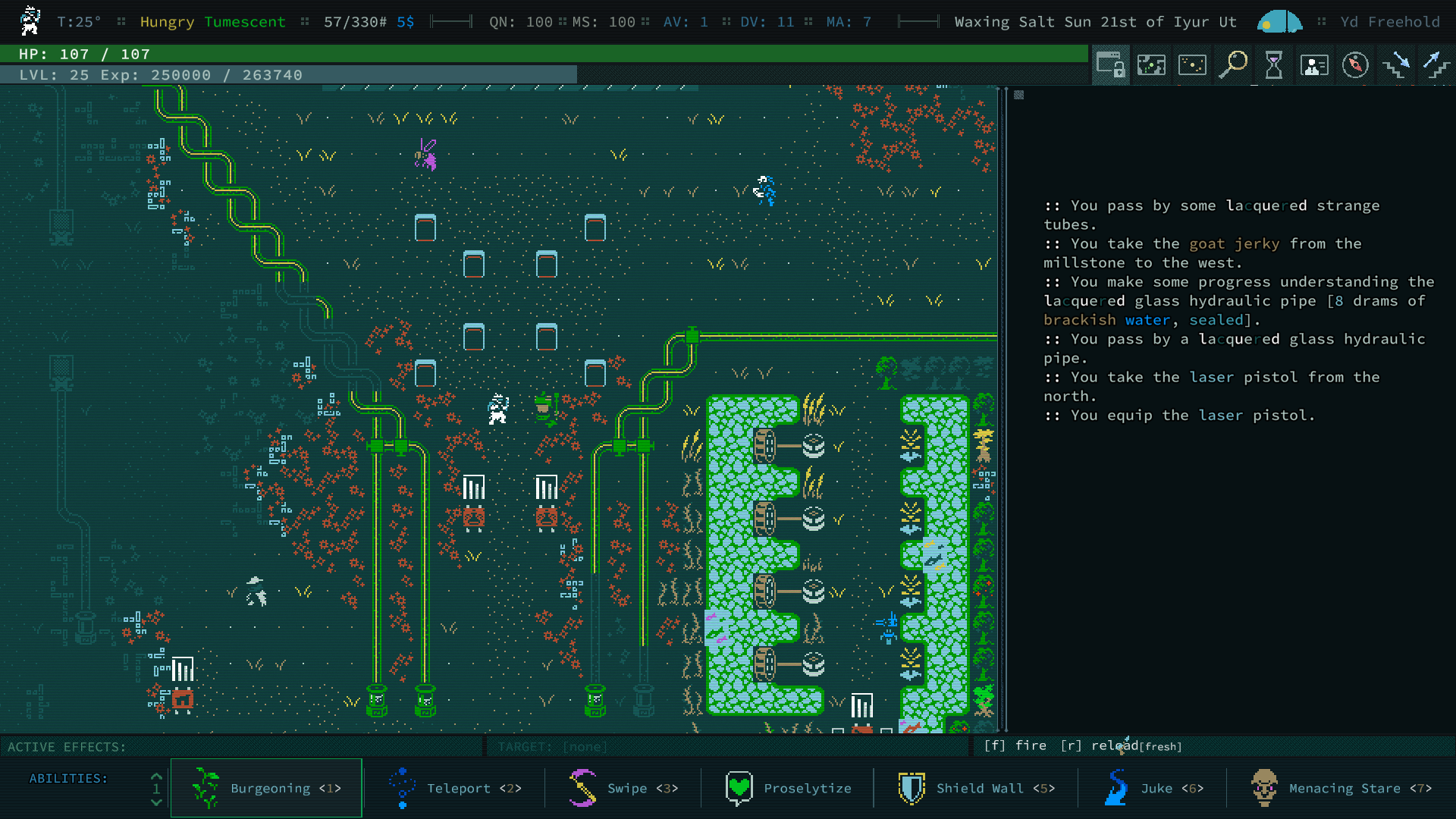
An overworld screen in Caves of Qud. The timeline on the right describes the actions that have taken place on the screen.

Unlike Rogue itself, Qud does have a canonical storyline and a static overworld map. The details of that overworld will change – within each World Map tile which can contain a named city or dungeon, there are 9 smaller maps which are randomized. After you start finding your way around, you can find quests which are the same from playthrough to playthrough (such as “O Glorious Shekhinah!,” which asks you to bring a bauble to a holy site for a religious zealot) and these eventually lead you toward the game’s “main quest.” With the 1.0 release, Qud does offer Roleplay and Wander gameplay modes with checkpointing, allowing players who reject that permadeath to pursue the game’s story.

In this way, Caves of Qud might more appropriately be compared with Morrowind. In discussing the game on the Eggplant podcast, designers Brian Bucklew and Jason Grinblat described a growing tension between the game’s 25 hour “main quest” and the game’s procedural roguelike design. In referring to Bethesda’s games, they pointed out that a lot of the side content where you investigate so-and-so’s brother’s disappearance in an otherwise unused cave, which often already uses procedurally generated parts, could also generate the geometry and population of the cave itself. They’ve applied that philosophy to Qud.

From your first conversation with an NPC, you’ll find that awkward “goodbye” at the bottom of your chat box replaced with “live and drink, friend.” The thoughtfulness of the writing in Qud is impressive, prioritizing worldbuilding and control of voice in a game that often promotes the absurd. On a Shelved by Genre bonus episode (sorry, it’s behind a paywall,) Grinblat discussed the game’s relationship to Gene Wolfe’s Book of the New Sun, specifically the ways that far future and fantasy collide. Unlike other fantasy and science fiction games, Qud does not serve you up NPCs who constantly explain the game’s lore to you – there are books which you can read if you’re interested, but otherwise the characters will simply treat you like you live there.

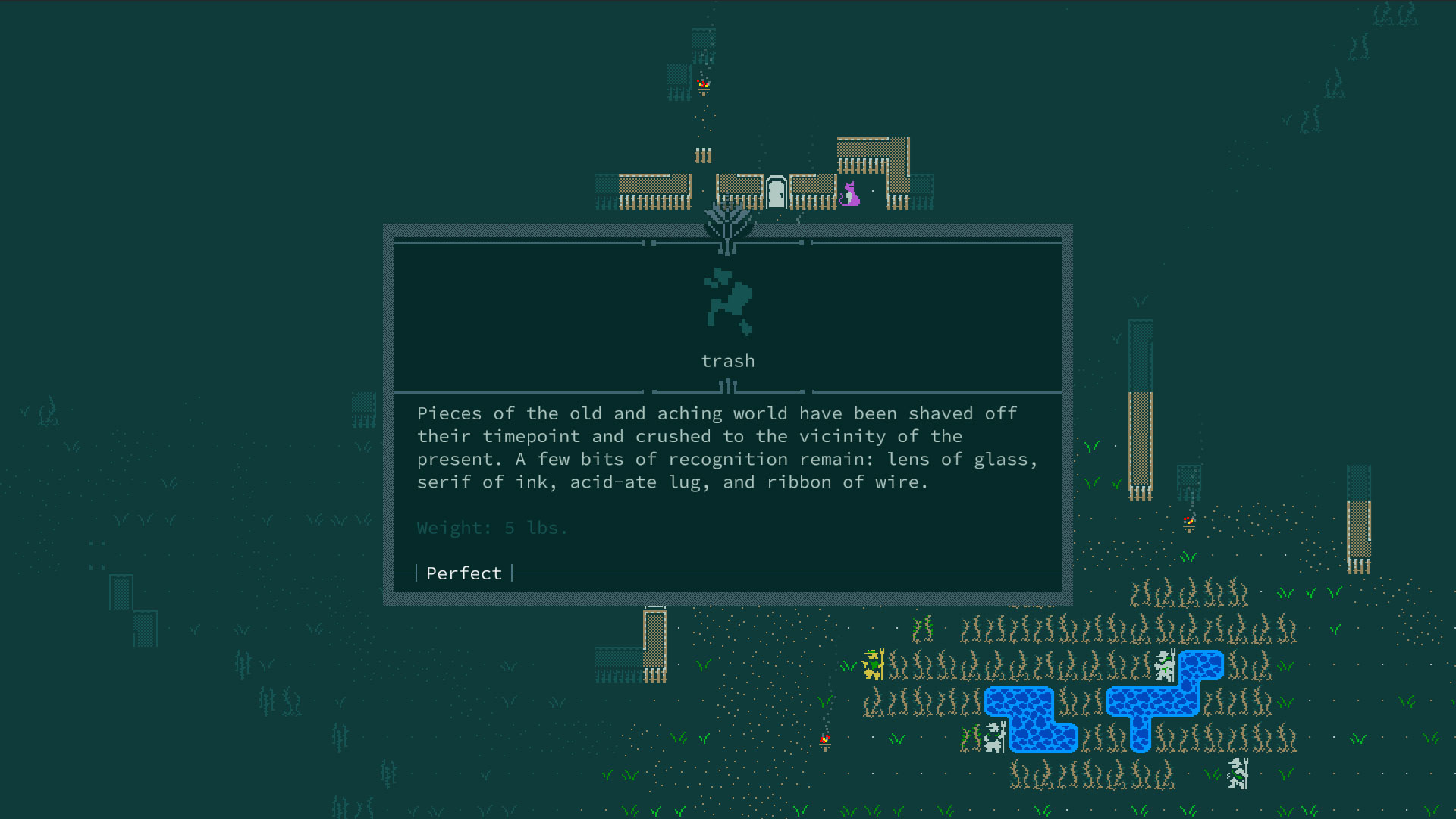
Even the trash is poetic in Qud.

As you start to question the sentience of the snapjaws you’ll likely be fighting in the game’s early hours, you’ll realize that even the baboons have an allegiance meter. Qud sets itself apart with the quality of its generator, the quality of its writing, and the power and detail of its simulation. Qud will allow you to earn the alliance of the birds that swoop down to nip at your shoulders – it will allow you to grant a locked door sentience only to dominate its mind and wander the land – it will let you carry spores in your heels that a bothersome turtle will nip to burst while talking to a town warden, turning him to your worst nightmare. 

This is a massive game, one which seems to take years to fully master. I have only a handful of hours of playtime, and most of its fans have accumulated hundreds. I am staking my claim that, actually, once I learn this game, it’ll ascend even higher. Even as it stands now, I’m so pleasantly blown away by the brief experience I have had with Caves of Qud. I hope someday to come back and elaborate on the intricacies, my favorite builds, all the things I’ve tried – I won’t be surprised if it’s years away.

LORELEI AND THE LASER EYES

Simogo Games
2024
Switch, PC, Playstation

Released just a couple months before the full staff resignation at Annapurna Interactive, Simogo’s newest puzzle adventure game Lorelei and the Laser Eyes marked the first in a multi-game deal with the publisher following the success of their previous title, Sayonara Wild Hearts. That behind-the-scenes drama may be responsible for the game’s relatively low profile, but I’d also venture to assume it’s the game’s devious reputation for difficult puzzling that has won reticence from potential fans.

However, Lorelei and the Laser Eyes represents the apex of the studio’s puzzle games. Compared to Year Walk and Device 6, Lorelei is easily the fairest, most compelling, and deepest puzzler they’ve assembled. The game is played entirely with movement controls (joystick or d-pad) and an action button – every button on the controller not dedicated to movement operates on the same control. If there’s no contextual action to complete, like reading a sign or accessing a locked door, then the button opens your main menu, where your full quest log of “mental notes,” your inventory, and every important document, map, design, or clue is stored in Photographic Memory. While this game uses many puzzle languages, it also contains all the information you need to complete the puzzles in question – the few times my wife and I resorted to hints over the game’s hundreds (thousands?) of puzzles, we always found that it was a logic gap between us and the solution, not a knowledge gap.

The player takes on the role of Lorelei Weiss, who is called to an old German hotel by the mysterious Nero Renzo to participate in a form of artistic exhibition. It becomes apparent through found documents, correspondence between Renzo and Lorelei, and supernatural forces that Renzo and Lorelei are previously acquainted both with this hotel and one another. Someone died here in a way that affected fate. The years 1847, 1963, and 2014 keep coming back up – what’s the connection? Solving this mystery and understanding the actual sequence of events guiding Lorelei and the Laser Eyes is engaging, emotionally satisfying, and helps the game’s intense atmosphere.

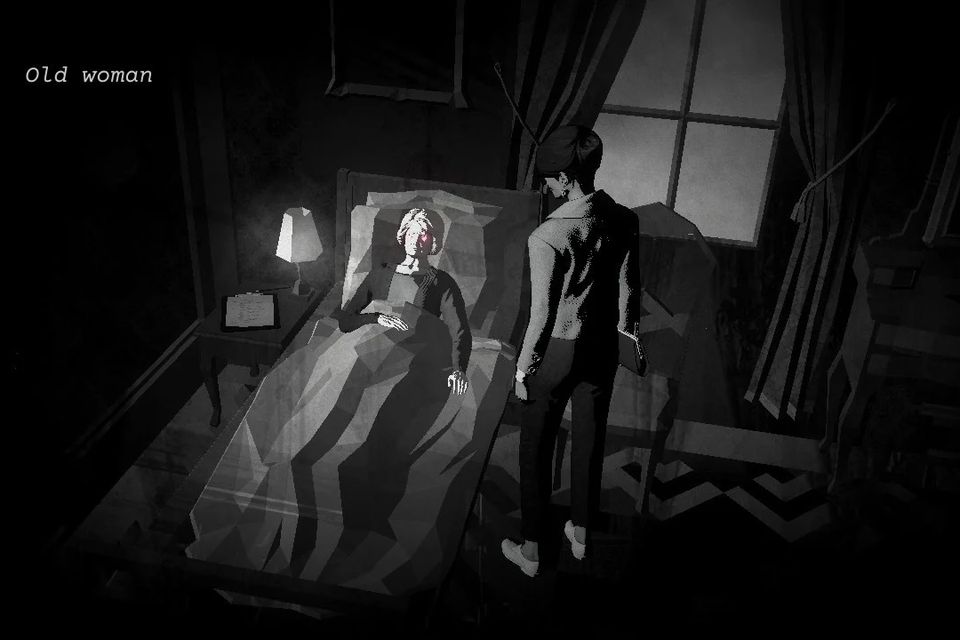
An old woman at the Hotel Leztes Jahr with laser eyes (left) and Lorelei Weiss (right.)

Atmosphere which has so much space in it! There’s the spooky haunted house, of course – it never becomes “Too Scary” but there are times you’re starting to feel some impending dread. The game informs you in the instructions you can read when you first start the game that you must make special note of anything someone with an owl mask tells you and that if someone points a gun at Lorelei, there is a risk of a game over. It can take a couple hours to find the first of these threats – knowing they hang overhead creates great tension. And when you do finally see your first supernatural beings, they’re striking without being so threatening you can’t offer the game to a scaredy-cat.

But the game is also full of humor. The first NPC you actually meet is a sweet dog named Rudi – then you meet Renzo, and a magician named Lorenzo, and everything either says is painted with a touch of the surreal and absurd. There are video games scattered around that need to be debugged – an elevator needs fixing and gets some funny dialogue – there’s a trap door that only goes off after you’ve stepped off it. There are jokes about the art world, European auteur filmmakers, even simple number puzzle jokes. It creates space for the game’s eventual melancholy tone, marrying the funny and scary into understanding that a tragedy played out, but not one without some humor.

And the design of the game is so striking. Everything you encounter will be black, white, and red – any other color you encounter will come from a screen. The game uses its limited palette and its fixed camera perspective to create an incredibly memorable sense of place. I won’t forget how Lorelei’s Hotel Letztes Jahr fits together, where red footprints lead, where red windows glow. I admit, that’s…also because there’s a lot of backtracking. If that’s a dealbreaker for you, you may not end up seeing the game’s penultimate puzzles through.

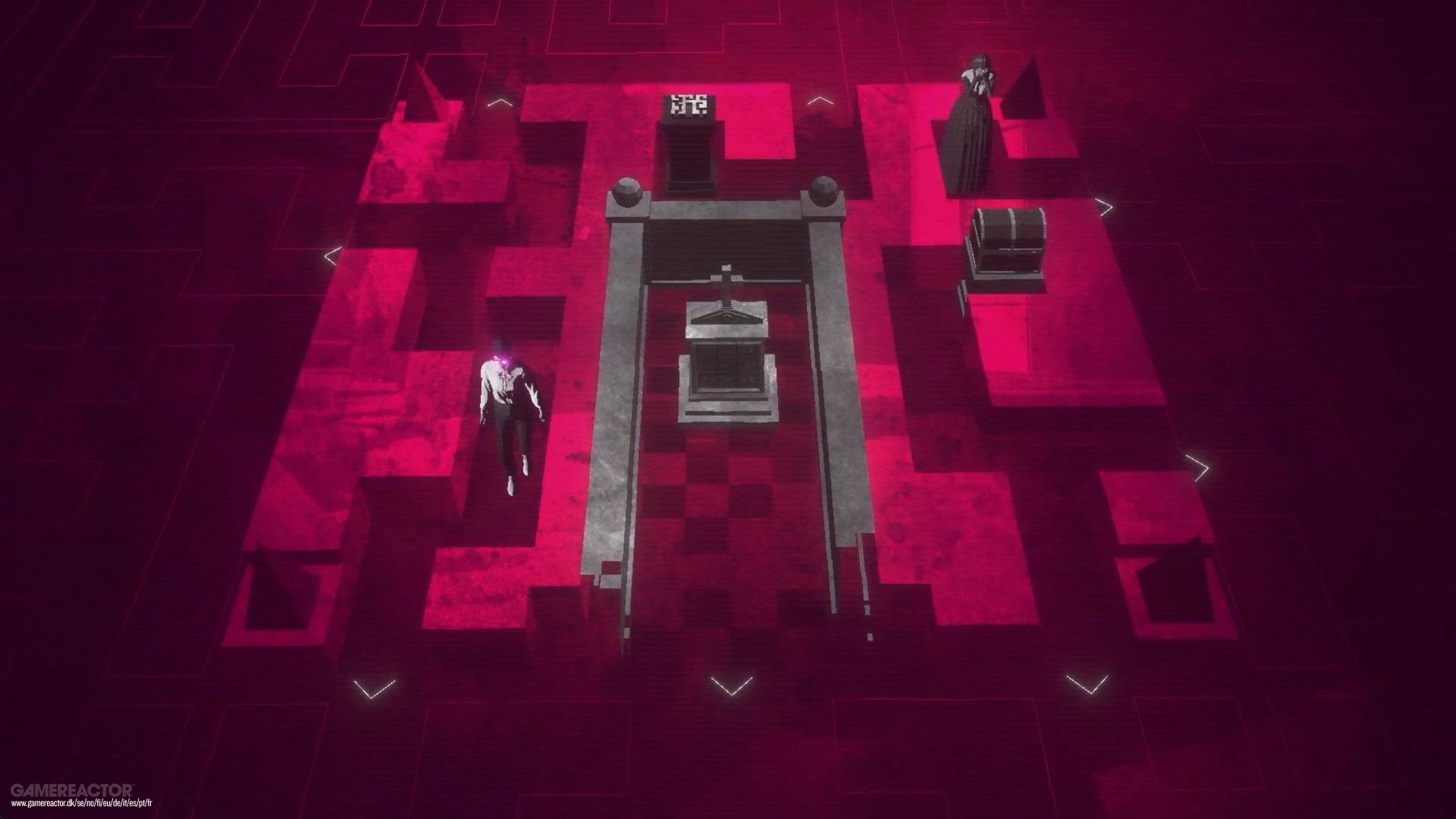
Relatively early on, you may find yourself in the red maze.

Without getting into explicit spoilers, I think this game has deceptively insightful things to say about creativity, being recognized in your time vs. after it, and the gap between outsider perspective and abject vapidity. It guards against this with that sense of humor. There is a confusion of identity across time, names repeated and relationships borrowed, parsing through the historical record and trying to assemble what exactly happened. This all builds towards an elegant, emotional conclusion, and the final moments of the game are a highlight of the gaming year.

Over a little less than a month, my wife and I would turn the lights down low (but not too low to read her notebook!) and play through this game together, putting two brains together to unravel the game’s strong collection of ciphers, logic puzzles, and mazes. It is an immensely pleasurable ghost story which marries many influences into a game that can not be replicated. While incomparable to rhythm optimist game Sayonara Wild Hearts, I believe Lorelei is the culmination of a decade of great puzzling and storytelling for Simogo. I can only hope that after whatever’s happened at Annapurna shakes out, they find their footing quickly.

NINE SOLS

Red Candle Games
2024
All Platforms

Like Nine Sols itself, I’m going to start by talking about Yi and Shuanshuan.

After Yi, our protagonist, is betrayed by his fellow Solarians, a child named Shuanshuan finds Yi revived in a cave outside his village. They develop a friendly, fraternal, paternalistic relationship offscreen – Shuanshuan is an orphan living in the “Apeman Village” (humans) who quickly takes to Yi as a “big bro” figure, who remains bemused and aloof. But when an annual ritual threatens to lead to Shuanshuan sacrificing himself, Yi intervenes and effectively ends the fiction of Shuanshuan’s world. The Apeman Village is a livestock farm – the ritual is submission to meat processing for the scientifically advanced Solarians.

Most games would play with this tension by driving friction between Yi and Shuanshuan, Yi trying to obscure the reality of exploitation from his “younger brother” for fear of repudiation and shame. But instead Nine Sols develops the relationship very differently – Yi takes pride in the opportunity to share his culture and technology with Shuanshuan, and Shuanshuan takes joy in learning new things. The tension isn’t completely abandoned, but Yi’s relationship with his adopted family is driven by a development of mutual love and respect rather than by a fear of loss.

Shuanshuan himself is written wonderfully as an independent child who quickly takes on creative projects with a sense of duty and willingness to practice. They do this without inflating his talent or hyperbolizing – he is a good artist for a young child, a decent musician for a young child, quick to learn games but slow to understand botany beyond “give the plant lots of nutrients.” He’s an upbeat little kid who occasionally surprises you with insight without being a perfect superchild. This is often very hard to write without getting annoying. I think they nail the prompt.

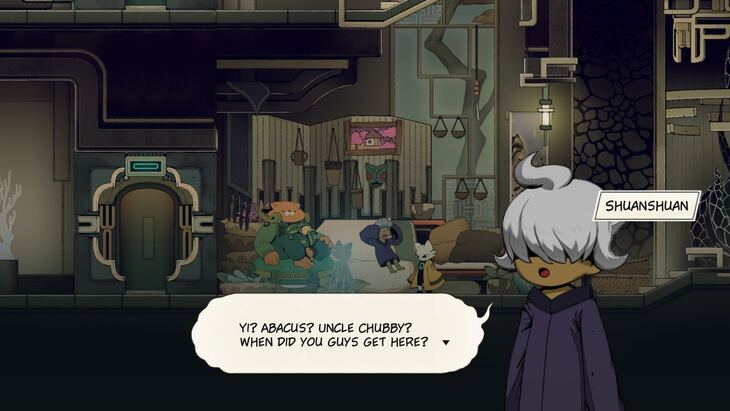
Shuanshuan realizing everyone’s here after a long VR gaming session.

The relationship between Yi and Shuanshuan is the emotional core that drives arguably the best “search action” (Metroidvania) game since Hollow Knight. Yi explores caverns, laboratories, and factories to find the Solarians who betrayed him and set an end to their dystopian monoculture. The battles against these Solarians (more later) are some of the best conceived difficult boss fights in years. Red Candle Games describes Nine Sols as “Taopunk [which] blends cyberpunk/sci-fi elements with Taoism and Far Eastern mythology.” Both in story and gameplay, it is a far cry from their previous horror games Detention and Devotion. The latter of those games infamously ran afoul of repressive Chinese government policies around Xi Jinping, being taken off the market for several years. Nine Sols emerges as their first crowdfunding effort since.

Nine Sols’ action gameplay and combat is a pleasant surprise from a studio known mostly for first-person horror narrative. It is, to put it simply, the sister to Hollow Knight the people demanding Silksong are craving. Similarly to that game, as Yi’s moveset improves, the game becomes a dance of swift movement and quickly hotstepping through enemy encounters on your way to the next major destination. Unlike other games in the genre, the economy is not scaled to require any sort of grinding – simply exploring the map and fighting the enemies you run into along the way is going to be enough to unlock all the major upgrades offered to Yi. I was always happy to re-explore an area and recognize that there was no real need for me to fight my way through its guards.

The moment that it all clicks for me is the relatively early unlock of the mid-air parry, which the game calls the “Tai Chi Kick.” This is required for use against certain charged attacks, which can only be parried this way, and also for bouncing in the air on certain switches. The Tai Chi Kick is satisfying partly because it has no punishment for misuse – you exit it quickly enough to launch an attack, you do not have a wait imposed if you start it too close to the ground, and so the only goal is to time it correctly for your foes. This allows you to navigate the exploration sequences bouncing past your foes’ volleys with speed and grace, creating a pleasurable verticality I hadn’t anticipated. It also turns the game’s boss fights into a frantic and aggressive near-constant movement, maybe most comparable to the whirling attack of Yoda in the Star Wars prequels.  The ground parry is effective, but generally harder to time and more vulnerable to more attacks.  It is almost always safest to be midair, because in the air, you can use the Tai Chi Kick.

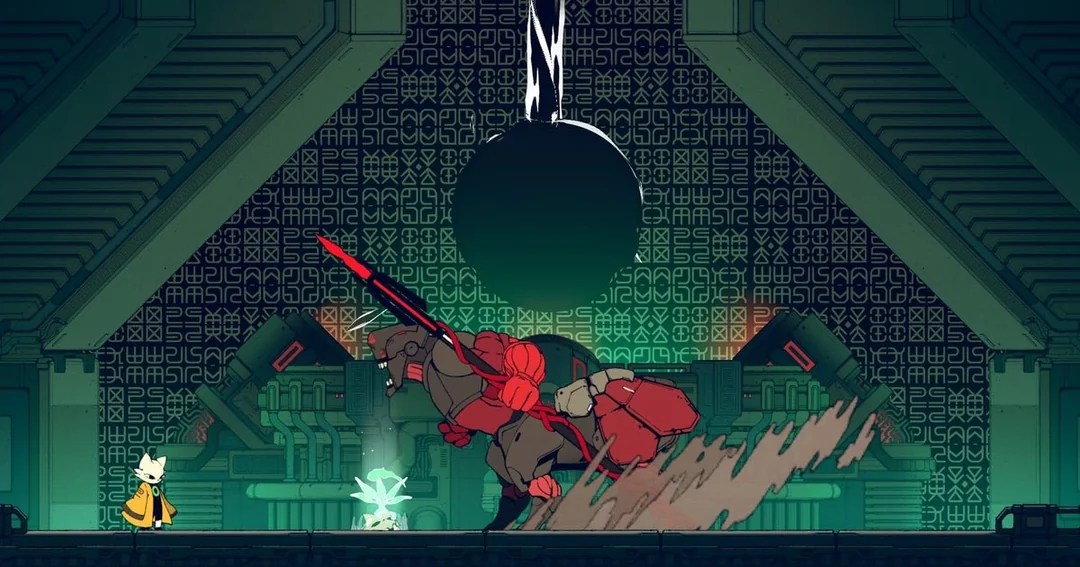
The first major boss in Nine Sols, a nasty centaur. That little corpse flower is the “revive” goober that lets you get back your XP points – yeah, it’s one of these!

Thankfully, the game offers difficulty options – its intended Standard difficulty is for genuine experts of Hollow Knight and Sekiro: Shadows Die Twice, aimed at people who know how to master a parry system as well as midair combat movement. That’s well beyond my paygrade, and I bumped it down to Story difficulty while fighting the game’s first real boss. The default story mode sets the game’s difficulty closer to the start of Hollow Knight rather than the endgame, though it offers additional modifiers to set the scales to your liking. Not every game needs this! But if you’re going to set the standard difficulty to go beyond some of the harder games on the market now, I appreciate the decision, especially for a studio developing their first action game.

I enjoyed this game’s many bosses – the titular Nine Sols are also each engaging area bosses narratively, with appealing, memorable designs and personalities. Their frequent conversation with Yi gives the game more of a character-based narrative than the loneliness many search action games prefer – Animal Well is a useful comparison point, with zero dialogue at all and the other animals serving at best as neutral observers. Finding out the nature of New Kunlun’s dystopia is continually satisfying and keeps the narrative stakes moving during otherwise gameplay-forward sequences.

I also forgot to mention – this is one of the best looking works of animated cartooning in games in many years. The character designs are so charming and memorable and expressive. The use of color throughout the game is so bright and decadent. Attack animations are distinctive, cool as hell, and legible enough to react accordingly. I also love the game’s music, driving orchestral work that invokes an amalgamation of Asian influences to represent some degrees of cultural difference. Again, achieving something so aesthetically lush is especially exciting coming from Red Candle, whose previous games utilized retro aesthetics and spare lo-fi elements to create a sense of dread.

Yi’s sister Heng (left) and Yi, on Penglai.

The game’s grand narrative tells a story of ambition for a scientific utopia crumbling against individual iniquity and shame. When the seams begin to show on an experiment, its supervisor pushes forward because they want to take pride in being the one to arrive at the solution. This either leads to a fascist indifference toward suffering or, just as often, the rising body horror of mutation gone wrong. The game contrasts this with memories of Yi’s younger sister, who is more spiritually attuned to their home planet Penglai. Red Candle is putting their chops to work in creating this undeniably Chinese riff on science fiction, the “Taopunk” label I hope one that continues to be explored alongside their work.

But alongside the bosses, the creeping horror, the study of an imbalance between spirituality and science, the thing that I found most rewarding and motivating in Nine Sols was finding a recipe book or an old VR headset and knowing I could bring it back to Shuanshuan to get another conversation with him. If there’s a biggest surprise to Nine Sols, it’s that a studio whose horror games were previously very painful and full of cruel fates and cruel people managed to tell the story of a relationship so full of joy and growth. There are monsters all around New Kunlun, slowly making their way toward Yi’s doorstep. But they can’t take that kid’s shine. 

LIKE A DRAGON: INFINITE WEALTH

Your annual Like a Dragon correspondent is reporting nine months after completing the longest, most sprawling game in the franchise yet. A direct sequel to 2020’s Yakuza: Like a Dragon, Like A Dragon: Infinite Wealth continues the story of Ichiban Kasuga and maintains that game’s turn-based combat with new character classes, character synergies, and a whole new setting in a version of Honolulu City.

I will start here by saying that unlike many other games in the franchise, this is firmly not a convenient place to jump in. Infinite Wealth starts with a two hour prologue that almost exclusively references the events of the previous game, and discussing the very premise of Infinite Wealth basically requires spoiling the 2020 title, as well as Yakuza 3-6 in varying degrees of detail. Many of the game’s narrative payoffs and rewards also involve easter eggs, recurring cast members, and an entire sidequest system required to make longtime franchise protagonist Kazuma Kiryu stronger, the Life Links system, involves reuniting with characters from previous games who may have been left on the sideline.

This is, essentially, your final warning, because in order to discuss what makes this game worthy, I have to dig into some of those Yakuza series spoilers. Suffice it to say this game has rewarding JRPG combat, enough minigames and side quests to rival Super Mario Party Jamboree, and a story more focused on character work and fan pleasure than on the social commentary and broader political intrigue of the previous title. I also will end this with a spoiler section about Infinite Wealth itself, because I want to expand a bit on why it isn’t higher for me.

These are the opening credits to the game, they’re delightful.

Ichiban Kasuga continues to reside in Yokohama’s Isezaki Ijincho precinct, where he helps ex-yakuza “orphaned” by the mutual dissolution of the Omi Alliance and Tojo Clan go straight in a society that looks down on them. He’s treated as a town hero for his role in exposing conservative politician Ryo Aoki and his Bleach Japan reactionary movement as corrupt and fascistic, but even with his newfound popularity, he’s still emotionally stunted by his eighteen years in prison. Unfortunately, someone’s decided to turn their sights back on him for his role in the end of the yakuza, and a V-Tuber uses misrepresentative footage to get him and his friends out of their jobs and back to investigating the underworld of Yokohama.

This investigation leads him to an opportunity – lay low for a while, go to Honolulu, and meet his long lost mother Akane. Things quickly go awry upon arrival – the game’s previews showed Kasuga nude on the beach, not remembering how he got there, and at the mercy of Honolulu’s police force. He’s rescued by Kiryu, who reveals that in his sad late-in-life exile, he’s been diagnosed with late stage cancer. Most of the people who love him are already under the impression that he’s dead, part of an exchange he’s made with the black ops Daidoji political faction – but the question remains whether or not he will die quietly or fight to get his life back.

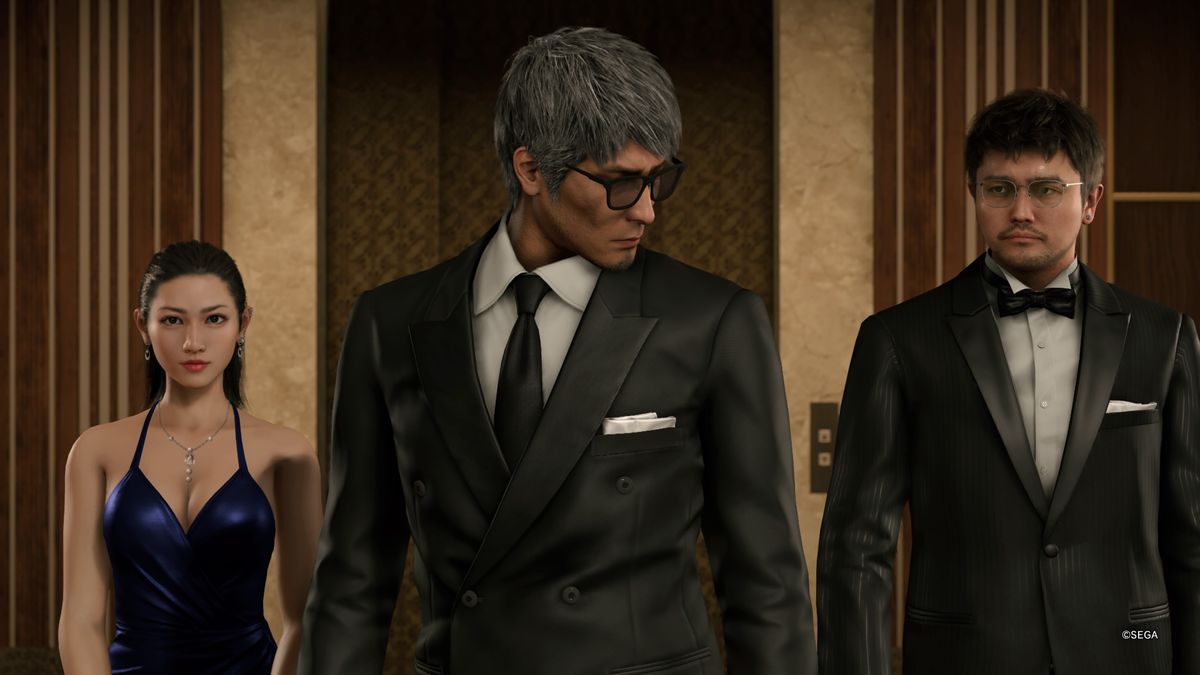
Chitose Fujinomiya (left,) Kazuma Kiryu (center,) and Eric Tomizawa (right) infiltrating a high roller casino.

The two men begin investigating the sudden series of events that have brought them both to Honolulu, the culmination of several criminal factions all seemingly looking for Ichiban’s mother. I’ll be honest – outside of what this maneuvering offers our characters in terms of character development, cool setpieces, and comedy, don’t worry about it too much. This isn’t the franchise’s most successful conspiracy. It does introduce some new party members, whose stories offer memorable twists and charming personalities, and have room for a lot of old friends. Two highlights are Chitose Fujinomiya, stylish scammer and bright new party member, and Yutaka Yamai, terrifying enemy heavy who finds himself chilled to the bone in the middle of blazing fire.

Where Infinite Wealth finds its narrative strength is in offering Ichiban and Kiryu personal challenges to overcome with those who want to help them. Ichiban’s emotional immaturity and naïveté are preventing him from developing romantic relationships in appropriate ways or from allowing him to appropriately grieve the life he missed out on, and the game’s emphasis on healthy relationships makes his emotional growth a real focus. Meanwhile, Kiryu, the unflappable, indefatigable man who can punch his way through any hardship, must finally learn to accept help, deny fate, and be vulnerable. The game builds systems around opening opportunities for that growth, and it really is a nice story when you get over the letdown of its loose plot.

Ichiban (center) on Dondoko Island, probably the largest new minigame in Infinite Wealth.

The game also pummels you with miniature campaigns of side content to pursue. Pocket Circuit, games like mahjong and shogi, karaoke, and arenas all return, sure. But now this game adds a crazy taxi based delivery campaign. Sujimon, the gag for the previous game’s bestiary, has been expanded into a full blown gacha collection battler with four gyms and a Sujimon League championship. An island tourism management game named Dondoko Island pokes fun at Animal Crossing while offering an eight hour campaign of fulfilling guest requests. There’s a Pokemon Snap equivalent where you shoot pictures in on-rails tourism rides. That’s all before you get to the franchise’s signature side quests, which are as plentiful and quality as ever, or the two megadungeons designed to promote level progression throughout the game rather than saving it for one rude difficulty spike right at the game’s conclusion.

The RPG combat of Infinite Wealth is far better balanced and offers much more variety than the previous title as well. It is much easier to combine movesets of different classes to make each character more unique, and the level progression is a lot smoother over the course of the game. The flow of fights is snappier, and character geography is much more rewarding to manage with more follow-up hits and combo attacks. The ability to rush down opponents lower enough leveled than yourself for a moderate XP hit (something like .7x XP for an auto-win?) makes traversing town a lot easier, too.

Like A Dragon: Infinite Wealth makes several much-needed corrections from the previous RPG, taking the gameplay where it needed to go in order to stand alongside a renaissance of turn based RPGs. I cannot personally argue that Infinite Wealth is the best game in the franchise’s recent run. I prefer the story of Yakuza: Like a Dragon and Like a Dragon Gaiden: The Man Who Escaped His Name a little too much to put it forward as champ. But given the strength of its polish, it might be yours.

With that, I’d like to say a little bit more about why – this is your last warning for Like A Dragon: Infinite Wealth spoilers!!!

Infinite Wealth villain Dwight (yes, that’s Danny Trejo) crossing blades with Ichi.

I maintain my feeling from the 2020 Game of the Year write-up I did that the first Ichiban Kasuga RPG really achieved something profound in telling a story that commented meaningfully on rising puritanical fascism and social inequality. The start of this game, focused on the fact that these ex-yakuza now are so ostracized that they can’t find work, really felt like a continuation on that attention to detail. The way the game ultimately builds toward a plotline where these ex-yakuza are being exploited by a supposedly goodwill rehabilitation company is, itself, following the storyline goals that I’d enjoyed the series setting forward. While there is a sense of “okay, I kind of hoped dissolving the formal Yakuza in the last game meant we needed to seek new stories,” I enjoyed the way this game handled the feeling that you’re never quite out in a society that stigmatizes redemption.

Tying that to YouTube cancel culture would be messy, but interesting! As a leftie, it’s compelling to examine the way the popular left masses (read: not people who actually, seriously, craft ideas for prison abolition, but People On Twitter or whatever) discuss prison abolition and then offer so little reparation or redemption to those who had a problematic post eleven years ago. The game also engages with YouTube bullying, though in a less adept way than previous RGG Studios title Lost Judgment did a couple years ago. Unfortunately, the game never actually ties these themes together – the YouTube cancellation ends up being part of a specific revenge conspiracy by the game’s ultimate villain, having nothing to do with societal opinion or ideological hurdles beyond “it’s easy to sway the masses.” This whole thread ends up making a pretty satisfying individual character arc for our V-Tuber (surprise: it’s Chitose!,) but it lets down any attempt to engage with the ideas beyond “yeah, they’re in the game!”

But really, if I had to say my biggest issue, it’s just that the villains are lame and have nothing valuable to add to the story. The guy who’s kidnapping Ichi’s mom and the little girl heiress to the Palekana organization is the flattest “I am corrupt and want power” villain the franchise has ever seen. Dwight sucks, and the Danny Trejo stuntcasting feels like it’s purely a diversion to keep you off the trail of the main storyline. The ultimate villain, Ebina, basically feels like a watered-down retread of jealousy and resentment ideas explored better in the previous game with the young master Masato Arakawa, and his desire to poison/take revenge on the yakuza feels too supervillainous and melodramatic to really feel like it’s saying much of anything.

The good new villain in the game, Yutaka Yamai, feels like he’ll end up Ichi’s equivalent to Goro Majima.

While I admire a lot of the character work for Ichi and Kiryu, I also feel like they both stop just short of really perfecting their arcs, too. Kiryu is a little easier to discuss. 2023’s Like a Dragon Gaiden: The Man Who Erased His Name explores what Kiryu’s been doing since he faked his death in Yakuza 6: The Song of Life, and it’s become infamous to franchise fans for its tearjerker ending. I’d heard that Kiryu is diagnosed with terminal cancer in Infinite Wealth before playing Gaiden, so I assumed that diagnosis is what would hit people in the gut. But instead, it’s a devastating act of kindness – Kiryu’s Daidoji handler, Hanawa, sets up a spycam so he can see the kids from the orphanage tell his staged grave how life has been going. Voice actor Takaya Kuroda gives an astonishing performance of grief during this sequence as Kiryu watching his loved ones grow and succeed and knowing he’ll never see them again.

It’s an emotionally deft ending, one that is unfortunately wholly unreferenced and is in fact almost undone by Infinite Wealth. Even from the game’s start, it’s immediately apparent that Gaiden was written after Infinite Wealth was completed, so the relationship between Hanawa and Kiryu is immediately less intimate and specific than we’d seen in Gaiden. Kiryu’s cancer diagnosis puts things on a running clock, but he’s seemingly more eager for adventure than he was in the previous game.

Then, during the course of the game, the Daidoji Faction effectively gets wiped out, Kiryu being alive is all but unveiled to the public, and he’s reunited with basically every single character he’s ever encountered, either face to face or as an eavesdropper. Some of these sequences are excellent – others, like the boss fight against three previous franchise icons, are melodramatic and not totally satisfying, though that one is at least mechanically pretty cool. It all culminates in feeling like this is a walking funeral, Kiryu minutes from the grave. I think ending on his death probably would have been too much, but it kind of just ends on a shrug, almost setting up that he’ll still be around for yet another death next game. It almost makes me wish Gaiden had been the goodbye, as much pleasure as it was to have him around in Infinite Wealth.

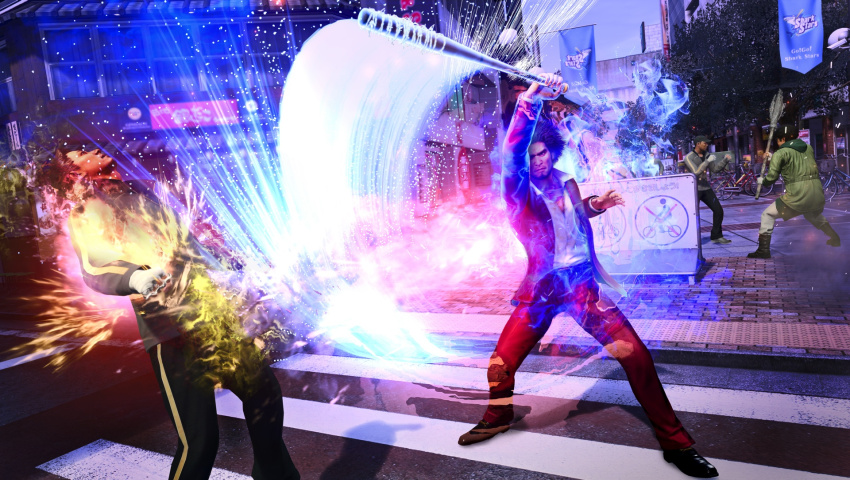
Ichiban thwacking a thug in Yokohama with his friend Yu Nanba in the background.

Ichi’s arc is actually pretty great, but it has almost nothing to do with the game’s story. I haven’t mentioned this at all yet, but during the game’s early hours, Ichi asks the previous game’s primary female party member Saeko Mukoda on a date after a couple years of friendship, and she agrees. However, he basically missed his entire young adulthood to being in prison when he took the fall for Masato, and he’s never actually been on a date before. It turns out to be a pretty decent date! But at the end, he gets so caught up in his immature fantasy that he proposes to her before even telling her that he actually likes her romantically – she, furious, politely ends the date and then refuses to speak to him until well into this game’s storyline.

This arc, ultimately, is about Ichi realizing that even though he’s “the hero of Yokohama,” working hard to improve the world and save his friends, he’s still completely ignorant about money, love, and all the basics of adulthood. His incarceration, combined with his already quirky personality, have left him a child in a grown man’s body. There’s a little bit of this tied into the main plot, with Ichi wondering what he’ll actually have to say to his long-lost birth mother, and their climactic conversation is sweet, understated, and helps show the growth Ichi’s been on during the game. But it has absolutely nothing to do with the conspiracy, and the decisions he has to make about his allegiances and navigating this new place ultimately have very little to do with his growth. There’s a dating app minigame that honestly feels more tied to what Ichi’s doing in his arc than almost any of the main plotline.

Like I said, Infinite Wealth is the longest, most sprawling game in the franchise yet. There are so many delightful moments in this game, both in the main plot and outside it. I love the sequence where Ichi decides he needs to try to get Akane’s attention in case she’s just in a remote place and so they film a YouTube video essentially hoping to go viral – Ichi’s “performance” is funny and really highlights the character’s charisma. I love his relationship with Chitose, who often talks in “wiser-than-her-years” absolutes that are repeatedly struck down by Ichi’s refusal to accept the status quo. I love Kuroda’s performance of scenes where he tells people of his prognosis – they are a quiet, sad, and repetitive grief saying goodbye to a genuinely iconic character. I love all the comic relief in this game, from action movie directors to rock gods who want a thunderstorm. There is so much to commend this game – I had a blast playing it.

Seonhee, the head of the Korean Geomijul in Yokohama.

TACTICAL BREACH WIZARDS

Suspicious Developments
2024
PC

At some point, I will wax on about XCOM 2, one of the great rickety video games, a tactical sci-fi strategy game so dense with cool stuff I put up with it crashing on me every couple hours. In the XCOM games, you command Earth’s united forces against alien invasion – in the second, you play as the rebellion twenty years after losing the first war. This is done on the battlefield with a small group of elite soldiers, choosing who moves where and shoots what alien, and also on the home front, allocating funds to build your own base and weaponry while researching weaknesses that might allow you to beat the technologically advanced alien menace.

Firaxis’s reboot XCOM: Enemy Unknown and its sequel, XCOM 2, introduced a degree of emergent storytelling and simulation-based variance to the strategy genre that has been the envy of many other developers. They made one with mobsters, Empire of Sin. They made one with Gears of War, Gears Tactics. They made one with Mario and Rayman’s Raving Rabbids – actually, they made two.

When it came time for Firaxis to release their own sequel to XCOM 2, they started with XCOM: Chimera Squad, which marked a dramatic change in tone and gameplay from the previous two games. Rather than commanding Earth’s army against alien invasion, you play an “elite peacekeeper” special ops cop squad keeping a city from descending into gang/cult warfare. Your squad is a scripted collection of characters, all unique and many having special powers, as opposed to randomly generated soldiers, and their relationships are developed in writing rather than a meter. And the scale of battles largely changed from city blocks wide open warfare into an emphasis on door breaches of smaller rooms, placing the focus on maneuvering quickly without getting outflanked.

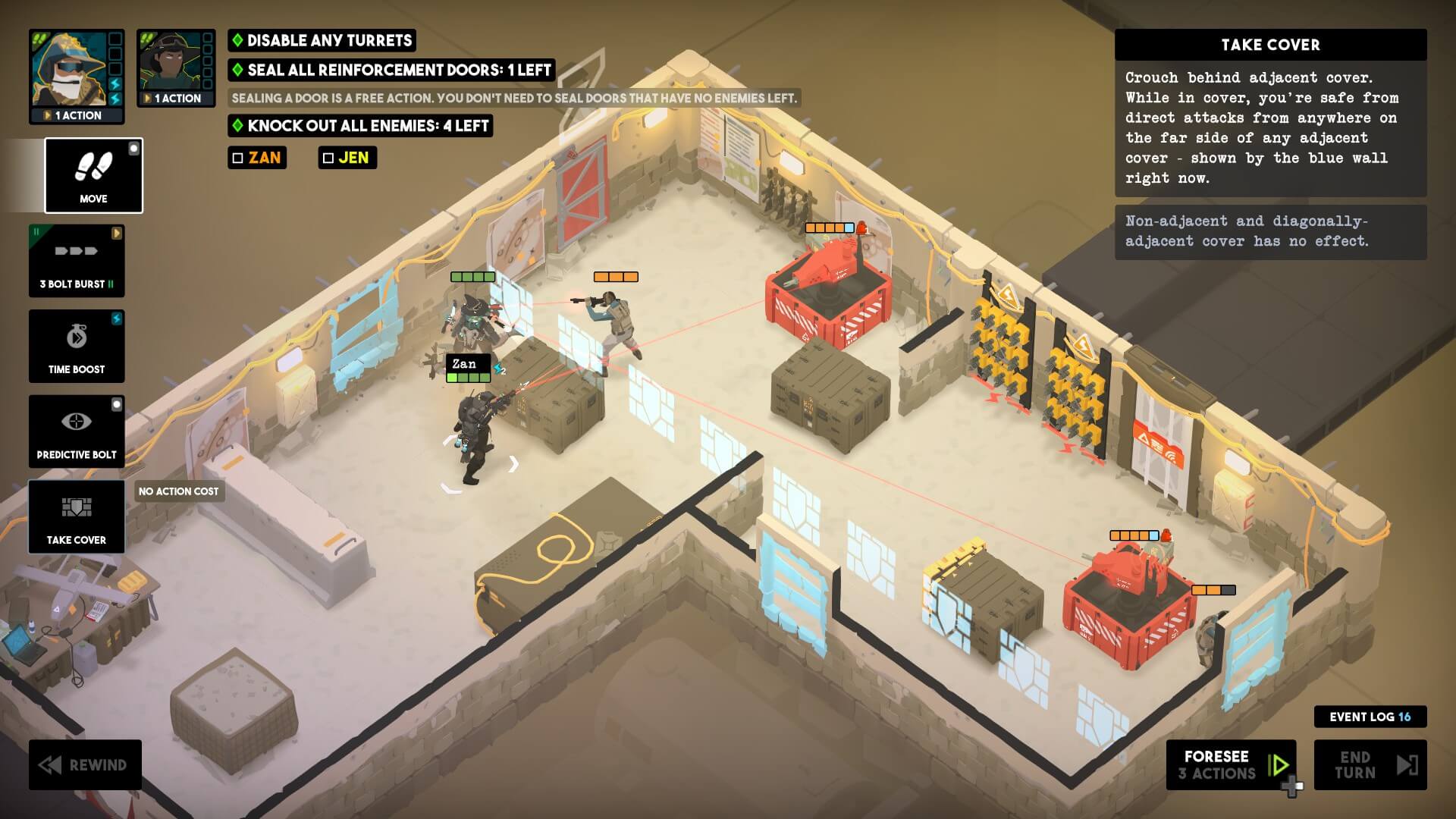
Some Tactical Breach Wizards gameplay. Your team is green – the enemy is orange.

I give all this history because Tom Francis, the director of Tactical Breach Wizards and ex-PC Gamer editor, cited frustrations with XCOM 2 as the primary inspiration for Tactical Breach Wizards. His game about wizards doing vigilante wetwork and stopping a villainous revenant is fantastical, but also uses XCOM’s military gameplay as a springboard. He wanted smaller-scale combat, an emphasis on characters with individual special powers, and settled on a theme of door breaches as a way to get there. He had no idea Firaxis was headed in the same direction, and when their game was announced and released, he took that as an opportunity to use Chimera Squad as a dry run and see what worked.

The thing is, on the surface, Tactical Breach Wizards deceptively feels very much like an XCOM game. Your units move on a similar grid, they take cover against walls and obstructing surfaces, they poke out to shoot, and they develop their abilities between missions. But Francis has made several changes to the formula beyond those that seem similar to Chimera Squad. For one, soldiers never miss in Tactical Breach Wizards – where XCOM was sometimes about gambling that this was “the best move you can make in a bad situation,” Tactical Breach Wizards always gives you the grace of seeing how the move was supposed to play out. For another, Tactical Breach Wizards adds a rewind button, allowing the player to undo their entire turn before letting the enemy take theirs. It even offers you a magical preview of your opponent’s turn, making sure you’re comfortable with the result of your actions before locking in your choices and presenting you with your next set of actions.

XCOM is a game structured for you to have a chance to lose the war – hell, XCOM 2’s plot takes that as the base premise. In Tactical Breach Wizards, there is an optimal move where your characters can clean up everything in two turns, not ever take a shot, and use their special abilities in a way that gives them the energy to do it again in the next room. Tactical Breach Wizards also drops the meta-strategy layer, settling for a simple “level up your units between battles” system rather than conceiving of a grand campaign. You can get extra experience points by completing sub-objectives, like using a special ability to take out three opponents at once or blocking reinforcement doors quickly. Tactical Breach Wizards isn’t a war game – it’s closer to a series of chess puzzles, giving you the opportunity to improve your tactical mind without ever structuring itself around the player making it ten hours in and having to start over.

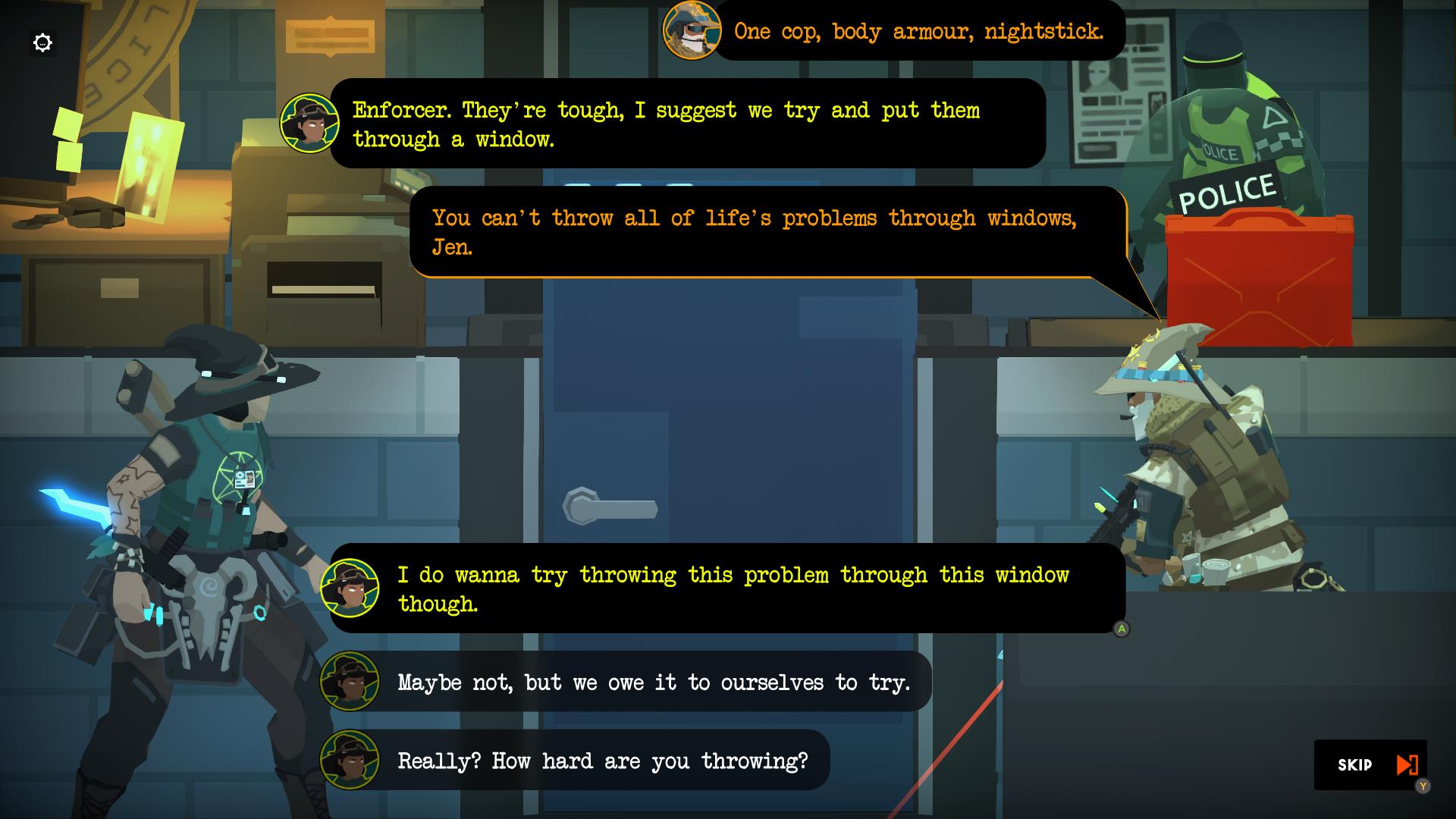
Jen (left) and Zan (right) talk about the next room they’re going to breach.

This fits perfectly with the game’s story, led by a collection of snarky mages who feel invincible and talk to one another like the X-Men. There’s Jen, the motormouth private detective whose power over electricity and speed with a broom makes her your most reliable offensive threat. There’s Zan, the smoking gun Gandalf who ends up being your anchor center, his first major ability being the ability to give allies more actions. The two of them are fighting Zan’s old commanding officer, Liv Kennedy, who Zan thought he’d lost in a mission gone wrong years before and has returned a revenant of violence and terror. But while they seem aware of the high stakes, they handle it all with one-liners and cool reserve, which helps them recruit more allies along the way.

It’s a writing tone some people have found…well, annoying. I like it pretty well, think it’s sometimes genuinely funny, and I think it’s pretty easy to zoom past even if you don’t. The most interesting thing narratively here is the choice to include dream missions, optional opportunities to improve your characters in less plot-forward scenarios. As the story continues, these begin to include anxiety dreams, where one of your player characters will consider their own character arc and motivations in ways that reflect the above-it-all comedic tone is a coping mechanism all these characters have adopted rather than the actual default state of the world.

I think, ultimately, what makes this game such a pleasure for me is Francis’s continued devotion to making games that offer incredibly precise perfection while allowing margin for error to still be entertaining. His first game, Gunpoint, is similarly built for laser focused execution and equally common flopping limply against a glass window. He continues to reuse the very satisfying window breaking noise from that game in Tactical Breach Wizards whenever you defenestrate your opponents. The game can swing from feeling like the odds against you are impossible to seeing the thread and feeling like you’re cheating because you’re so powerful. That’s one of the advantages of removing the dice and just letting the player do anything they set their mind to do.

ANIMAL WELL

Animal Well
Billy Basso
NS, PS5, XSX, PC

The insular popularity of Fez, your favorite game designer’s favorite game, has haunted me for twelve years. Designed primarily by infamous director Phil Fish and Renaud Bedard, the puzzle platforming of Fez dominates the cosmos of Animal Well, which trades Fez’s tone of post-Vonnegut observational comedy for a lonely, haunted malevolence. Instead of the hypercube tearing the cosmos into black holes, instead some dark, spiritual energy sends malevolence into the already carnivorous world of Animal Well. Your little blob darts into the remains of somewhere obviously forgotten.

Structurally, Animal Well has much in common with Metroid or Zelda, though it lacks either of their focus on combat. A 2D exploration platformer with a map so dense you’ll eventually fill all but the barest walls, your simple leap helps traverse abstract non-places filled with creatures and critters dangerous and benign. You navigate puzzles across four animal kingdoms, collecting tools which help you delve deeper into these mazes. My favorites of these are the yo-yo, which can hit switches down pits and around corners as it rolls on its string, and the thrown disc, which is sometimes a frisbee you throw or ride and other times a distraction for dogs and wolves quite a lot larger than yourself.

Animal Well has become known for its multiple layers of completeness – anything past the first makes Symphony of the Night’s inverted castle look like Porky Pig’s Haunted Holiday. The game contains 64 (or more?) eggs (like easter egg, get it?) which are the currency required to reach the game’s second ending and some of these fuckers are devious. Anything past the second layer requires Getting Online And Getting Help (or, at least, there’s one solution that factually requires that.)

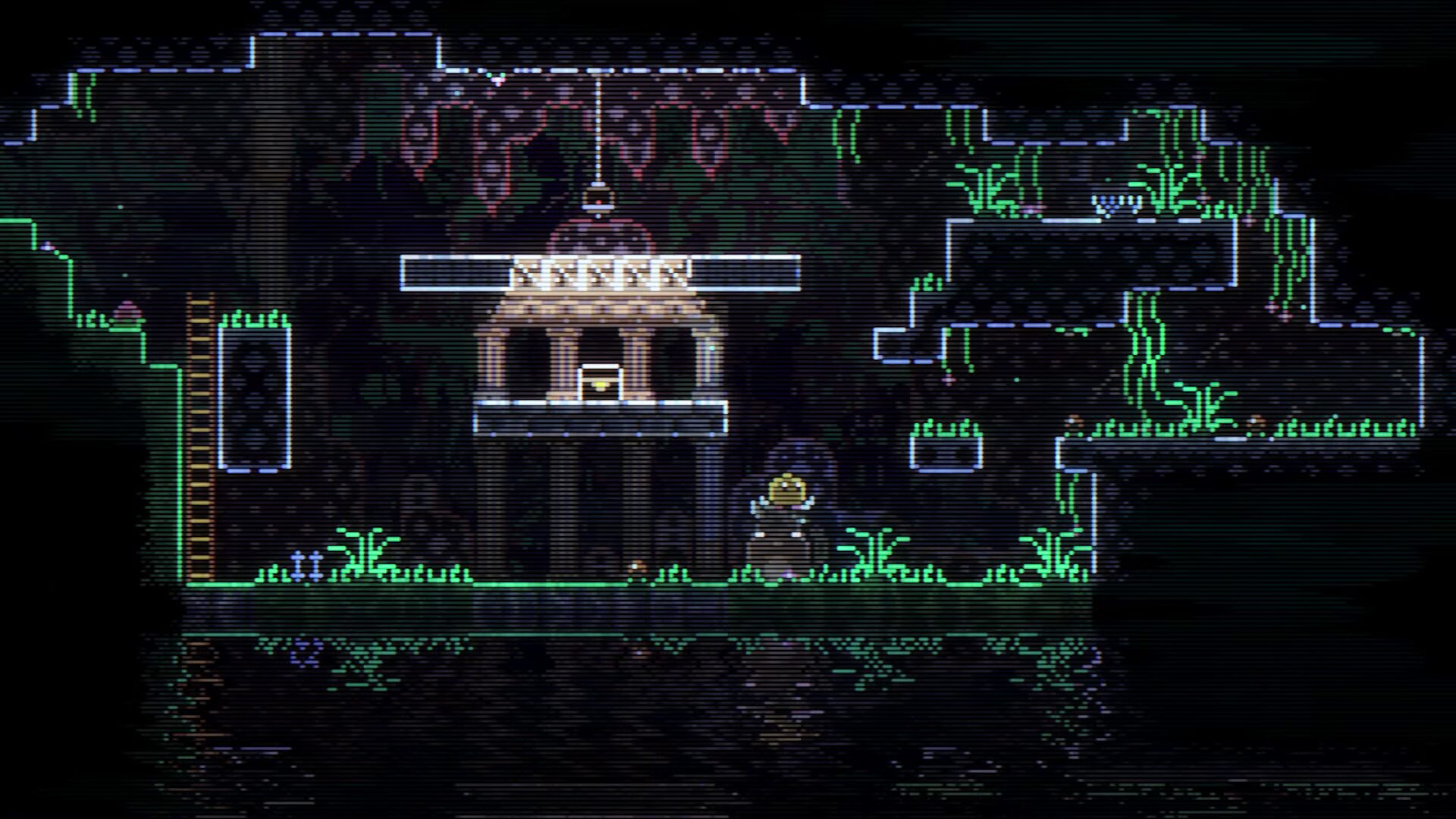
An early puzzle room in Animal Well.

I’ll be honest – I watched FuryForged’s explainer videos for the later secrets of Animal Well, which I found too frustrating and minute to track. I have no interest in this kind of map combing, especially without the additional hint of at least highlighting where more secrets lie. Especially compared to Fish’s Fez, which this game owes so much debt it grants Gomez a cameo, this game went past my patience. The secrets started to be less about having insight into how the game works and more about willingness to poke and prod every corner or wall of the map. In my opinion, you should stick to the core conceit – find the four flames, each buried within an animal kingdom, and collect as many eggs as you can find. The game’s core puzzles really reward explorative play, with the items you find allowing for creative play without requiring the hyper-athleticism of a game like Super Metroid. There are sequences which encourage reactive thinking, sequential logic thinking, intuitive and deductive reasoning, simple navigation, and pretty successful platforming.

But for my money, Animal Well’s real triumph is the aesthetic. There are so many delightfully rendered pixel art animals in here. They make so many good noises and have such charming animations. They are shaded so damned well. Some are adorable and others are very threatening. And yet, despite the population of critters around, this game feels very lonely. The user interface stays out of your way and immerses you in this place’s darkness. Even compared to a game like Hollow Knight, there’s a sense that this well was something more. I admire the achievement of this game’s nonverbal narrative, its evocation of a world that once stood.

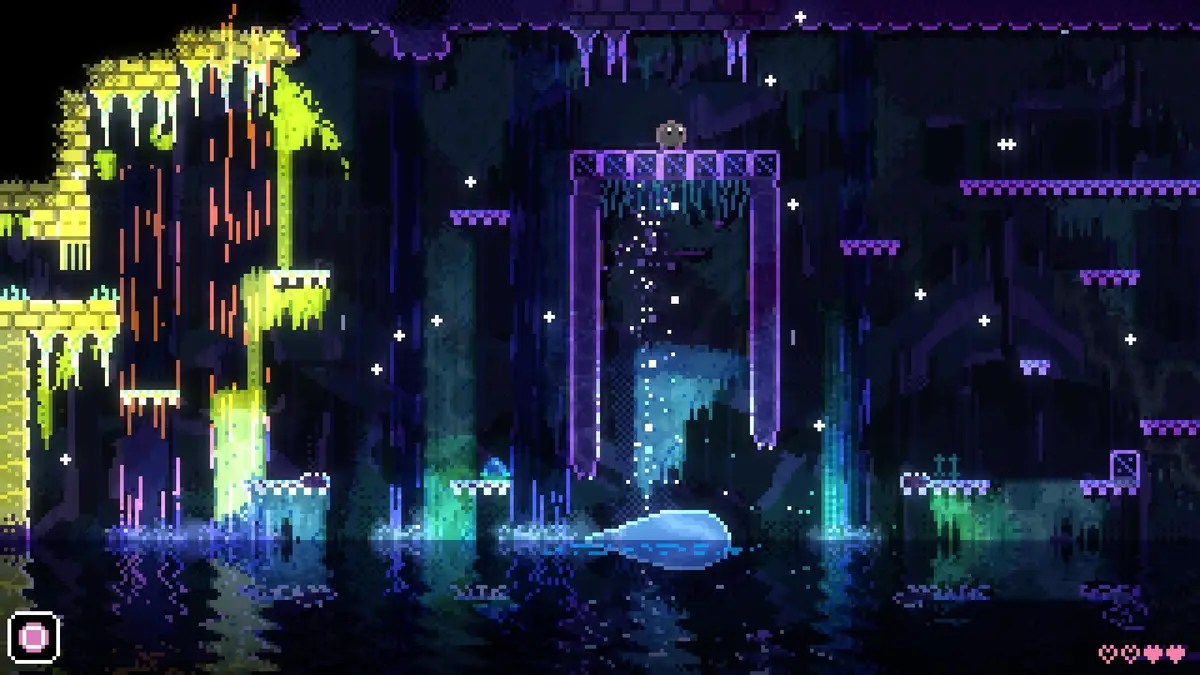
A whale!

There’s also wonderful sound design in here. There’s a lot of rushing water and machinery, but the highlight is the number of creative animal sounds. Occasionally, something like the flapping of wings is produced more faithfully, but the vocalizations of animals are typically synth bloops very similar to Pokemon cries. However, unlike that game series structuring those cries as musical jingles, Animal Well tends toward short, evocative noises, like the gulp of a chameleon or the brief chitter as a squirrel shuffles away. A lonely cooing sounds off in the distance every so often, and finding its source is immensely satisfying.

Animal Well communicates everything it wants to say nonverbally. It occasionally will prompt you with a button to interact with something, but there are not text boxes explaining how to use your frisbee disc. That isn’t to say it’s entirely shy of language – there are pictograms, there’s musical notation, there’s gates associated with specific switches and keys. But unlike some puzzle games, Animal Well celebrates the notion of discovery as play by cutting out that form of communication. That it does it pretty intuitively, especially in those first two layers of play, is pretty impressive to me.

People smarter than me, like Balatro developer LocalThunk (who unsurprisingly will make an appearance later in this series), have declared Animal Well the Game of the Year. I say they are smarter than me partly because this game did not surpass the realm of solvable in their eyes and also because they have made some works I am awestruck by. I both wonder if I’ve had my eyebrows blown off by my one experience with Fez and just don’t care to get out the pen and paper again and wonder if I’m just not programmer-brained enough for this particular puzzle logic. But even not being able to go the full distance and embrace Animal Well as a masterpiece like they have, I still find the game to be quite memorable, affecting, and creative, in ways that make it an easy recommendation for my friends who love to stare at a game screen and wonder aloud if they’re stupid and know the answer is “probably.”

ASTRO BOT

Team Asobi
2024
PS5

Astro Bot has been a Game of the Year finalist just about everywhere you can look, including taking home the prize at Geoff Keighley’s The Game Awards. The successor to PlayStation 5 pack-in game Astro’s Playroom, Astro Bot takes that game’s high-polish 3D platforming and blows it out to a full game, each level a fun, playful celebration of motion. In the way that Wicked or Dune Part Two is the film of the year, Astro Bot represents the peak of industry investment. It is everything your expensive game console wants to be able to do without any of the open world cruft, microtransactions, or cinematic storytelling. This is a celebration of video games as video games rather than as an alternate vehicle for an HBO miniseries or a pure capitalist skinnerbox.

It’s pretty good!

Even compared to some Mario games, Astro Bot’s jump, speed, and responsiveness to its environment is really satisfying. If you have love for running around in this kind of space and bonking orb-shaped baddies, this game has it in spades. When you land on the ice, rather than taking on that somewhat frustrating slippery-foot feeling Ocarina of Time players know all too well, Astro Bot starts ice skating, giving you propulsive forward motion but also a fine degree of control. The air hover allows for precise landings in a way the Super Mario Sunshine F.L.U.D.D. dreams of doing.

There are nine different upgrades you can find midway through a level, and each of them gives you a new way to experience the platforming and exploration of the game. Some are fairly simple – there’s a rocket boost, a racing charge forward, a boxing glove that lets you punch harder and farther. But they also have surprising uses – the boxing gloves also let you grab onto certain objects and swing farther. One highlight is a shrinking device that lets you get through small holes and navigate new spaces – it lets you get real small and see the levels in entirely new ways. About half of them feel directly ripped from Super Mario Sunshine or Galaxy, but they are all perfectly well implemented.

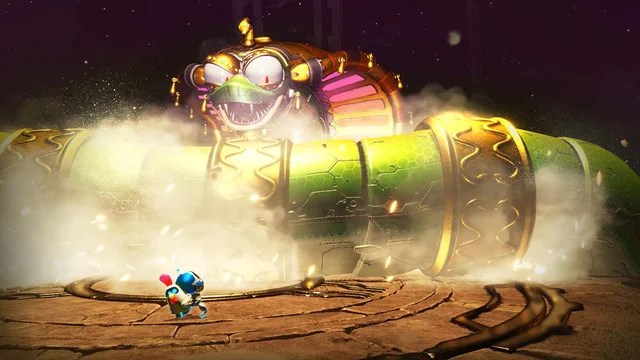
One of Astro Bot’s bosses, which are generally fairly standard pattern repetition bosses with some charming animation and a sense of large scale.

These upgrades help diversify the game’s many levels, each about five minutes in length and containing somewhere between 8-12 hidden secrets to obtain. Sometimes, like in Super Mario World before it, there are secret exits that unlock new levels. Sometimes, navigating the overworld map menu in your little spaceship gives you a chance to unlock new challenge “meteorite” levels. All of these are largely really well designed platforming levels, and if you’re someone like me who laments the fact that open world games often contain kind of haphazard play spaces where you’re meant to “find the fun,” Astro Bot rejects the idea that connective tissue is what helps attach you to a video game.

In fact, it basically rejects any kind of connective tissue. Astro Bot is constantly ping-ponging between different visual pastiches on its little planetoids. You’ll play a desert tomb level – a jungle level – a tundra level – and there’s no real effort made to try to sell these as places rather than video game levels. The enemies rarely receive any more personality, meant to be pretty interchangeable between levels.

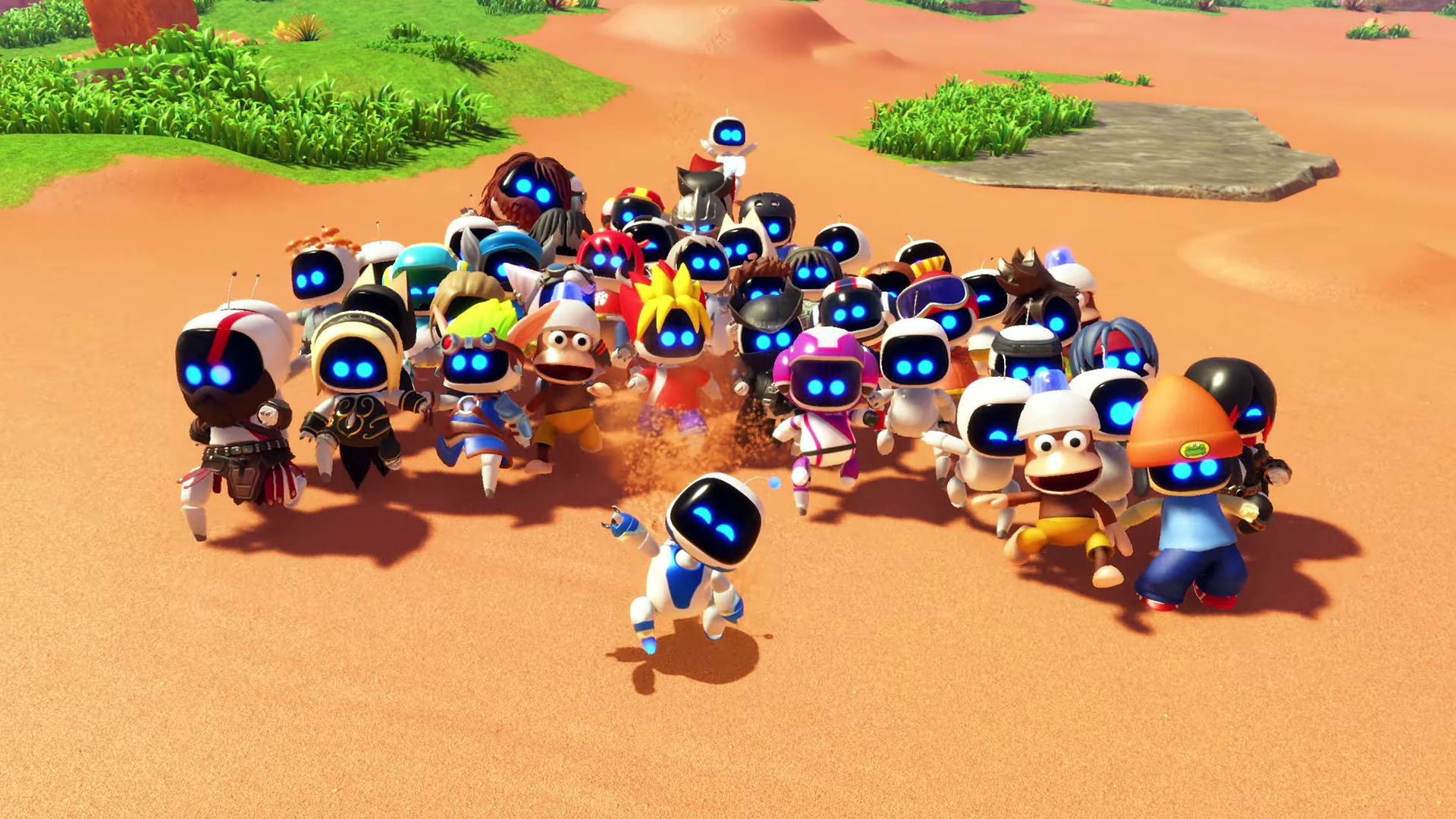
The only real sense of cohesion comes from the PlayStation brand. In every level, between one and three of the rescuable fellow bots will be costumed as a character from a different PlayStation game. It starts with you rescuing Ratchet and Rivet from the Ratchet & Clank games. Then, it’s Solid Snake, Psycho Mantis, and Gray Fox from Metal Gear Solid. This experience does not exclusively contain cameos from games as beloved as these or as distant in the past. When you complete a world, you end up playing an entire level based on one of these properties. Some of these game series have been dead for decades – others feel so new that it’s a little giving Poochie.

A host of bot cameos, including Parappa the Rapper, Kratos from God of War, The Hunter from Bloodborne, and many more.

All along the way, there is a nonstop chattering of these bots. They are constantly chirping, whining, woo-hooing. It is a lot like watching the Minions from Despicable Me. I find them completely exhausting. I started to get a headache. Despite the game having a pretty good soundtrack, I had to turn the sound off entirely after an hour to shut these damn bots up.

As curmudgeonly as I know I sound, I want to give some generosity to “loving the brand.” Not because I think it’s virtuous, to be clear, but because I remember being a child. I remember playing Super Smash Bros. for the first time, encountering Ness, and being fascinated by the concept of Earthbound, a game I would eventually play and fall in love with. I remember booting up Super Smash Bros. Melee and just wanting to hang out in its non-worlds to listen to the music and experience more of these games. I remember my dad declaring war against Banjo-Kazooie because of the non-stop squawking every time you took a step in Talon Trot.

I did not want to spend more time puttering around with the (quite intricate) physics simulations in Astro Bot’s world. I was not filled with wonder playing a level inspired by LocoRoco, a game somewhat unimaginable under modern Sony leadership where their games are either live service megaliths that are too big to fail (or will be shut down the moment they do) or are better suited to an HBO TV series. I did not enjoy seeing Kat from Gravity Rush, whose developer Sony Japan was gutted, the remainder forming Team Asobi and making Astro Bot. I can only imagine what a game without all these cameos might be like, given more space to develop its own identity like Shadow of the Colossus or Okami. And yet Nintendo never released another Mother game in the US – hell, it took decades to even get Earthbound available again on the Wii U or Switch. F-Zero and Kid Icarus were given one more chance before being resigned to ports of classic games. That didn’t stop me from chasing them down.

But there is a new Okami coming out! A new game from Shadow of the Colossus developer Fumito Ueda! The Gravity Rush director, Silent Hill creator Keiichiro Toyama, came out with a new game this year, a reimagining of Siren called Slitterhead. Slitterhead, dude! Whatever problems the game industry might have – and there are many – Astro Bot is not responsible for them. I hope it inspires young players to seek out these old classics, and I hope it inspires Sony and its colleagues to make those classics readily available.