Freehold Games
2024
PC
I am intimidated by the size and scope of Caves of Qud. Its game worlds are enormous on the surface and infinite in depth. Its character customization is as nuanced a statblock as any RPG I’ve played. Looking up clips on YouTube, you quickly find people executing a series of spells in order to transform their character into a clone of a sentient door. And, in any clip of that ilk, you’ll also find that player dying quickly.
Caves of Qud is, on its face, an RPG roguelike with static elements. By traditional, I mean that the game only takes its turn as you do – you can attack by walking into your opponent’s tile – and, yes, death is permanent in the game’s classic mode. You can even turn on an ASCII view if you’re really hardcore in your traditionalism. And like those games, Qud is hard. It took me two hours to successfully complete one of the game’s first static dungeons, Red Rock. Keeping track of all your abilities, the rough difficulty of each opponent, and recognizing when it’s time to sprint and run is quite challenging and takes a lot of time to learn.
The game also arms you with a powerful tool – the game’s mutation system, which unlocks all mutations from character creation rather than building a tech tree. Your character, from the beginning of the game, can start with an armored carapace – the ability to discharge lightning – four legs – mind control – precognition – teleportation. This system is a delight to experiment with, not least of which under the Unstable Genome archetype that serves up one of three new mutations roughly ⅓ of the times you gain a level. Almost every mutation is useful in some situations, and experimenting with the different builds across this open system allows a lot more variation for investment than many magic systems.
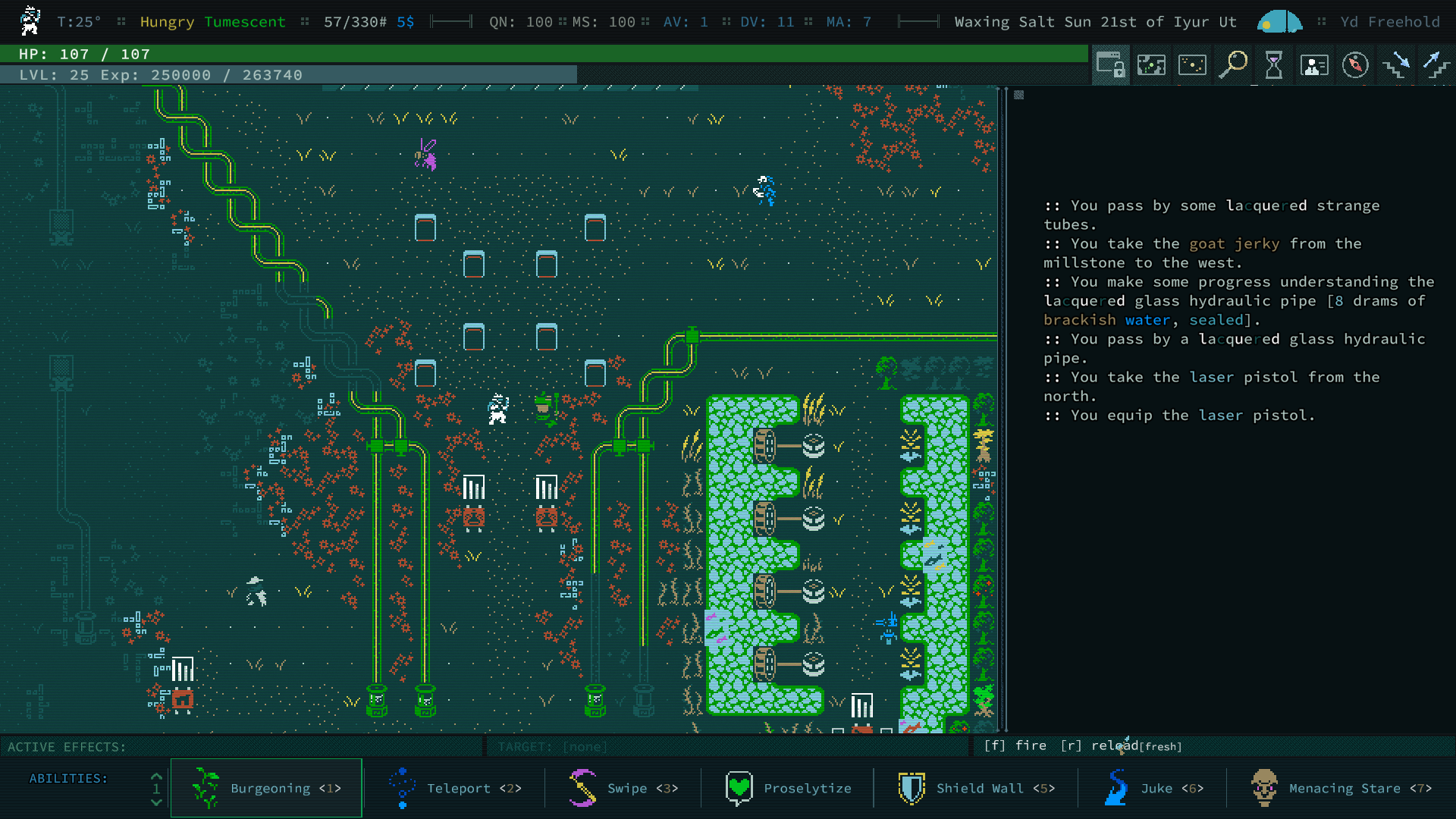
Unlike Rogue itself, Qud does have a canonical storyline and a static overworld map. The details of that overworld will change – within each World Map tile which can contain a named city or dungeon, there are 9 smaller maps which are randomized. After you start finding your way around, you can find quests which are the same from playthrough to playthrough (such as “O Glorious Shekhinah!,” which asks you to bring a bauble to a holy site for a religious zealot) and these eventually lead you toward the game’s “main quest.” With the 1.0 release, Qud does offer Roleplay and Wander gameplay modes with checkpointing, allowing players who reject that permadeath to pursue the game’s story.
In this way, Caves of Qud might more appropriately be compared with Morrowind. In discussing the game on the Eggplant podcast, designers Brian Bucklew and Jason Grinblat described a growing tension between the game’s 25 hour “main quest” and the game’s procedural roguelike design. In referring to Bethesda’s games, they pointed out that a lot of the side content where you investigate so-and-so’s brother’s disappearance in an otherwise unused cave, which often already uses procedurally generated parts, could also generate the geometry and population of the cave itself. They’ve applied that philosophy to Qud.
From your first conversation with an NPC, you’ll find that awkward “goodbye” at the bottom of your chat box replaced with “live and drink, friend.” The thoughtfulness of the writing in Qud is impressive, prioritizing worldbuilding and control of voice in a game that often promotes the absurd. On a Shelved by Genre bonus episode (sorry, it’s behind a paywall,) Grinblat discussed the game’s relationship to Gene Wolfe’s Book of the New Sun, specifically the ways that far future and fantasy collide. Unlike other fantasy and science fiction games, Qud does not serve you up NPCs who constantly explain the game’s lore to you – there are books which you can read if you’re interested, but otherwise the characters will simply treat you like you live there.
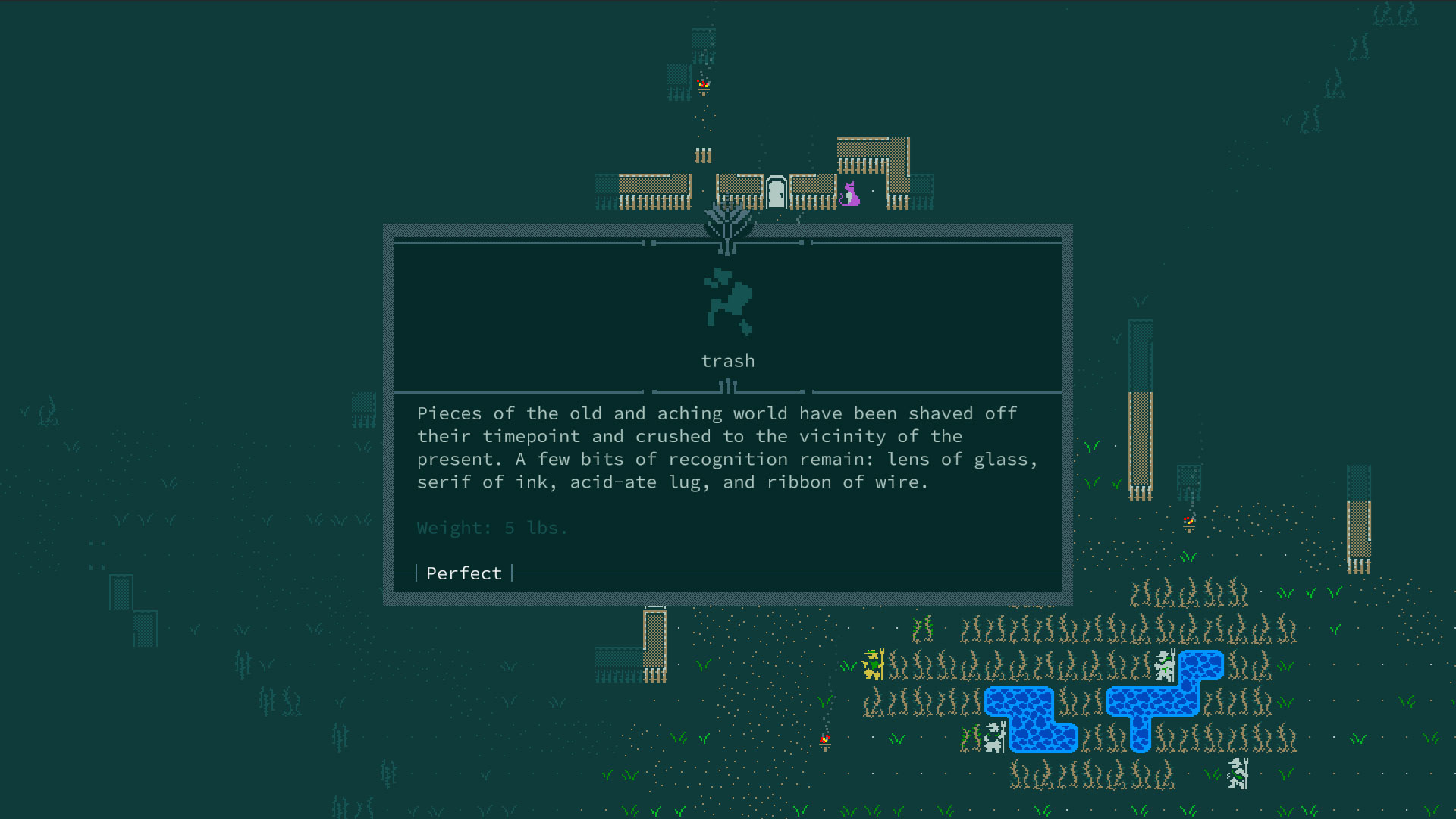
As you start to question the sentience of the snapjaws you’ll likely be fighting in the game’s early hours, you’ll realize that even the baboons have an allegiance meter. Qud sets itself apart with the quality of its generator, the quality of its writing, and the power and detail of its simulation. Qud will allow you to earn the alliance of the birds that swoop down to nip at your shoulders – it will allow you to grant a locked door sentience only to dominate its mind and wander the land – it will let you carry spores in your heels that a bothersome turtle will nip to burst while talking to a town warden, turning him to your worst nightmare.
This is a massive game, one which seems to take years to fully master. I have only a handful of hours of playtime, and most of its fans have accumulated hundreds. I am staking my claim that, actually, once I learn this game, it’ll ascend even higher. Even as it stands now, I’m so pleasantly blown away by the brief experience I have had with Caves of Qud. I hope someday to come back and elaborate on the intricacies, my favorite builds, all the things I’ve tried – I won’t be surprised if it’s years away.
 All My Friends