R.I.P. David Lynch

David Lynch (1946-2025.)

Lynch was not a filmmaker first. He’d gone to the Pennsylvania Academy of the Fine Arts as a painter, and only began filmmaking out of a desire to see his paintings move. His first “films,” Six Figures Getting Sick and The Alphabet, are mixed media exhibitions that, even after the rest of his strange and wonderful career, come across more as museum pieces than cinema. Six Figures Getting Sick, notably, was originally presented on a sculpture “screen,” complete with plaster heads bubbling out of it. Working contemporary to Warhol and the evolution of video art, Lynch diverted from that path with the AFI funded The Grandmother, which signalled many of his anxieties, thematic concerns, and stylistic flourishes from the very start.

But my favorite of these early shorts is actually The Amputee, a two minute film (with two different takes, on two different filmstocks) in which an older woman writes an opaque letter about a convoluted series of relationships. It’s a very simple, one shot film, where the titular amputee is played by Catherine Coulson, better known as Twin Peaks’s Log Lady. Coulson was working behind the scenes on Eraserhead when they decided to shoot The Amputee as a film test – she’d been brought on board with her husband Jack Nance, though they divorced before Eraserhead debuted. This short, to me, is emblematic of the way Lynch works with fellow artists, takes these little diversions, and discovers something magical. While Eraserhead is this moral shock, this exorcism of Lynch’s demons around city life and the family unit, it’s The Amputee that paints the way forward as an empathetic look at the frustrations of internal life and the gaps between people.

Lynch described himself as an absent husband and father, saying himself in Room to Dream that “film would still come first.” The safest way to stay in Lynch’s life was to be an artistic collaborator first and a friend or lover second. His loyalty to Coulson and Nance was lifelong – perhaps the most profound moment of David Lynch’s final mainstream work, Twin Peaks: The Return, is Coulson as The Log Lady, eulogizing herself. Her words come to me regularly, reminding me “about death – that it’s just change, not an end,” words that I’ll be thinking about for many days to come. Kyle MacLachlan, Laura Dern, Naomi Watts, Grace Zabriskie, Sherilyn Fenn, they all joined Lynch’s repertory family. Jack Fisk, Angelo Badalamenti, and Mary Sweeney, among many others, were collaborators over several decades. When he became largely homebound with his emphysema, sometimes the greatest collaborator was his own family.

“What Is David Working On Today? 5/5/22,” in which David shares the barn he made to teach “Farm” during COVID isolation.

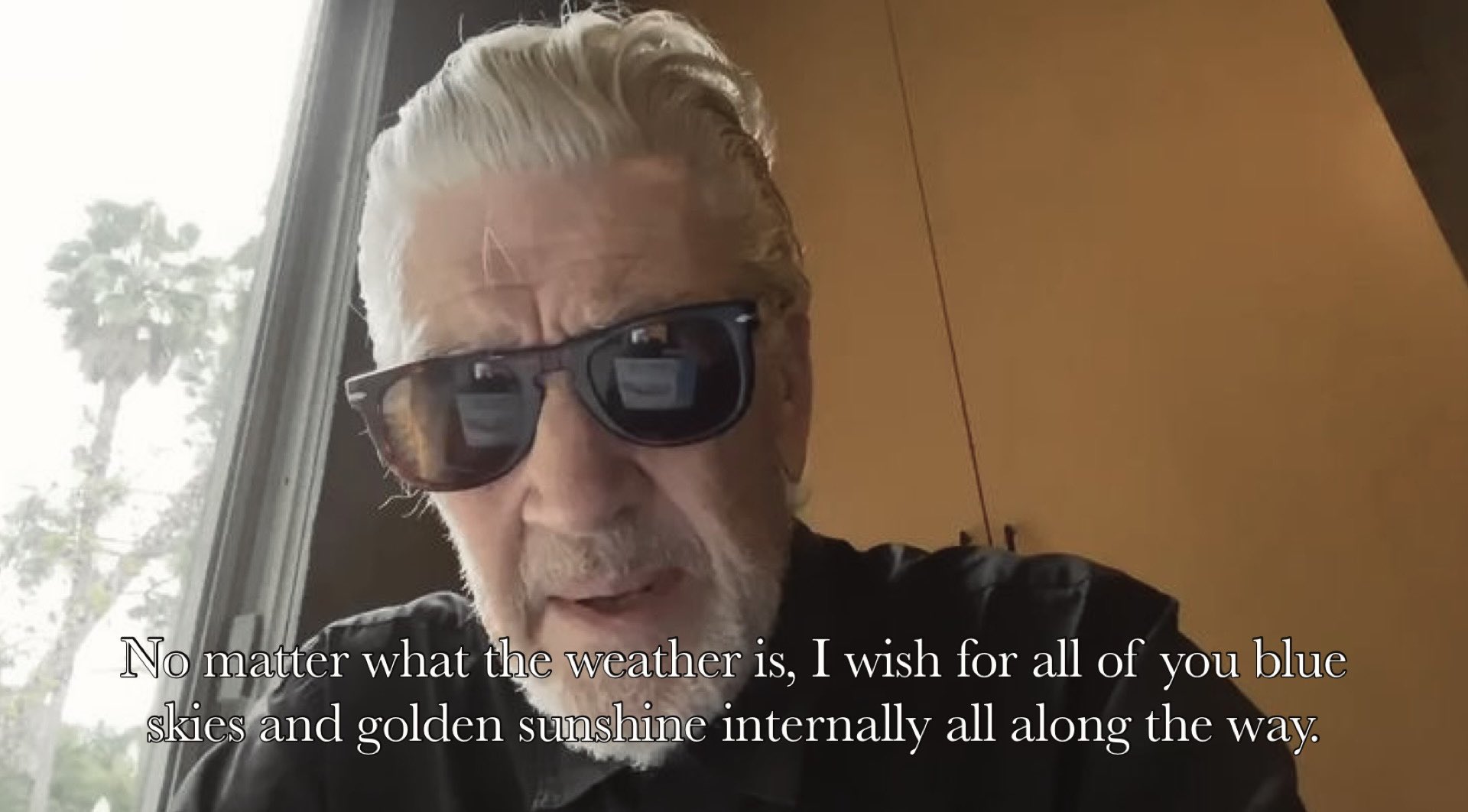
One of the greatest things about David Lynch was that, so long as the art was not “taken away from him,” he did not consider any of his artistic endeavors unworthy of love and attention. When David Lynch fell in love with Flash animation, he made Dumbland, which is not some intellectual exercise but is just as puerile and funny as anything on ebaumsworld or Newgrounds. When David Lynch made a barn for his daughter, he shared it with the world. When David Lynch did daily weather reports, he did it with pride, and when he had to stop, he did so apologetically because he knew they brought people joy. Some people voiced frustration with David highlighting an announcement only for it to be more experimental music with Chrystabell – but it’s his love for all this creation that made him the man who never thought twice about taking the personal path.

I don’t want to catalog what the films and Twin Peaks mean to me right now – I’d like to give them all the space they deserve, each a treasure worthy of being unpacked on its own, each not painting the full picture of who this man is to me. I named my newsletter The Horizon Line after his final on-screen appearance as John Ford in Steven Spielberg’s The Fabelmans. As I shared in my Blue Velvet piece, Lynch’s work is at the heart of so many of the relationships I have in my life. He is at the fundament of my worldview and identity, my belief in a person’s ability to grow, my belief that the inexplicable can also be human. Like many, every time he made a public statement or new work of any kind, I was happy to hear his voice again. I’ll miss him so dearly.
BLUE VELVET

BLUE VELVET
Dir. David Lynch
1986

The short films David Lynch made in art school, as well as Eraserhead, contain his intense visual horror flair and his otherworldly treatment of sound and light, but they’re deeply angry films, a young man railing against societal failures and expectations. The Elephant Man and Dune are adaptations, Lynch putting his distinct style onto other people’s work. But they also soften his edges quite a lot – Dune marks what I think his first real mature work showcasing empathy and friendship, the relationships between Paul Atreides and his friends full of liveliness. It’s the first time watching a David Lynch project I feel like you can really fall in love with some of the characters.

It’s also the last time Lynch would ever work on something that massive in scale, even accounting for Twin Peaks: The Return. The degree to which Lynch poured his heart into the film, the time he spent with Frank Herbert (who largely liked the film) undermined in post-production by the De Laurentiis family, ended Lynch’s desire to work on big-budget films going forward. Creative control came with a lower asking price – according to producer and Lynch collaborator Sabrina Sutherland, that approach is still getting pitches into board rooms as long as they aren’t about mythical Snoots.

The lessons he learned making Dune are visible in Blue Velvet, not least of which through the return of Kyle MacLachlan as Jeffrey Beaumont, another precocious golden lion-boy quickly corrupted by exposure to a world where naivete can become egomania. While Blue Velvet was conceived in 1973 alongside Eraserhead, it lacks that film’s sour edge and general misanthropy. The film is still on the knife’s edge of thriller and horror, depending on how unsettling you find its darkness, but it comes to that darkness through a deep love of its characters. Jeffrey is presented from the start as a character more like one of the Hardy Boys than Jack Nance’s Eraserhead Henry Spencer, and while he does find some unseemly, voyeuristic desires and a penchant for manipulation in himself, his conscience also always seems aware that these things are wrong.

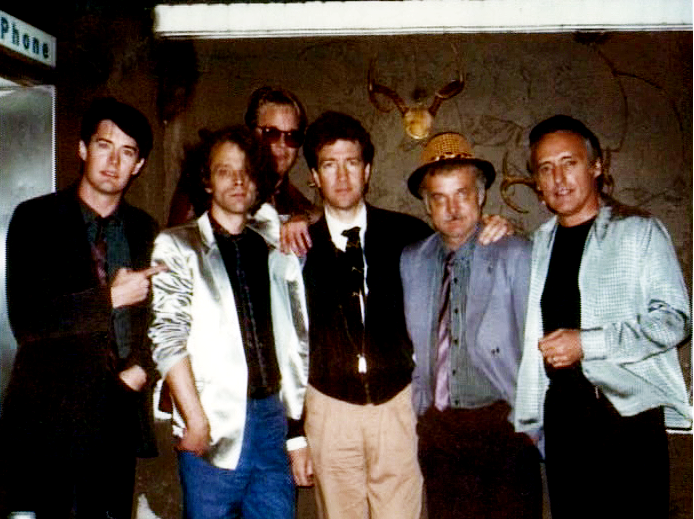
Lynch (center) and the boys (from left to right, Kyle MacLachlan, Brad Dourif, J. Michael Hunter, Lynch, Jack Nance, Dennis Hopper)

That melodramatic empathy with these characters is, to me, the real heart of the Lynchian ideal, as it combines tropes or familiar, mundane elements with intense tragedy or darkness. Some people take this to mean something as simple as “the radiator is menacing” – while I think that’s certainly true of Lynch, it’s also true of iconic images like the telephone on the stairs in Maya Deren’s Meshes in the Afternoon or the basement in Charles Laughton’s The Night of the Hunter. I think what really makes the Lynchian whole is the juxtaposition of menace and love, and just about every Lynch work from Dune onward is embodied by that ideal.

It’s certainly the primary iconic juxtaposition of Blue Velvet, Bobby Vinton playing over a suburban lawn until the grass leads us back to a severed ear. Isabella Rosselini’s Dorothy Vallens is tragic but also erotic, and her trauma response cycles between despair and desire in the flash of a moment. Frank Booth is a terrifying villain, and that villainy never comes forward more uncannily than watching Dennis Hopper sob over the performance of the woman he brutalizes. Even Dean Stockwell’s terrifying pimp Ben is given the Roy Orbison “In Dreams” solo, creating a dynamic of traditional American beauty and violent blood running under the surface. The only person spared this conflict is Laura Dern’s Sandy, whose only exposure to the darkness is to see it crashing down upon her lawn in the film’s crushing climax of melodrama.

David Lynch’s work has meant a lot to me for the past ten years or so, since I first met Twin Peaks and Eraserhead. Annie and I originally bonded over talking about Twin Peaks, and his films have been a source of many beloved memories of mine. Last summer, when we moved back to Madison, the first film we saw at the UW Cinematheque was Blue Velvet, and there I reunited for the first time with friends I met maybe six months after my first time watching Twin Peaks. It’ll remain a special experience to me for a long time.