ONE FROM THE HEART

ONE FROM THE HEART
Dir. Francis Ford Coppola
1981
VOD, Reprise on Blu-Ray

I don’t always find the Movie Brats best at their most sentimental. I do with Spielberg, where my favorite films are The Fabelmans, Catch Me If You Can, and Close Encounters of the Third Kind over his landmark blockbusters like Raiders of the Lost Ark and his prestige dramas like Schindler’s List. When he gets sweet, he puts up just the right amount of guard for most of the runtime and then allows absolute powerhouse wallops to rock you to your core. With Lucas, I vastly prefer Star Wars to American Graffiti these days – Scorsese, the crime epics of The Irishman and Killers of the Flower Moon notch a tier above movies like The Age of Innocence and Hugo. If De Palma has a sweet side, I’ve only really seen it in The Untouchables and Phantom of the Paradise, and I prefer the nastiness of Blow Out or Carrie.

By comparison, I’m still getting to know Coppola. I’ve seen the classic 70s quadrilogy, Bram Stoker’s Dracula, and outside I’ve only seen Peggy Sue Got Married and One From The Heart: Reprise. Peggy Sue I find nostalgic to the point of acrid, with really only its bizarre Nic Cage performance breaking through to make me think we might be laughing together. So I came into One From The Heart: Reprise knowing it was a film which bankrupted both Coppola and his Zoetrope Studios into financial ruin, a film reviled upon release that had seen some reappraisal since, and a “musical” sung through by Tom Waits and Crystal Gayle. I hoped to get some fun out of a calamity.

From the opening credits which unveil this reconstructed fantasy of the Las Vegas strip from under a sea of sand, I spent basically all 93 minutes of this film with my joyful smile in rictus. During the fantastical dream ballet sequence (shown in the trailer and borrowed in Damien Chazelle’s La La Land) I started crying. This story of two people falling out of love and still refusing to let go is not told effectively through the script, but through the film’s intoxicating color, music, and rhythm. The story, which positions Frederick Forrest’s Hank as so unlikable that you’re rooting for Acme violence against him by the film’s second half, serves as friction against that cocktail.

Hank……………………

Hank has been living with Frannie (Teri Garr) for several years, and they’ve fought and made up repeatedly the entire time. He cheats, they break up, they get back together the next day, and the dysfunction continues. This film’s fight appears to be the fight that finally ends things, and they pursue new relationships with new flings. Nastassja Kinski’s Leila can really only engage with Hank on a surface, physical level, a sheltered immigrant circus performer who romanticizes the idea of running away together. That relationship sings because, honestly, romantic fantasy is all Hank can provide, too – the death of their time together is built in from the moment they meet because she only wants a fantasy and he’s a facade.

The real meat of the movie is Frannie and Raul Julia’s Ray, a singer/waiter who challenges her to actually follow her dreams and see the world. Their relationship is lush, coming across as having real empathy, chemistry, sex, fun. Surrounded by skeptics, it was their scenes together that very obviously pulled everyone onto the same page. Their reunion after a couple small flirtations is the beginning of the film’s longest dance sequence, and while their dialogue together is much stronger than Hank and Leila’s, it’s the dance that sells you that these two are meant for one another.

Even outside the dance sequences, there are long, dialogue-free songs set to the Tom Waits and Crystal Gayle vocals. Early in the film, there’s a lot of walking from one end of the strip to the other, looking around longingly, bathed in neon and shadow. I’ve been explaining “what happens” in the film so far, but it’s really a film baked in How It’s Shown. Hank wandering through the cold blue neon of the martini bar and eventually seeing the giant superimposed Leila was an emotional powerhouse for me. I won’t say “the art speaks for itself,” but this film is a case where a picture is worth a thousand words, and there are too many pictures that make my heart soar here to dig into what I find so beautiful about each one as part of this film.

Frannie!!!!

The running story of Coppola at this time is about his upcoming Megalopolis. Once again, Coppola is betting the farm (in this case, the vineyard) on a passion project. The conversations around it have highlighted a lot of his personal failures, among them his lack of realistic perspective on the state of art commerce and his refusal to disavow evil men. There’s a tension between wanting to view Coppola as a master artist and tragic figure and the recognition that his choices lead him down the road he deserves. I’m not sure it’s as simple as believing that people get what they do or don’t deserve – my feelings on One From The Heart reflect that same tension, a film ending on someone who maybe would better have been left alone in a dark room. Maybe with future viewings, I’ll pull some new meaning from that last thirty seconds. For now, I’ll settle on it being a promise that the story is not quite over yet.

NIER REPLICANT

NIER REPLICANT
Yoko Taro, PlatinumGames
2021
Xbox, Playstation 4

“Weiss, you dumbass! Start making sense, you rotten book, or you’re gonna be sorry! Maybe I’ll rip your pages out one by one, or maybe I’ll put you in the goddamn furnace! How could someone with such a big, smart brain get hypnotized like a little bitch, huh? ‘Oh, Shadowlord, I love you, Shadowlord, come over here and give Weiss a big sloppy kiss, Shadowlord.’ Now pull your head out of your goddamn ass and start fucking helping us!”

These words greeted players eleven years ago every time they booted Cavia’s NieR Gestalt, released in the United States as NieR, an action RPG largely dubbed an interesting failure with a great soundtrack. Yoko Taro’s name at the time was completely unknown. That he has managed to transform NieR into a juggernaut uttered in whispered tones alongside Hollow Knight, Persona, and the like is the sort of project every game hopes to endure. Working with PlatinumGames, Taro remade NieR Replicant, the Japanese version of NieR, from the ground up, with rerecorded voice acting and music, new graphics and gameplay, and a new ending. He titled the remake NieR Replicant ver.1.22474487139… – I will be referring to the remake as NieR Replicant and the broad collection of games as NieR from here on.

NieR takes place in a fallen world. Whatever security existed before has succumbed to an encroaching plague known as the Black Scrawl and the progressive incursion of monsters the people call Shades. Our protagonist (named by the player, known by fans as Nier) searches for a cure to the Black Scrawl for his sister, Yonah, who lives in a village led by two twins, Devola and Popola. The Black Scrawl leaves Yonah an outcast, as no one knows how the plague spreads. When Yonah finds a rumor of a cure known as a Lunar Tear, she sets out to forbidden, dangerous ruins, where Nier rescues her and encounters a magical tome. The book speaks, informing Nier that his magic may be able to combat the Black Scrawl, and their adventure begins.

NieR adventures with gameplay in shocking and delightful ways. Without giving anything away, it references the history of adventure games and horror in surprising, funny moments that take the gameplay off-model. The remake, Replicant, has taken the moment-to-moment action gameplay outside those setpieces and transformed it into a modern, high quality Stylish Action Game, similar to a Bayonetta or Devil May Cry, but with so many accessibility options to remove as much difficulty as you like. If you find yourself frustrated by the combat, NieR Replicant is incredibly accommodating in letting you focus on the story. I think more games should offer experiences like this one, which don’t change the core experience on-screen and instead offer options to make it easier to see it through.

The NieR franchise, or the Greater Yoko Taro Project, is largely contextualized by repetition. Players of the breakout sequel NieR Automata will be familiar with his recurring approach involving replaying portions of the same game with minor variation that lead to different narrative outcomes. Players of any two Yoko Taro games in the NieR or Drakengard franchise will recognize his recurring tropes, themes, interconnections, and affection for his characters and lore. And, yes, to see NieR through to endings D and E, you will need to play through NieR roughly two and a half times. I love this fact – it remains one of the most powerful ways to build familiarity with characters and heighten the inevitability of its high highs and low lows.

The protagonist starts the game loving his sick sister, Yonah – he will come to love his ragtag party. From the foulmouthed Kaine, to the snobbish animate tome Grimoire Weiss, to the strange chipper child Emil, this found family comes together to care for one another so deeply that it will change the fate of the world. NieR Automata takes a science fiction approach to relationships, beginning from programmed remove and showing where emotion causes things to break down. NieR Replicant is an epic fantasy. Instead, its emotions are operatic from the very beginning. It uses that passion to focus on how everyone is capable of violent, world-changing love. 

NieR Replicant is also a dark fantasy. The protagonist loves Yonah, but over time, we also come to understand how he resents her illness and wishes he could have a normal adolescent life. Kaine and Emil undergo incredible trauma in their assistance to Nier, facing incredible sacrifices in the face of an immature, egocentric brat – a brat they love. The answers they find about the Shades, the Black Scrawl, and the world they live in are horrifying and raise existential questions about everyone they’ve ever known. NieR Replicant is special because it finds a way to marry intense, sincere kindnesses and awful, melodramatic tragedy.

Even if games aren’t for you, I have to recommend Keiichi Okabe’s music for the game. His style marries emphasis on acoustic instruments (strings, guitar, harp, piano) and women’s harmonized vocals. All of the vocal music in NieR Replicant is performed in the game’s fictional language, a language that sometimes sounds like Japanese, sometimes like German, sometimes French. Okabe’s musical themes communicate the emotional heft of its characters’ decisions and devotions. The soundtrack’s melodic drive, intense control of arrangement and orchestration, and willingness to vary between the familiar and the subversive reflects the game’s own mission. 

MY NAME IS MY NAME

MY NAME IS MY NAME
Pusha T
2013

Of every rap album, this might be the one where the highest number of full verses wander back into my brain. Ten years removed from Clipse (whose “Grindin’” I maintain is the best song of the 00s,) Pusha T reclaims all-time status with My Name Is My Name, his debut album after a number of mixtapes exploring his identity and sound as a solo artist. Unlike many of the rap albums of the last fifteen years, the track list is sparse, with twelve radio length songs and zero bonus tracks or skits.

The musical variety on this album within that short runtime is impressive. There are aggressive songs that only make sense in the context of the house inspired album rap of Death Grips and Danny Brown. There are ballads that serve as alternatives to Drake’s sad rap – there are gritty, trap beat songs ready for NBA championship ads. Pusha unifies it all, from the movie references, the coke jokes, the stoic exhaustion of a man who’s been doing all this a little too long. He’s elevated to another level as a rapper, with the complexity of his flows and the energy of his vocal delivery reaching new highs. 

Normally I only do one video for these album write-ups, but this video is so incredible!

The list of collaborators is top of the industry then and now, including Future, Pharrell, Jeezy, 2 Chainz, Rick Ross, and Kelly Rowland. In a top 5 all time Kendrick guest appearance, “Nosetalgia” has a second verse that shatters the at-bats by everyone else. By the time the “taco meat laying on his gold” delivery arrives, I’m back in my little rap dork driver’s seat, hitting every line like I’m doing it at karaoke. The obvious bum note is Chris Brown singing the hook of “Sweet Serenade,” a choice I’d already feel shitty about given his history of abuse, but the hook also doesn’t sound especially good. You aren’t listening to My Name Is My Name for its kind heart – this is coke rap with violence at its outskirts (and sometimes center stage.) 

At some point, maybe I’ll feel like writing about Kanye West again. His work meant an incalculable amount to me for many years – his disintegration was probably less into being an offensive reactionary and more into being a very boring one. The closest I’ll come this year is his executive production on this album – while every song he’s credited for producing has an essential collaborator, it’s hard to deny the aesthetic overlap with his album Yeezus earlier that year. At the time, when I was hooked on the guy, I loved this album all the more for its part in that myth.

In my memory, this album retreats into the “yeah, it was cool when it came out, but how great is it really?” zone only maintained by cowards. The moment I hear the opening shrieks of that Hudson Mohawke sample and the insane beat on “King Push,” I’m all in forever. “CB4 when you rhyme, Simple Simon.”

KEY TRACKS: “King Push,” “Numbers on the Board,” “Nosetalgia”
CATALOG CHOICE: King Push – Darkest Before Dawn: The Prelude
NEXT STOP: Wolf, Tyler the Creator
AFTER THAT: Shook, Algiers

MIND GAME

MIND GAME
Dir. Masaaki Yuasa
2004

This piece contains spoilers for the film Mind Game.

GKids released a wonderful Masaaki Yuasa boxset last year which meant I finally got to see Mind Game in proper high definition. It was almost like seeing it again for the first time, the vibrant colors of the film’s musical sequences shining bright a clean, the tiny details of the climactic sprint fully visible to me for the first time. I’ve mostly been rewatching my favorite film on a 480p file I got from Prof. Ridgely’s course on anime I took in 2012. At the time, there had been no official Western release of the film.

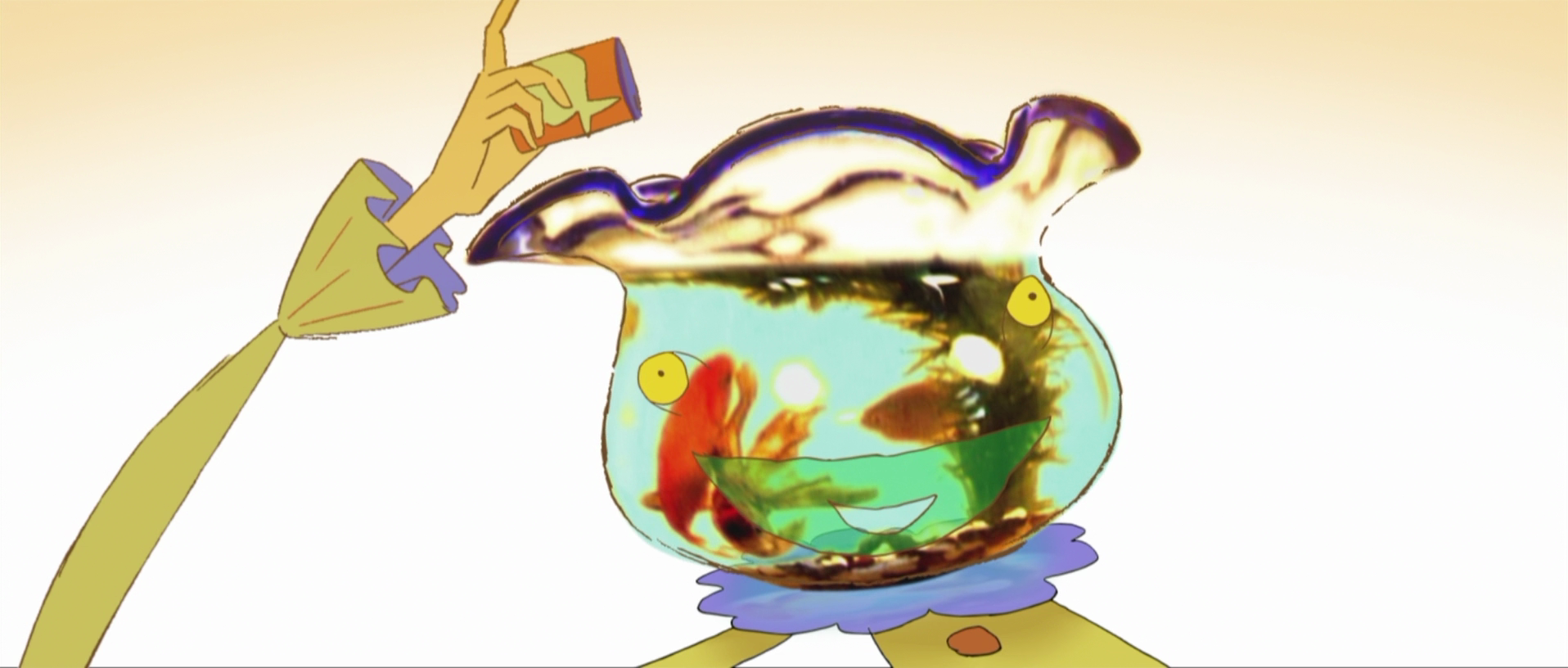
Mind Game portrays a young broke mangaka named Nishi who nurses a jealous crush on his childhood sweetheart Myon. They nearly went on a date once in high school, but got too shy to ever pursue it. When they reunite at the start of the film, she’s engaged to a nice, successful young man – and is being pursued by two yakuza seeking revenge on her womanizing father. When Nishi comes between Myon and the temperamental Atsu, he’s shot dead. Seeking to humiliate him, God shows him this death on a giant screen, on a hundred giant screens, looped, represented in 3D models, in slow motion, even in text. Then God tells him to surrender to oblivion – the afterlife is nothingness.

One vision of God in Mind Game’s afterlife.

When I’m faced with anxiety about a hypothetical risky situation, I maybe too quickly default to “the worst thing that happens is we die, and then we don’t have to worry about it anymore.” It’s a coping mechanism I’ve learned after a lot of unwelcome surprises in my young adult life. It keeps me from getting bogged down in the “but what happens ifs” and leading me toward the “so what do we do about its.” It maybe makes me complacent sometimes. Those pain points can be dealt with later, because pain isn’t fatal.

When I was still dating, this made it easy to ask people out, as getting a “no” back doesn’t leave me dead or in jail. Just asking to spend time together and then being pleasant to be around is, it turns out, also the secret to adult friendships – who knew? When it came time to uproot from Buffalo Grove and move to Nashville, this mentality kept me from considering cold feet. When it came time to leave Nashville and come back to Madison, it kept losing our apartment from creating total despair. When I think about somehow turning writing and media analysis into a career, this mentality turns waiting another few years until I’m in a “better place to write” into a pain point rather than an existential crisis. When jobs previous to the one I’m in now burdened me with overwork and too much responsibility with no increase in pay, I would say, “this too shall pass.” When I think about addressing my nonbinary identity, I have said “I don’t really want to get into all that right now” – that, at least, is starting to change.

This philosophy creates a tapestry of decisions and indecisions. Some are healthy and fun.  Others are stupid and painful. There are decisions that have no especially value-based consequence. Some people I’ve known react to it as optimism – that I refuse to give into despair. Others sense that it might be a form of nihilistic despair itself, that there’s a feeling that there’s no way to improve things beyond “at least we’re not dead.” I feel it both ways. I’m not convinced it’s healthy. I’m not convinced it isn’t, either.

After sharing this mentality with my therapist a few times, I was thinking about how this mentality relates to the compartmentalization of gaming. In video games, if you fail, you can always just start the game over. And you haven’t lost until you actually hit “game over,” in Tetris or in a Halo lobby. Losing the battle doesn’t mean losing the war. Any pain is only temporary (and, in a game, only “real” in the emotional sense.) Learning to accept the risk of defeat will make you a way better gamer – it makes it easier to learn from your mistakes in the moment, not give in to the anxiety of losing, and allows you to take greater risks without being so protective. Once you’ve learned enough mastery, you can recognize what’s actually worth protecting.

“The worst thing that happens is we die.”

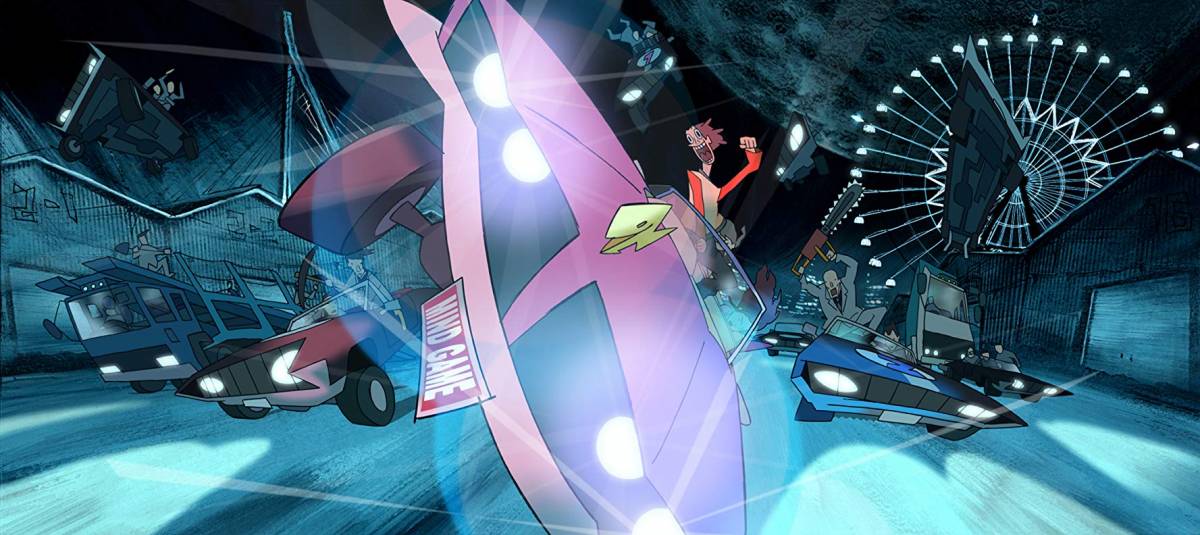
Nishiki sobs at first, but then he realizes that God is headed back toward life itself. He decides he’s not going to give in, that he’s not going to let it end this way. He sprints back to life and takes the second chance he’s been given in a manic stride, killing Atsu, stealing the other older officer’s car, and kidnapping Myon (and her sister, Yan.) They end up in a violent car chase, driving off a bridge, and being saved only by the grace of a blue whale swallowing the car whole. So begins the true movie of Mind Game – a modern riff on Jonah and the Whale.

Inside this whale, our trio meets a nameless hermit – he’s survived at least thirty years inside the belly of the beast, himself escaping a criminal past. He’s collected an incredible wealth of treasures within his shelter and made friends with a Jurassic pal. Inside the whale, Nishi, Myon, and Yan find new life. It’s a place for play without commerce, without social expectation beyond the family, without the concept of competition. In a lot of ways, this becomes a sex comedy for a while. It’s a mess, and the way it handles one character’s sexual exploration is even messier.

I love Yan!!!

The way this sequence is filmed is unbelievable – it is so colorful, so fantastical, so lively. Masaaki Yuasa is largely known as a master of setting animation to vibrant color and danceable music. You can go back to his earliest credits on Crayon Shin Chan and Chibi Maruko-Chan, to his first animated sequences, and see the kind of blissed out work he does in that setting. To me, it’s ecstatic. Some people would describe it as “trippy,” others synesthetic. I see also Merrie Melodies and Looney Toons, the origins of character cartooning. This film enters development shortly after the Superflat exhibition opens in Japan and begins to tour internationally. Mind Game isn’t coherent with the philosophical cynicism of Superflat as a movement (that distinction goes to Tamala 2010: A Punk Cat In Space,) but I can see a line between their postmodern visions of color and iconography.

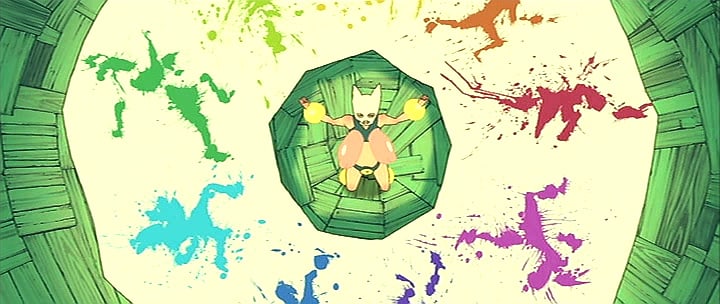
The end of the time in the whale comes and we head toward the film’s climax. Our heroes hatch their escape plan. After their race back to life, a montage plays of these characters’ entire 20th century ancestry. Every small decision in their lives is played in sequence, creating an apparent butterfly effect chain of every choice and non-choice made by our characters. Nishi’s high school heartbreak, the hermit leaving home for the last time, Atsu’s yakuza boss being raised as the patriarch. It is a tapestry of decisions followed by a final epitaph affirming life.

Just before their climactic attempt at escape, Nishi deflects the fear the hermit expresses about trying to escape the whale. Nishiki declares: 

“So what! I wanna get out! ‘Cos there’s so much out there! So many different people, living different lives! Incredibly good guys, bad guys… Folks completely different from us! It’s one huge melting pot! See, it’s not about success, dying in the streets, who’s better, who’s not! I just want to be a part of it! I realized that even if I’ve no connections, no talent, even if I’m one big loser, I want to use my hands and feet to think and move, to shape my own life! We can just die here or we can try, see what we’ve got!”

This movie is my heart. It’s my favorite.

DRUG WARS

Drug Wars
John Dell
1984
PC/DOS, ripped off as Dope Wars

Animal Crossing players are likely familiar with the turnip stalk market. Each Sunday morning, a traveler named Sow Joan (or her also-punned granddaughter, Daisy Mae) comes to your little Animal Crossing town selling turnips. You’re expected to buy them in bulk for roughly 100 bells (the standard currency of Animal Crossing.) Over the course of the next week, your local shop will buy turnips for anywhere from 30 bells to 600. Should you fail to sell them over the course of the week, they will rot.

It’s a fairly basic market speculation simulator, and the way to “game” the system is to have enough friends playing the game that one of them can call everyone over to their market when their turnip prices are favorable. Successfully taking advantage of the market is what allows Animal Crossing players to go from struggling to maintain a balance of $60k to swimming in billions over the course of a year. Because you’re not paying rent or buying groceries, failed investments rarely ruin lives.

This basic concept – buy low and shop around till you can sell high – is the core of 1984’s Drug Wars, programmed by a solo developer named John E. Dell. You have 30 days to make as much money as possible – you start with $2000 and a debt of $5500 owed to loan sharks. You buy and sell cocaine, heroin, acid, weed, speed, and ludes. You can also buy guns for fighting off Officer Hardass and his fellow cops, or trenchcoats for holding more drugs. The interest on your debt to the loan sharks grows quickly and can end your game entirely, but taking out a bigger loan is the only way to get a decent score.

The original DOS Drug Wars.

That arcade infrastructure of the “high score” is an interesting one for a PC game released during the video game crash of ‘83-’86. PC games held strong during this time, but arcades and consoles were on the way out, meaning it was not especially likely people would see that high score. But Drug Wars offers no other ways to celebrate your success – there’s no nominal “buy a nice car” or “buy a Scarface mansion” money goal you’re meant to reach. It’s all measured by that score. Shut out all conception of material reward, material harm, material wealth. You grind drugs and kill cops to be the best drug dealer you can be.

There are other multiplayer games that evolved around the buying and trading of materials to establish market values around this time – Taipan! and StarTrader were cited as direct inspirations for Dell. Like StarTrader, M.U.L.E. uses a similar space colonization theme and multiplayer competitive concept. The difference that leads to Dell’s choice in subject matter and eschewing multiplayer is that Dell was an edgy sophomore in high school. Drug Wars was an assignment for his computer lab. As the story goes, the game was later rewritten and rereleased so many times that even the shareware retitling “Dope Wars” has its own classic nostalgia.

Drug Wars on a TI-83 graphing calculator.

The simplicity of Drug Wars is an accident shaped by its creator trying to get a decent grade. That simplicity is what makes it endure. Games go through cycles of simplicity and hypercomplexity. Right now, I think we’re on a wane, coming down from a peak of percentile modifiers to subsurface microstats and arcane board games and RPGs that seek to simulate the walking balance of a mech’s hydraulic limb system. There is a desire to just get back to skill being built around risk management, with any math being relatively basic.

In that sense, Drug Wars is important to me as a central reminder of how a small game you made in a couple weeks can endure forty full years. Of course, John E. Dell never made a dime off Drug Wars, and according to him, he rarely gets work off its reputation either. Ideas are just as easy to find cheap and sell high.  If you’re clever, mechanics can be reshaped from colonial exploration to sophomoric crime cartoons by a literal sophomore – and then back into cute animal cottagecore by the biggest game developer in the world.

RUMOURS

RUMOURS
Fleetwood Mac
1977

For as long as I’ve moved to rating things out of 5, Rumours was my go-to example of a commonly accepted 5 star masterpiece. It’s a perfect cultural object, and it’s been rediscovered repeatedly my entire life. My friends and I found it through Rock Band 2’s inclusion of “Go Your Own Way” – then another generation through “The Chain” in Guardians of the Galaxy Vol. 2 – then another through the “Dreams” longboarding cranberry juice TikTok. Part of the reason this album can keep being rediscovered is that every one of its eleven songs could be the song of a generation. I guarantee “Second Hand News” will get its day in the sun.

Of course, when you bring up Rumours, the instant association is with its mythology. A web of infidelity and broken hearts. If you’re a lyric-first listener, this is a vulnerable, rich text, and its legacy would be secured by that alone. But what makes Rumours such a consensus masterpiece is that you can just as easily zone out the lyrics’ meaning and purely enjoy the sound. Lindsey Buckingham, Stevie Nicks, and McVie sing almost every song with an impressive degree of remove, delightful break-up pop in the same vein as The Beatles’ White Album.

The exceptions, where I feel the weight of pain is really allowed to break the mask, are “The Chain” and “Oh Daddy.” The former’s blues intensity is shaped around Mick Fleetwood’s drum kick, but it’s the Buckingham/Nicks vocals that ascend the song into a ritual of divorce. Christine McVie provides backing vocals on the song as well, but “Oh Daddy” is really her chance to turn her back on the brave face of “You Make Lovin’ Fun.” It’s a more traditional pop ballad of the era, but the plaintive lead goes perfectly with Buckingham’s slinky guitar line.

Pop is mastered by the interplay of John McVie’s bass lines, Christine McVie’s keys, Buckingham’s guitar parts, and Fleetwood’s percussion. Everyone is so thoughtfully building every perfect structure with so many delightful musical details and fills. It makes every listen an opportunity for rediscovery. That interplay is really what makes Rumours so special to me. Its legacy as metatext is fun to talk about, but I think more than anything, the band poured their newfound independence into embellishing sonic opportunities with solid gold.

KEY TRACKS: “Dreams,” “The Chain,” “You Make Lovin’ Fun,” but also all of them!

CATALOG CHOICE: Buckingham/Nicks, Fleetwood Mac (1975,) Tusk

NEXT STOP: Heart Like A Wheel, Linda Ronstadt

AFTER THAT: Ask Rufus, Rufus & Chaka Khan

STREET FIGHTER III: THIRD STRIKE

STREET FIGHTER III: THIRD STRIKE
Capcom
1999
PC, Xbox, PS4, Switch (part of Street Fighter 30th Anniversary Collection)

If you’ve never seen it before, watch the embedded clip.

Street Fighter III: Third Strike is partly notable for its parry system. By flipping the control stick toward your opponent at the right moment, you can deflect all damage from an attack. This is a little risky, because hitting the opposite direction will block the attack whether you’re too early or not, more safely allowing you to defend 75% of the damage. Parrying also allows you to much more quickly launch your own counterattack, preventing your opponent from having time to guard themselves. In the above clip, Daigo Umehara as Ken at the very bottom of his health bar parries every hit in Chun-Li’s fifteen hit super combo, with each parry offsetting the timing for the next hit, before launching his own surprise super and winning the fight against Justin Wong. Daigo went on to win the tournament (a Street Fighter fan corrected this failed memory – he made Grand Finals, but lost to Kenji Obata!) and become known as the greatest fighting player in the world for the next decade.

One of the complaints that comes up around learning some Street Fighter games is that they’re too simple, your responses to your opponent’s strategy too programmable, and that leads to a game that can feel kind of stale. This is part of why it’s become a popular learner’s game – one of the best intro to fighting games primers I’ve read centers first on the most basic match, Ryu vs Ryu, and argues that this mirror match basically makes up all variations on the game’s strategy questions. A lot of Street Fighter’s core design is a triangle of decisions – you can guard to try to mitigate damage, you can attack and risk getting hit, or you can move and try to improve your position. Within each miniature situation, variations on this triangle will play out – attacking high, low, or from the air – attacking with projectiles, punches, or grappling through guards – blocking high, low, or jumping to dodge. Those nested triangles break apart what otherwise might play out as a rock-paper-scissors game, like the Mushi-King arcade cabinets in Japan.

The parry breaks apart these triangles by offering a new gamble. Because you can take that risk to avoid all damage and counter more quickly, all courses of action become a little more dangerous, leading to a series of choices that open up that triangle (into more than just a square!) Where your opponent across the screen might have felt safe throwing fireball after fireball because the only way for you to approach him would be to safely jump over each one, opening you up to a big uppercut, now you can walk forward, parrying each projectile, advancing while maintaining your own momentum – provided your skill at parrying is high enough to not open yourself up to punishment.

I knew I wanted to get a fighting game in here, mostly because I love them but rarely play them these days. When I was in college, my roommate Jake and I could sit for hours getting one more match in of Super Street Fighter IV, Marvel vs. Capcom 3, or Third Strike, learning more against one another than against any other opponent. Jake would drill combos, watch videos, read strategies, learn advanced techniques in the lab. I rested on my fundamentals, learned my handful of characters, got as in-tune with their capabilities as possible.

Coming back to Third Strike a decade later, the only two characters I even remotely remember are Ryu (who I play in every Street Fighter game, including the quite excellent Street Fighter 6) and Elena. Elena represents what I love most about Third Strike – she’s a lanky capoeira fighter whose moves flow comfortably into one another without becoming long dial-a-combos I had to master in hours of practice. While she’s unpredictable and difficult to manage for new players, she’s actually one of the weaker characters in Third Strike – her moves require very perfect timing or else trap the player in relatively lengthy animations that are easy to defend against. But her unique fighting style, bubbly personality, and shock white hair make her a memorable part of the Third Strike ensemble.

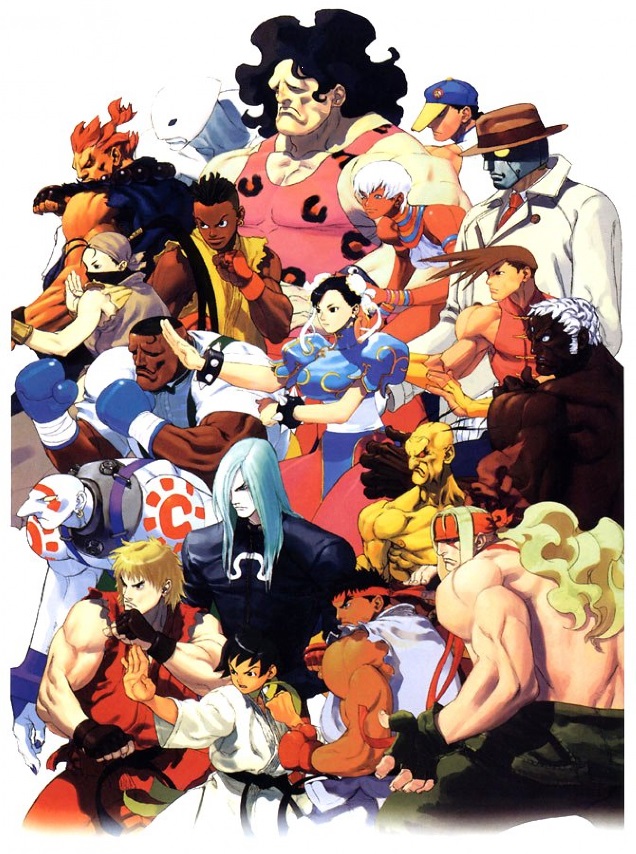
Street Fighter III famously brings back almost none of the iconic Street Fighter II cast – Third Strike’s nineteen character cast makes a concession by bringing back Chun-Li alongside Ryu, Ken and Akuma. Only a few members of that cast have come back in future entries and only in re-releases or DLC expansions, meaning most of them are best learned in Third Strike itself. The new cast is a little less superhero-comics oriented than Street Fighter II’s – whether that comes in the form of cool, hip designs like Sean or Yang or the horrific oddity of characters like Oro or Necro.

All this is realized in a pixel art aesthetic that remains unmatched. The animation on character movement is so fluid and expressive without requiring the outsized toon faces of something like Metal Slug. The backgrounds include empty streets, rainy rooftops, and grimy subway stations, giving the game a real backstreets, underground spirit. The soundtrack combines breakbeat and instrumental hip-hop better than almost any game since, a dealer’s choice of cool sonics that also lay a foundation for any number of melodic approaches on top, whether that’s needed to capture a runaway shinobi’s melancholy or to just launch into a perfect jungle breakdown. I couldn’t possibly tell you the story of Third Strike – Street Fighter lore is immensely detailed and requires playing hundreds of hours of mediocre single-player gameplay when it doesn’t also require reading addendum comics. But I can tell you this world feels a little dangerous, a little like the few heroes of its past that still walk its alleys get assailed by private detectives and snot-nosed kids with a mean right hook.

Most of my experience with fighting games these days is watching tournament and stream highlights. I’m in the iconic fighting game Hard Drive dead zone, and I have neither the free time nor the drive to get better. Tournament highlights from Third Strike are always enjoyable because the game’s unique cast is still complex enough to reward playing the vast majority of its characters and the game’s pace is not so fast that the combos are unreadable. The animation clarity is smart, too. The hits that deal the most damage look like the hits that do the most damage. The supers zoom in and let you know when something serious is about to happen without interrupting with a long canned animation. It’s just so many small, intelligent decisions like these being made to make a game that’s lasted twenty five years.

Daigo Umehara still plays regularly, but he’s fallen to the wayside over the past twenty years. Justin Wong actually has maintained a better overall win percentage across more games, his fundamentals allowing him to transfer his skills to games like King of Fighters, Marvel vs. Capcom, and Mortal Kombat, but Wong still finds himself streaming Third Strike regularly. It still gives me pleasure every time I see someone square up against Justin Wong’s iconic white Chun Li hoping to reclaim the greatest moment in fighting game history.

MESHES OF THE AFTERNOON

FYI – this film is also available on Criterion Channel in higher quality.

MESHES OF THE AFTERNOON
Dir. Maya Deren, Alexander Hammid
1943

Elliptical haunting nightmares inventing new dream logic. There’s a lineage of the dadaist and surrealist imagery of the early 20th century. I unfolded a greater understanding when I watched Jean Cocteau’s Blood of a Poet, Wladyslaw Starevich’s The Cameraman’s Revenge, Man Ray’s Return to Reason. I saw Meshes of the Afternoon early in this journey, directed by reference to my love for David Lynch. Unsurprisingly, I didn’t “get it” then, appreciating some of the imagery but only able to make reference to things I had already seen.

I’m still nowhere near an expert on abstract or experimental cinema, having largely seen only the most acclaimed and beloved films or museum pieces I happened to have someone else program. I find it hard to engage with abstract cinema at home, especially anything longer than a few minutes long. Something like Bruce Baillie’s Quick Billy is hard for me to keep in my head with streaming video quality and phone notifications. So, please consider my love for Meshes of the Afternoon a pledge that you, whoever you are, can enjoy it too.

The story, told simply, is a cat & mouse between our heroine, a dreamer, and a mysterious stranger with a mirror for a face. She chases the mourner/reaper and finds it carries a knife. Parts of the chase keep recurring, both lived and observed from afar, omens of violence rising until a desperate conclusion. As much as I love the more daring shots, some of the most impactful are the mundane images. Closeups on her falling asleep in the chair or running to follow the mourner, those are such incredibly daring and modern images. The tension still gets me, the uncomfortable feeling of impending doom.

Meshes of the Afternoon is a late silent film, though Deren’s third husband Teiji Ito wrote a classical Japanese score (embedded above.) I’ve watched it with Ito’s score, in silence, with a faux-Badalamenti score, with Liturgy’s Aesthetica. My tip for watching silents at home, if you cannot find a score that works for you, is simply to put on music you feel like listening to. There are unexpected synergies to whatever you can choose, from Outkast to Buckwheat Zydeco. If it makes it easier to commit your attention, it’s the correct choice for that day.

I had to train myself to watch and enjoy silent film. It took about a year of learning how to watch what I was looking at, and many of my early Letterboxd reviews document growing pains in that process. I lack forgiveness of myself for failing to be a better critic sometimes. There’s a decent chance that ten years down the line, I’ll read most of what I’ve published in this birthday project and go, “ah, damn, what a naive kid.” I think writing about perspective in Meshes of the Afternoon is putting me both in the mindset of the dreamer and the mourner, looking to future’s past. While I take great pleasure in Meshes of the Afternoon, this film still stumps me. Let this be an engraving of humility, reminding me how much more room there is to grow.

SYRO

SYRO
Aphex Twin
2014

Richard D. James, better known as Aphex Twin, referred to his most recent full length album as his “poppiest album yet.” I don’t know that I necessarily think anything here is more accessible or friendlier than “Alberto Balsam” or “Windowlicker,” but relistening to Syro, I’d forgotten just how melodic and beautiful the album tends to be. The earworm that’s been in my brain for a decade is “180db_[130]”, maybe the album’s most frantic dance cut, high drama that fits voguing or an evil movie nightclub more than an actual night out. When I spend time away from Syro, that harsh synth melody overtakes the more austere beauty of “XMAS_EVET10 (thanaton3 mix)” or “”syro u473t8+e” (piezoluminescence mix).”

You’ll also notice, if you’re unfamiliar with the album, that unless you’re listening to it so frequently you’ve got these titles memorized, that the album resists identifying individual tracks. According to James, the album consists of ideas written over six or seven years, none he considers forward-looking experimental music, all of which he considers ruminations on the past. The variation on this we might be more familiar with are letters and poem series, titled by date or sequence rather than by something more poetic and evocative. Most interpretations of the track titles here are descriptions of gear and technical detail – “minipops 67 [120.2]” refers to the MiniPops drum machine, likely take 67, set at 120.2 BPM, lord knows what a source field mix is. The album cover includes a record of the album’s production and promotional costs. Despite being a “pop album,” this is a documentation of a period of time more than a Concise Statement.

I’m as far from a scholar of electronic music as they come. I hear stuff, like what I like, integrate it into my playlists, and roll on. So when people say this is a culmination of thirty years of electronic music history, I believe them. I hear playful reverie, memories of holidays past, reflection on a quiet afternoon. I hear the soundtrack to a nightmare movie rave. I hear a feeling that the form has been mastered and now it’s simply about the pleasure of creation. These thoughts are abstract, and I’m not sure I could map them for you directly to a timestamp or even a track title. By disconnecting the music and its context, James has created a throughline from electronic instrumental music back toward the sort of classical roots. This album exists because the studio and equipment to create it existed and demanded to be played.

James has continued to make music, releasing EPs every few years rather than full length albums. He’s toured once in that time and played sporadic festivals as well. Based on the teaser timeline set last year leading to the EP “Blackbox Life Recorder 21f/in a room7 760”, he’s due to disappear for another couple years before giving us another bite sized update. Between Syro and the previous full length album, Drukqs, James claimed he’d written six unreleased albums. It’s possible that like some classical composers before him, there are hundreds of recordings we won’t hear until a century has passed. I hope selfishly to get to hear some of his beautiful sounds sooner.

KEY TRACKS: “minipops 67 [120.2],” “XMAS_EVET10 (thanaton3 mix)”, “180db_[130]”

CATALOG CHOICE: …I Care Because You Do, Richard D. James Album

NEXT STOP: Black Origami, Jlin

AFTER THAT: Flamagra, Flying Lotus

BLUE VELVET

BLUE VELVET
Dir. David Lynch
1986

The short films David Lynch made in art school, as well as Eraserhead, contain his intense visual horror flair and his otherworldly treatment of sound and light, but they’re deeply angry films, a young man railing against societal failures and expectations. The Elephant Man and Dune are adaptations, Lynch putting his distinct style onto other people’s work. But they also soften his edges quite a lot – Dune marks what I think his first real mature work showcasing empathy and friendship, the relationships between Paul Atreides and his friends full of liveliness. It’s the first time watching a David Lynch project I feel like you can really fall in love with some of the characters.

It’s also the last time Lynch would ever work on something that massive in scale, even accounting for Twin Peaks: The Return. The degree to which Lynch poured his heart into the film, the time he spent with Frank Herbert (who largely liked the film) undermined in post-production by the De Laurentiis family, ended Lynch’s desire to work on big-budget films going forward. Creative control came with a lower asking price – according to producer and Lynch collaborator Sabrina Sutherland, that approach is still getting pitches into board rooms as long as they aren’t about mythical Snoots.

The lessons he learned making Dune are visible in Blue Velvet, not least of which through the return of Kyle MacLachlan as Jeffrey Beaumont, another precocious golden lion-boy quickly corrupted by exposure to a world where naivete can become egomania. While Blue Velvet was conceived in 1973 alongside Eraserhead, it lacks that film’s sour edge and general misanthropy. The film is still on the knife’s edge of thriller and horror, depending on how unsettling you find its darkness, but it comes to that darkness through a deep love of its characters. Jeffrey is presented from the start as a character more like one of the Hardy Boys than Jack Nance’s Eraserhead Henry Spencer, and while he does find some unseemly, voyeuristic desires and a penchant for manipulation in himself, his conscience also always seems aware that these things are wrong.

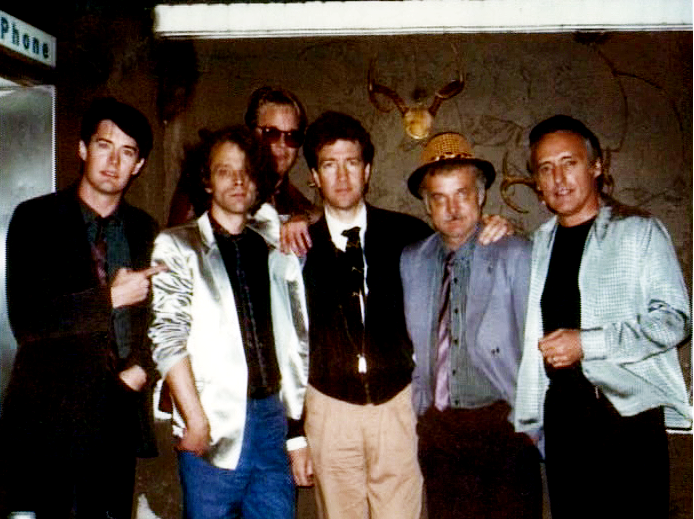
Lynch (center) and the boys (from left to right, Kyle MacLachlan, Brad Dourif, J. Michael Hunter, Lynch, Jack Nance, Dennis Hopper)

That melodramatic empathy with these characters is, to me, the real heart of the Lynchian ideal, as it combines tropes or familiar, mundane elements with intense tragedy or darkness. Some people take this to mean something as simple as “the radiator is menacing” – while I think that’s certainly true of Lynch, it’s also true of iconic images like the telephone on the stairs in Maya Deren’s Meshes in the Afternoon or the basement in Charles Laughton’s The Night of the Hunter. I think what really makes the Lynchian whole is the juxtaposition of menace and love, and just about every Lynch work from Dune onward is embodied by that ideal.

It’s certainly the primary iconic juxtaposition of Blue Velvet, Bobby Vinton playing over a suburban lawn until the grass leads us back to a severed ear. Isabella Rosselini’s Dorothy Vallens is tragic but also erotic, and her trauma response cycles between despair and desire in the flash of a moment. Frank Booth is a terrifying villain, and that villainy never comes forward more uncannily than watching Dennis Hopper sob over the performance of the woman he brutalizes. Even Dean Stockwell’s terrifying pimp Ben is given the Roy Orbison “In Dreams” solo, creating a dynamic of traditional American beauty and violent blood running under the surface. The only person spared this conflict is Laura Dern’s Sandy, whose only exposure to the darkness is to see it crashing down upon her lawn in the film’s crushing climax of melodrama.

David Lynch’s work has meant a lot to me for the past ten years or so, since I first met Twin Peaks and Eraserhead. Annie and I originally bonded over talking about Twin Peaks, and his films have been a source of many beloved memories of mine. Last summer, when we moved back to Madison, the first film we saw at the UW Cinematheque was Blue Velvet, and there I reunited for the first time with friends I met maybe six months after my first time watching Twin Peaks. It’ll remain a special experience to me for a long time.