World of Horror Panstasz, LLC 2023 PC, Switch, PS4
Dark gods unleash eldritch horrors on Shiokawa, a small Japanese coastal town, and your survivor is one of several young people who feel responsible in some way to stop the horror before it’s too late. There’s Haru, a young criminal who robbed a haunted mansion and now seeks to defeat the evil that killed his accomplices. Kouji’s a young photojournalist who’s trying to stop a government cover-up. My favorite is Mimi, the nursing student (?) whose obsession with the macabre makes her think battling these monsters is a great opportunity to put her “medical skills” to use. Most of these characters have a featured “challenge” run, which amps up their characterization while also amping up their weaknesses – “Mimi’s Little Project” features her experimenting on her own body to try to, uh…well, it’s not always clear, but the results are never wholly good for the player.
World of Horror plays out as an adventure game combined with a turn-based RPG. Upon starting each playthrough, you receive 5 of the game’s 22 mysteries, short adventures you’ll play through in Shiokawa and the surrounding area. You move from location to location, checking out shops or seeking resources, before hitting the explore button. Explore draws a “card” from the event deck – these can be a fight, a skill check, a choice, or sometimes just sheer bad luck. Collecting items, spells, and allies will help you battle the game’s greatest foes or survive the game’s numerous challenges. Combat is a little confusing, with weapons being defined by their lead stat and certain moves being defined by their own, but after some trial and error it becomes simple enough.
Not every mystery ends with a boss – learning the mysteries offered can result in smart play. “Eerie Episode of Evolving Eels,” in which you and your neighbor Kana investigate a third weird neighbor’s apartment, ends up being a major boon to take early, as Kana can become a permanent ally reducing all combat damage by -1. “Perilous Parable of the Peculiar Painting” can either be one of the game’s most dangerous mysteries, ending with an extremely challenging boss fight, or it can be very safe and earn you one of the game’s best weapons.
Aiko battles against an ANIMATED HEAD in “Vicious Verses of a Violent Vigil.”
The danger of these mysteries pairs perfectly with the horror of the game’s art. Drawn entirely in MS Paint in designs that are legible in 1-bit monochrome (the game also offers two-tone color palettes), World of Horror is full of great 80s fashion and horrible scissor-beasts. It’s among the best works of pixel art I’ve ever seen. There’s very little animation, which is why I can’t nominate it in that category, but when it does appear, it’s striking. The game’s soundtrack has been haunting me since release – when I read Junji Ito’s Uzumaki last year, I put on this game’s soundtrack as my background music.
It’s hard for me to pick a favorite mystery, but “Vicious Verses of a Violent Vigil” is a break in form that’s really successful. The intro reads: “You’ve received an official-looking letter. What does a law firm from Tokyo want from you?… ‘We regret to inform you of the passing of our client and your grand-uncle. His funeral will be preceded by an overnight vigil as per the client’s request.’ There’s an address and a list of people expected to arrive. You don’t recognize any of the names… Intrigued, you decide to check it out, what’s the worst thing that could happen?” Shortly after beginning to explore, you receive a pamphlet containing the rituals of this funeral. Following them serves someone – not following them someone else. Midnight rolls around, and (shock and awe) things get dark!
World of Horror takes the basic structure of Fantasy Flight’s Arkham Horror card game, smartly simplifies its rather archaic structure, and colors the core with aesthetic and narrative inspirations from Junji Ito’s Uzumaki to Sion Sono’s Suicide Club. It is perhaps the definitive J-Horror anthology video game, combining the popular rumor-based ghost stories of early internet BBSes with the bizarre and powerful monster designs of horror mangaka. It’s a remarkable, weird game, one that still has unimplemented storylines waiting for developer Panstasz to return and expand on. My understanding is that he now works at a dentist’s office, occasionally plugging away at this game privately, updating us when he has something new to share. If he never does, hopefully someone else can take the lessons of this game and make something just as strange and tense.
THE LEGEND OF ZELDA: TEARS OF THE KINGDOM Nintendo 2023 Nintendo Switch
Tears of the Kingdom’s greatest strengths are in its use of mystery to drive plot, in lost time to create pathos, and its incredible mechanical depth to enhance the gameplay of Breath of the Wild. I found the eventual storyline regarding Princess Zelda to be quite moving, and the dungeons at the centerpiece of this game’s five major temples are clever and concisely designed. Songs like “Lookout Landing,”“Water Temple,” and the new “Main Theme” prove Manaka Kataoka (who got her start writing the iconic “7 P.M.” theme from Animal Crossing: New Leaf will be one of the greatest composers in gaming history. Rather than share the same sort of post I typically do regarding Tears of the Kingdom, an enormous and gorgeous game which could merit an entire playthrough diary and a book’s worth of criticism, I’ve decided to share the diary I wrote during my first days with the game.
5/14/2023
I’ve decided to start keeping a diary of my sessions playing The Legend of Zelda: Tears of the Kingdom. There are a number of root causes, but the primary is pretty simple – I want to track my own understanding of the game’s world and lore, exploring the narrative empty space the game offers. It wouldn’t be the first time that I started expanding on a narrative throughline and had it collapse by game’s end. Skyward Sword’s Groose, in a heroic sacrifice, seals Demise within himself and becomes the Demon King Ganondorf, destined to battle his friend Link generationally and lose every time, maybe intentionally. Or…not. But that empty space I filled in still feels thematically relevant and possible, informing how I think about the game’s text. Maybe that misdirection was always in place.
Tears is full of empty space, literally and figuratively, for the player to try to piece together a mystery. A being what look like Zelda keeps being spotted throughout Hyrule, only she doesn’t really behave like Zelda and seems capable of some kind of teleportation or projection. My theory, right now, is that this is The First Zelda, Queen of Hyrule, the Sage of Time (so named by the Sage of Wind) who has projected forward to aid (or threaten) Hyrule’s people. Documented so far, I’ve spotted her:
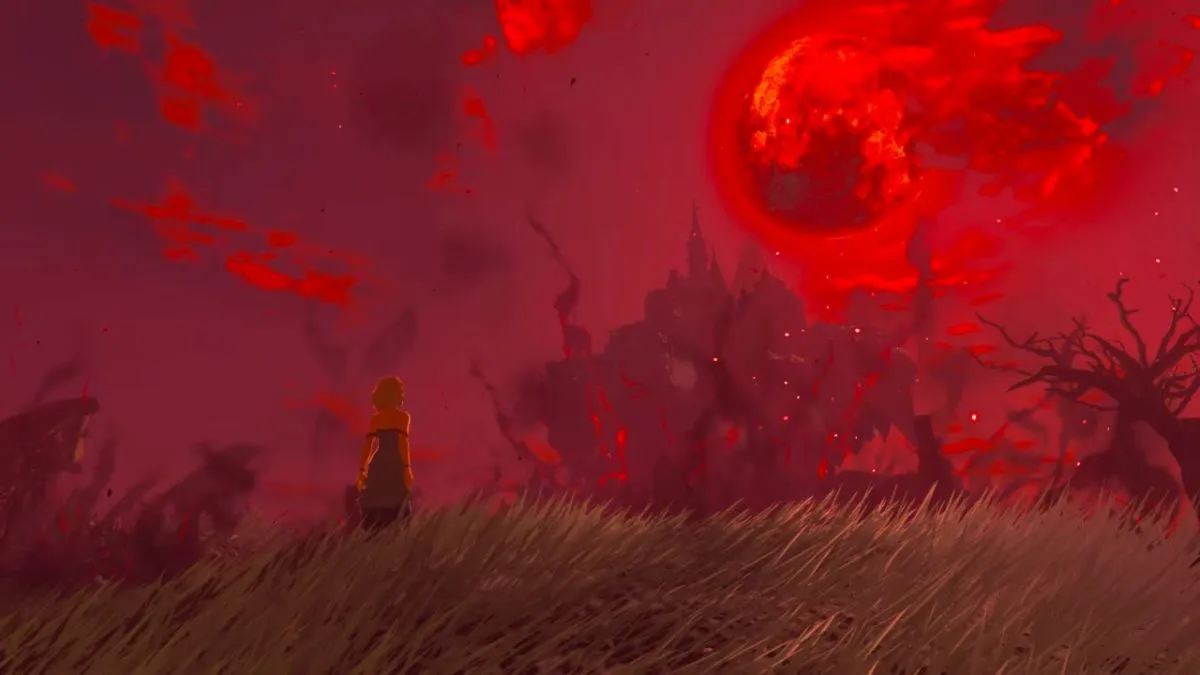
-Silently blessing Link’s arm with Recall, in the body of a Golden Tear. -Receiving the Master Sword from Link, presumably back in the past. -Standing on Hyrule Castle’s ruins before floating away in golden light. -The Blood Moon rises, with new, more confident, slightly fear-inspiring dialogue. -*REPORTED*: Zelda came to Kakariko Village after the Upheaval dropped the Ring Ruins. After inspection, she told Purah and her team to stay away from one particular floating ruin. (I can’t airdrop onto it – maybe an angle where pictures can help?) -Spotted in Rito Village, though no mention of her doing anything but floating away. -Spotted on Stormbringer Ark, just walked forward and disappeared (no floating.) -Seen in Memory of the Sage of Wind, where she’s called “The Sage of Time” and in which she predicted Link’s quest.
Zelda in front of the Blood Moon.
Any of these appearances could hypothetically be “Our Zelda” (would like to come up with a name for her. The Archeologist?) or The Sage of Time, or even any Zelda in between those two. So far, none of the Zeldas I’ve seen since separating in the Tomb Depths acts like our Zelda. She’s more direct, mostly, with the rest being on the marginalia. Our Zelda is prone to tangents, repetition – she’s a little nerd and we like that for her. She’s also much more timid. I believe these are appearances by The Sage of Time, and Our Zelda is still somewhere else.
The Stormbringer Ark legend is a curious one. Why did the Rito return to Hyrule? Did they first reach the Stormbringer during The Demon King’s first invasion? The memory of the Sage of Wind indicates so. No other reference to an upheaval is mentioned during the Sky Temple. Did the Rito people simply not participate in the Imprisoning War? Was the Stormbringer (armed with cannons) used as the lead battleship in an aerial fleet? Many questions still to answer. Winter has thawed with Colgera defeated. I’m a little melancholy to have fully reset the region so quickly, but I don’t actually love snow areas in these games, so I’m more likely to dig deeper.
Other threads to pull on in the next sessions:
-Kakariko Village’s Ring Ruins. Still don’t know what these are. One story about the six sages found so far. Might have to make a priority here. -Hateno Village’s Mayoral Election. The fashion lady is obnoxious. I’m helping Reese. I do really like the hat she designed, though. -Lurelin Village’s pirate invaders. They’ve taken over my favorite town in the whole game. I’ll have them longshanks. I wonder if you’ll have to go around and find all the citizens who’ve left, or if word will travel for you. -How long has it been since BOTW? Seemingly, at least a few years. Zelda built a school in Hateno and took over Link’s house. Tulin has come of age, from childhood to becoming a warrior. Paya is now a young adult. -Impa’s pilgrimage. She left with someone and put Paya in charge to search for something. I wonder if we’ll find her out there. -The Chasms and Sky Archipelagos. If there is some broader narrative to explore above or below, I haven’t found it yet. No quests are really sending me up or down to explore yet. I know the Yiga Clan is in the depths somewhere, though. I need to hunt for some sky quests. Maybe then I’ll be able to upgrade my power supply. -The Lucky Clover Gazette. Stable questline. Maybe the first thing I’ll do is warp around to different stables and progress those questlines ASAP. Give myself some more direction. -Lookout Village. Haven’t really dug deeper into the castle or what’s going on in the village. Supposedly, after the first Temple is completed, stuff opens up in Lookout. I’ll have to stop back. -Bubblefrog Caves. No idea who to trade the snowflakes to. Satori gave me a clue to look for caves. I wonder if that’s still online, or if it’s been long enough that I’d need to return to the mountain to extend the blessing. -Din’s dragon. I’ve seen Farrosh and Lanayru. No sign of the red dragon yet. I haven’t been north of the castle except for the Rito questline.
I’ve visited three of the major towns and activated their warps. That leaves five more, right? -Tarrey Town -Gerudo Town -Death Mountain Town -Zora’s Domain -Lurelin Village
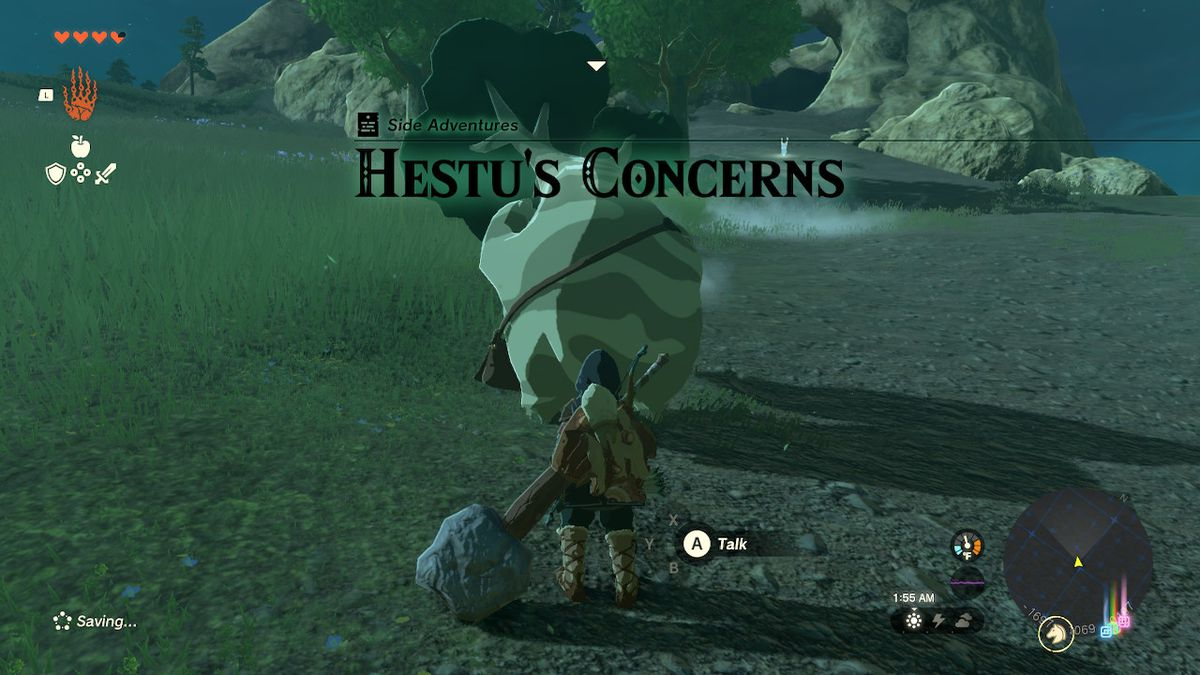
Lurelin is next. After that, I’ll have to start poking around. I did see that Hestu is apparently northeast of Lookout Village, so I’ll head that way in the hopes of expanding my inventory.
Hestu in Tears of the Kingdom.
5/15
Okay, I made very little lateral progress (just getting east of Lookout slightly) but I made a ton of progress on many of these questions. It’s crazy how much of this game is just laying about in open fields to surprise.
-Bubblefrog Caves. I’m headed for Woodland Stable to meet the “old couple” there who collect Bubblefrog medals.
-Lookout – Things didn’t open up *that* much after the temple. Hestu’s arrived, thankfully. The hidden passage under the castle has a Demon Statue and a little loot down there, but until I can break black blocks, I’m not getting any deeper. (Diamond weapons? Eldin power of summoning?) I’ve unlocked the next phase of Josha’s Chasm questing, to find an underground temple and get a power there (Auto-Build?)
-Impa’s pilgrimage. Sure enough, she was right on the path from Lookout to Rito, investigating the Geoglyphs. This was probably the most impactful bit of lore I got all session – the Geoglyphs each carry one of the Dragon’s Tears, which unlock a memory of Our Zelda’s experience on the other side of her time jump. She definitely is operating in the past! And it seems I was wrong about The First Zelda. If the Sage of Time is not Our Zelda, then she’s also not the First Queen of Hyrule. The First Queen of Hyrule, Rauru’s wife, is a Hylian named Sonia. Each Geoglyph has a memory (found in a small water pool on the design). The next phase of Impa’s quest, where I can presumably find the locations of all the designs and add them to my map, is in a cave in the Hebra trench.
-Lurelin Village’s pirate invaders. Zonai Monster Control have been sent to contest the pirates. I’m headed that way next *for sure* after the Woodland Stable (lol).
-Ancient Hylian text crashed down into the Lookout, sending Wortsworth the Lore Expert to Kakariko Village. Maybe this will allow the questline to progress?
-A construct merchant crashed just north of Lookout, offering a trade of 100 crystallized ore (or whatever currency) for 1 energy cell. Thankful I’ve got that all sorted now!
-Found some brightcap hunters and shield surfers all headed toward the Hebra region. And a cave with a “white bird’s treasure” north in Hebra. If I need to make some cash and find new weapons, I should probably explore northern Hebra.
-Hit 8 hearts, so I’m headed for my first stamina ring. Will switch back to hearts till at least 16 i think after that?
-The Lucky Clover Gazette questline seems to have pointed me toward a vision of Zelda riding some great beast. The images look unfamiliar – maybe this game’s interpretation of Dodongo, but otherwise not recognizable to me. (Dodongo are one of the Zelda 1 enemies still not interpreted in this game, so they’d make sense! There are too many not included to list, though, and they certainly won’t add all of them.)
Main quest stuff: I’m surprised, but returning to Lookout has definitely pointed me toward Eldin next. They’re battling a Gloom crisis on Death Mountain, turning Gorons hostile, but the land is temperate and the need for fire-resistant armor is temporarily eliminated. I’m sure once I clear the Gloom it’ll be back in full swing, though…maybe will buy the armor before I complete that questline.
Lurelin calls, though.
Impa’s blimp overlooking the Geoglyph.
5/16
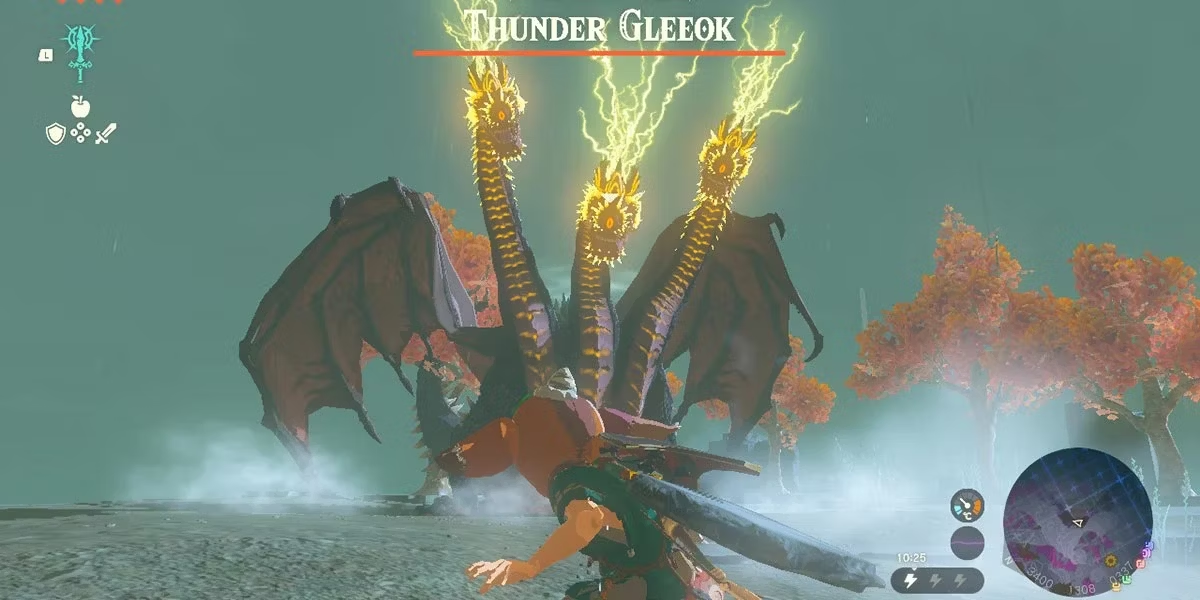
Lurelin draws even nearer! I’m overlooking the swamp now, with an awful Thunder Gleeok visible overlooking the path into Lurelin. I found a pirate ship on the coast as well, so I know I’m getting close. (Unfortunately, given every enemy appears to be a black or blue foe, I may be here waaaaay too early.) Some headway on other questlines as well.
-The “odd couple” collecting bubbulfrog medals is Kilton and his brother. I never really interacted with Kilton in BOTW, and it feels like he’s got a different vibe.
-We are close enough in time to the Upheaval that a sidequest where borrowing farming tools from a stable is close enough to be a misunderstanding. Maybe a few months.
-Found my first Gloom monsters east of the castle. That was…terrifying oh my god!!!! They can take a lot of damage!
-The Yiga Clan have set up shop on the Great Plateau. I got a Yiga mask after setting free a designer. They also outlined on a map three other locales – they’ve kept their primary base in the desert, but also set up north of the castle in Hebra and even further east of Death Mountain in Akkala.
-The Great Plateau also had by far the most powerful shield I’ve found so far.
-I’ve found the musicians and the first Great Fairy! The others are marked on the map, and they’ll require musicians of their own. You can meet the musicians outside of the band’s tour, you just have to figure out where they went. The drummer is somewhere north of Kakariko, the flutist is at the Horse God’s old stomping ground stable.
-Speaking of the Horse God, a nap revealed that it can be found at a stable in Akkala. People looking for the Horse God think they can find the White Stallion.
-The journalism questline so far has been fairly relaxed, but hasn’t helped me find much of anything about Zelda. The Great Fairy seems to think the blonde figure who looks like Zelda isn’t her.
I also found another couple memories. The first was mostly just showing Rauru’s sage power – big fire of lasers, but also saw Ganondorf’s Gerudo forces (and his summoning of the molduga.) The second was more important – it depicts Sonia’s grave (the mural in the intro also depicts Ganon taking the Secret Stone from Sonia, presumably killing her) and Zelda confronting Rauru about their demise. He mentions “his hubris” leading them to that point. His hubris…maybe Ganon came looking to make a pact? Or maybe just peaceful conquering.
Almost to my goal. Almost rescued my friend from pirates.
The south Thunder Gleeok.
5/17/2023
LURELIN IS SAVED!
That’s really the only major event in this session that I saved. Bolson is there and is going to help rebuild the time – 15 logs and 20 hylian rice. That was one long fucking fight.
I also did fight my way through the black bricks in the Hyrule Castle-bunker passage. It was a fun run! It leads basically into the bottom of the castle, what’s left after you shoop half the castle into the sky. I did one more major event. I leapt under the chasm under Hyrule Castle…and, yeah, unsurprisingly, that leads into the endgame. It’s a long series of tunnels, full of black horriblins, shock like likes, shock keese, ice varietals of both of those, and a white lynel. All of the above are covered in gloom. And then you eventually make it back to the tomb from the beginning. The mural – it reveals that using the monster sword, they can summon a great dragon to battle Ganon back. Past that, you jump down into the heart of the gloom, where a cutscene plays and you fight a full horde of Ganon’s army alongside any sages you’ve gotten secret stones. Since the spoilers abound (I already know too much about the dragon being summoned, for example) I figured I’d find this out sooner rather than later anyway, and thankfully now I know how difficult it is to accidentally stumble into the endgame. (How many people accidentally found themselves battling Calamity Ganon in BOTW? This is way more obvious and requires way more intentional travel. Though…maybe there’s a shortcut I haven’t found.)
This was a very weird year in my life! We spent almost half of it in North Carolina, seeing only Avatar: The Way of Water and The Super Mario Bros. Movie in theaters during that time. Then we moved back to Madison, a city I haven’t lived in since 2016. I immediately fell back in love with the city’s movie scene and reconnected with old friends. That’s meant that I haven’t watched a ton of movies at home, primarily seeing things at free screenings at the university. My fellow UW Cinematheque regulars will recognize many of these films from the Madison Premieres series.
Because I publish these at the Oscars on purpose, I’ll say that this year I liked every nominated film for Best Picture that I’ve seen, even though I’ve left three of those off this list. Maybe they just did a very good job, or maybe I’m getting older. Past Lives is a brilliantly acted debut that is shaggy in a few places. Maestro is a weird-as-hell movie I might grow to love over the years, but I wish the marriage drama worked a little better for me. And Poor Things may be more style than substance, but I had a hoot watching Stone and Ruffalo especially in such good goofmaster spirits.
Each of these write-ups includes a reference to any streaming service members can watch the film on for free. With one exception, all of these films are available either on streaming services or VOD rental.
HONORABLE MENTION: The Pope’s Exorcist
Dir. Julius Avery
Netflix
The Pope’s Exorcist is not my #24 film of the year. I’m not sure The Pope’s Exorcist is my #30 film of the year. But I want to watch Russell Crowe play Father Gabriel Amorth in like six more of these perfectly paced perfect little movies for morons. He rides up on that little Vespa, sits and drinks whiskey while speaking in Italian, and the whole thing is going delightfully if a little calmly. Then the last half hour hits and we get a perfect Madcap Special Effects Extravaganza. The Pope’s Exorcist hits the lizard brain in a way even Branagh’s Poirot couldn’t quite manage this year.
A big “see you later” to Ferrari, Magic Mike’s Last Dance, Showing Up, American Fiction, The Holdovers, All Of Us Strangers, Aquaman and the Lost Kingdom, Beau is Afraid, Broker, Dungeons & Dragons: Honor Among Thieves, Eileen, Furies, Godzilla Minus One, In Water, John Wick Chapter 4, M3gan, Master Gardener, Napoleon, No Bears, Pacifiction, Passages, Perfect Days, Saturn Bowling, Shin Kamen Rider, The Crime Is Mine, The First Slam Dunk, The History of the Minnessota Vikings, and The Killer.
23. The Sweet East
Dir. Sean Price Williams
VOD
I saw The Sweet East much earlier than it’s ended up available to everyone else, so I know some people would probably call it my “first movie of 2024.” This is the most Chapo Trap House-brained movie I’ve seen in a long time, a picaresque fantasia of fringe politics and embarrassing yuppies. The first ten minutes make a pretty awful first impression with Talia Ryder’s Lillian being caught in a PizzaGate riff, but once that’s past, it’s pretty damned funny for the rest of its runtime. Simon Rex, Ayo Edibiri, and Jacob Elordi are probably the highlights of the extended supporting cast. The film, directed by Safdie Brothers and Alex Ross Perry cinematographer Sean Price Williams, looks fantastic and nails a lot of great visual gags throughout.
22. Priscilla
Dir. Sofia Coppola
Max
Sofia Coppola returns to the caged bird structure of The Virgin Suicides, Marie Antoinette,The Beguiled, and, arguably, Lost in Translation. Cailee Spaeny as the titular Priscilla is asked to play a tough role, given she needs to be both our POV character and one who we understand has basically sacrificed all internal identity for years at a time. It’s not an especially kind film to Priscilla Presley given where it chooses to cut to black, but it’s an incredibly well-observed story about that sort of self-annihilation.
21. You Hurt My Feelings
Dir. Nicole Holofcener
Showtime
A writer (Julia Louis-Dreyfus) overhears her husband (Tobias Menzies) telling her brother-in-law (Arian Moayed) that he hates her new novel. You Hurt My Feelings is marriage dramedy about imposter syndrome and “little white lies” and is my first Holofcener film. She’s the director of films like Enough Said and Walking and Talking, and it pretty well lived up to my understanding of her work. This film was a challenge to get through for me, the social discomfort being a sore anxiety spot for me. But I’m glad I pushed through! The back half is full of confrontations and reconciliations that shared something valuable about communication, cutting things off, and making value judgments. Dreyfus is very obviously suited to the material, which feels like a more dramatic approach to her classic TV work.
20. Rotting in the Sun
Dir. Sebastian Silva
MUBI
I said “I’m definitely going to see Big Gay Beach Movie” the moment I saw this trailer. The trailer maybe was not representative of how much of Rotting in the Sun was at the Big Gay Beach, but good lord, did it not hold back on the Big Gay while it was at that beach! Instead, this film spends most of its time as a very funny meta-thriller about class dynamics and social media toxicity, with both Sebastian Silva and co-star Jordan Firstman playing versions of themselves that are not very kind portraits. It’s very funny, the thriller portion of the film is quite tense, and Catalina Saavedra still haunts me as Silva’s assistant and maid Vero.
19. The Adults
Dir. Dustin Guy Defa
VOD
Cringe comedy’s tough in film! I think of the apocalyptic cringe of something like Rick Alverson/Gregg Turkington’s Entertainment, where all you want to do is stop looking at the screen. The Adults is packing cringe comedy into drama, which forces the cringe behavior of this theater-kid sibling dynamic into diegesis. It ends up with some really funny moments as its core trio of siblings break into embarrassing inside jokes in front of other people, and then carry that awkwardness into their independent lives as well. This serves as a really special performance showcase, especially for Hannah Gross and Sophia Lillis, and even if the big heart didn’t quite land with me as hard as it did for some people I saw it with, I still really enjoyed it greatly.
18. The Settlers
Dir. Felipe Galvez Haberle
VOD
Haberle’s impressive debut western situates colonial violence against drunk black comedy. The Spanish and English worlds descend upon Patagonia in the form of a Queen’s soldier, a Texan cowboy, and the half-Chilean sharpshooter. Their job is to find safe passage from their Spaniard boss’s plantation to the Atlantic shore, and rack up a genocidal body count along the way. The first half of The Settlers manages an incredible mounting tension all building toward a pretty horrific sequence of violence, and then pulls back to a more intellectual cultural critique of these bloodthirsty profiteers. This is done in gorgeous landscape photography and with a rousing adventure film score by Harry Allouche, which sets the stage immediately for a film that starts rollicking and ends in despair.
17. Skinamarink
Dir. Kyle Edward Ball
Hulu, Shudder
Maybe oversold as “the scariest movie in years” for a lot of people, Skinamarink is now iconic as a verb or situation for “being trapped in a house you can’t leave with something you can’t see.” That’s crazy given just how abstract and experimental Skinamarink is as a film. Most of the dialogue is murmured by children who are often off-camera – some of it is subtitled but not all of it. There’s no real plot so much as an encroaching sense of dread and wrongness, an aesthetic darkness captured beautifully on such a low budget. Something cruel is happening and its evil only grows stronger as the film goes on. I certainly can’t recommend Skinamarink to everyone, but it’s such a singular, inventive film that it’ll likely be the go-to reference point for future Skinamarinks to come.
16. Spider-Man: Across the Spider-Verse
Dir. Joaquim Dos Santos, Kemp Powers, Justin K. Thompson
Netflix
Visual imagination trumps everything else in this sequel to the still-overwhelmingly-great Into the Spider-Verse. Across the Spider-Verse never quite reaches its heights narratively, but pound for pound this is still full of many of the craziest animated images I’ve ever seen on screen. Steinfeld’s Gwen Stacy and Luna Lauren Velez’s Rio Morales also pack emotional wallops into expanded roles from the previous movie. There’s some shorthand I don’t like here, I think the “canon event” narrative device that became the movie’s central meme is outright kind of bad, and until the sequel I can’t say whether or not the Miles storyline is headed anywhere good, but I have confidence I’ll love looking at it most of the way through.
15. Bottoms
Dir. Emma Seligman
Amazon Prime
Goshdarn riot. The premise of Bottoms maybe sells “Gay Girl Fight Club” as a little more radical a concept than Seligman and Sennott were going for with the script. They’re really just making a broad comedy, closer to Hot Rod or Superbad, and maybe some people were disappointed by that. I thought everyone in this movie was really funny, from Ruby Cruz to Marshawn Lynch, and Rachel Sennott and Ayo Edibiri are so good together. I like that Sennott’s PJ is just, like, an awful friend, a shitty teenager that never really gets redeemed. The Avril needledrop is one of the best jokes I saw all year.
14. Anatomy of a Fall
Dir. Justine Triet
VOD, Hulu March 22
Stretching the definition of courtroom drama by allowing so much mistrial to occur that it almost begs to be a film set outside Earth, Anatomy of a Fall marketing itself on the phrase “Did She Do It?” is an extension of its commentary on the violence of a justice system. We watch Antoine Reinartz as prosecutor lambast Sandra Voyter’s (Sandra Huller) character and enter everything from art to sexuality into public record as evidence Sandra killed her husband. She, along with her attorney Vincent (Swann Arlaud, the hottest exhausted guy in a movie in 2023) interrupt regularly to attack the absurdity of a legal argument that ends up offering very little in the way of evidence.
This ends up forcing the film to be less of an actual legal procedural than a moral and ethical wrestling match, a determination within the self to decide whether legal theater can ever meaningfully determine guilt in any edge case, an understanding of the damage inherently done under these circumstances. The gravity of that damage primarily falls on Milo Machado-Gradner’s Daniel, the blind son who cannot look away from the dissolution of his world, a brilliant performance from an actor I hope we continue to see.
13. Knock at the Cabin
Dir. M. Night Shyamalan
Amazon Prime
The Twilight Zone, alongside this film, are at their best when they beg the question, “What if the things you 100% knew to be true were wrong?” Some people have found Knock at the Cabin’s apocalyptic stakes to be deflating the film’s tension, determining “well, the film only works if the apocalypse is coming and these stakes are too crazy, so where’s the tension?” I think that understands the film’s POV a little incorrectly. Instead, I think the tension comes from “how can the horsemen possibly convince anyone they’re right?” Bautista’s performance anchors that tension brilliantly, realizing so early on just how high the odds are stacked against them.
The history of a lot of the horror genre stems from the perspective of punishment – those who sin are persecuted by Great Evil, in karmic retribution. Beyond religious morality plays, that history extends into classic pulp horror comics and the 70s and 80s slashers. I think Knock at the Cabin very smartly understands how to reverse engineer that history into interrogating why those who already are most marginalized or persecuted bear the weight of that Great Evil’s wrath.
12. The Zone of Interest
Dir. Jonathan Glazer
VOD
Details are the substance with The Zone of Interest, a near-plotless film about the evil inherent to domestic class fantasy and the genocidal background noise of self-annihilation. The film sets itself against the silhouette of Auschwitz, and I think the big picture is the banality and decay. Not just “the banality of evil,” but also the banality of their imagined Good Life. These fascists living high on the hog are boring – they do boring things, they keep a boring garden, they have boring conversations. Their kids are shitty and mean – in real life, they grew up to be even shittier. They’re poisoning their imagined Garden of Eden, from the air filled with the fumes of death to the river filled with ashes and bones, from the flowers bleeding to their own bodies rebelling against them. Maintaining the fantasy of domesticity while slaughter sits in the background destroys us.
The absolutely horrifying score, by Under the Skin and Jackie composer Mica Levi, is the film’s greatest achievement – the end credits theme is one of the most horrifying pieces of music I’ve heard in my entire life.
11. Barbie
Dir. Greta Gerwig
Max
I’ve been team Gerwig since Lady Bird in 2017, so I had pretty high faith that Barbie would deliver, but I never predicted what exactly she’d do with The Barbies and The Kens. A movie this heavily seen is inherently going to be both underrated and overrated, and I’m probably doing both at once. I think Robbie and Gosling are so funny and so strongly in character in this film – it would deservingly be listed alongside either’s best performances. The “What Was I Made For?” Montage made me cry. The “Push” cover made me laugh so hard. I think Kingsley Ben-Adir was so phenomenal as Gosling’s Benvolio Ken, an underrated supporting turn in a movie full of strong ones. This movie’s a treat, one I’d happily toss on right now.
10. May December
Dir. Todd Haynes
Netflix
It’s crazy a movie about such an uncomfortable subject manages to be so much fun as May December. A poison pill unsurprisingly too weird for the actors’ branch at the Oscars, May December is either a very dark comedy or a funny drama, depending on which part you emphasize, “loosely” based on the Mary Kay Letournau case. The story of Charles Melton’s Joe Yoo is a devastating arc about someone reckoning with his exploitation and infantilization by his wife (Julianne Moore,) along with the intense repression of his feelings of inadequacy and inability to maintain healthy relationship boundaries. The story of Natalie Portman’s Elizabeth Berry is a pitch black satire about how artists dredge up other people’s pain to make spurious dramas that probably shouldn’t exist. Samy Burch’s screenplay and Haynes’s direction of performance both balance the trauma and the absurdity of the proceedings, and the film left me both uncomfortable and fully satisfied. The ending scene puts a perfect pin on a film that’s already won me over.
9. The Wonderful Story of Henry Sugar (and Three More)
Dir. Wes Anderson
Netflix
At one point, I had all four of the Wes Anderson short films on this list because I really do think they all excel at different things. Poison, starring Dev Patel, is probably the funniest, with the performances from Benedict Cumberbatch and Ben Kingsley really matching phenomenal narration from Patel. The Swan has my favorite performance of the batch in Rupert Friend’s narrator, quietly furious, maintaining an emotional outrage that is devastating to watch. But it’s The Wonderful Story of Henry Sugar, which hands off between Cumberbatch, Patel, and Kingsley, that has to be my personal favorite – all three deliver unbelievable material, of course, but it’s the short’s visual imagination that makes it my favorite. This isn’t Anderson’s first film that fully breaks the fourth wall to depict special effects or character arcs – The French Dispatch handing off from Tony Revolori to Benicio del Toro is still probably my favorite – but this is the most he’s ever embraced that style, and I think it works beautifully.
8. Dad & Step-Dad
Dir. Tynan DeLong
VOD, NoBudge
Without any contest, Dad & Step-Dad is the funniest movie I saw all year. Colin Burgess (as Jim, the Dad) and Anthony Oberbeck (as Dave, the Step-Dad) deliver every line as such a fucking meal. The primary comedy comes from watching two dorks try to out-alpha one another, first passive-aggressively and later much more aggressively. But then there’s their thirteen year old son, Branson (Brian Fiddyment, decidedly not thirteen years old) who goes on his own hilarious journey. I’ve been saying lines from this movie every day since I saw it basically just to make myself laugh. If you enjoy the trailer, it delivers on that register for basically the entire running time. I’m gonna be shouting about this movie forever.
7. Afire
Dir. Christian Petzold
VOD
“What if a guy sucked?” That’s the central comedic question of Afire, which sets stuffy crumbum author Leon (Thomas Schubert, hysterical) to a Baltic beach resort where everyone else is having a good time. He’s sharing his holiday home with a photography student named Felix (Langston Uibel) and they’re meant to finish their major projects while enjoying the water. When they find out they’re double-booked with free spirit Nadja (Paula Beer,) Leon becomes inconsolable, rude, and simultaneously completely worthless as a writer. I grew to love these characters and the people they brought into the house for their strong senses of humor. When the stakes rise in the third act, it culminates in a really poignant character drama, but before that it’s perfectly set clashing personalities against one another to keep things awkward, funny, and always laughing at the right guy.
6. The Boy and the Heron
Dir. Hayao Miyazaki
Theaters (this is the only film listed not on home video yet)
I so excitedly bought the 2021 Bruno Navasky translation of Genzaburo Yoshino’s How Do You Live?, a wonderful book about a young Japanese boy named Copper with a vivid imagination who learns with his uncle and his friends at school about his place in the world. It’s a wonderful story, filled with humor, funny facts, and philosophical lessons aimed at teaching children how to be kind, relate to a world from which they’re sheltered, and take perspective. I bought it because it was the book Miyazaki was basing his next film on – after seeing The Boy and the Heron, I hope he considers going back and adapting it some day after all!
Explaining the plot of the film is to spoil it – broadly, there’s a grieving boy who loses his mother, and he encounters a fantastical mystery that leads to a world of discovery. There is certainly some thematic overlap between this and How Do You Live?, but The Boy and the Heron is the open wound of a person who feels that the world we’ve created is a self-defeating one that may need to be torn down before something can be built in its place. Its bold formal decisions challenge the style and narrative coherence of Miyazaki’s previous work, and it’s almost impossible to say with simplicity “what it was about.” I know that I still found it profound, exciting, beautiful, funny. One of the best things a film can be is a puzzle – not a film you watch and fully understand the first time, but one you try to piece together over many years. I look forward to rewatching The Boy and the Heron, hearing the astonishing Joe Hisaishi score, and discovering this film again and again.
5. Killers of the Flower Moon
Dir. Martin Scorsese
Apple TV
Of all the films on this list, this is the one I’m worried I’m still underrating. Killers of the Flower Moon offers up its own weaknesses – the much-discussed ending (which I adore) is an admission of culpability by Martin Scorsese. He and Eric Roth have taken David Grann’s book and done what they can to center the Kyle and Burkhart families but in the end, this film is hoping to start conversation, not to be the definitive text. I’ll say that if anyone’s earned the benefit of the doubt on that idea, it’s Martin Scorsese, whose work as a producer and whose World Cinema Project at the Film Foundation have meaningfully brought to life and preserved films from marginalized voices.
Setting aside the “shoulds” of this film, Killers is so powerful because it honors Mollie and Ernest as characters. It never forgives Ernest Burkhart his vile crimes, easily the least likable man I’ve ever seen Leonardo DiCaprio play, but it also understands that he believed himself capable of compartmentalizing “love” and money until one devours the other. The attention for the film has largely come down to Lily Gladstone’s performance, which is one of the best anyone has given. I actually think it’s become a bit overstated how much of her performance is dedicated to reacting and being soulful – her Mollie is so funny, so wonderful at leading Ernest through their courtship or gossiping with her sisters, so great at speaking her mind but then not belaboring the fight. Like Barbie and Oppenheimer, it also has an incredibly wide cast of supporting players – I’ll shout out Tantoo Cardinal as Mollie’s mother, who I think invests a lot of joy what could be an afterthought character.
4. Monster
Dir. Hirokazu Kore-eda
VOD
Monster’s advertising has largely highlighted the importance of different perspectives in understanding how a story is really to be understood, but the story it actually tells is more of understanding how the limits of our own perspective keep us from understanding the behavior we observe. The film tells the story of about one month of time – a fire burns down a hostess club, Sakura Ando as Saori uncovers that her son is depressed and believes it’s due to persecution at school, and then a rain storm builds to a climactic conclusion. We see this month or so three times, from different characters’ points of view. Only by seeing all three stories can we understand what’s really happened.
The worldview this film paints is a sinister one – we see decent people try to live decently only for them to be surrounded by people who come across as cruel, uncaring, possessed by a system of beliefs that cannot allow humanity through. Annie described that from the title and the extent of darkness on display, she anticipated a malevolent horror to unveil itself. Without spoiling anything, I’ll say this film remains firmly a drama, not a horror film, and any Monsters we see are terrestrial in nature, even as some of the film’s best characters dream of something bigger.
Hirokazu Kore-eda is growing to be considered one of our modern masters, with now five or six films I’d consider to be instant classics of Japanese cinema. Shoplifters, Kore-eda’s 2018 film, remains a shining beacon I look back upon with awe. There are sequences in that film that manage such an ingenious marriage of tone, performance, aesthetic, and philosophy that I maintain it’s one of the greatest examples of what a director can achieve. Monster speaks to me much more deeply than Shoplifters, and while it’s not as astonishing a feat of filmmaking, the depth to which it grabbed me from beginning to end was immense and powerful.
3. One Fine Morning
Dir. Mia Hansen-Love
Amazon Prime
At least since COVID quarantine began, I’ve been struggling a bit with focus and memory. My long-term recall, to childhood, has never been especially strong, but I have to make more of a conscious effort to write reminders to myself or I’ll forget what I’d planned to do these days. That feeling certainly lends itself to a sense of dread watching Lea Seydoux’s Sandra relate to her father, Pascal Gregory’s Georg, as he succumbs to the advanced stages of a neurodegenerative disorder called Benson’s Syndrome. The subject matter is something One Fine Morning approaches without the melodrama of imminent peril – Georg’s sorrow comes in the form of his loss of independence and clarity of thought, not because he’s harming or endangering himself.
This film also combats this sense of loss with new opportunities – the other primary story is Sandra kindling a romance with a married friend and trying to manage her daughter’s expectations about where that might be leading. The romance itself is not the most passionate, but that texture carries in Seydoux’s performance from scene to scene, and it ends up giving her one of her best characters I’ve seen. She’s funny, exhausted, literary, philosophical, bereft, sexy, angry – if I was going to recommend one film to understand why some consider her one of the best actors in the world, it would be this one. The sensitivity of Hansen-Love’s direction and screenplay combine to make a film that approaches aging and degeneration with the grace and levity to make its often sunny cinematography and romantic diversions feel less like a spoonful of sugar to help the medicine and more like the natural course of life during transition.
2. Asteroid City
Dir. Wes Anderson
Amazon Prime
Asteroid City is a joyful parade of pleasures. Without spoiling it, Wes Anderson sets a grieving family into the small Southwest American road stop of Asteroid City to participate in a youth science competition – when Science Happens, they’re asked to quarantine with a hyperqualified Wes Anderson ensemble while the United States government puts its pants back on. There’s at least two or three layers of frame narrative put on top of this story, all of which I found delightful, but suffice it to say the world of Asteroid City is a play and we see its actors and creatives trying to figure out what it all means right alongside their characters.
This film is as gorgeous as anything Wes has ever produced, the red rock and sands creating a perfect backdrop for delightful costuming and set design. It’s so darn funny, from Jeffrey Wright’s General Gibson giving a hysterical autobiography on stage to Tilda Swinton’s Dr. Hickenlooper realizing the kid scientists outclass her, run laps around her and her team. There’s singing cowboys, deadpan Scarlett Johannsen, a scenery chewing Tom Hanks. It’s got the sort of emotional poignancy many of Wes’s films have, maybe closer to Moonrise Kingdom than the open wound of The Life Aquatic.
Right near the end, the film takes a turn into a back alley I hadn’t anticipated, and Margot Robbie makes a two minute appearance that is the best individual scene of acting anyone had all year. It’s a scene that’s funny but also one I can’t watch without crying. It recontextualizes everything the film has been about up til that point, all its metanarrative of “why do we tell stories and why do we tell them this way” and its satire and its comedy and reframes everything we’ve seen as the story of learning to remember why and how we live at all. I’m a sucker for Wes Anderson, and this is up there with any of his best.
1. Oppenheimer
Dir. Christopher Nolan
Peacock
Many of us who love Oppenheimer have spent a substantial amount of time discussing the film figuring out which of its many scientists and soldiers are at the top of your squad. From David Krumholtz’s citrus-slinging Isador Rabi to Tom Conti’s unflappable Albert Einstein, Jack Quaid’s bongo-bearing Richard Feynman to the Christmas gift of Kenneth Branagh’s Niels Bohr. Hartnett, Damon, Safdie, Clarke, DeHaan, Urbaniak, Thirlby, Modine, Peck, Ehrenreich, Blair – the Best Supporting Performance category at any given awards body could belong solely to performers from the film Oppenheimer, each bringing different energies to this massive ensemble project, different character philosophies. The fabric of the film is woven with guarded loving kindness, petty resentments, fatalist violence.
When it finally came down to a tournament of “Oppenheimer Guys” on Twitter, none could best Oppie himself. Murphy will likely take home his Oscar on Sunday – I’ve come to believe this is a generational performance since seeing it, the sort of incredible character work only comparable to Peter O’Toole in Lawrence of Arabia. There is something to simply bearing the weight of this epic ensemble project, but it’s also a matter of maintaining both an emotional arc and psychological arc that tracks across the film’s diverging timelines. I relate to Oppenheimer’s frozen moments and autopilot martyrdom just as easily as I do his confusion at how other people experience his concept of fidelity.
I read this wonderful piece by Neil Bahadur as I was composing this and I was very struck by his argument for the film’s structural innovation. His words called to mind Cloud Atlas, which uses this sort of technique to draw parallels between different people across different plot lines and invoke a cosmic, psychic link between different storylines. Oppenheimer manages to use that emotional rhythm without ever summoning the question, “well, he didn’t know that yet, why did he do that?”
I haven’t rewatched the film – I don’t know that I’ll ever rewatch it at home, reserving it for the biggest screens imaginable. I remember my Barbenheimer day viewing. I remember the terror I felt in the theater. There is something I find deeply, elementally frightening about nuclear annihilation. I found it impossibly harrowing, but what I’ve taken home with me is the film’s many depictions of people, of love, of petty harm. It’s a painful film in many ways, but also one that makes the argument for why the pain is worth the fight.
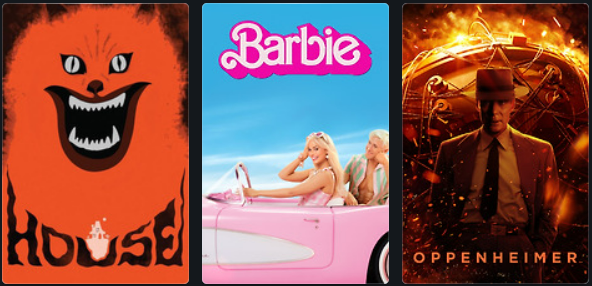
A surprise retrospective, a lakeside screening of my favorite live-action film (behind only Masaaki Yuasa’s 2004 debut Mind Game), turned my Barbenheimer double feature into a triple. I do not know if the programmers intentionally sought out synthesis between Oppenheimer and Barbie when programming Obayashi’s 1977 cult horror classic House, but it remained an unmissable meeting point between the impossible girlhood of Barbie and the bloody indifference of Oppenheimer.
We began our journey at 10:30am with Oppenheimer in IMAX. This was earlier than I hoped – the AMC management clearly did not receive my psychic relays for an ideal post-lunch 1pm screening, and suffice it to say it left my vibes through lunch afterward in shambles and disarray. Nolan has made his match to Interstellar, two films about the end of the world with vastly different conclusions. Interstellar argues that human ingenuity will face the end of the world and through sheer force of will, warmth, and white-hot blinding love, it will conquer impossible odds and survive. Oppenheimer, instead, argues that human ingenuity and its failure to commit to any ideals will wreak the end of the world – if it has not done so already.
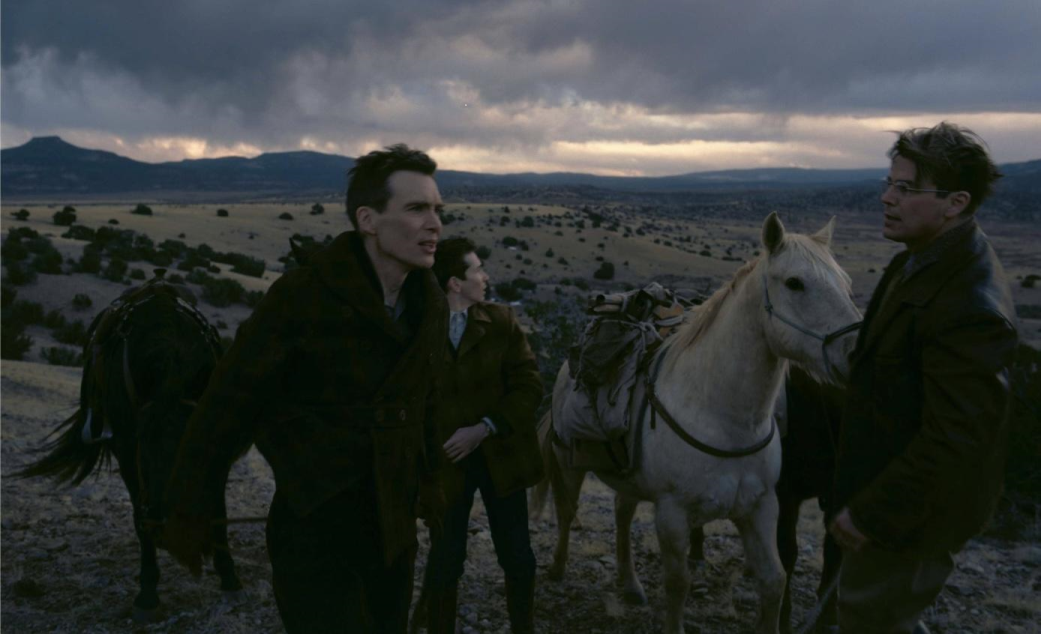
Without the magic tricks of wormholes, dream layers and larger than life comic book villains, Nolan pushes himself into a corner and turns out the best filmmaking of his career. Granted, he’s hired the best of the best in terms of collaborators. Hoyte van Hoytema and Ruth de Jong reunited for some of the desert photography we saw in last year’s best-looking film, NOPE, as Oppie and various companions ride horses through the New Mexico badlands and the Los Alamos Manhattan Project site. Ruth de Jong crafts wonderful, meticulous, memorable spaces alongside newcomer Emin Hüseynov, some based on historical record, others intentionally never recorded. Composer Ludwig Göransson was Tenet’s most valuable player, and he turns in breathtaking work here as well, ratcheting incredible tension and release as we build toward the Trinity detonation. Among the greatest editors alive, Jennifer Lame keeps these sequences legible and also disorienting.
It is insane a film this dour and this nihilistic is being sold as part of the greatest double feature in the history of summer blockbusters. Part of that is that when the pyrotechnics do go off, they maintain a wonderful balance of genuine spectacle and distinct horror. The Trinity test shredded my ego. It made me feel small within my seat. The aching pain of the remainder of the film, carried in Murphy’s once in a lifetime performance, withered me to a trembling husk. Most of my companions did not have such a hard reaction to the film. We made jokes about Joshes Peck and Hartnett, Branagh’s flexible accent work, and lamenting that the Pugh character is saddled with the film’s two worst scenes, the sex scenes no one quite knows what to make of beyond recognizing that it paints Oppenheimer and Tatlock as pseudointellectual assholes. We mostly loved the film.
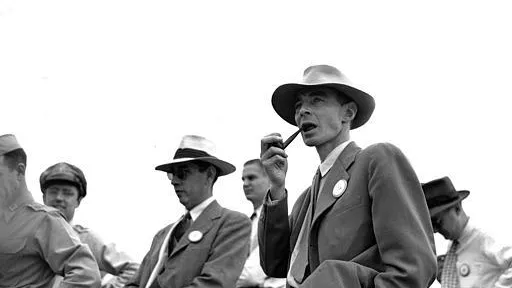
The real Oppenheimer.
I really do think Murphy is walking an incredible tightrope in this film. To play a man so uncommitted to anything beyond forward momentum shatter upon completing his greatest achievement is difficult enough to make compelling, but on top of that, you have the fragmented timeline presenting ego death Oppie well before we’ve seen him at his most confident. He (and Nolan, and Lame) have managed to make a character arc that works both when considered chronologically and in the sequence the film presents, and they’ve done so without aggrandizing a character who is rightfully called a crybaby and criticized for his inability to commit to any values or moral scruples until he’s already done his worst. “You can’t commit the sin and make us all feel sorry for you,” Blunt’s Kitty Oppenheimer gets to state near the middle of the film – I don’t find myself ever feeling sorry for him, but once he can see what he’s done, it’s a scathing indictment of the world we’ve built since.
It’s not all the abyss. Nolan gets some hokey jokes in, fills the screen with fun characters, and builds a community that feel like they have genuine relationships, politics, ideas and ideologies. I agree with the sense that there was another hour of the film on the cutting room floor, only sacrificed to get that 70mm print out there, because there’s propulsion around these wonderful characters on the side who never quite get their chance to shine (specifically, Olivia Thirlby and Josh Zuckerman jump out as actors who might have had a bunch of material cut). Matt Damon, Robert Downer Jr, David Krumholtz and Josh Hartnett all get to bring some life back to the film – it’s a pleasure to see Alden Ehrenreich get to play off of a revitalized RDJ. The moment to moment thrills of reunions, breakthroughs, and “men sitting around a table making big decisions” are the stuff I knew Nolan had in him. It’s the ecstatic he reaches into here, and the nuance with which he engages in this film’s politics, that had me very much surprised.
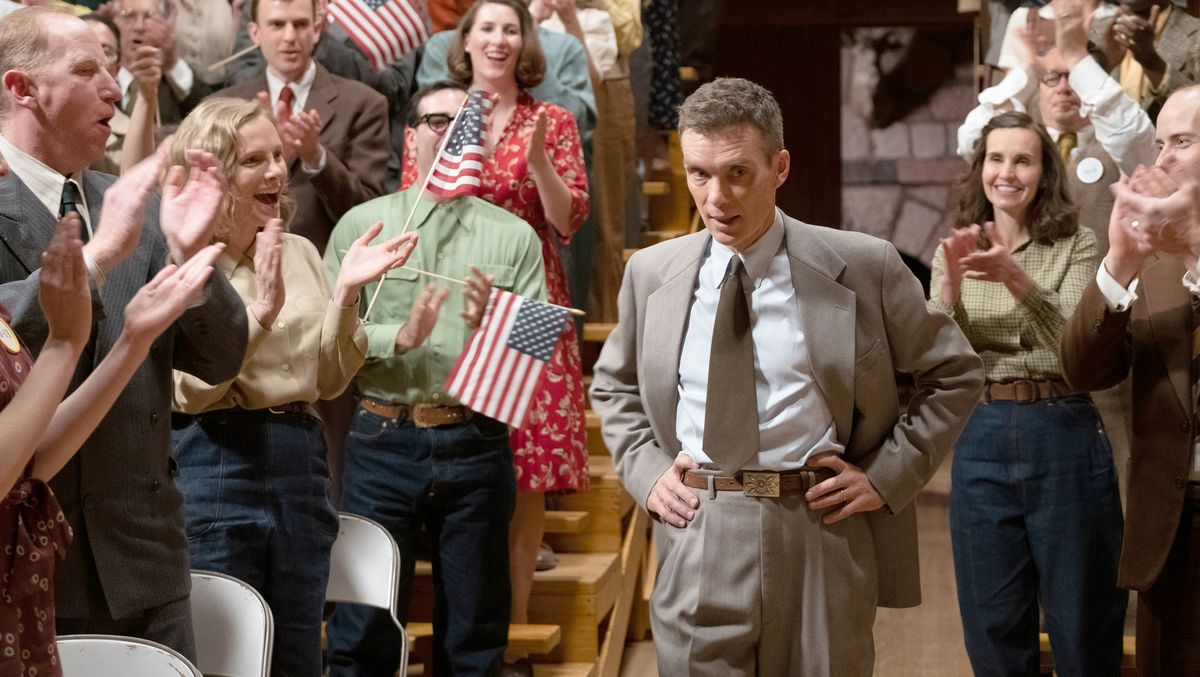
A day that will be remembered.
We continued on to lunch, which took too long to come out, played with pets (including one very heavy cat,) and made our way to Barbie at 5pm. I connected Gerwig to Ang Lee in my review of Little Women, a film which shared a striking humanism and sensitivity for modest joy with the master Lee’s Sense & Sensibility. The most obvious analog to Barbie, then, would be Lee’s Hulk, a formally ambitious, visually impressive adaptation of a seemingly simplistic property that’s being interrogated with more thoughtfulness and purpose than previously. But Lee’s film’s interrogation is achieved by amping the melodrama of the film to a mixture of psychological character study and Greek archetypal mythic storytelling. It digs very deeply into the core relationships with a lot of grimacing and distress, and it offsets that discomfort with its incredibly striking visual sense.
Gerwig goes a different direction here, though I would argue it still matches that humanistic approach. For one, obviously, Gerwig’s film is a sex comedy about the absurdity of gender norms and a political farce about systems of power and oppression. While I think it still very much takes seriously the emotional states of Barbie, Ken, and the two “real world” leads Gloria (America Ferrera, who is really great!) and her daughter Sasha (Ariana Greenblatt) it’s not nearly as built upon the Trauma of The Absent Father or The Oedipal Crisis. It trades Freud and Sophocles for intersectional feminism and fragile masculinity, and I’d argue a more pop-focused Twitter rendition of those subjects than Lerner or hooks. (Which isn’t to say Gerwig isn’t reading those books, too – just that what ends up on the screen is broader, more digestible, and familiar to those of us terminally online.)
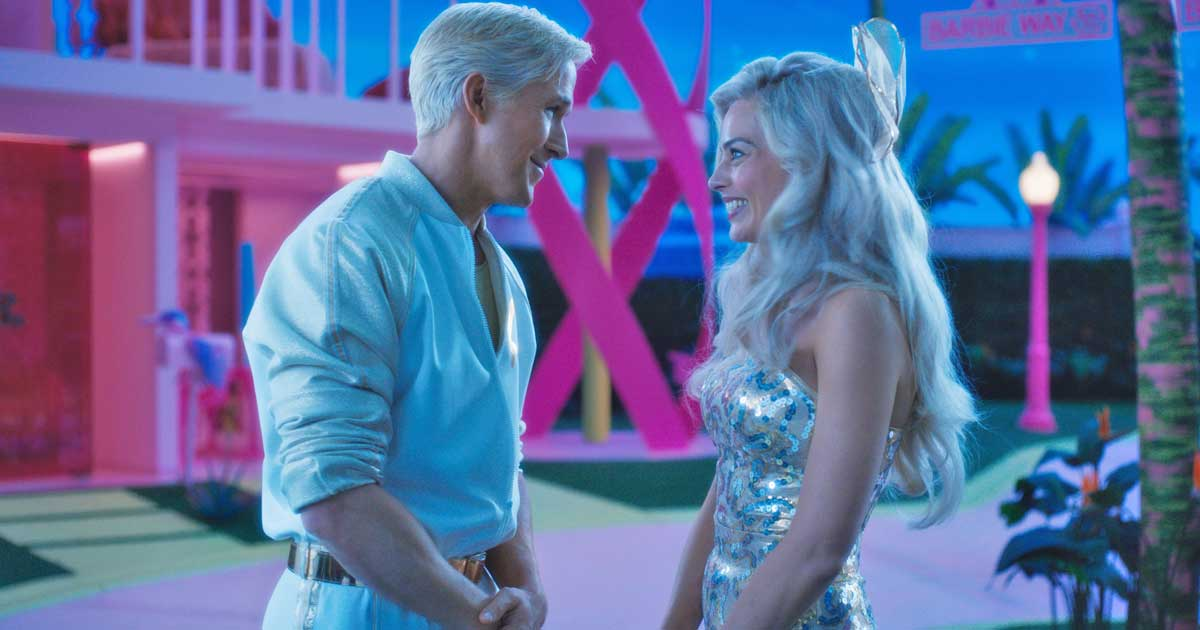
Stereotypical Barbie and Beach Ken.
But for another major difference between Barbie and Hulk, Gerwig steers clear of declaring a true villain. There are antagonists – Ferrell’s condescending “ally” profiteer, Gosling’s turn as the meatheaded version of Ken – but they never become anywhere near as unsympathetic as Nolte’s Brian Banner, a disgusting snake of a man. And that is, of course, very intentional – Gerwig has spoken about how this film’s feminism is a “rising tides” feminism examining how failure to understand how gender roles work and the standards they enforce sink everyone into the ocean. Gosling really is born to play Beach Ken, a sympathetic but deeply flawed man whose impotence and ignorance are so readily willing to channel into vengeful malice. It’s an arc we’ve been told plays out regularly these days, the alt-right pipeline that we’re told starts from men not being validated for the sexual desire.
It’s in this morass that Barbie sets itself, and it elegantly dances around getting mired in any real-world ugliness for all too long. The longest extended sequence of exploring these themes, Ferrera’s monologue, is somewhere between a “clap-rather-than-laugh” gag suited to the modern comedy scene of Hannah Gadsby and Bo Burnham and a tour de force acting moment for Ferrera. It worked for me, and it’ll work even better for the huge audience of people seeing this that aren’t embedded in daily queer lefty feminist close readings of mass media. By otherwise keeping things relatively compartmentalized, it’s able to keep its levity at the forefront, a lovely confection.
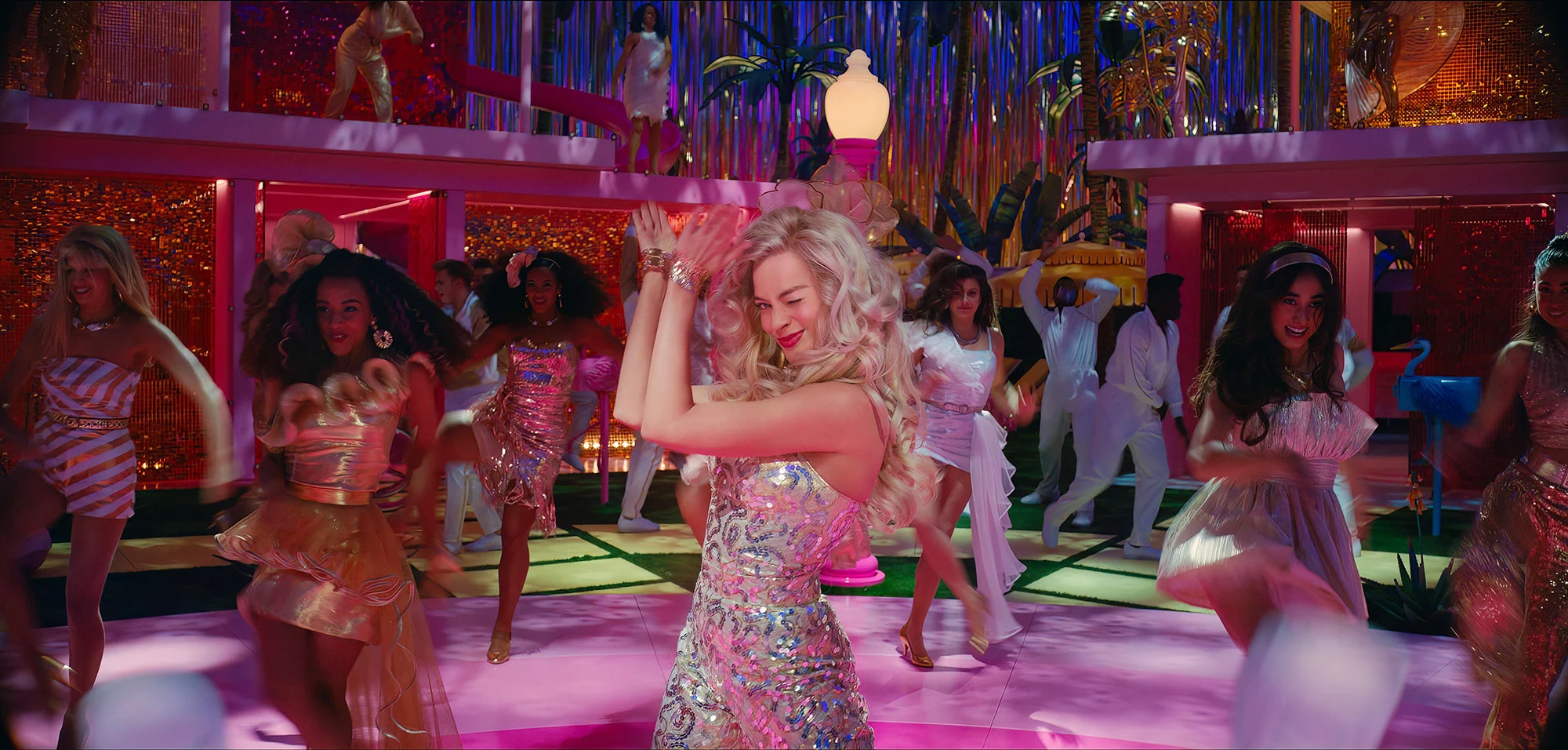
Barbieland!
While picking standout cast members aside from the leads is difficult – I really enjoyed Alexandra Shipp as Book Barbie, Rhea Perlman as Ruth, and Kingsley Ben-Adir as Benvolio Ken – it’s not hard to shower production designer Sarah Greenwood in praise. The Barbieland world looks genuinely incredible – it’s such a wonderful work of production design, and the amount of delight clearly put into making every visual choice work is really astonishing. It’s a degree of visual imagination I certainly wasn’t anticipating out of a Gerwig movie based on her prior work (though Little Women is a great looking film) and it was thrilling to see it come together so wonderfully. There’s also a couple sequences toward the end of the film that invoke the work of Donen and The Archers that I think are special both as staged and as conceived, and it’s really wonderful that they were able to get those scenes in front of so many people.
If I really was going to make the comparison to another film’s success, Barbie isn’t Hulk, nor is it Josie and the Pussycats or Clueless as I’ve seen some people say. Barbie is Austin Powers course-corrected to ensure audiences actually get the joke this time. Austin Powers is an archetype of the sex machine hero of the patriarchy turned into a freaky little goblin, and by 2005 half the male audience just wanted to be Austin and actually would ask women out loud if they “make them horny, baby.” I think Gerwig tunes this film so that everyone understands that while we love to see the Kenergy, we do not want to be Ken. Ken doesn’t want to be Ken. Ken’s going to be Kenough instead.
Also, uh, good soundtrack on this one.
At this point, I was pretty tired. We’d partied a little too hard the night before Boppenheimer anyway, and eating only one meal and some cheese curds was not a recipe for success. But Obayashi’s House is a longstanding personal favorite, and like when I saw Zardoz a few weeks ago (I went long on that one too,) it felt like a personal welcome back to Madison gift for me to see it on a big screen surrounded by friends who’d never seen it before. It was relatively low stress to be reunited with it again, and it really did feel like the appropriate meeting point of the two films I’d seen already.
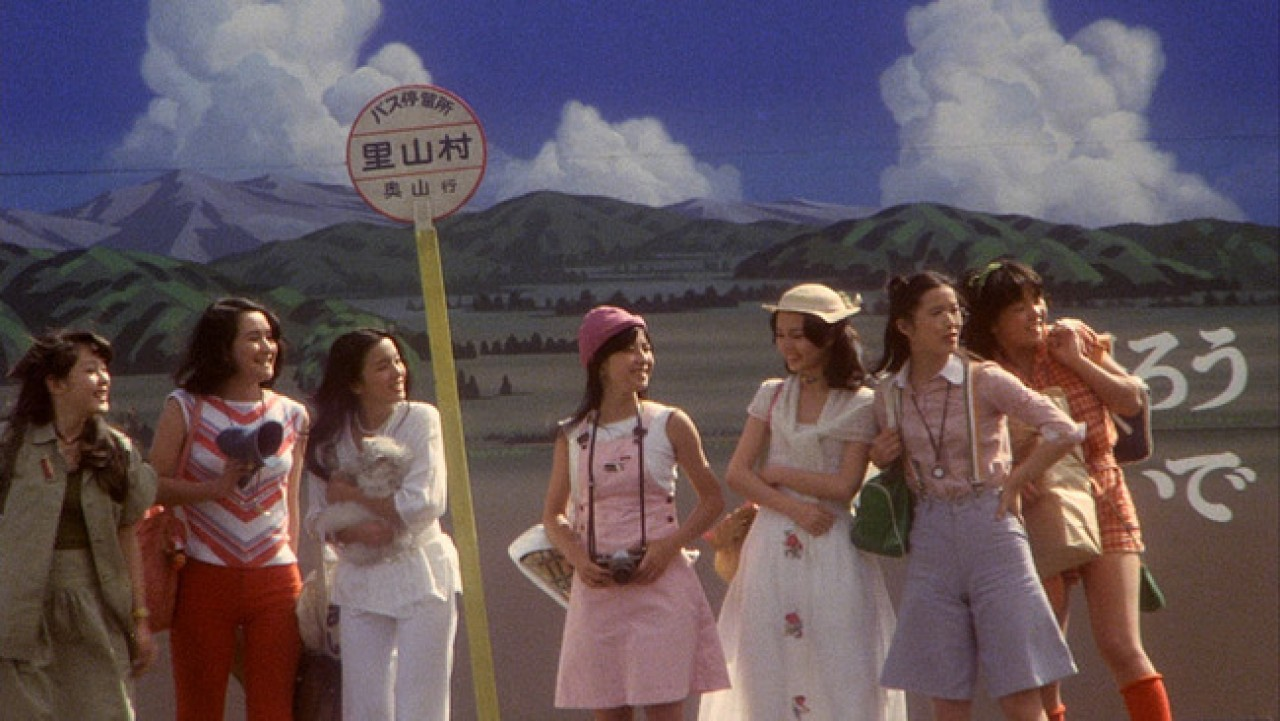
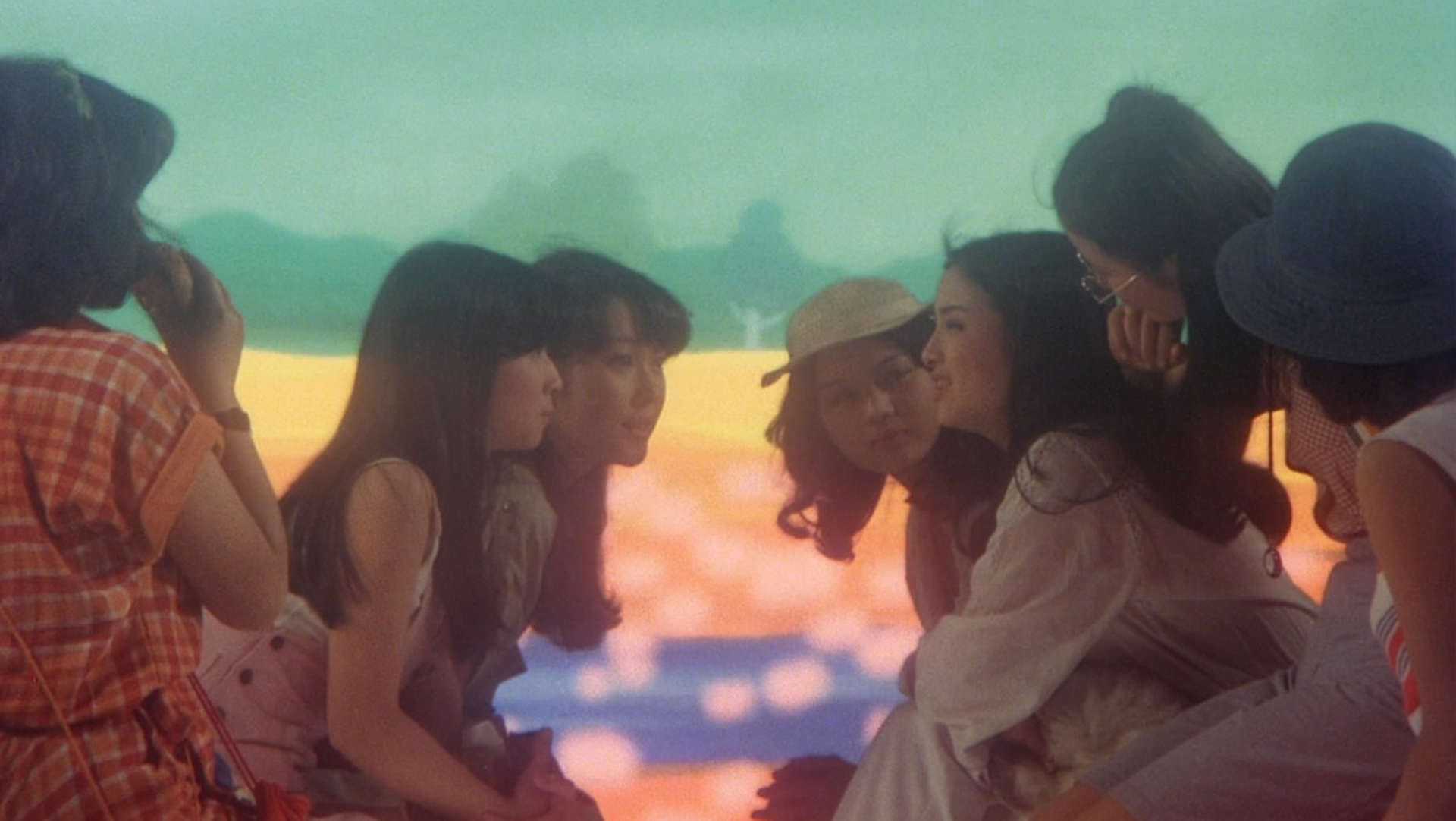
Obayashi’s history in advertising brings forward the comparisons to Barbie in a visual flair. We see absurdist comedy with stop-motion mechanics, animated backgrounds to live action sequences, flashes of sparkles and color that almost always get a laugh from the audience. But our characters, too, are stereotypes of girlhood popular in the booming shojo market of the period. There’s three named for their personalities, Gorgeous, Fantasy and Sweet, and four named for their hobbies, Melody, Prof, Kung Fu and Mac. Based on how fun Kung Fu is in this film, it’s too bad we never see Karate Barbie in the Gerwig film.
Left to Right: Kung Fu, Melody, Gorgeous, Fantasy, Sweet, Prof, and Mac.
These seven friends are planning their summer vacation, when Gorgeous is thrown for a loop. Her father is remarrying eight years after her mother’s death – unfortunately, he’s kept this a secret until the last minute, and introducing his new wife throws Gorgeous into a tailspin. She decides to cancel her family vacation and invite her friends (whose plans were thrown off by an unexpected pregnancy) to her Auntie’s house. This all plays out like a slice of life comedy, not unlike some of the TV dramas still being made today. There are cut-ins, zooms, even title cards clarifying all the names about twenty minutes in. It’s really, really charming stuff, and it lends a layer of safety and camp to the proceedings long before the horror begins.
But the tropes of these friends also end up playing them against one another, never in ways where they are openly fighting, but in ways where they occasionally diminish or dismiss one another’s concerns, limiting their expression. There’s a great scene where the other characters are trying to think logically and exactly mimic Prof’s gait and gesticulations – it’s cute, but also shows how much confidence they lack in themselves. Prof also gets hit with a “you’re so pretty without your glasses” remark that doesn’t register with her as meanspirited, but it is striking. Mac is probably the hardest to swallow – her thing is eating too much, and the other girls make comments about her weight (which she objects to frequently!) Fantasy really gets the worst of it, constantly having her witnessing the supernatural horror which will swallow them up as her daydreaming and imagining things. If these roles weren’t so defined, they wouldn’t be so easy to entrap – and Auntie’s magic snares don’t have to work very hard to pull them to their dooms.
The first piece of inspiration for this movie – Obayashi’s daughter being afraid of a “killer mirror.”
House’s connection to Oppenheimer may be a little more subtle, but it’s a matter of understanding the horror of the film. In an early sequence, Gorgeous shares the backstory of her Auntie in the form of a silent film all the girls watch together. She’s a young woman who became affianced to a young doctor in a small town. The young doctor is drafted into World War II – he promises to return to her, and she promises to wait for him. When he’s shot down, she decides to wait for him for the rest of her life in the titular house, and after her sister is married, she waits alone. And she’s really, truly alone – the last time Gorgeous has seen Auntie was ten years ago, when Gorgeous’s mother was still alive. When Auntie receives the note of her lover being missing in action, we see blood fall from her hands and a baby cry – we hear this baby’s cry again late in the film, during the climax, when a deep blow has been done to the ghost running the house.
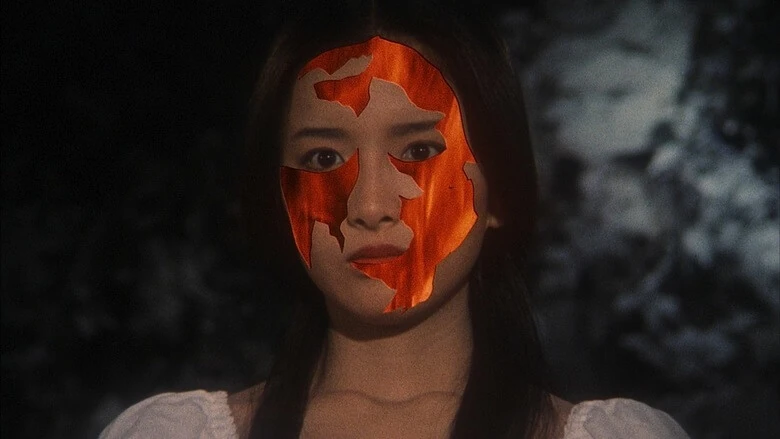
This backstory frames the film’s central haunting as a tragedy. After the war, this widows who survived her dead was paid no real mind – if her pain prevented her from simply finding another willing man, she was isolated and abandoned. In a moment where Fantasy frames this devotion as romantic, the film cuts to the atomic bomb. Obayashi himself was a child of Hiroshima, losing all his friends in the bomb at age 7. A diary found toward the end of the film reads, “There are no young women in the village now. I’m all alone.” This is ambiguous, as it may have been written before Auntie died and became the witch-spirit haunting the old house, or it may be after she’s eaten all the young women who were left. This violence against Auntie, the lack of care paid to unmake this single-minded devotion, creates a cycle of violence and misogyny which leads to her quite explicitly becoming a predator upon the virginal women who she entraps in the house. It is a chain reaction, the violence begetting violence beginning with the war and ending upon seemingly kind, innocent young women who know nothing more than the basics of history book lessons in school.
The train scene.
It is this sadness which underlies House’s scares, and yet Obayashi maintains incredible levity throughout the film. The visual invention on display and his incredible management of tone (including the expert use of whiplash) is the anchor through what is, admittedly, a story told in bizarre sequence and, underneath the effects, a pretty sad conceit. The aforementioned sequence in which Gorgeous tells her Auntie’s story is preceded by a child reading a picture book about the trains of Tokyo – it zooms in, and briefly, the film becomes animated in the style of the picture book, zooming along past Mount Fuji. When the background changes to a grassy glade, Sweet leans in to ask Gorgeous about her Auntie – they talk about this in front of the animated background, beginning the story, before cutting to Auntie’s story. There’s dancing skeletons, carnivorous pianos, bucket-butt slapstick, butt-biting and cats, cats, cats.
The fact remains no one else could possibly have made House. In order to replicate the feeling of it, they had to release two epics on a single day. Anyway, do Oppenheimer before Barbie. You’ll need the Kenergy before going to bed.



 All My Friends