ONLY LOVERS LEFT ALIVE

ONLY LOVERS LEFT ALIVE
Dir. Jim Jarmusch
2013

Core dividing lines on the reception of Only Lovers Left Alive come down to one question – are the immortal vampire artists Adam and Eve, portrayed as burned out gen-X rock idols by Tom Hiddleston and Tilda Swinton, the coolest icons of hipster culture ever or semi-pretentious dorks? Division on that answer sets up so much of where a viewer’s sympathies lie, whether or not you think their lives are suffocatingly tedious or eternally romantic. I was originally set up by film critics to believe they were meant to be as cool as Jim Jarmusch himself, and in watching I realized too many of the film critics I read spent most of their free time reading Wikipedia pages about the Christopher Marlowe/William Shakespeare conspiracy and Rolling Stone magazine. To be clear, I actually think the film works either way – it’s just that it creates a huge split on how you choose to read the central characters.

According to Adam, the world is dying. The “zombies” (read: us) are polluting our spaces and our bodies, fighting over oil when we should be fighting over water, desecrating our architecture and dishonoring our scientists. All the vampires are experiencing some of the negative outflow, here – human blood itself is more full of toxins (well, toxins to vampires) and a bad batch can spell the end for these immortals. He’s taken on the persona of a reclusive rock star who doesn’t want any of his music being published, a droning noise rock played by Jarmusch’s own band SQÜRL. If you see Adam as the arbiter of cool, this dismay is cosmic in scope, an indictment of humanity – we have a living god, and we have failed him. If you see him as a self-pitying dweeb, you hear him say “I don’t have heroes” and it’s easier to notice when Eve finds his wall of fame with photos of Buster Keaton, Jimi Hendrix, William S. Burroughs, RZA.
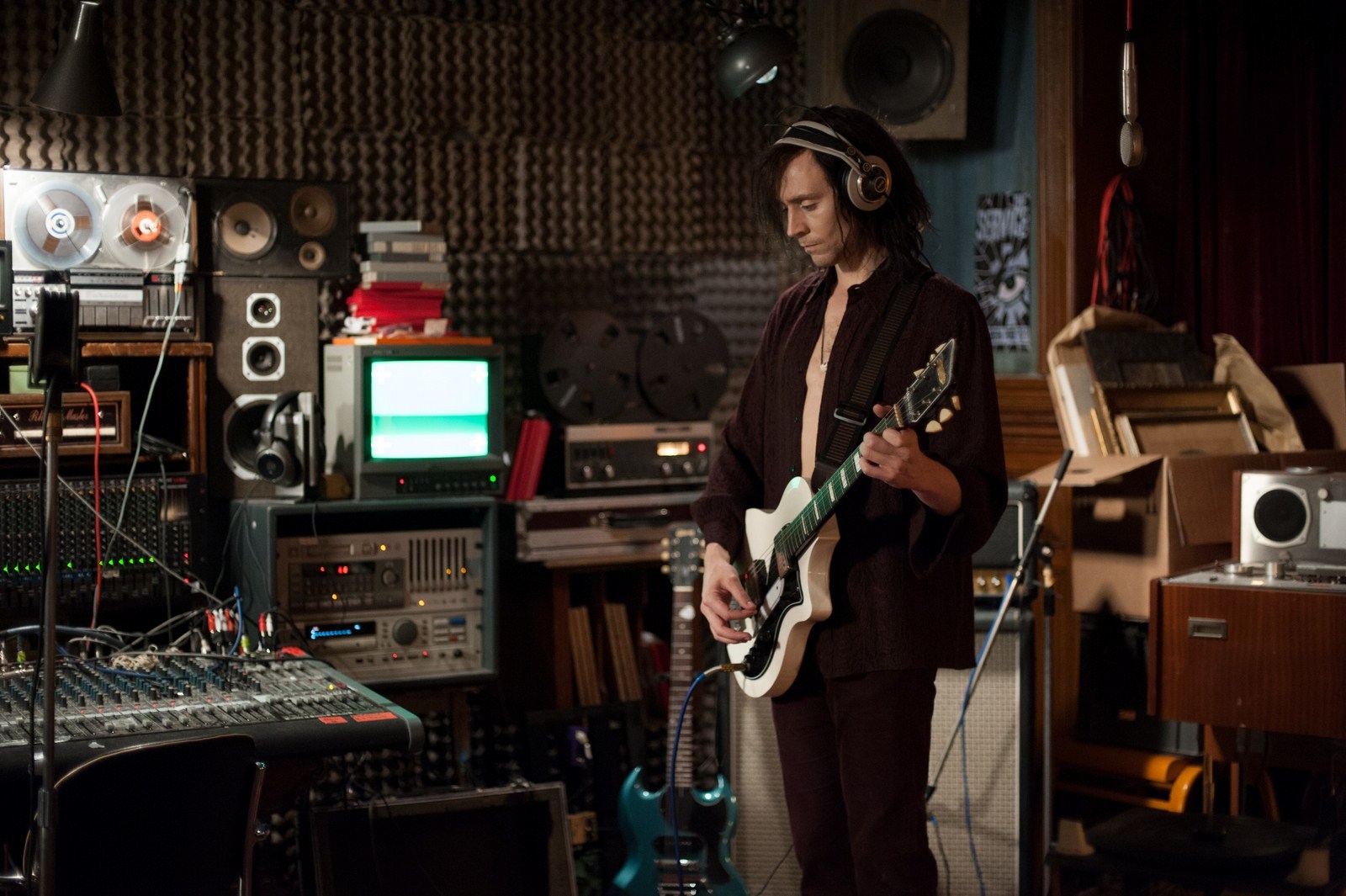
Adam, riffing on a level that is frickin sublime.

“I don’t have heroes.” Adam actually doesn’t have heroes. Heroes fight valiant adventures and die. He’s made art religion, and these are idols. The work got out there – they’re immortal. Gods. He knows as well as anyone that the world is still alive. And we see that reinvigoration happen late in the film when he sees a live performance and finds it admirable. Eve tells him about the singer and says, “She’s going to be very famous.” Adam says, “God, I hope not. She’s much too good for that.” Shut up, nerd!

But whether or not they’re performing some of the exhaustion, Adam and Eve live sad, tired lives. They’re married, and they love one another, but they also need years or more apart. They’ve built lives on different continents because they badly need their space. Adam is contemplating oblivion – Eve is a little more comfortable because of her friendship with Kit Marlowe (John Hurt, perfectly warm) but knows he’s starting to become less lucid. While they take joy in so many little things, so many familiarities, they despair in different resignations. Eve is certainly more upbeat, but Tilda plays her as a little too placid, a little too indifferent, and the moments of sincere disappointment bring out a volatility.
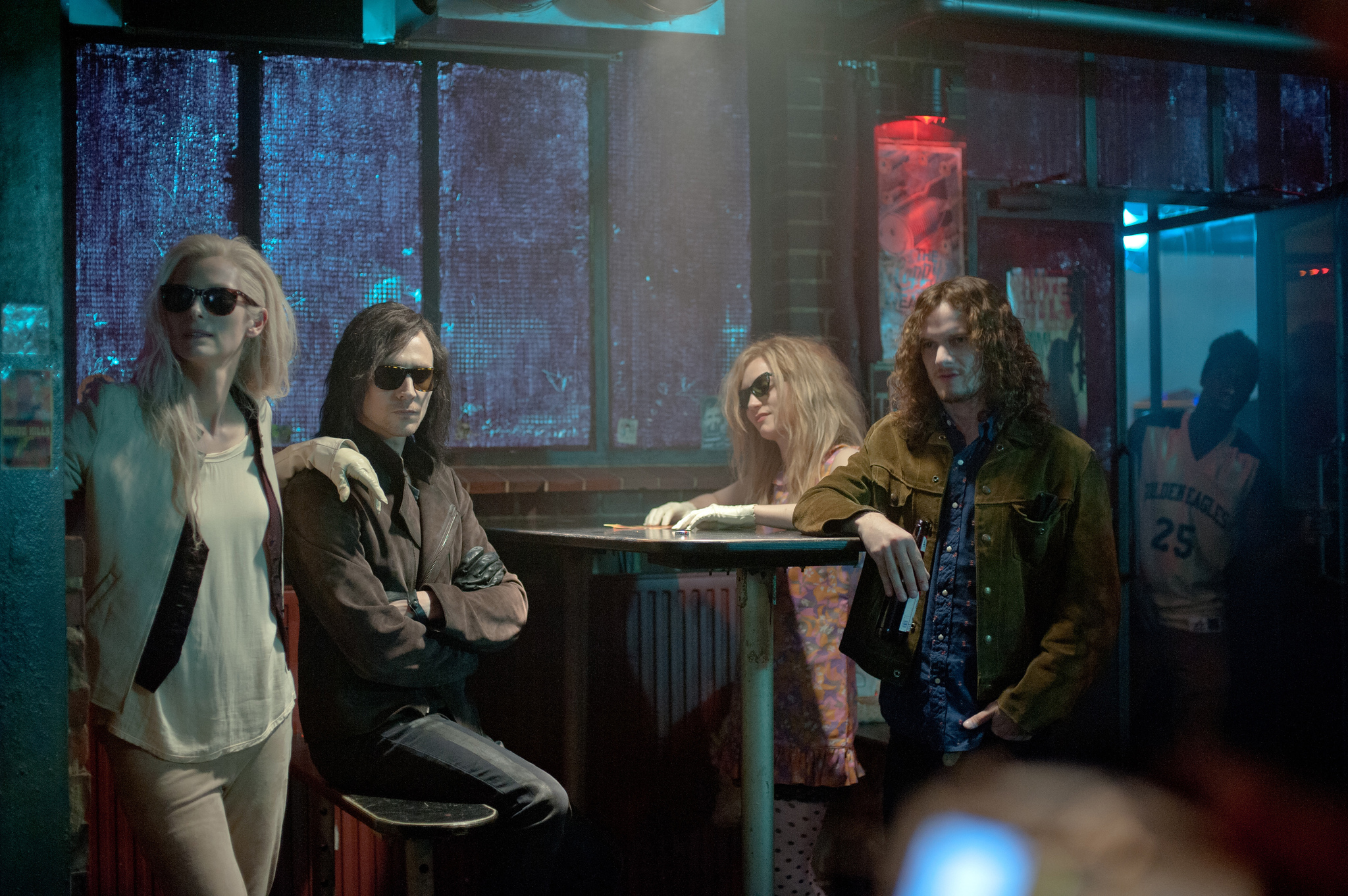
Eve, Adam, Ava, and Ian at the White Hills gig.

That sadness comes between so many little bouts of tastemaking, art celebration, and is surrounded by a very funny supporting cast. Anton Yelchin plays the sweet Renfield to Adam’s Dracula, a young rock fan named who seems to be a middleman for expensive goods. He’s deferential, naive, and overwhelmed to meet people he admires. Jeffrey Wright plays Adam’s supplier of “the good stuff,” and his big scene is so funny, played as a too-cool-for-school doctor and dealer. Wasikowska plays Eve’s sister Ava as a menacing socialite lush, and you immediately get why Adam is so loath to let her visit. The movie is funny, cute, and everyone is having a good time. It’s really only when Jozef van Wissem’s lute score takes focus that the tragedy will set back in.

Hipster cool is consistently identified as the core of Jim Jarmusch’s appeal beyond the independent cineaste landscape. He exports cool bands, cool actors, vibes, and haunted landscapes in urban settings. That Gen-X cool is also occasionally appropriative, performative, and insular. I think what makes Only Lovers Left Alive stand out among Jarmusch’s films is that it gives the audience space to both admire and laugh at the speed with which these hipster vampires can identify wood grain by its Latin name or cite the exact year of a release. That admiration and amusement doesn’t come at the expense of the film’s dramatic stakes, either, and it became a gateway to the slow cinema Jarmusch has often cited as an admiration.
HEARTHSTONE: HEROES OF WARCRAFT

Hearthstone: Heroes of WarCraft
Blizzard Entertainment
2014
PC, Mobile

Of all the games I’m writing about this month, Hearthstone is the one I’m most embarrassed to have given so much of my time and energy. A quick-play, simplified rerun of Magic: The Gathering, Hearthstone is ugly, unbalanced, and largely based on lore I don’t care about at all. I loved WarCraft III when it came out, but I never made the jump to World of WarCraft, so the vast majority of card references are totally lost on me here.

The basic premise is very familiar to Magic players. You and your opponent have 30 card custom built decks of creatures, spells, and weapons. Each turn, you get energy in the form of mana to play cards that can attack your opponent’s creatures or their life total directly. Every turn, you get more mana, so you slowly ramp up from early jabs into colossal game-defining uppercuts until you or your opponent is defeated. The game is in building your deck to be as consistent at winning as possible and defend itself from your opponents’ strategies.

The thing it took me so many years to stop admiring about Hearthstone is its dedication to using the tactility of a collectible card game, which I’ve loved since the Pokemon TCG I grew up playing and collecting, and combining that with its digital format to do things that were completely impossible (or, at least, immensely inconvenient) in a tabletop card game. One of the simplest, “Discover,” gives you an opportunity to add one of three randomly generated cards to your hand. In real life, this would require both players having a semi-unlimited number of every printed card to function – digitally, you can just give someone the opportunity to use this card they might not own for a single game.

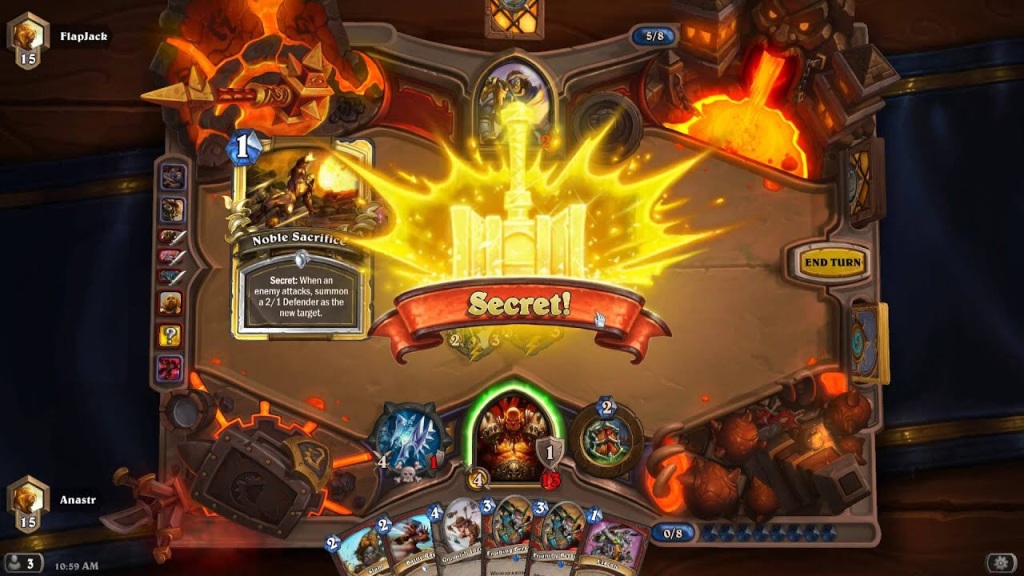
like cmon man this is so garish garrosh

There are mechanics that reward having only odd or even cost cards in your deck, mechanics that shuffle five random super-rare cards into your deck, mechanics that require players to only have one of each selected card in your deck (rather than the typical max of two) to get access to a special effect. These mechanics could maybe be achieved by registering with a judge before a given game or by owning a massive library of cards to play with, but they’d be onerous to track at best.

Hearthstone is at its best when it takes advantage of its digital format. Its single player adventures take advantage of asynchronous gameplay to create memorable puzzle-card gameplay. But, over five or so years, the number of mechanics forced a power creep and level of investment that made the game completely inaccessible to newcomers. I think many of its best mechanics have been lifted into other digital card games like Slay the Spire, Inscryption, and Balatro. The game’s last gasp for me was its Battlegrounds mode, a direct riff on the DOTA AutoChess mod that never quite offered anything on top of that formula other than “more money.” I haven’t played in years, and probably never will again, but I’ll always appreciate the excitement Hearthstone showed toward combining tabletop and digital card games and pushing that genre into a new era.

NIDHOGG

NIDHOGG
Meshoff Games
2014

Two duelists meet in the battleground. Sometimes it’s a castle – sometimes a waterfall – sometimes Valhalla. They jab, deflect, jump, dodge, and spar until death does them part. This is the “normal” part of Nidhogg. Then they run.

Nidhogg is fencing football. The player who’s most recently won in a duel takes possession of the screen and sprints toward the opponent’s goal. Whoever makes it there first is swallowed by the titular world-devouring serpent for an audience of cheering fans. The other player will be reborn every few seconds to make a valiant defense and stop them, and if they win, they take possession and start running.

This ends up making for some of the most frantic twitch gameplay I’ve ever seen. It’s easy to pick up and play for two people who have never played before, but it’s also full of details  that make it difficult to master. The duelist can hold the sword at three different elevations – holding your rapier at the same height as your opponent’s thrust can block attacks, but raising or lowering your blade over the opponent’s sword can knock it from their hands. Holding the sword up above your head leaves you defenseless, but it also allows you to throw the sword at your opponent. After deflection or a throw, you can run faster, but your only defense is a smartly timed kick.

All of this is rendered in crazy pixel graphics. Your technicolor duelist bleeds their color all over the battlefield, leaving a paintball arena of battle spoils as you run back and forth over the course of a match. The animation is so precise and well-animated that each action feels snappy and responsive while also feeling expressive and surprisingly violent. The music by indie musician and producer Daedelus is synchronized to player action, so every game has its own unique soundtrack. It’s a simple game that’s easy to read – playing with friends makes for a great pass and play game.

Video games are so cool, man. I play the sequel, Nidhogg II, at I/O Arcade Bar every time I go – in the sequel, your dudes are nastier, the game offers a bunch of different weapons, and there are even more crazy stages to fight on. I still prefer the simplicity of the original game at home, but the madcap experience of playing with friends hasn’t gotten old a decade later.

SYRO

SYRO
Aphex Twin
2014

Richard D. James, better known as Aphex Twin, referred to his most recent full length album as his “poppiest album yet.” I don’t know that I necessarily think anything here is more accessible or friendlier than “Alberto Balsam” or “Windowlicker,” but relistening to Syro, I’d forgotten just how melodic and beautiful the album tends to be. The earworm that’s been in my brain for a decade is “180db_[130]”, maybe the album’s most frantic dance cut, high drama that fits voguing or an evil movie nightclub more than an actual night out. When I spend time away from Syro, that harsh synth melody overtakes the more austere beauty of “XMAS_EVET10 (thanaton3 mix)” or “”syro u473t8+e” (piezoluminescence mix).”

You’ll also notice, if you’re unfamiliar with the album, that unless you’re listening to it so frequently you’ve got these titles memorized, that the album resists identifying individual tracks. According to James, the album consists of ideas written over six or seven years, none he considers forward-looking experimental music, all of which he considers ruminations on the past. The variation on this we might be more familiar with are letters and poem series, titled by date or sequence rather than by something more poetic and evocative. Most interpretations of the track titles here are descriptions of gear and technical detail – “minipops 67 [120.2]” refers to the MiniPops drum machine, likely take 67, set at 120.2 BPM, lord knows what a source field mix is. The album cover includes a record of the album’s production and promotional costs. Despite being a “pop album,” this is a documentation of a period of time more than a Concise Statement.

I’m as far from a scholar of electronic music as they come. I hear stuff, like what I like, integrate it into my playlists, and roll on. So when people say this is a culmination of thirty years of electronic music history, I believe them. I hear playful reverie, memories of holidays past, reflection on a quiet afternoon. I hear the soundtrack to a nightmare movie rave. I hear a feeling that the form has been mastered and now it’s simply about the pleasure of creation. These thoughts are abstract, and I’m not sure I could map them for you directly to a timestamp or even a track title. By disconnecting the music and its context, James has created a throughline from electronic instrumental music back toward the sort of classical roots. This album exists because the studio and equipment to create it existed and demanded to be played.

James has continued to make music, releasing EPs every few years rather than full length albums. He’s toured once in that time and played sporadic festivals as well. Based on the teaser timeline set last year leading to the EP “Blackbox Life Recorder 21f/in a room7 760”, he’s due to disappear for another couple years before giving us another bite sized update. Between Syro and the previous full length album, Drukqs, James claimed he’d written six unreleased albums. It’s possible that like some classical composers before him, there are hundreds of recordings we won’t hear until a century has passed. I hope selfishly to get to hear some of his beautiful sounds sooner.

KEY TRACKS: “minipops 67 [120.2],” “XMAS_EVET10 (thanaton3 mix)”, “180db_[130]”

CATALOG CHOICE: …I Care Because You Do, Richard D. James Album

NEXT STOP: Black Origami, Jlin

AFTER THAT: Flamagra, Flying Lotus

MINI METRO

MINI METRO
Dinosaur Polo Club
2015
PC, iOS/Android, Switch, PS4

Most games that get cited as “perfect” are either so purely gameplay that they can be modified to fit any aesthetic you want or require such a bizarre cocktail of ideas that they cannot be replicated in any other medium. Tetris is a beautiful game of mechanical perfection – the two best Tetris games of the 21st century, Tetris DS and Tetris Effect, transform the game in wildly different ways. The former, Tetris DS, is a celebration of Nintendo history with a Capsule Corporation menu aesthetic, borrowing sprites directly from NES classics including The Legend of Zelda and Metroid. The latter, Tetris Effect, sends Tetris into the new age stratosphere, with a sea of stars and a pulsing electronic soundtrack, a vibe somewhere between Burning Man and cult imagery. Alternatively, you can have the Super Mario franchise, where you have to cohere overall plumbers, giant turtles, extreme anime pop visuals, and ragtime or big band soundtracks – there is no dramatic “genre” or “mode” that this fantasy obviously fits, no game we play in real life that this matches beyond “pretend.”

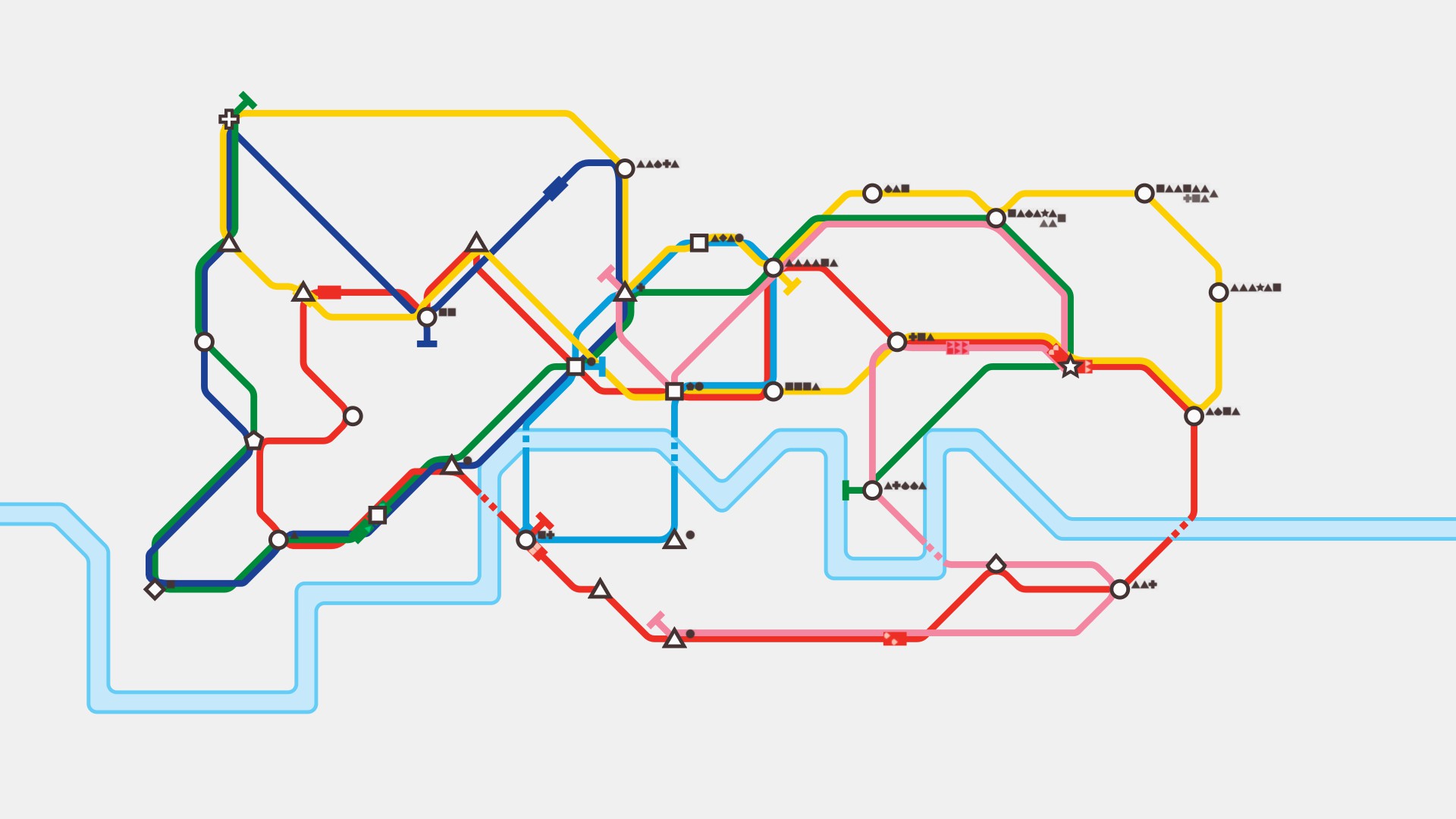
Mini Metro illuminates the gap in this contrast by combining its pure gameplay with an immediately identifiable aesthetic that instantly teaches the player how to play it. The game takes place on a topographical railway map. Different shapes appear over time representing stations – each station starts receiving customers, represented by the station shape they’re trying to travel to. You draw rail lines between these stations (with just a drag and drop, easy as can be) and immediately trains start trafficking them along your drawn railway. Your goal is to keep the system running as long as possible before a station’s capacity overflows.

Drawing an effective railway is not simulated purely by distance, but also by the order you’ve drawn your stops – rerouting a line may result in a cleaner pathway that allows the train to take a turn smoothly rather than having to stop at a 180 and build speed again. Each in-game week, the city invests a little more funding – this can take the form of tunnels and bridges for crossing water features, additional trains to travel your rail lines, or additional lines of travel, each represented by their own bright color. The game comes down to drawing smart, efficient lines, and managing your choices in investment to protect yourself from accidentally hitting a dead end. 

Designers could complicate this system and add currency for each rail line, add structural concerns for bridges about how long a carriage can cross safely, include “quality evaluations” along the way for earning extra bonuses from investment. But every decision in Mini Metro stems from the core concept of the aesthetically minimal topographical railway map. These ideas are not those represented visually on the map, and so they’re never introduced. Even the game’s soundtrack (by It Follows/Fez composer Disasterpeace) exists only in the forms of tones which play when passengers arrive or depart from a station. 

A London run at its conclusion.

What separates Mini Metro from other “perfect” video games in my mind is the fact that it so directly looks at a real world concept and adapts it into a compelling and legible game. For comparison, Tetris began as an imitation of a pentomino puzzle game – in a sense, that relates back to Tetris, but the game is also an imitation of other box filling games, not a real world phenomenon. It’s a signifier of a signifier, never quite reaching back to whatever the original meaning was. Shigeru Miyamoto came up with the concept of the Pikmin series because he’d gotten into the habit of gardening and liked imagining a little world in his garden – but the experience of commanding Pikmin as a small military and using them to perform a long-term scavenger hunt has almost nothing to do with gardening. 

Development on this game started after a trip on London’s Underground – even if it hadn’t been London, it’s hard to imagine this game starting any other way. I’ve only encountered city train systems while traveling, and I still can so quickly understand what’s happening in the game because the gameplay is so well communicated by the iconic aesthetic. The railway map design allows the game to abstract more literal simulation without losing focus on the game’s actual intent, which is managing and designing an effective transit system. It’s a motivating game design philosophy, a reminder that play can be right in front of our noses rather than requiring the imagination to create a funny little plumber who shoots fireballs at kappa. Mini Metro is ingenious in the same way the George Dow and Harry Beck transit map model itself is ingenious, communicating where the trains go without literal geography, using easily recognized symbols to communicate importance, and using attractive bright colors that catch the eye and linger in memory. 

Desert Golfing 1

Because this piece is no longer available in The Daily Cardinal without use of intense google-fu, I’m reposting it on my own website. This piece originated in The Daily Cardinal’s Arts section on September 29th, 2014.


Some might say that beginning my residency as The Daily Cardinal’s video games
columnist with an editorial on a mobile game is inauspicious. But amidst the
several titles entangling me, none pull as much focus as the stark “Desert Golfing.”
Described by iOS developer Adam Atomic (“Canabalt,” “Hundreds”) as “the ‘Dark
Souls’ of ‘Angry Birds’”—perhaps the most absurd form of description, akin to the
constant ringing question begging, “When will video games have their “Citizen Kane”
moment?,” whatever that means—it is a spare experience that closely evokes the
beloved RPG’s unforgiving indifference.

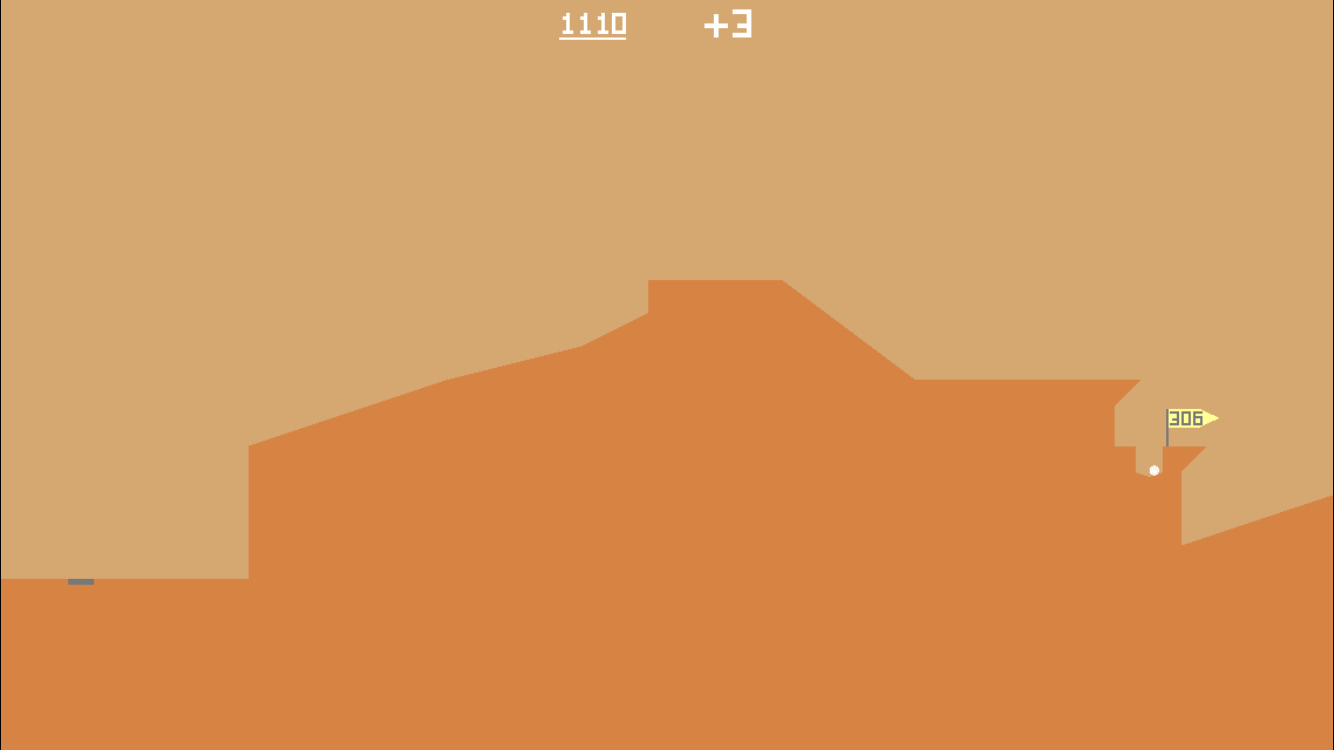
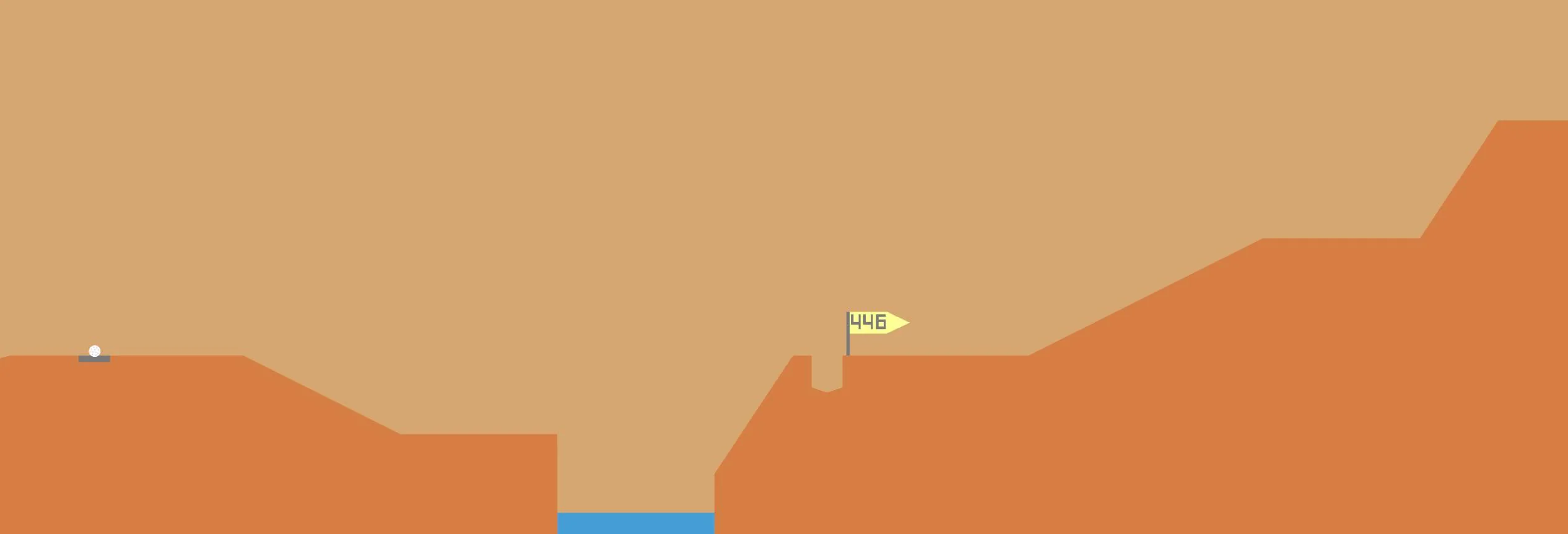
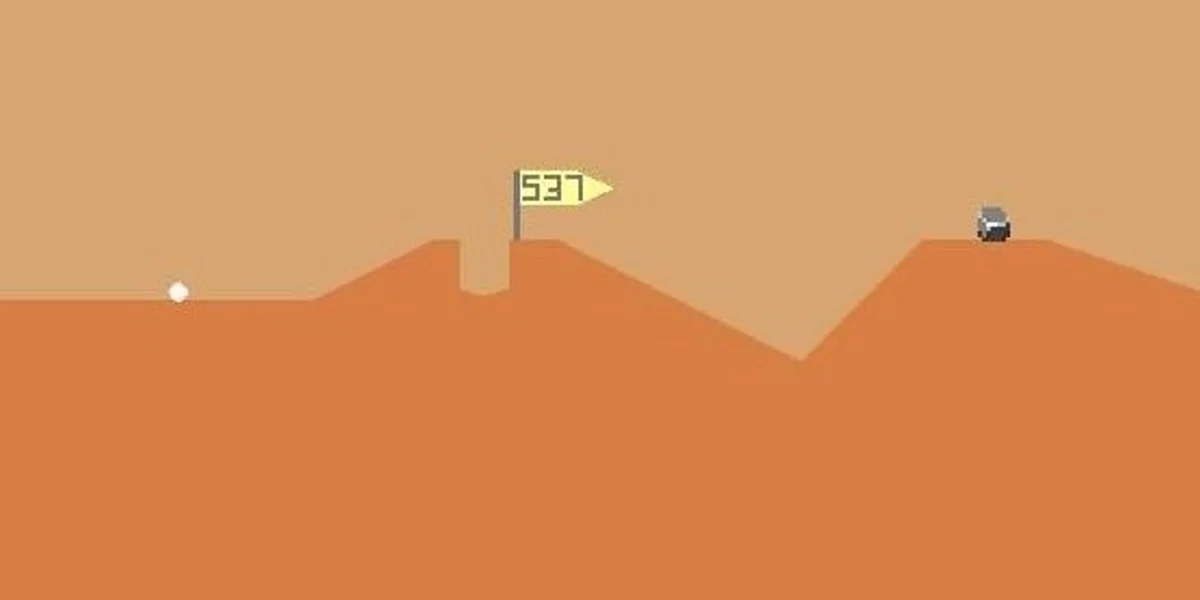
The game’s presentation is flat and hot; a light brown sky is delineated against a
rough and imposing dark orange landmass. Like a construction paper collage, the
angular hills defy the often-natural rolling dunes. Other times, the land towers above
the small white ball at impossible angles, revealing the constructed nature of each
hole. When the first prop appears beyond simple land and hole flags, it does so
without fanfare, yet it simultaneously serves as a secret to be uncovered and a
fascinating invigoration, an omen that, yes, there is more to discover in this vast
wasteland.

The game presents itself in the iTunes store with a short haiku: “To see a world in a
bunker of sand/And a heaven in a wild cactus,/Hold infinity in the pocket of your
shorts,/And eternity in Desert Golfing.” It appears to be near endless. At hole 2172, I
have yet to feel a need for the game to end. The furthest hole I can find a peer to have
reached is hole 2884.


Yet the game must have an end, for it is clearly authored and personally manipulated;
unlike “Minecraft” or “Flappy Bird,” each player encounters the same courses (as
made evident only by a handful of diligent players posting screencaps to Twitter) and
no one has yet reached an “impossible” course. The continuing journey towards the
game’s denied conclusion is not so much a race as a pilgrimage. And, yes, those
farthest along the two-dimensional path are reporting that there is something to see
upon the horizon.

Swinging at the golf ball is performed exactly as one might launch a red bird at a Bad
Piggy, albeit the game permits you to place your finger wherever on the screen you
might like. Its difficulty often lies in the treacherous nature of its sand; most golf
games use sand as an occasional trap, impossible to escape without using too many
strokes. “Desert Golfing” offers no such escape from the sand, but as a result offers
advantages one might not have previously perceived in the frustrating particles. Sand
will catch a ball as easily as it will allow it to move each simple grain; the ball is
capable of stopping on an incline if it arrives there at the proper angle, but will
tumble or, worse, bounce if granted a bit too much angular momentum.

A simple score counter hangs atop the screen; rather than offer your average-per-hole
or total strokes per 18-hole course, the game keeps a constant count, tallying your
every swing as you ascend into the hundreds or thousands of holes. In one sense, this
is freeing; there is no end in sight, allowing players to swing to their hearts’ content and improve their scores later, upon easier holes. Simultaneously, every swing takes on meaning towards the hole. There is no resetting the game and “starting over to improve one’s score;” your mistakes are only altered by improved performance over the continuing sands.

Time-wasting is often how mobile games are excused for their simplicity, but “Desert
Golfing” offers a meditative experience. With so little detail, the focus must simply be
on the mechanical; “aim, pull, release, observe, repeat” is its rhythmic drum. Games
often feature this same rhythm; September’s largest release, “Destiny,” offers the
same promise of the sublime upon the horizon and the same sort of “aim, pull,
observe” rhythm, albeit with grander skyboxes and sand and a far smaller geography.
“Desert Golfing” is available on iPhone and iPad for $1.99, and on Android devices for
$.99.

I’m Flushing My Animal Crossing Town.

I walk through my little fruit groves, perfect oranges and succulent peaches hanging from beautiful green trees. My town’s fountain is surrounded by flowers, and a bridge has nearly finished reconstruction just nearby. Before I cross the river, I stop in at Brewster’s Cafe. He mutters, “Coo to see you.” I sit across from my old friend, knowing that Mayor Alex isn’t going to see Brewster again.

I offer to work part-time for him one last time, and I question whether or not I should close my town. And as I work the counter, my favorite resident, Freya, asks for her mocha. I question my move again. And then, of course, my next customer is Samson.

Image

Samson. I’m so sick of Samson. I’ve had Samson in three separate villages throughout my Animal Crossing career over the last ten years, and he’s always been one of my least favorite villagers. I’ve done everything in my power to get him to leave. And then I remember that I’ve been trying to get Camofrog to leave too, and then I remember that I’ve had two villagers in the last six months that I’ve wanted to keep, and they remain two of four villagers I want to keep at all.

I love the layout of my town. It’s very convenient, and leaves plenty of room for an orchard. But my two favorite villagers, Twiggy and Papi, both left without warning during my absences. I’ve had a string of bad luck. So I could either wait eight months for these villagers I dislike to move out (of course, if another Gwen, or Broffina, or Limberg, or Hans were to move in, that would be worse still!) or I can restart and hope for the best.

My girlfriend is storing my stuff. It’s nice that Animal Crossing New Leaf makes it so easy to store things. And I’ll miss the progress I’ve made. It’s modest, to be sure, but I can pretty much do what I like. I just need new neighbors. Some people might point this out as a flaw with the game; MOST of the villagers are “not awesome,” so why do I praise the relationships in the game?

Well, I think most of the villagers are pretty rad, but even aside from that, even many of the most reviled villagers have their fans. The Tumblr community assured me that people do in fact like Hans and many of my least favorite villagers. I just can’t get past them.

Image

Like everything in life, sometimes you just need a change of scenery. Goodbye, Grænvale. I’ll miss your tall fruit trees and your beautiful rivers. But, well, I certainly won’t miss Samson.