Last year, I celebrated my birthday by publishing 60+ write-ups about my favorite movies, albums, and video games. It’s one of the most rewarding creative projects I’ve ever taken up, and I look back at those pieces with pride and share them when a friend picks up something I love. On top of just having enjoyed the process of publishing so many words, I enjoy having the pieces to look back on themselves, a testament to my thoughts and feelings about a work, maybe not the totality of what I want to say about something I love but a representation of some of that love.
I aspired to do the same project this year, and every year moving forward. Depression and motivation got away from me. Some of that writing energy went into Horizon Line, which I’m very proud of writing each week, and I also accept that it’s taken up some of my creative energy to maintain. I have far fewer pieces ready today than I did in 2024.
Rather than abandon the project entirely, I’m adjusting the timeline. Last year, I published 60 pieces in 30 days – this year, I’m committing to spending at least 20 minutes per day writing, probably with an interruption or two related to work or celebration, until I hit at least 60 pieces. That may take the summer – that’s okay! I’d rather have the gift to myself of celebrating my favorite works than cut myself the slack, and the timeline will matter less than the reward.
Anyway, expect to see me post a new piece to my site every few days for the rest of the summer. I have eight pieces drafted so far. I’ll publish one per day for the next week and see where we go from there. If you’re reading what I’ve written and enjoy it, please let me know! The encouragement will help with the motivation, and I’m sure I’ll be happy to tell you about the stray thought I had the day after publishing that didn’t make it in the piece.
As these articles go up, they’ll continue to be linked from this landing page. The ones I have written out but not linked are still in the drafting process.
Released just a couple months before the full staff resignation at Annapurna Interactive, Simogo’s newest puzzle adventure game Lorelei and the Laser Eyes marked the first in a multi-game deal with the publisher following the success of their previous title, Sayonara Wild Hearts. That behind-the-scenes drama may be responsible for the game’s relatively low profile, but I’d also venture to assume it’s the game’s devious reputation for difficult puzzling that has won reticence from potential fans.
However, Lorelei and the Laser Eyes represents the apex of the studio’s puzzle games. Compared to Year Walk and Device 6, Lorelei is easily the fairest, most compelling, and deepest puzzler they’ve assembled. The game is played entirely with movement controls (joystick or d-pad) and an action button – every button on the controller not dedicated to movement operates on the same control. If there’s no contextual action to complete, like reading a sign or accessing a locked door, then the button opens your main menu, where your full quest log of “mental notes,” your inventory, and every important document, map, design, or clue is stored in Photographic Memory. While this game uses many puzzle languages, it also contains all the information you need to complete the puzzles in question – the few times my wife and I resorted to hints over the game’s hundreds (thousands?) of puzzles, we always found that it was a logic gap between us and the solution, not a knowledge gap.
The player takes on the role of Lorelei Weiss, who is called to an old German hotel by the mysterious Nero Renzo to participate in a form of artistic exhibition. It becomes apparent through found documents, correspondence between Renzo and Lorelei, and supernatural forces that Renzo and Lorelei are previously acquainted both with this hotel and one another. Someone died here in a way that affected fate. The years 1847, 1963, and 2014 keep coming back up – what’s the connection? Solving this mystery and understanding the actual sequence of events guiding Lorelei and the Laser Eyes is engaging, emotionally satisfying, and helps the game’s intense atmosphere.
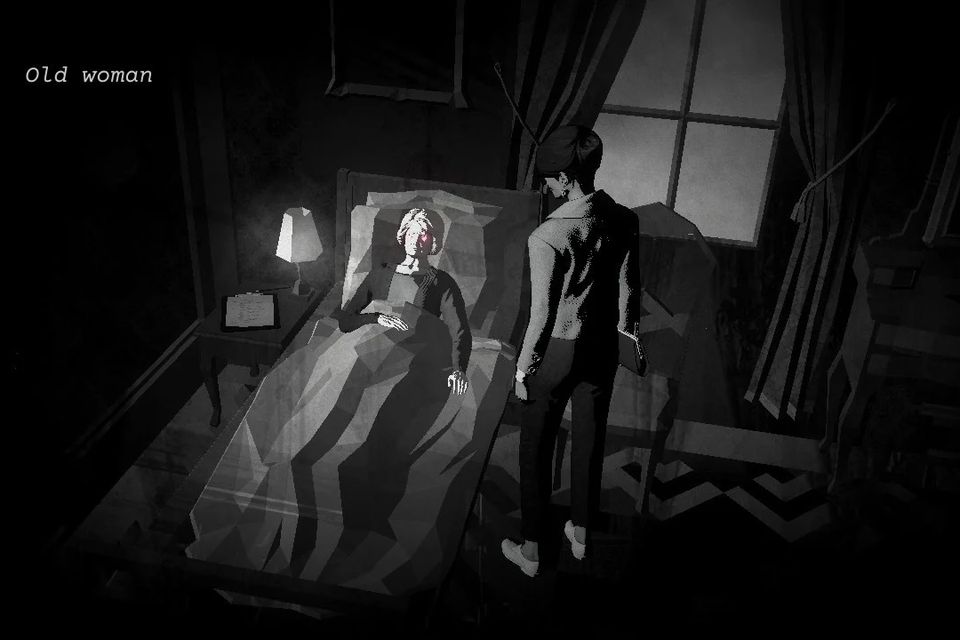
An old woman at the Hotel Leztes Jahr with laser eyes (left) and Lorelei Weiss (right.)
Atmosphere which has so much space in it! There’s the spooky haunted house, of course – it never becomes “Too Scary” but there are times you’re starting to feel some impending dread. The game informs you in the instructions you can read when you first start the game that you must make special note of anything someone with an owl mask tells you and that if someone points a gun at Lorelei, there is a risk of a game over. It can take a couple hours to find the first of these threats – knowing they hang overhead creates great tension. And when you do finally see your first supernatural beings, they’re striking without being so threatening you can’t offer the game to a scaredy-cat.
But the game is also full of humor. The first NPC you actually meet is a sweet dog named Rudi – then you meet Renzo, and a magician named Lorenzo, and everything either says is painted with a touch of the surreal and absurd. There are video games scattered around that need to be debugged – an elevator needs fixing and gets some funny dialogue – there’s a trap door that only goes off after you’ve stepped off it. There are jokes about the art world, European auteur filmmakers, even simple number puzzle jokes. It creates space for the game’s eventual melancholy tone, marrying the funny and scary into understanding that a tragedy played out, but not one without some humor.
And the design of the game is so striking. Everything you encounter will be black, white, and red – any other color you encounter will come from a screen. The game uses its limited palette and its fixed camera perspective to create an incredibly memorable sense of place. I won’t forget how Lorelei’s Hotel Letztes Jahr fits together, where red footprints lead, where red windows glow. I admit, that’s…also because there’s a lot of backtracking. If that’s a dealbreaker for you, you may not end up seeing the game’s penultimate puzzles through.
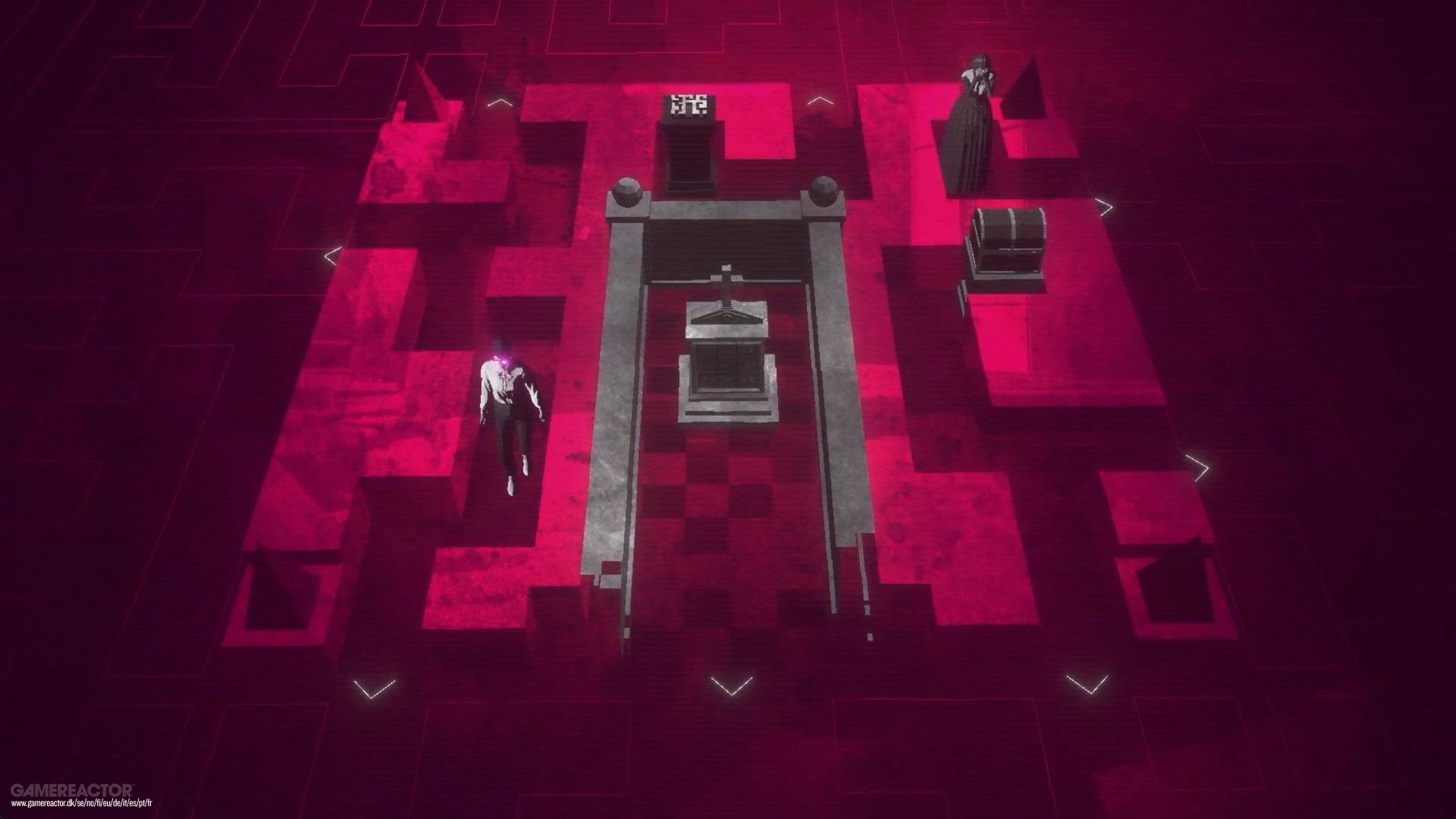
Relatively early on, you may find yourself in the red maze.
Without getting into explicit spoilers, I think this game has deceptively insightful things to say about creativity, being recognized in your time vs. after it, and the gap between outsider perspective and abject vapidity. It guards against this with that sense of humor. There is a confusion of identity across time, names repeated and relationships borrowed, parsing through the historical record and trying to assemble what exactly happened. This all builds towards an elegant, emotional conclusion, and the final moments of the game are a highlight of the gaming year.
Over a little less than a month, my wife and I would turn the lights down low (but not too low to read her notebook!) and play through this game together, putting two brains together to unravel the game’s strong collection of ciphers, logic puzzles, and mazes. It is an immensely pleasurable ghost story which marries many influences into a game that can not be replicated. While incomparable to rhythm optimist game Sayonara Wild Hearts, I believe Lorelei is the culmination of a decade of great puzzling and storytelling for Simogo. I can only hope that after whatever’s happened at Annapurna shakes out, they find their footing quickly.
THE ONLY SON Dir. Yasujiro Ozu 1936 Criterion Channel
This piece originally ran on September 23, 2019 in The Solute. Please follow the link at the end of this preview for the full piece – there is no paywall.
“Life’s tragedy begins with the bond between parent and child.”
The Only Son, Japanese director Yasujirō Ozu’s first talkie (and 35th film) u, opens with this brief, unattributed axiom. A brief prologue introduces us to Ozu’s famous style and tone— shooting subjects head-on, looking directly into the camera to confront the viewer with their emotional culpability. But we also see a parochial pre-war Japan where a mother (Choko Iida) cannot afford to send her son to middle school. A visit from the elementary school teacher reveals both the son’s lie about his future and the impossible but important task of adapting to a world that will change Japan very, very soon.
So begins a tale of a simple drama — a mother gives her last remaining days of youth to support her son, and after graduating college, he doesn’t respect her enough to tell her when he gets married or when he has a child. His justification is that he hasn’t become successful enough as a businessman — he is living in shame, but his mother is far less hurt by his fiscal “lack of success” and more by the man he has become.
If you’ve never seen it before, watch the embedded clip.
Street Fighter III: Third Strike is partly notable for its parry system. By flipping the control stick toward your opponent at the right moment, you can deflect all damage from an attack. This is a little risky, because hitting the opposite direction will block the attack whether you’re too early or not, more safely allowing you to defend 75% of the damage. Parrying also allows you to much more quickly launch your own counterattack, preventing your opponent from having time to guard themselves. In the above clip, Daigo Umehara as Ken at the very bottom of his health bar parries every hit in Chun-Li’s fifteen hit super combo, with each parry offsetting the timing for the next hit, before launching his own surprise super and winning the fight against Justin Wong. Daigo went on to win the tournament (a Street Fighter fan corrected this failed memory – he made Grand Finals, but lost to Kenji Obata!) and become known as the greatest fighting player in the world for the next decade.
One of the complaints that comes up around learning some Street Fighter games is that they’re too simple, your responses to your opponent’s strategy too programmable, and that leads to a game that can feel kind of stale. This is part of why it’s become a popular learner’s game – one of the best intro to fighting games primers I’ve read centers first on the most basic match, Ryu vs Ryu, and argues that this mirror match basically makes up all variations on the game’s strategy questions. A lot of Street Fighter’s core design is a triangle of decisions – you can guard to try to mitigate damage, you can attack and risk getting hit, or you can move and try to improve your position. Within each miniature situation, variations on this triangle will play out – attacking high, low, or from the air – attacking with projectiles, punches, or grappling through guards – blocking high, low, or jumping to dodge. Those nested triangles break apart what otherwise might play out as a rock-paper-scissors game, like the Mushi-King arcade cabinets in Japan.
The parry breaks apart these triangles by offering a new gamble. Because you can take that risk to avoid all damage and counter more quickly, all courses of action become a little more dangerous, leading to a series of choices that open up that triangle (into more than just a square!) Where your opponent across the screen might have felt safe throwing fireball after fireball because the only way for you to approach him would be to safely jump over each one, opening you up to a big uppercut, now you can walk forward, parrying each projectile, advancing while maintaining your own momentum – provided your skill at parrying is high enough to not open yourself up to punishment.
I knew I wanted to get a fighting game in here, mostly because I love them but rarely play them these days. When I was in college, my roommate Jake and I could sit for hours getting one more match in of Super Street Fighter IV, Marvel vs. Capcom 3, or Third Strike, learning more against one another than against any other opponent. Jake would drill combos, watch videos, read strategies, learn advanced techniques in the lab. I rested on my fundamentals, learned my handful of characters, got as in-tune with their capabilities as possible.
Coming back to Third Strike a decade later, the only two characters I even remotely remember are Ryu (who I play in every Street Fighter game, including the quite excellent Street Fighter 6) and Elena. Elena represents what I love most about Third Strike – she’s a lanky capoeira fighter whose moves flow comfortably into one another without becoming long dial-a-combos I had to master in hours of practice. While she’s unpredictable and difficult to manage for new players, she’s actually one of the weaker characters in Third Strike – her moves require very perfect timing or else trap the player in relatively lengthy animations that are easy to defend against. But her unique fighting style, bubbly personality, and shock white hair make her a memorable part of the Third Strike ensemble.
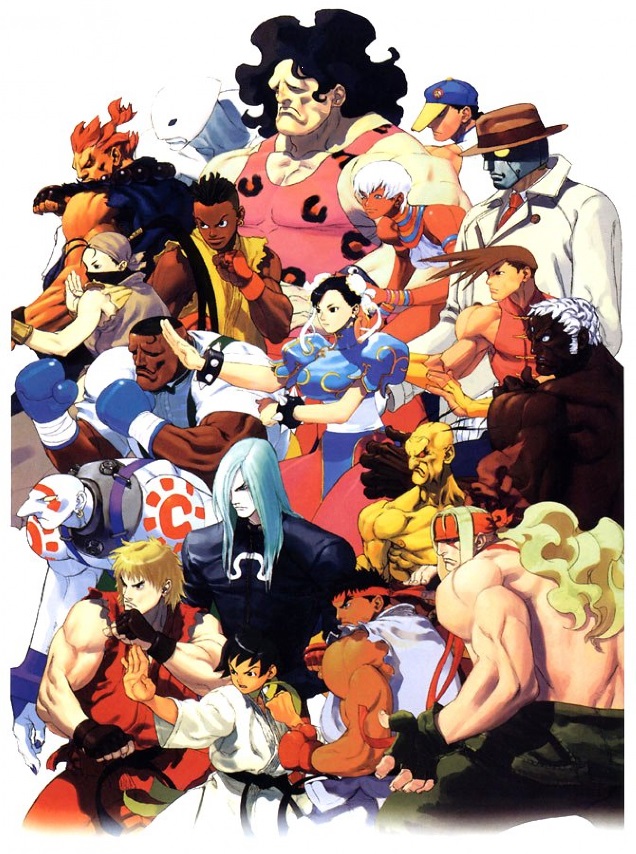
Street Fighter III famously brings back almost none of the iconic Street Fighter II cast – Third Strike’s nineteen character cast makes a concession by bringing back Chun-Li alongside Ryu, Ken and Akuma. Only a few members of that cast have come back in future entries and only in re-releases or DLC expansions, meaning most of them are best learned in Third Strike itself. The new cast is a little less superhero-comics oriented than Street Fighter II’s – whether that comes in the form of cool, hip designs like Sean or Yang or the horrific oddity of characters like Oro or Necro.
All this is realized in a pixel art aesthetic that remains unmatched. The animation on character movement is so fluid and expressive without requiring the outsized toon faces of something like Metal Slug. The backgrounds include empty streets, rainy rooftops, and grimy subway stations, giving the game a real backstreets, underground spirit. The soundtrack combines breakbeat and instrumental hip-hop better than almost any game since, a dealer’s choice of cool sonics that also lay a foundation for any number of melodic approaches on top, whether that’s needed to capture a runaway shinobi’s melancholy or to just launch into a perfect jungle breakdown. I couldn’t possibly tell you the story of Third Strike – Street Fighter lore is immensely detailed and requires playing hundreds of hours of mediocre single-player gameplay when it doesn’t also require reading addendum comics. But I can tell you this world feels a little dangerous, a little like the few heroes of its past that still walk its alleys get assailed by private detectives and snot-nosed kids with a mean right hook.
Most of my experience with fighting games these days is watching tournament and stream highlights. I’m in the iconic fighting game Hard Drive dead zone, and I have neither the free time nor the drive to get better. Tournament highlights from Third Strike are always enjoyable because the game’s unique cast is still complex enough to reward playing the vast majority of its characters and the game’s pace is not so fast that the combos are unreadable. The animation clarity is smart, too. The hits that deal the most damage look like the hits that do the most damage. The supers zoom in and let you know when something serious is about to happen without interrupting with a long canned animation. It’s just so many small, intelligent decisions like these being made to make a game that’s lasted twenty five years.
Daigo Umehara still plays regularly, but he’s fallen to the wayside over the past twenty years. Justin Wong actually has maintained a better overall win percentage across more games, his fundamentals allowing him to transfer his skills to games like King of Fighters,Marvel vs. Capcom, and Mortal Kombat, but Wong still finds himself streaming Third Strike regularly. It still gives me pleasure every time I see someone square up against Justin Wong’s iconic white Chun Li hoping to reclaim the greatest moment in fighting game history.
Richard D. James, better known as Aphex Twin, referred to his most recent full length album as his “poppiest album yet.” I don’t know that I necessarily think anything here is more accessible or friendlier than “Alberto Balsam” or “Windowlicker,” but relistening to Syro, I’d forgotten just how melodic and beautiful the album tends to be. The earworm that’s been in my brain for a decade is “180db_[130]”, maybe the album’s most frantic dance cut, high drama that fits voguing or an evil movie nightclub more than an actual night out. When I spend time away from Syro, that harsh synth melody overtakes the more austere beauty of “XMAS_EVET10 (thanaton3 mix)” or “”syro u473t8+e” (piezoluminescence mix).”
You’ll also notice, if you’re unfamiliar with the album, that unless you’re listening to it so frequently you’ve got these titles memorized, that the album resists identifying individual tracks. According to James, the album consists of ideas written over six or seven years, none he considers forward-looking experimental music, all of which he considers ruminations on the past. The variation on this we might be more familiar with are letters and poem series, titled by date or sequence rather than by something more poetic and evocative. Most interpretations of the track titles here are descriptions of gear and technical detail – “minipops 67 [120.2]” refers to the MiniPops drum machine, likely take 67, set at 120.2 BPM, lord knows what a source field mix is. The album cover includes a record of the album’s production and promotional costs. Despite being a “pop album,” this is a documentation of a period of time more than a Concise Statement.
I’m as far from a scholar of electronic music as they come. I hear stuff, like what I like, integrate it into my playlists, and roll on. So when people say this is a culmination of thirty years of electronic music history, I believe them. I hear playful reverie, memories of holidays past, reflection on a quiet afternoon. I hear the soundtrack to a nightmare movie rave. I hear a feeling that the form has been mastered and now it’s simply about the pleasure of creation. These thoughts are abstract, and I’m not sure I could map them for you directly to a timestamp or even a track title. By disconnecting the music and its context, James has created a throughline from electronic instrumental music back toward the sort of classical roots. This album exists because the studio and equipment to create it existed and demanded to be played.
James has continued to make music, releasing EPs every few years rather than full length albums. He’s toured once in that time and played sporadic festivals as well. Based on the teaser timeline set last year leading to the EP “Blackbox Life Recorder 21f/in a room7 760”, he’s due to disappear for another couple years before giving us another bite sized update. Between Syro and the previous full length album, Drukqs, James claimed he’d written six unreleased albums. It’s possible that like some classical composers before him, there are hundreds of recordings we won’t hear until a century has passed. I hope selfishly to get to hear some of his beautiful sounds sooner.
Muscleman here has usurped my suitcase as his new favorite bed.
For my birthday this year, I set out to write about twenty of my favorite albums, twenty of my favorite video games, and twenty of my favorite films. I did this partly because I could not decide what I wanted to do for my birthday this year. I also did this partly to kick myself in the ass and make myself put words into a text field. I’m hopeful getting into the daily habit of writing roughly 1500 words to finish this project will convince me that I should get to at least 500 each day rather than writing only four times a year.
Many of these works are consensus masterpieces, and many of them are more personal favorites. All of them are works I love very personally. I looked at my lists of favorites and picked some which I have not written about to satisfaction. I have vaguely given myself a lofty goal of writing about every work which I consider a personal favorite and what it means to me – where possible, I’ve given bias to works I’ve already revisited over the past year or two rather than giving myself additional homework in completing this project.
This also includes the first written music criticism I’ve done since I was in college. I find music criticism exceptionally challenging, and that’s precisely why I’m making myself do it. The format of these album write-ups is borrowed exactly from Tom Moon’s 1000 Recordings To Hear Before You Die, a book I’ve treasured since I was thirteen or fourteen years old. Should you find yourself a copy, you’ll find a better music critic than I ever aspire to be.
If you decide to come along for this journey, I really appreciate your readership. If you want to talk to me about something I’ve written, I’d love to hear your thoughts. I don’t know if I’ll be doing this project again, but it feels good to be nose deep in a word processor. These pieces were largely written in one sitting as drafts and then edited once before publication – while they don’t make up the highest caliber of word-tinkering and scansion-smoothing in my writing history, I hope they are a pleasant enough read.
As these articles go up, I’ll have links posted on this master page and a preview of what’s coming tomorrow!
Because this piece is no longer available in The Daily Cardinal without use of intense google-fu, I’m reposting it on my own website. This piece originated in The Daily Cardinal’s Arts section on September 29th, 2014.
Some might say that beginning my residency as The Daily Cardinal’s video games columnist with an editorial on a mobile game is inauspicious. But amidst the several titles entangling me, none pull as much focus as the stark “Desert Golfing.” Described by iOS developer Adam Atomic (“Canabalt,” “Hundreds”) as “the ‘Dark Souls’ of ‘Angry Birds’”—perhaps the most absurd form of description, akin to the constant ringing question begging, “When will video games have their “Citizen Kane” moment?,” whatever that means—it is a spare experience that closely evokes the beloved RPG’s unforgiving indifference.
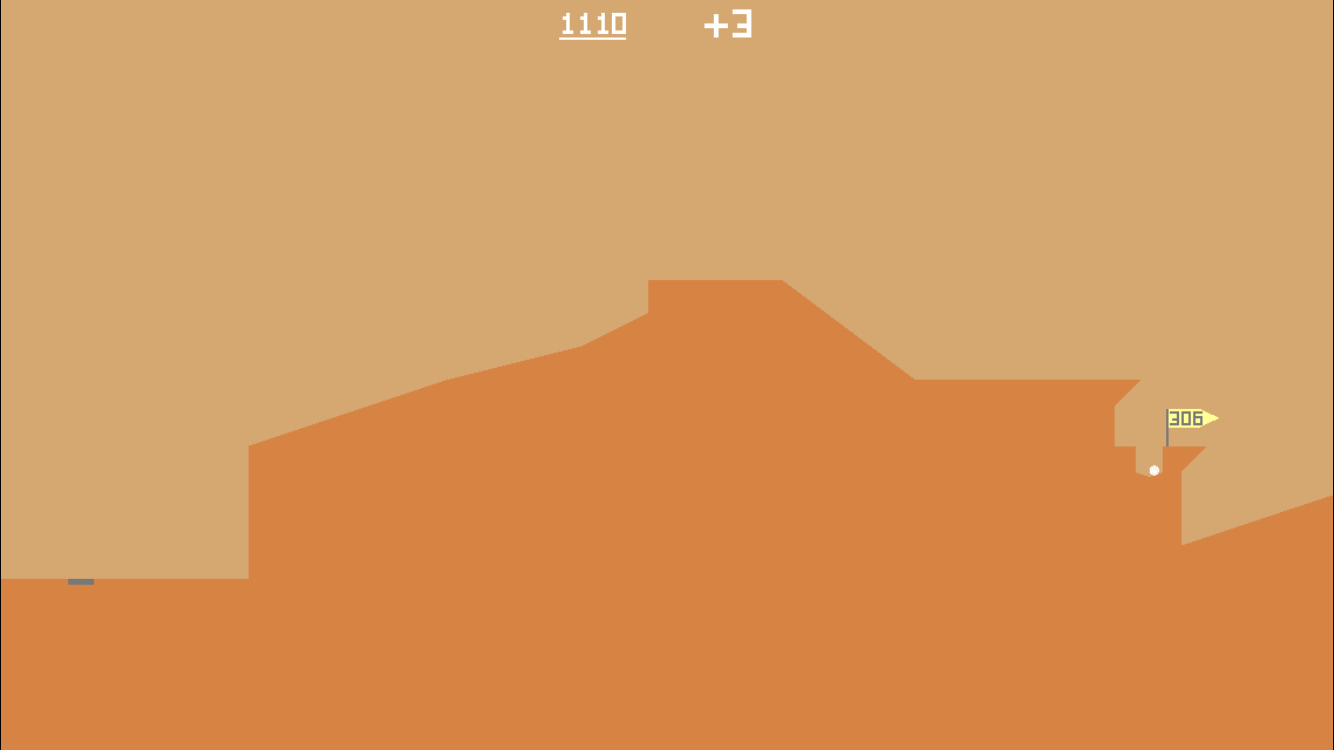
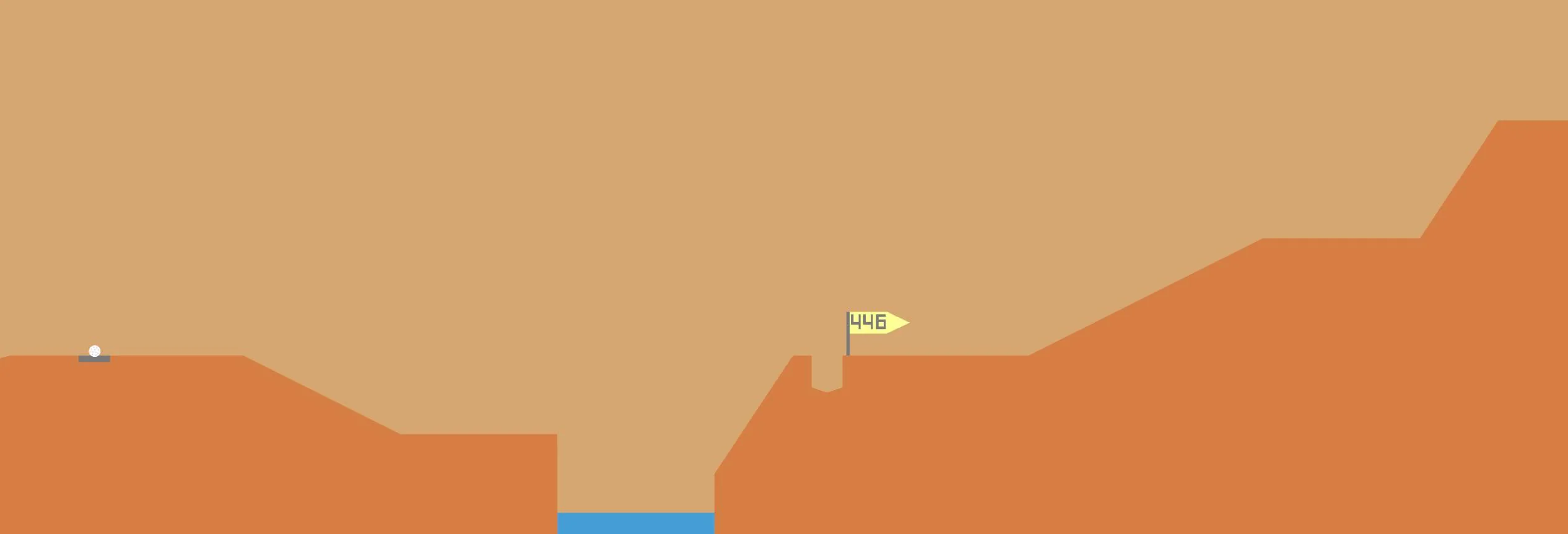
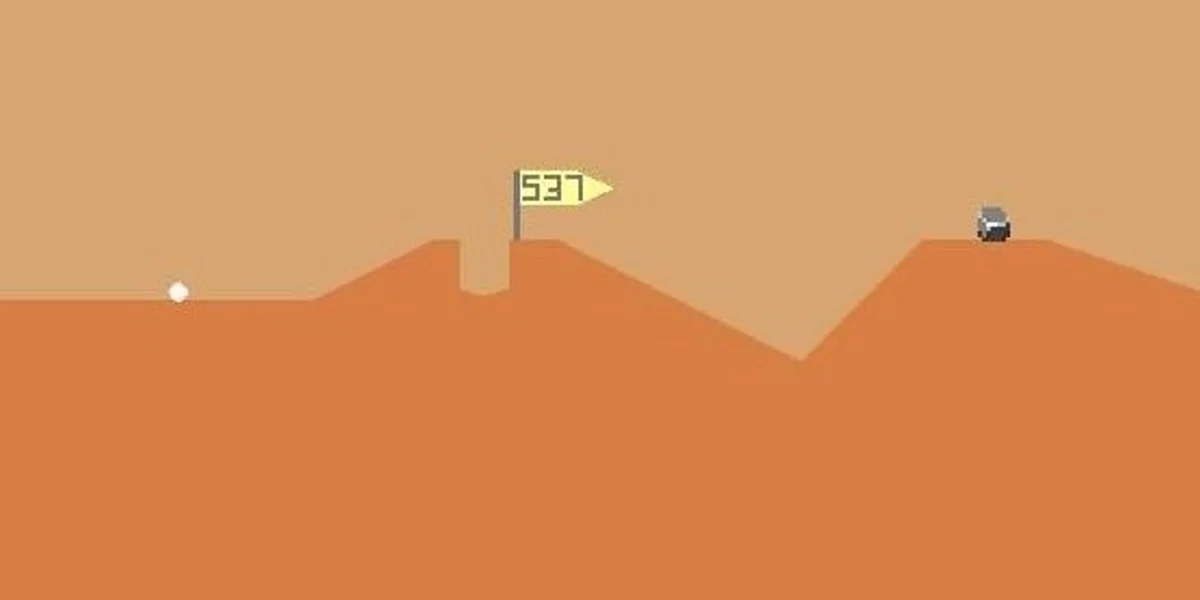
The game’s presentation is flat and hot; a light brown sky is delineated against a rough and imposing dark orange landmass. Like a construction paper collage, the angular hills defy the often-natural rolling dunes. Other times, the land towers above the small white ball at impossible angles, revealing the constructed nature of each hole. When the first prop appears beyond simple land and hole flags, it does so without fanfare, yet it simultaneously serves as a secret to be uncovered and a fascinating invigoration, an omen that, yes, there is more to discover in this vast wasteland.
The game presents itself in the iTunes store with a short haiku: “To see a world in a bunker of sand/And a heaven in a wild cactus,/Hold infinity in the pocket of your shorts,/And eternity in Desert Golfing.” It appears to be near endless. At hole 2172, I have yet to feel a need for the game to end. The furthest hole I can find a peer to have reached is hole 2884.
Yet the game must have an end, for it is clearly authored and personally manipulated; unlike “Minecraft” or “Flappy Bird,” each player encounters the same courses (as made evident only by a handful of diligent players posting screencaps to Twitter) and no one has yet reached an “impossible” course. The continuing journey towards the game’s denied conclusion is not so much a race as a pilgrimage. And, yes, those farthest along the two-dimensional path are reporting that there is something to see upon the horizon.
Swinging at the golf ball is performed exactly as one might launch a red bird at a Bad Piggy, albeit the game permits you to place your finger wherever on the screen you might like. Its difficulty often lies in the treacherous nature of its sand; most golf games use sand as an occasional trap, impossible to escape without using too many strokes. “Desert Golfing” offers no such escape from the sand, but as a result offers advantages one might not have previously perceived in the frustrating particles. Sand will catch a ball as easily as it will allow it to move each simple grain; the ball is capable of stopping on an incline if it arrives there at the proper angle, but will tumble or, worse, bounce if granted a bit too much angular momentum.
A simple score counter hangs atop the screen; rather than offer your average-per-hole or total strokes per 18-hole course, the game keeps a constant count, tallying your every swing as you ascend into the hundreds or thousands of holes. In one sense, this is freeing; there is no end in sight, allowing players to swing to their hearts’ content and improve their scores later, upon easier holes. Simultaneously, every swing takes on meaning towards the hole. There is no resetting the game and “starting over to improve one’s score;” your mistakes are only altered by improved performance over the continuing sands.
Time-wasting is often how mobile games are excused for their simplicity, but “Desert Golfing” offers a meditative experience. With so little detail, the focus must simply be on the mechanical; “aim, pull, release, observe, repeat” is its rhythmic drum. Games often feature this same rhythm; September’s largest release, “Destiny,” offers the same promise of the sublime upon the horizon and the same sort of “aim, pull, observe” rhythm, albeit with grander skyboxes and sand and a far smaller geography. “Desert Golfing” is available on iPhone and iPad for $1.99, and on Android devices for $.99.
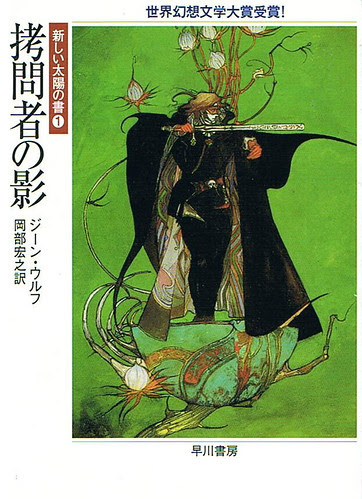
Yoshitaka Amano’s cover for The Shadow of the Torturer.
For the past several months, my fun pitch for The Book of the New Sun has been: it’s a science fiction novel where the narrator thinks he’s in a fantasy novel. Severian’s describing his matachin tower Citadel and you’re ho-humming along, and then suddenly he brings up how the bottom of it is a propulsion chamber and you realize it’s a goddamned rocket ship. In the first chapter, he sees a man shoot an evil green light and refers to it first as a “radiant wand” before realizing it’s a laser gun. Severian wields a big sword and rides around on mutant horses called destriers. Yet paying close enough attention reveals that the portrait of the gold-helmeted man he finds in the guild library is a photo of the Apollo 11 moon landing. Now that I’ve finished reading these books, I’d like to offer some more organized thoughts.
This spring, I started skimming science fiction literature. My own creative work has been headed in that direction for some time – still a little early to share the fruits of that labor – and I found comfort in reading the work of those who made historical marks in the community, landmarks that themselves created their own subgenres. I read Dick’s The Man in the High Castle, Gibson’s Neuromancer, McCarthy’s The Road, and the firstcouple books of King’s Dark Tower in short succession, and took my first step into Pratchett’s Discworld with Monstrous Regiment. These were all books that loomed over the entire science fiction genre – their influence and popularity is regularly cited for inspiration and personal recommendation alike. I enjoyed each one of them, which I think are varying degrees of entertaining and profound. But also, sometimes it’s just enough to have lobster-monsters go “dod-a-chick?” and have them walk after your characters.
Our author, Gene Wolfe.
Until a podcast by a few critics I like picked up Gene Wolfe’s Book of the New Sun, I’d never heard of the saga or Wolfe himself. No one I’ve had a conversation with knows these books either, which surprises me only a little. You can find quotes from Le Guin, Ellison, Disch, and Gaiman all declaring Wolfe a master of fantasy fiction. You can find them calling him “a modern-day Melville,” “the greatest writer in the English language today,” Proust meets Beethoven, and Wolfe’s prose holds up to the highest scrutiny. It is gorgeous, thoughtful, musical work, and it works equally well for action and introspection. But these books are an odd, challenging read with a genuinely craven protagonist, and I think it’s telling that the highest acclaim I can find for these books is in deep genre spaces or on 4chan’s greatest books of all time.
The Book of the New Sun is quickly described as a science fiction/fantasy saga of four books written by an engineer and Catholic convert reckoning with the more grotesque mythology of scripture and its exegesis. On a dying Earth (“Urth”), a boy named Severian is raised by a guild of imperial torturers in service of a divine ruling Autarch – when Severian betrays this guild’s laws, he is exiled and set on an adventure that will put him directly at the center of Urth’s fate. While our narrator Severian claims that his betrayal was that he “showed mercy to a woman he loved,” this is one of the many half-truths Severian will offer us.
Before I get into the mess of Severian, I’ll introduce the mostly delightful cast of characters Severian meets, and the pulpy thrill of the adventures he gets into. There’s the traveling actors Dr. Talos and Baldanders, who at first seem to be a match for The Princess Bride’s Vizzini and Fezzik, that rope Severian into a 16th century morality play. For a time, Severian travels with a veteran sailor named Jonas, who has a nonstop bucket of bizarre aphorisms and a knowledge of spacefaring monsters like the hydra-bat notules. He travels from time-traveling greenhouses to underground cities of man-apes, fights a Monster Manual of fire-breathing salamanders whose heads bloom like a flower right before they unleash their scorching torrent, meets aliens in masks and witches in rituals. In the second book, I think he gets ambushed six times, mostly because he’s so lost in the sauce of his philosophizing that he simply fails to pay attention to his surroundings.
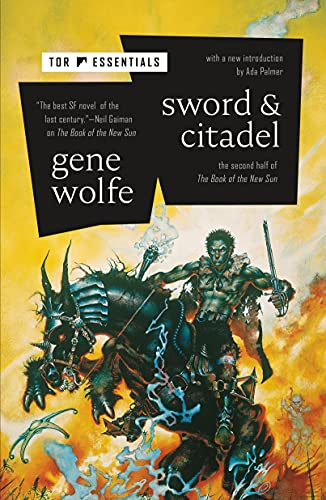
Don Maitz’s cover for Sword & Citadel, a compilation of the second two novels (these are the edition I read.)
Runs in the second and third book fly by where a full two hundred pages are made up of rip-roaring good times. Many of the coolest fantasy ideas I’ve ever read occur over a single chapter, and while Severian reflects on them, it’s on to the next leg of the adventure. The book takes us from garden parties to daring escapes to monsters and monarchs without any room to breathe – even within the picaresque novel formula, there’s significantly less quiet between moments of serious impact and importance. There’s a lot of incident in these books, and very little of it isn’t reflected on by our narrator. Severian repeatedly reminds us that he has a “perfect memory,” except for all the times he doesn’t and all the times he isn’t paying attention because he’s too busy thinking about how badly he’d like to sleep with just about any woman in front of him.
I enjoy a story about a freaky little creep. There are times where Severian pushes the boundaries of that, either because he’s so casual about it (maybe never moreso than sexual violence he commits in the second book) or because some of his longer digressions point toward conclusions I find distasteful. Especially in the third and fourth novels, Wolfe advances a form of Christian Science through Severian’s musing, working to reconcile his own (self-described) “rational” beliefs with the beliefs of his Catholic wife. It advances arguments against “science gone awry” with panicked allegories to plastic surgery, cloning and genetic modification, and argues that ungoverned science will lead to moral degradation.
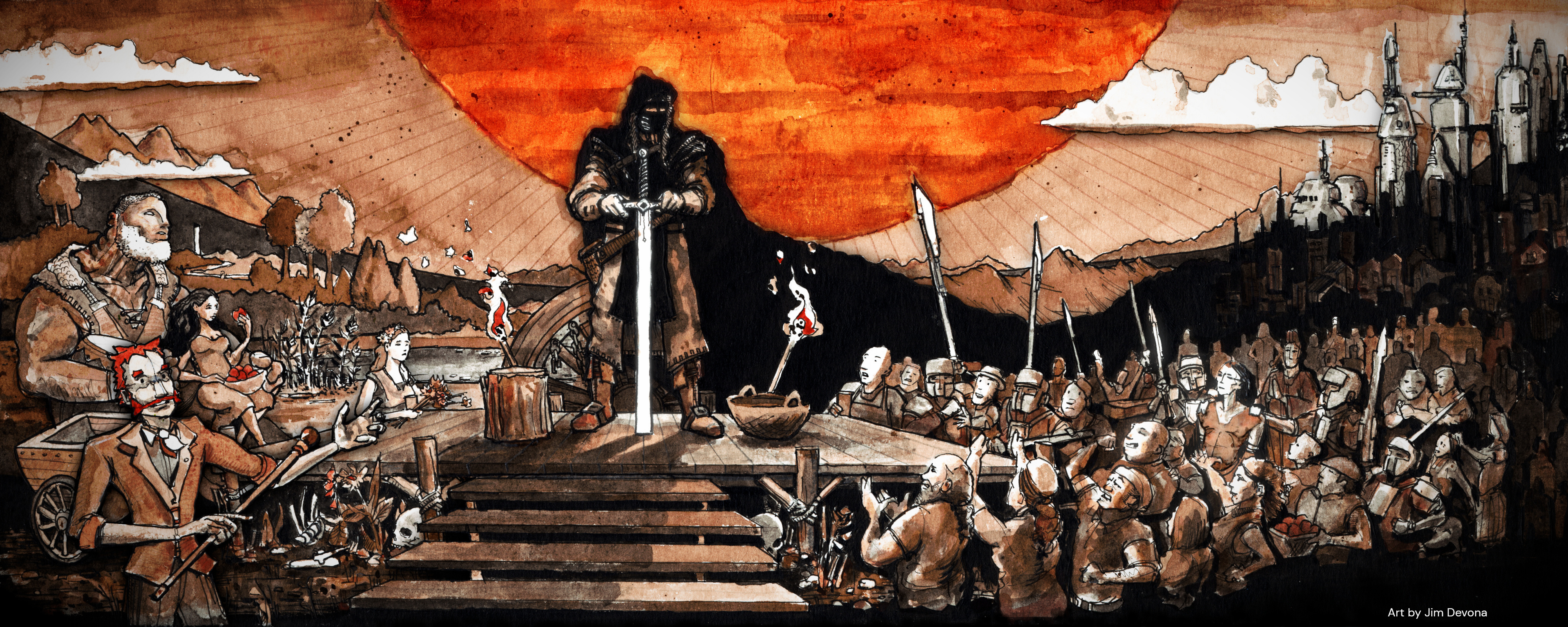
Jim Devona’s art commissioned for the Book of the New Sun book club Alzabo Soup podcast (which I have not listened to.)
Severian’s value system is entirely warped by an institution which has made him monstrous, and he will go on to be a murderer, executioner, rapist, bigot, serial traitor, and self-mythologizing oblivious teenager. However, our narrator is loquacious, introspective, philosophical, and significantly more attentive to the emotions others experience than the character we see Severian to be in his actions with other people. As we keep reading, we come to understand how he has changed so dramatically in what he repeatedly reminds us is only a matter of months – the majority of the story’s action, barring the first eight or so chapters which loosely flit between the beginning of the story and Severian’s boyhood prior, occurs over the span of roughly a single year.
There are direct and indirect references to the life of Christ and The Confessions of St. Augustine throughout, as well as attempts to reconcile more literal exegetical readings of Catholic literature and sacrament. While Severian’s own life, as he tells it, resembles many incidents in the life of Christ, I would not go so far as to say he is meant as a Christ figure himself, but a study of how even the cruelest and most selfish of young men, raised in a world built to prevent him the path to righteousness, might become at least a more complicated man. I was not raised Catholic and likely miss a good amount of the philosophy and scripture Wolfe is working through, though I do know some of Augustine. Severian is not nearly so penitent for his evils. He tells them very plainly, without beseeching a higher power to cleanse him of sin, and often offers excuses and justifications for his actions. Alongside them, he tries to find meaning in it all.
It’s in this balance that The Book of the New Sun finds itself a gripping read. It has serious ideas written about seriously, but also wants to make sure it has room for a little green man from the future who’s scamming people with false prophecy. Not all of those serious ideas are agreeable, tastefully explored, or especially profound, but the combination with pulp adventure and the quality of Gene’s writing is hard to match. Both in terms of philosophical thinking and just pure cool fantasy storytelling, many of the people who love these books basically never stop reading them. If you read these books on my behalf, I’ll be so excited to talk about them with you – for now, I’m taking a break from genre fiction with Lawrence’s The Rainbow.
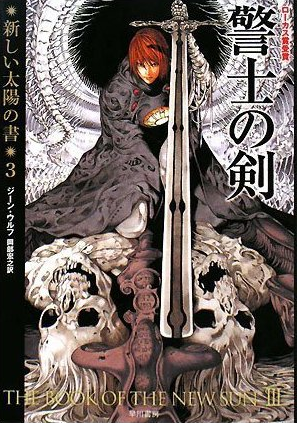
Takashi Obata’s cover for The Sword of the Lictor.
I’ll leave with a passage from The Shadow of the Torturer’s first chapter, for my money the most beautiful individual moment in these four novels. These words tipped me full tilt into the world of Wolfe, and I hope reading them intrigues one person enough to tip them into Urth’s orbit.
“We believe that we invent symbols. The truth is that they invent us; we are their creatures, shaped by their hard, defining edges. When soldiers take their oath they are given a coin, an asimi stamped with the profile of the Autarch. Their acceptance of that coin is their acceptance of the special duties and burdens of military life – they are soldiers from that moment, though they may know nothing of the management of arms. I did not know that then, but it is a profound mistake to believe that we must know of such things to be influenced by them, and in fact to believe so is to believe in the most debased and superstitious kind of magic. The would-be sorcerer alone has faith in the efficacy of pure knowledge; rational people know that things act of themselves or not at all.”
Half the film lists from this past year have made bold statements about the state of movies. I don’t really have those same thoughts. The movies I love continue to be made, are in production now, are being greenlit. The movies I don’t love continue to make most of the money, but maybe that’s just called turning thirty. The fact is that in 2021, many of my favorite filmmakers made new films, almost all of those films were great, and I had the opportunity to see many of them in a theater if I had wanted to do so.
It feels good to be back at the movie theater. I did not see most of the movies on this list in a movie theater. I’m not sure I typically see most of my best-of list in a movie theater. This isn’t some comment on the state of streaming vs. theaters, or on my own taste. I like my couch. My dog’s here, and if I need to get up and go pee, I won’t miss the climactic death of the film’s leads (as happened at my screening of one of this year’s best films.) My couch is where I’ve watched masterpieces by Tarkovsky, Keaton, Varda, Dunye, Antonioni, etc. And yet it feels good to be back at the movie theater. Heartbreak really does feel good in a place like the movie theater.
While I do keep a spreadsheet with my best actor, best director, best documentary, etc. etc., my picks are hardly so out there that they require special notice. I will identify those when I name the movies that gave me them. Of all the movies that can’t make this list, I’m saddest that Escape Room: Tournament of Champions and Malignant slipped away – as far as movies I’d recommend for pure fun, those are the two that I’ve smiled about over and over again.
As for the films I’m saddest I haven’t seen, and hopefully will catch up with someday: I hope to love F9, Memoria, The Tragedy of Macbeth, Saint Maud, Earwig and the Witch, Malmkrog, The Woman Who Ran, French Exit, The Voyeurs, About Endlessness, Venom: Let There Be Carnage, A Hero, Cry Macho, All Light Everywhere, The World to Come, Procession, Belle, The Truffle Hunters, The Night House, Bad Trip, and Azor. No, I did not see Spider-Man: No Way Home. I let Endgame be my offramp from the MCU – 22 of those were enough for me.
21. Dune
Dir. Denis Villenueve HBOMax
After repeatedly sharing my distaste for Villenueve’s previous science fiction, I have to be nice to Denis – my fear that he’d sell out Dune’s integrity for emphasis on the Bene Gesserit witches or Game of Thrones-esque scheming were unfounded. Villenueve’s approach to adapting Dune may be humorless, but, for example, allowing Rebecca Ferguson to take such a risk in humanizing the role of Lady Jessica really speaks to him understanding the core tension of the material. I still prefer Lynch’s take, but Villenueve’s Arrakis has such incredible mystic power. I hope he can bring it home in part two.
20. Beckett
Dir. Ferdinando Cito Filomarino Netflix
The fact that Beckett, one of the most fun films of the year, has been completely buried is a tragedy. A political thriller about a guy (John David Washington) having the worst “vacation” of his life in Greece, this is just fuckup cinema at its finest. What anchors this film is its incredible team – shot, edited, and scored by some of the business, Beckett had me more and more excited as it went along, to the point where its ultimate political message fell aside to just rooting for this sad, broken, constantly frazzled man unwilling to die. If they announced a Beckett 2, I’d be there day one.
It’s crazy that this is the point in the list where the ranking becomes sort of irrelevant – from here on just up to the top 5, every film does exceptional things, and in five years, I could see myself mixing and matching this entire remaining order.
19. West Side Story
Dir. Steven Spielberg
HBOMax
Modernizing West Side Story feels like a foolish errand, and smarter,more appropriate people than me have written about how this film, while better incorporating Spanish, is still failing Puerto Ricans. Beyond that, there are choices I would not have kept – holding I Feel Pretty directly after the rumble without an intermission feels too sharp, moving Gee, Officer Krupke before the rumble makes the second half pretty dour, no matter the metatext Somewhere’s beauty is as a duet!! – but they belie my love for this damn show, and the old Robert Wise film, too. Spielberg’s direction here is often breathtaking. It’s hard to beat the dance at the gym, which is maybe the best scene Spielberg’s captured since the ending of Close Encounters of the Third Kind. But…he manages to come close, from the reflective puddle shot in Maria to the street dancing of America.
18. Undine
Dir. Christian Petzold
Hulu
The third Petzold film in a row to make my year-end list, if Beckett resembles Hitchcock doing North by Northwest, Undine resembles Vertigo. Fate and fantasy intermingle in the love life of Paula Beer’s Undine, but it’s in the staggering unreality of regular life that Undine hits hardest. Watching her speak about Berlin’s urban development only to lose herself in the scale model midway, or attending the bottom of a nearby lake with Franz Rogowski’s Christoph to visit the legendary giant catfish Big Gunther, there is a powerful feeling that the world is too big and majestic to comprehend. The back half retains some of the myth’s tragedy without adapting it beat for beat – like every Petzold I’ve seen, its ending hits a powerful melancholy.
17. The Souvenir Part II
Dir. Joanna Hogg
VOD
Hogg’s prior film, 2019’s The Souvenir, depicts a semi-autobiographical romance with a manipulative addict that ends in grief. I didn’t connect to it – while it was honestly made, I found it uncharismatic. But it was always conceived with this second film in mind, a sequel film in which the fictional version of Joanna Hogg makes a fictional version of The Souvenir, and the process of sorting through her love and pain. This film has more room for light slipping back into Julie’s life, including an electric reprise from Richard Ayoade (a high point of the first, too, but even sharper and more fully drawn here,) funny scenes with Joe Alwyn and Charlie Heaton, some rich and warm visual experimentation that (to me) recalled The Archers and Derek Jarman. That added warmth gives the tragedy of the first film room to hurt deeply. I’m excited to revisit the first eventually and give it more credit, as this film would not work as well if it weren’t earned by the first.
16. Parallel Mothers
Dir. Pedro Almodovar
VOD
Without wanting to spoil this film, because a lot of the fun is in discovering winding corridors, few directors on earth are as good at framing the way love and betrayal can make having the conversations you need to have incredibly complex without taking the film into hysterics. There’s a subdued quality to this almost soap-opera story that makes the film feel quite He uses this emotional, personal story between two women as an anchor for his more targeted political commentary, a conversation about denial individual and national. Cruz would rightfully win on Sunday for her funny, well-rounded, never withdrawn performance.
I was predisposed to like the “nun sexploitation thriller” by the director of RoboCop and Showgirls, but I’m not sure that description is entirely appropriate. Verhoeven didn’t make an exploitation film, really, but a film about the punishment of believing Too Deeply meeting its match in mania and self-aggrandizement. Protesting the film’s sexual content seems absurd when the film is based on a true account of the persecution of sexuality in the Catholic Church. But also it is actually sexy, and it’s also almost as funny as RoboCop, and it’s also gross and outrageous and righteous in its violence and sexuality. It’s among the most fun movies I watched all year.
Contending with the lore of Paul Schrader, the cardshark misogynist who posts incessantly on Facebook while writing forty years of incredible screenplays, is not something I’m equipped to do here. The Card Counter barely even uses his knowledge of poker as it explores the subculture of gambling as the small talk between the scenes of the film’s real target – the torture committed in the name of the United States at Abu Ghraib. The Card Counter explores how perpetrators surviving a system of abuse become classical Bickle-esque time bombs. Oscar Isaac gives his best performance in eight years (since his incredible work in A Most Violent Year) as the dead man walking William Tell.
13. The Last Duel
Dir. Ridley Scott
HBO Max/Hulu
Unfortunately, every clip of The Last Duel I can find sells this movie as miserable and grim – which erases just how funny parts of it can be. Marketed all wrong as a kind of combination #MeToo reckoning and period piece, I know all too well the reasoning behind this film earning deep vitriol. The Last Duel doesn’t quite fail Jodie Comer, but I can’t vouch for the film’s success on her behalf, its politics about sexual violence too pat and its characterization of her lead too neat. More interesting as a study of fraternal attitudes than feminist activism, Matt Damon and Ben Affleck started their careers under Harvey Weinstein’s wing, and this film successfully portrays the way their boys club culture sweeps evil under the rug. Interrogated, too, is Damon’s weird lack of charm: when Ben Affleck groans, “he’s no fucking fun!,” it feels true to the man’s distasteful descent into disconnected bigotry and crypto endorsement. Both men, really, are doing career best work here – Ridley acquits himself well, too, and surpasses that in the titular Last Duel, which is one of the most grueling and visceral action sequences I’ve seen in a long time.
12. No Sudden Move
Dir. Steven Soderbergh HBO Max
A crime comedy about a fiasco robbery from the director of Ocean’s Eleven should be a slam dunk crowdpleaser, so of course it swiftly vanished from esteem. The fisheye lenses, the Tommy Newman score, the deep bench of supporting performances – it’s almost easy to take Soderbergh for granted, as he’s made one of the best films of the year nearly five years running now (I except 2018’s Unsane but include this year’s Kimi already) and all of them have come out on HBOMax or Netflix instead of in theaters. But, really, Don Cheadle, Benicio Del Toro, David Harbour, Brendan Fraser, these stars all make meals of their roles in this just as smaller names Amy Seimetz and Bill Duke do. The ultimate reveal that this is also part of a broad Brockovich-esque corporate conspiracy is the sort of icing on the cake that shows why Soderbergh is one of the best working. He recognizes the way power appreciates power from the streets to the suites – a surprise supporting role that appears toward the end of the film puts a great exclamation mark on this thesis.
11. The Worst Person In The World
Dir. Joachim Trier
VOD
I recently heard this film described as subdued, like “a collection of moments that wouldn’t normally be considered movie-worthy.” This, I think, is insanity. The Worst Person in the World has at least five scenes that are so incredible each would be reason enough to revisit the film twenty years from now on its own. The party where two people “don’t cheat” is one of the sexiest scenes I’ve seen in a movie in years. The film’s first breakup, incredibly real and well acted. A TV interview gone wrong, electric and real. The lead performances from Renata Reinsve, Anders Danielsen Lie, Herbert Nordrum – three of the absolute best of the year.
10. The Green Knight
Dir. David Lowery
Hulu/Showtime
Fog, haze, and hard light define the aesthetic of The Green Knight, setting itself firmly in the selective memory of Boorman’s Excalibur. I know some people feel this didn’t cohere to a greater whole for them, but I really treasured the way this characterized Dev Patel’s Sir Gawain. Lowery expands with fantastical interludes that highlight the psychedelic danger of the Arthurian world and anchor his interest in Gawain’s sexual encounters with Alicia Vikander’s Essel. The ending is a proper “best of both worlds” moment, a study of fatalism against bravery.
9. Evangelion 3.0 + 1.0: Thrice Upon A Time
Dir. Hideaki Anno
Amazon Prime
For starters, no, you cannot dive straight into this last chapter of the Neon Genesis Evangelion story. The anime saga about children piloting giant robots (that turn out not to be robots) has come to a head with Thrice Upon A Time, the fourth film in the “rebuild” saga. These films represent a different kind of remake. These films start quite literally shot-for-shot adapting the TV anime, but, slowly, small changes butterfly effect until massive alterations to the timeline send the second half of this story into entirely new directions. This finale takes Evangelion somewhere it never had space for – it creates hope for kindness and life surrounded by the monstrous apocalypse at the heart of this series. The Evangelion saga has remained among the most visually impressive, well-acted, emotionally intense animated works for over twenty five years – somehow, this final film still manages to surprise.
8. Annette
Dir. Leos Carax Amazon Prime
Dumb guy pitch for Annette – for like two hours, the most outrageous shit imaginable happens and is also a rock opera. In this world, babies sing and fly, sex is an act of reverent sacrifice, comedians twirl around in a boxer’s robe and unleash verbal abuse on their audiences. There’s murder, sex, music, dance, comedy, a halftime performance at the Hyperbowl. Simon Helberg of The Big Bang Theory gives maybe one of the five best performances of the year as an accompanist and conductor. And underneath all of that, Carax swirls dreams, self-doubt, grief, power plays, and parenthood’s obligations. Of every film this year, this is the most audacious.
7. Old
Dir. M. Night Shyamalan
VOD
“The beach that makes you old” is an incredible concept for a movie. But it isn’t an obvious fit for a summer horror movie – rather, it better fits an existential drama, one about how bodies affect our relationships to one another and ourselves. Shyamalan finds a balance between his stilted, mannered dialogue and intense emotion while still including a handful of really greasy-handed grossout horror gags. There’s an incredible anger in this film at the feeling that we lost the best years of our lives for reasons totally out of our control that I found very relatable. The film is directed with an incredibly athletic pacing and top shelf cinematography by Mike Gioulakis, without which the story could not have such heart. I recognize that this film is too ridiculous for some people, that the dialogue doesn’t work, in the same way Twin Peaks The Return and Showgirls chase people away. But, boy, I haven’t stopped thinking about it since I saw it.
6. Licorice Pizza
Dir. Paul Thomas Anderson
VOD
Alana Haim and Cooper Hoffman are my paired favorite performance of the year – they both excel when they’re apart, but they also could not exist without one another’s presence. Cooper Hoffman is a magician. The son of maybe my favorite actor of all time obviously had this role tailor-made for him, but he still manages to summon up incredible life for Gary Valentine, from limitless charm to bewildered fear of a sudden end. Alana Haim, meanwhile, plays such forward arrested development, richly funny while also playing insecurity and occasional petty meanness. Their relationship, obviously one we’d condemn in real life, still feels wholly real, mutual, frustrating, and yet clearly we see why they come back to one another. Full of brief supporting turns that had me howling with laughter (one discourse-dominating omission aside), Licorice Pizza could do the same as every other PTA and eventually steal this whole list.
5. The Power of the Dog
Dir. Jane Campion Netflix
Listening through the Blank Check miniseries on Jane Campion’s films this winter, The Power of the Dog is maybe Campion’s most straightforward film since The Piano. For how ambiguous its story can be, it’s a film that takes great pains to make sure you understand how to feel about each character as you’re watching. It’s also probably the culmination of her work and her best film? Compared to other Campion films, this one operates more on an architectural ecologic level, where the takeaways for the film aren’t necessarily as direct on the story so much as the ways characters respond to one another’s circumstances. The little moments of characters alone doing soft stims – Cumberbatch blowing bubbles, Smit-McPhee rubbing his comb, the tragic fate of Dunst’s Rose – belie a film about seeking input in a lonely, quiet world. I relate to the way this film portrays how difficult it can be to sit with your thoughts.
4. On-Gaku: Our Sound
Dir. Keiji Iwaisawa VOD Easily the most obscure film on my entire list, On-Gaku Our Sound is a crowdfunded anime film almost entirely made by its director. That independence allows him to make an extremely funny anime about a high school delinquent trio that decides to start a…masculine “rock” band that blows almost its entire animation budget on rotoscoping incredible musical sequences. It’s not a deep film, though it does address concerns of burnout, stage fright, and the trap of rejection. Its heights are largely in how hard it made me laugh and the fact that the final musical performance in this film is just the best work of animation I’ve seen in a film since Spider-Man: Into The Spider-Verse. I could watch this thing a hundred times.
3. The French Dispatch
Dir. Wes Anderson HBO Max
My friend Jack Read pointed out the moment in The French Dispatch where after a life of violence, the two actors portraying the mentally disturbed violent convict Moses Rosenthaler trade places. Tony Revolori, seated in his cell, looks straight at the camera – Benicio Del Toro enters from behind, taps his shoulder, and takes his place in the chair, is given Moses’s signature necklace, and Revolori walks off camera. It’s a sweet moment only Wes Anderson seems to trust he can include in a film – it’s a technique you might see in staged theater, but by creating a film that exists in aesthetic reality rather than any one logic, he can depict it without derailing anything he has happening.
Artist convicts, student revolutions, food critics getting wrapped up in kidnappings – at first blush, the soul, comedy, and artistry of The French Dispatch overwhelmed my ability to study the way Wes Anderson’s new anthology looks at the role of police brutality, oppression, and the role of a free press, but at this point, I’ve gotta say it’s just the whole package. Jeffrey Wright’s food critic is my MVP, great as he’s ever been, evoking both Orson Welles and James Baldwin without ever betraying that both could be egotists. I would have been happy to see this in a theater anyway just for the shot of the cats of Ennui and the illustrated covers of The French Dispatch in the credits – Anderson remains maybe the most influential and iconic visual artist of the 21st century, and there’s no reason style can’t be substance. That it’s Wes Anderson’s best live action movie since The Life Aquatic was a pleasant shock.
2. The Matrix Resurrections
Dir. Lana Wachowski HBOMax
The moment I saw the trailer, I said “this is gonna be the greatest film of all time.” It…wasn’t quite that great, but it was a hell of a lot closer than I feared. The first act of this film is as on-the-nose a media satire as anything in Speed Racer, but Keanu plays the emotional reality of a day-in, day-out loop with outsized honesty and a great sense of humor. The “White Rabbit” montage is maybe the definitive pandemic scene in a movie. As this extends into its more science fiction second and third acts, it extends to come to the universal thesis of Wachowski films – love conquers all, and when there is The One, there are always those who carry him.
And, of course, as Lana Wachowski has said, this is a film about contemplating stepping off the platform. An incredible moment of this film is about how survival inspires survivors. I deeply connected to the way this film addressed the despair of cognitive distortions that make a world seem totally empty and the suicidal impulse of meaninglessness. I saw it a little later than a couple people who wrote incredibly on the subject. I’ll link them here.
Sometimes, it really is just obvious. Hamaguchi’s three hour low key drama about a staging of Uncle Vanya and the secret things we keep inside is just the best film of the year. The core narrative of the film expands on Haruki Murakami’s short story in which a driver and passenger discussing the passenger’s relationship with his deceased unfaithful wife and the man he caught her having sex with – Murakami’s story is blunt, frustrating, uncut Murakami tabloid gossip. Hamaguchi gives all four of these leads far more humanity, depth, their own secrets and histories. The performances in this film are full with everything I want to see in a performance.
And yet it’s the portion of the film that is entirely Hamaguchi’s invention that really blew my heart open – the multilingual performance of Uncle Vanya, attempting to break open the barriers of theatrical convention, characters conversing without conversing. I can’t intellectualize why this depiction of people working so hard together to make something new spoke to me so deeply – multilingual theater as a real concept dates back decades, as you can find searching for thesis statements on the subject. But this film dramatizes that production, addresses the difficulty that can come with condescension between different languages (especially towards mute languages – a powerful conversation midway through the film is between our Japanese protagonist and a speaker of Korean Sign Language) and never takes for granted that this vision would be “easy.” It moved me very deeply – the final performance is the most moving scene this year in film. I finished these three hours and thought to myself, “I could watch this again in its entirety right now.”
One of my group chat’s pastimes is sharing every time a listing for a “surprise house” is discovered on Twitter. Surprise houses are homes that look perfectly reasonable from the outside and host either some truly strange interior decoration choices or some poor architectural planning. In the case of 7355 River Trace Dr, our favorite room was described as “a court of hell and you’re on trial.” A great surprise house will have a moment like with 1204 S 18th Street, where all you can say is, “Glad the roof is normal at least.”
Last year, the world discovered 8800 Blue Lick Rd and its virtual tour – and the game command, “find the bathtub.” If you haven’t toured 8800 Blue Lick Rd, please pause reading this and try to find the bathtub – it will likely not take you more than a half hour to experience, and I’m going to reference specific details of the space in the blog. I’m hardly the first person to write about 8800 Blue Lick Rd as a game – I like this summary of its history best. I started writing this piece as I was writing my Games of 2020 posts, and my friend Steve said “Alex, you left off 8800 Blue Lick Road.” I am still cursing myself for leaving it off the list.
The tour, of course, is what escalates 8800 Blue Lick Rd beyond its humble place as a listing – the mechanical process of figuring out where you can walk to next, and the maze of figuring out which rooms lead toward something new, is more mechanically involved than your average “walking simulator.” People have created their own scavenger hunts, meaning this is the first home tour I’m aware of that offers 100% completion.
As with all surprise houses, 8800 Blue Lick Rd tells its own story. The infamous bathtub belies the story of its history as a Christian school and church – the endless amount of refuse intimate the status as an independent reseller operation. The more personal details are told by the scarecrow display and the Hillside Swim Team towel. People lived here – a family lived here. They lived here recently enough that there’s laundry left undone, even setting aside the cat. Even looking at the living spaces, they are overstuffed to the point of disbelief. The trash clearly never goes out.
This house tells a story of collection. It tells a story of the excuse that “we can always sell it if we don’t want to keep it” leading to a hoarding breakdown. It tells a story of the excess of this reselling business crowding into the living spaces otherwise preserved – the “Star Wars fans” room that has old clothes and half-spent bottles of cologne is becoming an receptacle for inventory. The “living room” is also home to hundreds (if not thousands) of discs in binders and on spindles. The kitchen is a landing for the same sort of cardboard receptacle storage as the DVD rooms downstairs.
That personal story is a ghost story, and it is fiction. Nothing I suppose about the homeowner is necessarily backed up by Baio’s history and interview – when interviewed, he seems like a well-adjusted guy with a great seller score. It is not a story told by the living. It is a story told by their absence.
When video games attempt to tell the sort of story a surprise house tells, they tend to force the fiction out from ambiguity. In Gone Home, you will not just find a few of your grandfather’s possessions, you’ll find clues to open a safe and read his will, along with letters confessing his misdeeds. In a game like BioShock or The Last of Us, if those histories tie into a central character, they will be externally manifested as a direct confrontation or even boss fight. In a game like L.A. Noire or Skyrim, that investigation will become a weapon in your rhetorical arsenal to confront or manipulate the keeper of a secret. The joke of the “skeleton on the toilet” is really the home of most environmental storytelling – because games require the creation of unique assets, it’s very difficult to justify telling stories and then not drawing attention to them.
Action games employ this sort of explicit purpose for each object in order to fulfill their objectives as power fantasies, which makes sense. Even disempowerment fantasies like The Last of Us are about being able to fight back as things are taken from you, and the process of poring over homes and “taking what’s useful” is itself part of that fantasy. But I don’t think this is the only reward of power you can achieve with this sort of design. Fascination with the minutiae of life curated rewards an inherent voyeuristic fantasy – being able to wander through a dead home and touch what you want is still a power fantasy in Whatever Happened to Edith Finch, and that would be true even if you didn’t progress into fantasy sequences representing the untimely deaths of the unlucky Finch family.
That same mentality extends to the design of escape rooms, shows like Sleep No More, and their descendants. The true fusion seems to be beginning with the Las Vegas attraction Omega Mart, which escalates that live investigation through objects into a fully emergent narrative, with rebelling sisters and books of accounting to pore over. There is an anthropological code to crack, and a designed “story” to be learned. When I first heard about Omega Mart, I heard there were people with notebooks taking down every detail they could from record books in the shop’s manager’s office. It’s like if you combined Disneyland and Myst, and I wonder how many times you can charge someone admission before they’ve “solved it” to satisfaction.
Last year, an online haunted house game went into early access named Phasmophobia. Its predatory ghosts are procedurally generated in a way that does not necessarily connect to the property you explore. Playing as a paranormal investigation team (your Ghost Hunters vibes) you’re tasked with uncovering in what form the ghost has manifested and collecting documentation of paranormal activity before it strikes down your team with the efficiency of a slasher movie villain. The houses are very plain, largely owing to the game being developed by a single programmer. He’s hoping to have the game ready for a full release in 2021.
What’s wonderful about Phasmophobia is how little it takes to start getting the players psyched out. If lights go out, or water starts running, people immediately gravitate toward the assumption that the ghost objected to their actions. The game allows the player to use their mic to speak directly to the apparitions, meaning they might actually “not have liked something you said.” The different types of ghosts owe to different kinds of deaths, but at no point is the solution to an investigation “uncover who killed the ghost and how.” Obviously, there are programmers or hackers digging into the game’s code able to tell exactly how responsive the ghosts are to player action – but, so long as you keep that mystery for yourself, the game tells its own story.
I would like to see some handshaking between the ambiguity of Phasmophobia’s design and the haunted house exploration of a game like Gone Home, or Tacoma, or What Happened to Edith Finch. I’d like the feeling of a “surprise house” in a game, one that doesn’t feel the need to include a drama waiting to be discovered with the tone of a Hallmark drama or Netflix original miniseries. Netflix’s The Haunting of Hill House, which does show its spirits incredibly directly, is a lot scarier before the final two episodes make thunderingly obvious every fright’s emotional and logistic purpose.
Aside from a brief property overview on a home like 203 E Morrison St, which can explain the architectural story at hand, there is no living record of the tenants. I think I appreciate that these homes are so mysterious – where Gone Home does offer the joys of a VHS collection to tell a story, 8800 Blue Lick Rd. offers no diary entries to explain why the owner has so many copies of The Devil’s Rejects. Anything we can guess about the personalities of the owners of 228 Townsend Ave is based in the obvious division in interests shown by the decor, though…they presumably have to have some overlap, right? I’d like more instances where I cannot have the full answer – I’d like more games that replicate the feeling of being somewhere you shouldn’t and being alone with your own projections onto the environment.
These haunted houses have no ghosts except the ones you bring in with you, and they need no more narrative than the excess which shaped them.










 All My Friends
