MINI METRO Dinosaur Polo Club 2015 PC, iOS/Android, Switch, PS4
Most games that get cited as “perfect” are either so purely gameplay that they can be modified to fit any aesthetic you want or require such a bizarre cocktail of ideas that they cannot be replicated in any other medium. Tetris is a beautiful game of mechanical perfection – the two best Tetris games of the 21st century, Tetris DS and Tetris Effect, transform the game in wildly different ways. The former, Tetris DS, is a celebration of Nintendo history with a Capsule Corporation menu aesthetic, borrowing sprites directly from NES classics including The Legend of Zelda and Metroid. The latter, Tetris Effect, sends Tetris into the new age stratosphere, with a sea of stars and a pulsing electronic soundtrack, a vibe somewhere between Burning Man and cult imagery. Alternatively, you can have the Super Mario franchise, where you have to cohere overall plumbers, giant turtles, extreme anime pop visuals, and ragtime or big band soundtracks – there is no dramatic “genre” or “mode” that this fantasy obviously fits, no game we play in real life that this matches beyond “pretend.”
Mini Metro illuminates the gap in this contrast by combining its pure gameplay with an immediately identifiable aesthetic that instantly teaches the player how to play it. The game takes place on a topographical railway map. Different shapes appear over time representing stations – each station starts receiving customers, represented by the station shape they’re trying to travel to. You draw rail lines between these stations (with just a drag and drop, easy as can be) and immediately trains start trafficking them along your drawn railway. Your goal is to keep the system running as long as possible before a station’s capacity overflows.
Drawing an effective railway is not simulated purely by distance, but also by the order you’ve drawn your stops – rerouting a line may result in a cleaner pathway that allows the train to take a turn smoothly rather than having to stop at a 180 and build speed again. Each in-game week, the city invests a little more funding – this can take the form of tunnels and bridges for crossing water features, additional trains to travel your rail lines, or additional lines of travel, each represented by their own bright color. The game comes down to drawing smart, efficient lines, and managing your choices in investment to protect yourself from accidentally hitting a dead end.
Designers could complicate this system and add currency for each rail line, add structural concerns for bridges about how long a carriage can cross safely, include “quality evaluations” along the way for earning extra bonuses from investment. But every decision in Mini Metro stems from the core concept of the aesthetically minimal topographical railway map. These ideas are not those represented visually on the map, and so they’re never introduced. Even the game’s soundtrack (by It Follows/Fez composer Disasterpeace) exists only in the forms of tones which play when passengers arrive or depart from a station.
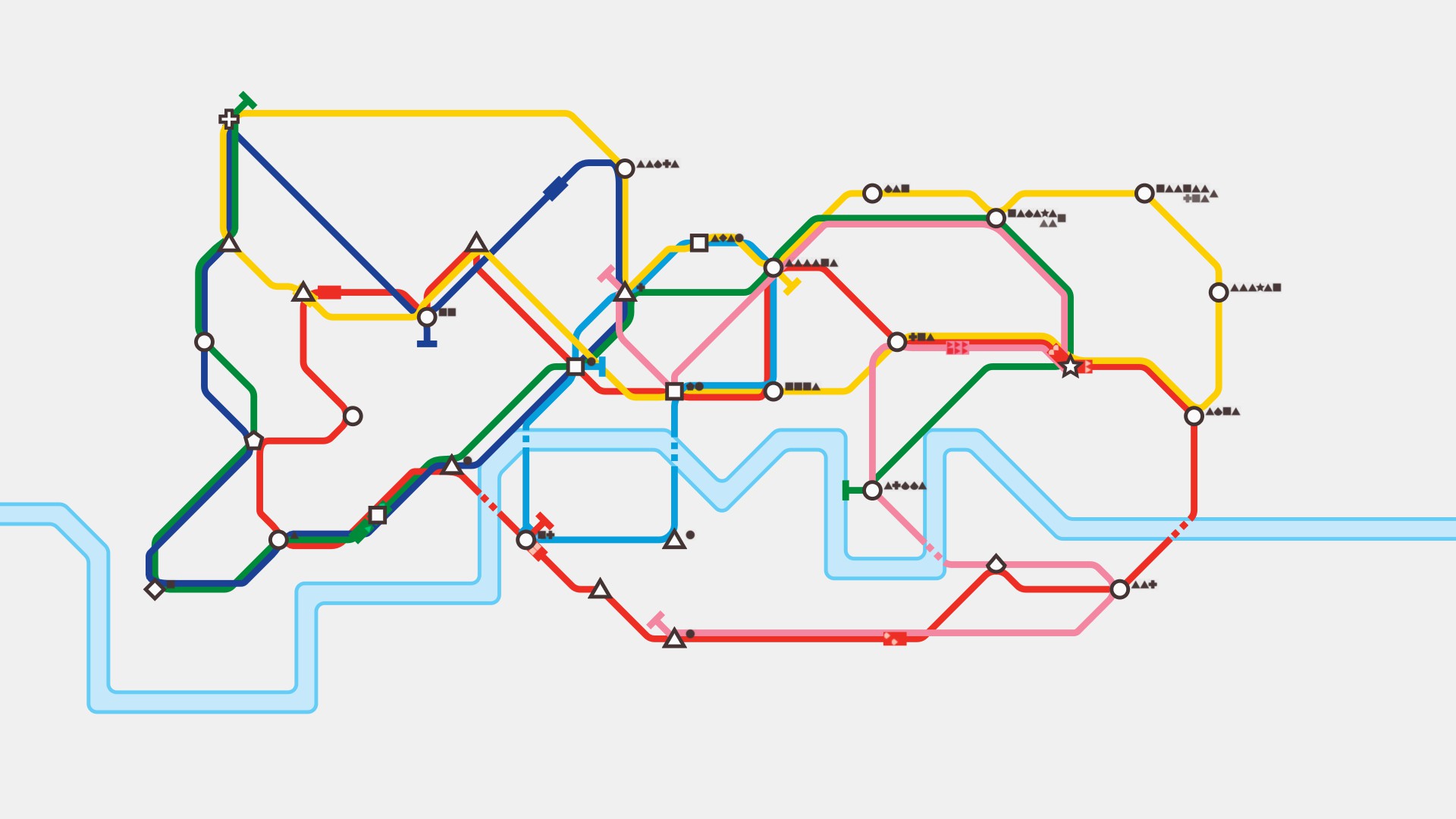
A London run at its conclusion.
What separates Mini Metro from other “perfect” video games in my mind is the fact that it so directly looks at a real world concept and adapts it into a compelling and legible game. For comparison, Tetris began as an imitation of a pentomino puzzle game – in a sense, that relates back to Tetris, but the game is also an imitation of other box filling games, not a real world phenomenon. It’s a signifier of a signifier, never quite reaching back to whatever the original meaning was. Shigeru Miyamoto came up with the concept of the Pikmin series because he’d gotten into the habit of gardening and liked imagining a little world in his garden – but the experience of commanding Pikmin as a small military and using them to perform a long-term scavenger hunt has almost nothing to do with gardening.
Development on this game started after a trip on London’s Underground – even if it hadn’t been London, it’s hard to imagine this game starting any other way. I’ve only encountered city train systems while traveling, and I still can so quickly understand what’s happening in the game because the gameplay is so well communicated by the iconic aesthetic. The railway map design allows the game to abstract more literal simulation without losing focus on the game’s actual intent, which is managing and designing an effective transit system. It’s a motivating game design philosophy, a reminder that play can be right in front of our noses rather than requiring the imagination to create a funny little plumber who shoots fireballs at kappa. Mini Metro is ingenious in the same way the George Dow and Harry Beck transit map model itself is ingenious, communicating where the trains go without literal geography, using easily recognized symbols to communicate importance, and using attractive bright colors that catch the eye and linger in memory.
CELESTE Maddy Makes Games PC, Switch, Playstation, Xbox
I Was Born For This.
“It was her dying wish.”
“I have to do this.”
The mountain is joining the pantheon of quests in games, alongside a princess in another castle, an alien outsider threatening planetary destruction, and, yes, revenge. There is a mountain; we go to the mountain to climb it. In Journey and God of War, much of that journey is just in getting to the mountain. It is always visible in the horizon; sweeping vistas after long climbs show us that we have “gotten closer,” but not close enough to tell how far the mountain really sits. After a time underground, both games find the base entry point, the snow falling to our character’s face, tassels and scarves flowing in wind.
Celestetoo is a game about a mountain. Like the prior year’s Getting Over It with Bennett Foddy, it is a game that starts at the bottom of that mountain from the beginning, teaches you the base mechanics of its precision platforming, and sends you on your merry way. And I think Celeste uses that mountain as a similar concept to Foddy’s as a reflection of the player’s own potential depression, insecurity, and need for a hard fought victory. These are, I think, perhaps the two best platformers of the decade in that they introduce new platforming mechanics while using expert intentional level geometry to communicate themes and an idea.
“Introduce” is, in some ways, a tough verb for Celeste, which to an outsider familiar with Matt Thorson’s prior game Towerfall might look like an actual ROM hack of that game. Its movement and airdash were immediately familiar to me, as I’d spent hundreds of hours playing what I’ve (obnoxiously) called “the Best Smash game, bro.” (Towerfall will get one of these columns someday soon, too, when I have a chance to get everyone together and play it for an afternoon.)
Celeste then does something better, that thing our favorite platformers do. Each chapter of Madeline’s story introduces new mechanics. Elevators that move on touch, blocks of starstuff that shoot Madeline forth like she’s cutting through jelly, feathers for Dragon Ball’s nimbus flight; each is quickly explained, quickly understood, and a project to master. These mechanics are then still remixed into later stages, but carefully and thoughtfully and not “because we were afraid it would be disappointing if we left it behind.”
And then it does something even better. It tells Madeline’s story of depression and isolation, and of her willfulness to climb this mountain. It meets Theo, who is kind, aloof, and feels like a real friend, whose musical theme is cozy as James Taylor. It introduces Madeline directly to her other self, who injects the game with as much humor as she does pain. And it does this all with the lightest of touches…except for the brilliant score by Lena Raine (plus credited remixers for the truly difficult B-Sides) which is a natural, exhilarating fit for the game.
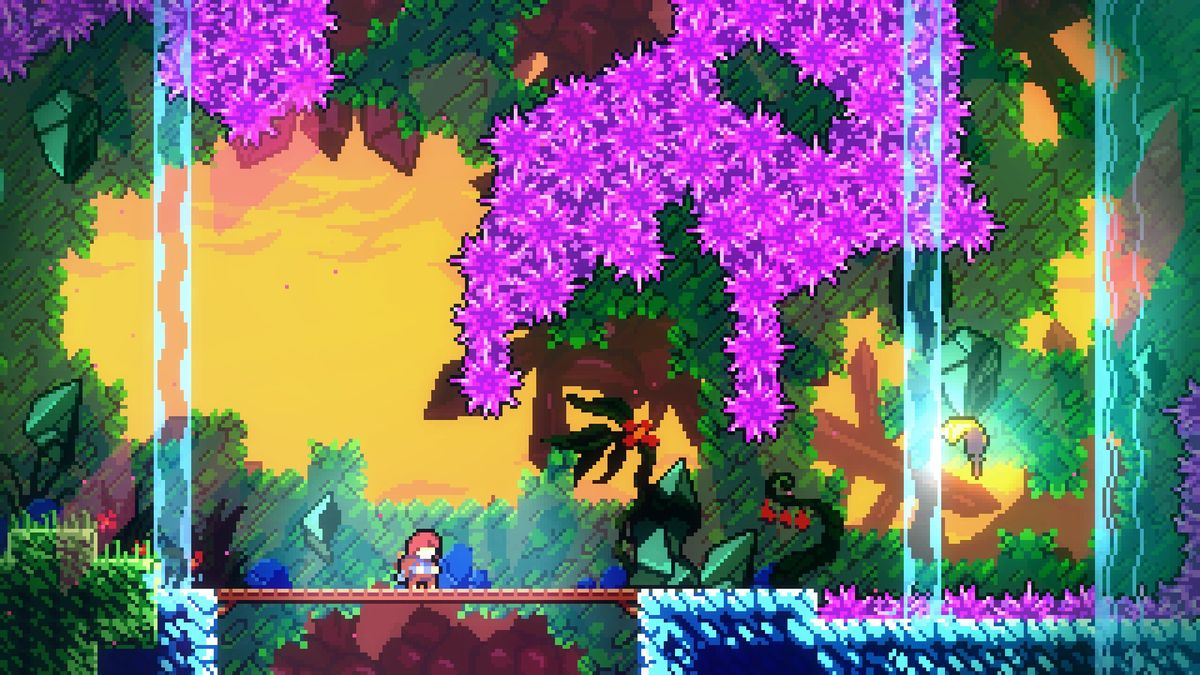
Celeste also has no trouble breaking out of its “mountain” theme to play with color.
Lastly – Celeste’s Assist Mode is a hallmark for accessibility in games. That a game so openly confident in its difficulty, so inviting to be compared to “masocore” games and ripe for speedrunning, also is so kind to its player and wants to avail itself to disabled gamers who might gain something from Madeline’s story? It’s just the whole package. They made what they wanted, and made everything they wanted.
Celeste is maybe most iconic for its creator, Maddy Thorson, using the game to come out and transition, to mild outrage from anti-woke chuds and celebration among queer gamers desperate for icons in a dude-heavy landscape. It is not the first queer game by a trans developer, nor is it the most outwardly queer game. However, prior landmark queer games are largely dialogue-heavy adventure games or visual novels, or the comedy short-form experiments of developers like Robert Yang or Nina Freeman. Celeste takes advantage of a gap in the market – a game aimed directly at the heart of the speedrunning hardcore gamer community. Anyone who’s ever watched Games Done Quick knows just how overwhelmingly queer the speedrunner demographic seems to be – Celeste manages to combine queer aesthetics with a gameplay-first design, executing a precise shot at a previously unfulfilled niche. It’s become a landmark “most important” game for that reason – thankfully, it’s a great example of where “most important” and “most fun” meet.
PENTIMENT Obsidian Entertainment PC, Xbox, Nintendo Switch
Describing the process of pitching Pentiment to the executives at Obsidian Entertainment, Fallout: New Vegas director Josh Sawyer stated, “I never would have proposed Pentiment if it weren’t for Game Pass,” the Xbox subscription service which offers a Netflix-like model for playing new games. Indie game development creates brilliant games, but Pentiment is the sort of achievement that can only be made with the decades of expertise leveraged by its development team and the resources afforded by studio development. One look at its art in motion reveals the nature of this staggering accomplishment – they have married the medieval art of liturgical Dutch masters with a game Sawyer described in the linked interview above as “Night in the Woods meets The Name of the Rose.” The presentation of this game is clever and full of the kind of ideas smaller teams cut for scope.
You play primarily as Andreas Maler, an apprentice artist working on his masterwork (think master’s thesis in a grad program) in a monastery outside the small Bavarian village of Tassing. You characterize Andreas through dialogue choices which offer you great freedom, but his voice and sense of humor largely remains the same wherever you place his values. Andreas, meanwhile, characterizes his peers, with different fonts reflecting different levels of literacy – when he realizes he had somebody wrongly pegged, their next line will play out, change font, and then be presented again to reflect their class and education. It’s the sort of judgment you get used to Andreas making.
Andreas defending friend and mentor Piero from the snobby Brother Guy.
The game’s story spans twenty five years in Tassing’s history where the town is thrown into uproar by a series of murders, all seemingly disconnected…save for one mysterious link. Andreas takes it upon himself to solve these murders and protect the falsely accused, partly because he is an educated outsider but also because he is somewhat arrogant and selfish. These murder investigations take place over the course of a handful of days. Andreas will visit with different townsfolk to ask questions, potentially lure them into exposing secrets, and collect evidence. At the end, whether he has enough evidence or not, he will nominate someone for execution, and depending on his case, his accusation will succeed or fail.
Unlike classic LucasArts games, it is impossible to collect all of the evidence and information you need in one playthrough. Convicting the wrong person for a crime won’t stop the game in its tracks. It’s a storytelling game, and part of that story involves finding your own values as you explore impossible situations. As a result, navigating the game’s choices becomes a series of very intentional decisions, and exploring Tassing’s world merits eagle-eyed attention. As a roleplaying game, it gives you so much space to play, to solve problems and find new ones based on choices you made hours ago, that it compares favorably with Sawyer’s prior landmark quest design in New Vegas.
Pentiment’s story is told with expert writing which neither becomes self-serious and dry or the Monty Python skit the art evokes for many modern players. The game is very funny without being condescending to its characters – it respects them as people, not so different from us, but also respects the difference a world of rotted food and Catholic governments would have on its characters’ worldviews. There are moments in this game where a less expert hand might make this a diatribe, but Sawyer and his narrative design team manage to largely keep Pentiment in the voice of the manuscripts which have survived from the era – albeit in plain English rather than unnecessary Middle dialect.
Andreas, dreaming of Saint Grobian and his revelers.
On that Middle dialect – I don’t want to scare people away who might enjoy this game but may not have the Medieval European history education to enjoy it. Whenever a proper noun or historical movement is invoked, you can hit the view button and it will zoom you out to view definitions of each of those terms. Adding in-line footnotes to a game based in history is so outrageously smart that it should become a standard in almost any narrative game. The UI itself is presented as a medieval text, clear maps and quest logs laid in an artful tome.
The joys of Pentiment come in unraveling its mystery and coming to love its characters. Its core mystery weaves in and out and comes to a satisfying conclusion. In the meantime, meals, knitting competitions, local festivals, gossip and play give you opportunities to care for the people you might be sending to conviction. One of my favorite characters is Klaus Bruckner, a block printer and family man whose sense of friendship and loyalty are spoken in sometimes blunt but fair clarity. There are ten other characters I might’ve selected.
One highlight is optional. An Ethopian priest, Brother Sebhat, has come to visit Tassing’s monastery to present his manuscripts for study and documentation. However, he hasn’t gotten a chance to meet the townspeople. He asks you to organize supper. When you arrive, more people than he ever imagined have joined to meet him. Sebhat takes the opportunity to learn about life in town and share his experiences as an outsider, before reading a passage from his own bible. The game’s art style changes at this moment – he presents the story of Lazarus in the art of Ethopian Orthodox Catholicism, with the townsfolk joining this story. The children ask why everyone in his bible is brown. Sebhat’s storytelling gets the chance to express a deeply felt, reassuring sermon about death and salvation, a welcome balm during this murder investigation. As he’s telling his story, one of the little girls steals Andreas’s hat – she then mad dogs you, like, “are you going to interrupt Brother Sebhat to get your hat back?” If you let her keep the hat, twenty years later, her child will be wearing it as a family heirloom.
Brother Sebhat’s Bible, at the moment Andreas’s hat is stolen.
That sequence, I think, highlights the deftness with which Pentiment expresses its narrative. Pentiment is not afraid of the scripture in its world, willing to embrace religion as a powerful force in the lives of its characters, but remains skeptical of the institution which governs that religion. It celebrates the difference between different churches, the churchless, the pagan, the European and African, between men and women. It tells this serious story with a sense of humor, the recognition that sometimes kids are just little shits, without becoming a farce. Sebhat’s supper is one of many scenes that moved me deeply.
I’m a geek for this kind of stuff – medieval literature meets murder mystery is a fanfiction my dreams wrote up while I was writing D&D campaigns in high school. I never thought it would be realized in a video game. It is chock-a-block full of magic, empathy and history. Pentiment marries a celebration of life alongside a recognition of the hardship and violence of a time where most leave no monument. From graves marked for “Two innocents” to the ruins of Roman aqueducts littered throughout Tassing, Pentiment works to preserve a history many never learned.
Because this piece is no longer available in The Daily Cardinal without use of intense google-fu, I’m reposting it on my own website. This piece originated in The Daily Cardinal’s Arts section on September 29th, 2014.
Some might say that beginning my residency as The Daily Cardinal’s video games columnist with an editorial on a mobile game is inauspicious. But amidst the several titles entangling me, none pull as much focus as the stark “Desert Golfing.” Described by iOS developer Adam Atomic (“Canabalt,” “Hundreds”) as “the ‘Dark Souls’ of ‘Angry Birds’”—perhaps the most absurd form of description, akin to the constant ringing question begging, “When will video games have their “Citizen Kane” moment?,” whatever that means—it is a spare experience that closely evokes the beloved RPG’s unforgiving indifference.
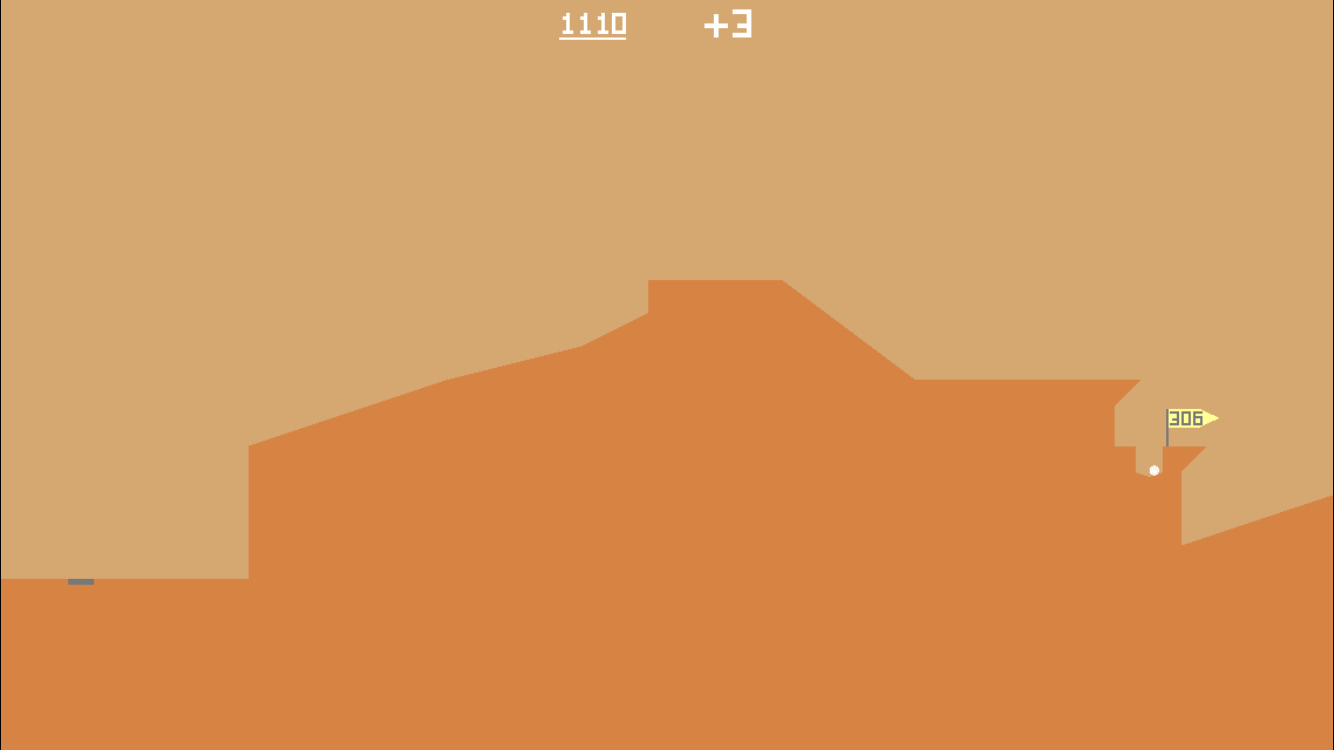
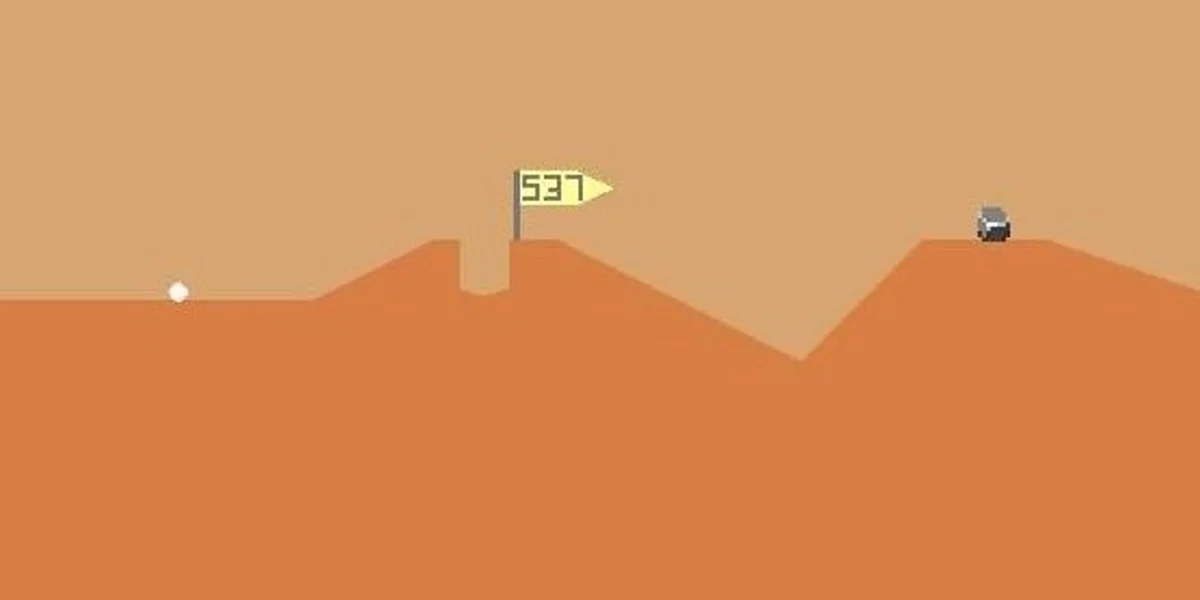
The game’s presentation is flat and hot; a light brown sky is delineated against a rough and imposing dark orange landmass. Like a construction paper collage, the angular hills defy the often-natural rolling dunes. Other times, the land towers above the small white ball at impossible angles, revealing the constructed nature of each hole. When the first prop appears beyond simple land and hole flags, it does so without fanfare, yet it simultaneously serves as a secret to be uncovered and a fascinating invigoration, an omen that, yes, there is more to discover in this vast wasteland.
The game presents itself in the iTunes store with a short haiku: “To see a world in a bunker of sand/And a heaven in a wild cactus,/Hold infinity in the pocket of your shorts,/And eternity in Desert Golfing.” It appears to be near endless. At hole 2172, I have yet to feel a need for the game to end. The furthest hole I can find a peer to have reached is hole 2884.
Yet the game must have an end, for it is clearly authored and personally manipulated; unlike “Minecraft” or “Flappy Bird,” each player encounters the same courses (as made evident only by a handful of diligent players posting screencaps to Twitter) and no one has yet reached an “impossible” course. The continuing journey towards the game’s denied conclusion is not so much a race as a pilgrimage. And, yes, those farthest along the two-dimensional path are reporting that there is something to see upon the horizon.
Swinging at the golf ball is performed exactly as one might launch a red bird at a Bad Piggy, albeit the game permits you to place your finger wherever on the screen you might like. Its difficulty often lies in the treacherous nature of its sand; most golf games use sand as an occasional trap, impossible to escape without using too many strokes. “Desert Golfing” offers no such escape from the sand, but as a result offers advantages one might not have previously perceived in the frustrating particles. Sand will catch a ball as easily as it will allow it to move each simple grain; the ball is capable of stopping on an incline if it arrives there at the proper angle, but will tumble or, worse, bounce if granted a bit too much angular momentum.
A simple score counter hangs atop the screen; rather than offer your average-per-hole or total strokes per 18-hole course, the game keeps a constant count, tallying your every swing as you ascend into the hundreds or thousands of holes. In one sense, this is freeing; there is no end in sight, allowing players to swing to their hearts’ content and improve their scores later, upon easier holes. Simultaneously, every swing takes on meaning towards the hole. There is no resetting the game and “starting over to improve one’s score;” your mistakes are only altered by improved performance over the continuing sands.
Time-wasting is often how mobile games are excused for their simplicity, but “Desert Golfing” offers a meditative experience. With so little detail, the focus must simply be on the mechanical; “aim, pull, release, observe, repeat” is its rhythmic drum. Games often feature this same rhythm; September’s largest release, “Destiny,” offers the same promise of the sublime upon the horizon and the same sort of “aim, pull, observe” rhythm, albeit with grander skyboxes and sand and a far smaller geography. “Desert Golfing” is available on iPhone and iPad for $1.99, and on Android devices for $.99.
Crime stories often invoke familiar themes. Fraternity and loyalty, duty vs. intimidation, the corruption of power, the decay of an institution. The Yakuza saga, now eight core games and numerous spinoffs and adaptations, begins with the story of Kiryu Kazuma, an up-and-coming enforcer for the broader Tojo Clan’s Dojima Family, surrendering ten years of his life to take the fall for a murder he didn’t commit. Yakuza Kiwami, released in 2017 alongside prequel Yakuza 0, commits to retelling the story of the original 2005 Yakuza as part of an effort to revitalize the franchise.
Yakuza’s story, that of Kiryu Kazuma breaking away from his foster brother Nishikiyama Akira, is the story of a man realizing he’s not young anymore. It’s the story of a man realizing that in order to protect the people he loves, including a young girl looking for the woman he left behind when he went to prison, he can’t protect everybody. It’s also the story of how getting something always comes with a cost, and Kiryu ends up spending a lot of time solving other people’s problems. Kiwami is a messy story, one full of tangents and setpieces before arriving at a more dramatic conclusion.
An introduction to Yakuza’s combat, emphasizing the four different battle stances (Rush, Brawler, Beast, and Dragon.
Where Kiwami succeeds is as an action game and an open world. The core brawling combat of Yakuza Kiwami, with four separate movesets divided into “stances,” is a delight to play and rewards thoughtful preparation and adaptation to different opponents. Every enemy you fight is named, helping to build the sense of place Kamurocho is building. And Kamurocho, the red-light district that is home to several Yakuza games, is bustling with life, sidequests, and teeming with fun minigames and details. Wandering around from the taller buildings in the Hotel District to the tight alleyways of the Champion District, you’ll find everything from slot car racing to batting cages. It’s a gorgeous rendition of city streets, and the loving attention to detail in each step of Yakuza’s world helps to ground its beloved characters.
Since the revival of the Yakuza franchise, I think most people are familiar with the games’ heightened sense of comic absurdism and representations of positive masculinity. It’s true – Kiryu is the definition of a criminal with a heart of gold, a man whose head isn’t always on straight but whose most powerful traits are his sense of empathy and his unbeatable fists. The Dragon of Dojima has helped more victims of abuse and exploitation, offered more empathy to queer people on the end of their ropes, and nonjudgmentally entertained strange hobbies or kinks more than any other character in gaming history. The colorful world of Yakuza leads you to many strange corners, but it generally comes away with a smile or accepting laugh rather than reflecting a close minded worldview.
A side-by-side comparison of a cutscene featuring Majima Goro – lacking English subtitles, this shouldn’t be considered a spoiler.
Yakuza Kiwami…isn’t as kind as its sequels. While the new content in the remake reflects that generosity in spirit (and a couple dated sidequests have been rewritten to match the modern series’ tone and inclusivity,) the core story of Yakuza is being told as it was in 2005. A comparison of cutscenes between the 2005 and 2017 games reveal that most of the main storyline is in fact replicated shot-for-shot in the modern engine. That means that the story hasn’t improved on any weaknesses present in the story from the beginning, and that includes the absence and eventual violence against women throughout the story. The Yakuza franchise, in general, is a franchise where characters die dramatically, and characters you’d hoped to see for the next five games have their storylines ended in moments. But Kiwami occasionally fails to treat those deaths with the gravity of subsequent entries, and it can be jarring and off-putting compared to the reputation of this series.
The real question regarding the sudden popularity of the Yakuza franchise in the West is “why now?” After Yakuza 0 and Kiwami, the franchise has become one of Sega’s most beloved franchises outside Japan, leading to an effort to remake and remaster entries 2-5 before moving to an international release model going forward. The answer is, I think, quite simple – the games successfully iterated into their more modern incarnation with Yakuza 3, but the sprawling, epic story of the franchise was hard to enter for newcomers with the games’ latter entries. Rebooting the story with accessible entry points allowed people to get in on the ground floor, meeting the characters for the first time.
An example of one of the many Majima Everywhere scenarios.
One other motivating factor – Kiryu’s counterpart, Majima Goro. Majima is the second protagonist of Yakuza 0, a game where Kiryu and Majima’s parallel stories only briefly intersect to tell the broader narrative of the prequel’s superior story. He was included in the original Yakuza, voiced in the English dub of the PS2 game by Mark Hamill, and was essentially a miniboss you fought a couple of times. Now, in 0 and Kiwami, he’s presented as Kiryu’s blood rival, the Mad Dog of Shimano, and much of the new content in Kiwami is centered around providing new opportunities to duke it out in increasingly absurd situations. Hiding underneath giant traffic cones, luring Kiryu into soaplands for private parties, and simply howling the word “Kiryu-chan,” the Majima Everywhere gameplay system adds a gameplay villain comparable to the Resident Evil remakes’ Mister X and Nemesis, always a threat wandering the open world and ready to shake you down. Majima’s zeal for life brings out the best in the Yakuza franchise, and this is the best possible introduction to the character.
Which brings out the question – okay, this isn’t the best representative of what’s great about Yakuza, so is it where I should start? I’d probably still argue yes – while its story is more simplistic, the strengths it has in introducing characters and thematic underlining is a pitch-perfect way to meet Kamurocho’s Tojo Clan. And the anchoring relationship between the found family of Kiryu and a little girl named Haruka-chan makes this must-play stuff for understanding where Kiryu will go forward. But if you start it and the story starts to lose you, go ahead and drift off to Yakuza 0 or Like a Dragon and see if those set off the fireworks before you come back. I say – if you’ve never tasted Yakuza’s particular blend of soap-opera melodrama, peak absurdist comedy, and genuinely badass action before, you probably won’t be able to get enough.
Yakuza Kiwami is available on PS4, Xbox One and Xbox Series X consoles, and PC, for around $20. The game is also available on Xbox Game Pass, along with the other Yakuza games in the Kiryu Kazuma saga.
Fashion is rarely the subject of a game. Now, fashion, wardrobe choices, character editors, those are a massive part of many RPGs, sims, and minigames within larger genre titles, but fashion itself is rarely the focus a game drives itself on. Style Savvy Trendsetters, the second in the Style Savvy series, keeps that focus centered – the next entry, Style Savvy Styling Star, branches out into the pop idol industry in an attempt to give the game a clearer sense of direction. Trendsetters instead uses this more freeform milieu to create a setting for the game’s real focus – spiritual fulfillment and relationship building. When I look at people comparing the franchise’s entries, there’s a strong contingent who never were satisfied with the next two titles. Unfortunately, I never played them myself, probably for the same reasons this game was ignored by so many in the first place.
The core gameplay of Style Savvy: Trendsetters, the outfit designer, is fairly simple. You collect clothing for your shop, and then work with customers to find outfits that work with their needs in terms of budget and style. Each clothing item or accessory is separated by where on the body it is worn (there are three layers for shirts, for example, separated into whether they function as a base layer or as outerwear.) As you select items on the touch screen, they populate onto a mannequin on the top, building the outfit as it tallies the sale total against the customer’s budget. When you’ve assembled your suggestion, the customer will decide whether or not to make the purchase. Rinse, repeat, make cute outfits, meet new people.
Your stylist, a self-created avatar, is hired on as the assistant at a local women’s clothing boutique. A few days into your job, the shop’s owner decides to pass control of the store to you – having gone through the tutorial of assembling outfits, you’ll now be responsible for selecting the store’s stock and style, keeping up with current fashion trends, hiring new assistants, and directly assisting customers with selecting new clothes that meet their needs. The day-to-day operation ends up serving as a fairly satisfying shop management simulation, where sales feel personalized and more detailed than just setting a price on an item and letting the day pass. Clothing recommendations require keeping in mind elements of style and seasonal weather, which give you reasons to sell more than “the most profitable” items in your shop – and every customer will keep what you sell them, so you want to try your best to only sell things you actually think look good!
This structure ends up providing a drip feed for new story content, most of it focused on your relationships with your customers or fellow workers throughout the city at local cafes, makeup shops, and so on. But inklings drip in about your shop’s former owner trying to become a superstar fashion Some number of weeks into building relationships, creating aesthetics, and exploring the city for social opportunities, you’ll gain the ability to select and outfit men’s clothing at your boutique as well, and eventually enter your boutique into fashion competitions in an effort to expand your store’s brand.
How many weeks? Well, I honestly don’t remember. There…isn’t a lot of writing about Style Savvy Trendsetters on the internet. A handful of reviews exist from the time of release – one of the five on MetaCritic is print only, and another links out to a site that no longer has reviews whatsoever. There’s only one in-depth customer list on GameFAQS – and zero walkthroughs, clothing lists, or competition guides. I remembered that Leigh Alexander used to tweet about the game – I’m fairly confident that’s how I originally found out about it! – but I can’t find anything in my searches now. This lack of guidance ends up leaving the discoveries of the game feeling even more special, more intimate. Style Savvy: Trendsetters might be one of gaming’s best kept secrets. If so, I’m glad I get the chance to share it with you.
Let’s walk through a short play session, maybe twenty minutes or so. I’ll boot up my file on the third copy of this game I’ve bought over the years, which I’m probably about three hours into playing.
In my shop right now, I have Shea, my assistant. Per the game’s tooltip, “She’s a bit of a scatterbrain but works hard to make up for it.” I like her updo and denim vest, but the black-and-creme striped top she wears under it doesn’t quite line with the buttons – I have an option to change her outfit, so I suggest a different striped top, this one pale cyan and white, with a small blue bow at the collar. She thanks me for the suggestion, and I move back on to my customers.
First, there’s Guinevere, a serious-looking woman in a black blazer and knee-length straight skirt. Checking the tooltip, “she has asthma but is training every day for a half marathon.” This isn’t her first visit – she has a budget today of $300. Checking in on my other customers, I have a first timer in a cute soft outfit and glasses (“She slathers on the sunblock because her skin is so sensitive”) and India (“She’s a waitress at the cafe and has a serious thing for dinosaurs.”) I take too long deciding and find out for the first time that each game day is processing on a timer – it’s not about how many customers you choose to help, but how long you take. Now the pressure is on. It’s now nighttime, and my customers have changed over!I’ll help this next first-timer. There’s now a customer with long dark blue hair and blue polka-dot dress. She has a budget of $800, so we’re picking her quickly. Her name is Wren: “Listen up! I have some great news for this city! There’s going to be a new makeup studio opening near here! Everyone around here is going to be so gorgeous! Once it’s open, you’ll be able to buy makeup there!” Makeup is highlighted in yellow – a new feature is being added to the game. Wren asks me for a feminine skirt as her first purchase – let’s help her out.
The game opens directly to the skirts menu – it doesn’t highlight which skirts are “feminine,” though. To discover that, you either need to know your wholesaler and styles, or you can use the menu to highlight all the feminine items in stock at your store. Feminine in this game means “adult, but not formal.” It’s a style I’d affiliate with business casual. Noticing her leather brown vest, I pick out a brown fluted-hem skirt from Marzipan Sky. It’s well within her budget, so I’ll ask her to try it on rather than take a look first – it’s a double-down mechanic, going all in rather than offering choices.
That feeling of putting on a new piece of clothing you love – you see it in your customers every time. They receive these suggestions as an opportunity for a Sailor Moon style transformation sequence – they are empowered to be their best selves in the clothing you’ve selected. “I decided on a whim to try it on, and I was blown away! It’s perfect for me! This look is just what I was going for! So sophisticated!” She isn’t buying anything else today, but sometimes these sales will lead to customers asking for an entire new outfit. You’ll see them in clothes they’ve bought from you going forward, mixed and matched with what they already own.
Eventually, as a player, you come to know these keywords, these wholesalers, and, yes, these customers. They’ve written hundreds of customers, and compared with Animal Crossing, there’s a lot less shared dialogue between them than you might expect. Combine that with the number of events available in the game at an ever-expanding list of locales, and you end up with hundreds of hours you can spend long after your shop is 100% solvent.
What makes that gameplay so appealing is how much of the writing is geared toward people who actually behave, well, like people. Some of them have mundane problems, like a lack of self confidence, or job dissatisfaction, or a history of dismissing their ex-girlfriends’ love for dressing well. Those relationships reflect something very real, which is the way putting effort into your own appearance can make you realize your own self-worth, or how valuable putting effort into something you care about might be. Other characters are bubbly and fun from the jump, and their conversations tend toward being like easier, occasionally more superficial friendships.
In addition, I have to say, it’s a blast to play a game where the clothes actually look good. I always love to notice details like the button-work on a cardigan, the stitching on a pair of pants, the little accent stripes on a scarf. All of it suits the game’s character models well, who look very much like classical fashion school hand-drawn models, the sort you might see in traditional design drawing. I like the music too – catchy, easy-going music, mostly jazzy, a little bit elevator-y at times. But I spend a lot of time with the game with the music off, mostly because it is such an easy pick-up-and-play title.
There are obvious limitations to this game’s appeal. While I think the game does a decent job presenting racially diverse customers to the player, there is absolutely no body diversity – everyone is shaped like Taylor Swift or Andrew Garfield, reinforcing a monopoly of the thin and slender in fashion that many of its players won’t see themselves in. For a game with a fairly thoughtful approach to how strange and wonderful people can be in the city, there’s also not any explicit queer representation within the game, which is something I’d like to see them approach in a sequel. And, for all that great clothing can do for a person, the game frames that clothing in a sort of utopian capitalism, with no real concern given to where clothing comes from beyond “a warehouse wholesaler” and “a smartly selected boutique”, leaving it fairly unconcerned with any serious consumerist critique.
Still, I love this fantasy. I love living in a world where I think about expression. I love playing in a world where problems are easily solved. I love looking at clothes, and looking at those clothes on people who are nice and who I want to dress. Maybe someday there will be the Style Savvy clone that Stardew Valleys the original and builds even more into a queer utopia. When it does, I will remember this game.
You can expect me to write about this one again someday, now that you’ve been introduced.
Style Savvy Trendsetters is only available on the Nintendo 3DS, and currently sells at $39.99 digitally in the US. You can also find the game for significantly cheaper as a physical copy on online storefronts. The game is localized as New Style Boutique in the PAL region, and Wagamama Fashion: Girls Mode Yokubari Sengen! in Japan.
The game hangs in sounds easily remembered and in feelings of genuine shock. In piano tinkling out of a band practice room, in murmurings about what lives at the bottom of the well, in a tattoo of the golden Triforce. Other Zeldas can lay claim to some of this ferocious energy, but until Breath of the Wild stole Olympian fire, no other Zelda would ever conquer a Reader’s Poll but Ocarina of Time.
Today is its 20th anniversary. Two decades gone. We have come back full circle. The most beloved games of 2018 all openly wear its colors. God of War is now an environmental puzzler with lock-on behind the back combat. Red Dead Redemption 2 officially turns the series outward toward digging through cranny and nook as its most ardent fans drop off the main storyline one by one. All that keeps Monster Hunter World from carrying the Zelda costumes presented in Monster Hunter Generations Ultimate is its lack of a Switch release.
I have been grappling with Ocarina of Time since its release. I have experienced envy, fury, pride, dejection, frustration, abandonment, and, eventually, acceptance with Kokiri Forest and the Hyrule that it calls home. Once the height of imagination and grandiosity, it sits now like an empty dollhouse, the furniture gathering dust.
In the past, I’ve wantonly made public my apostate perspective of Ocarina as “the worst 3D one.” I cite the obtuse adventure-game logic of its occasional difficult puzzles (find the sword in a hole in the wall behind the sword training center, a place useful for non-sword owners; use gravity to fall on web one and only one time – an environmental object’s ability to bear your weight will not return as a mechanic,) the simplicity of the rest, the ugly emptiness of its dungeons, and the resistance of beautiful weirdness.
This was inspired by a friend I’d suggested play the game as her first Zelda. She loathed the experience. Another friend and I set out to replay the game and found ourselves powerfully critical. What wonder it once held to our child’s eyes was replaced with repulsion. “This” was the game being held above so many we loved, above even those we still loved from that dusty N64?
Yet this rejection too was that immaturity that stops the high school student from seeing the animated films they loved all their childhood. We refused to admit how much of the game was simply bound to our code at that time. We could not imagine fumbling with the controls any longer, now bred into full literacy. We could not feel that pride at mastery we once developed as kids. We could not hear the shop music as anything but a jingle used by YouTubers to entreat the likecommentsubscribebelow.
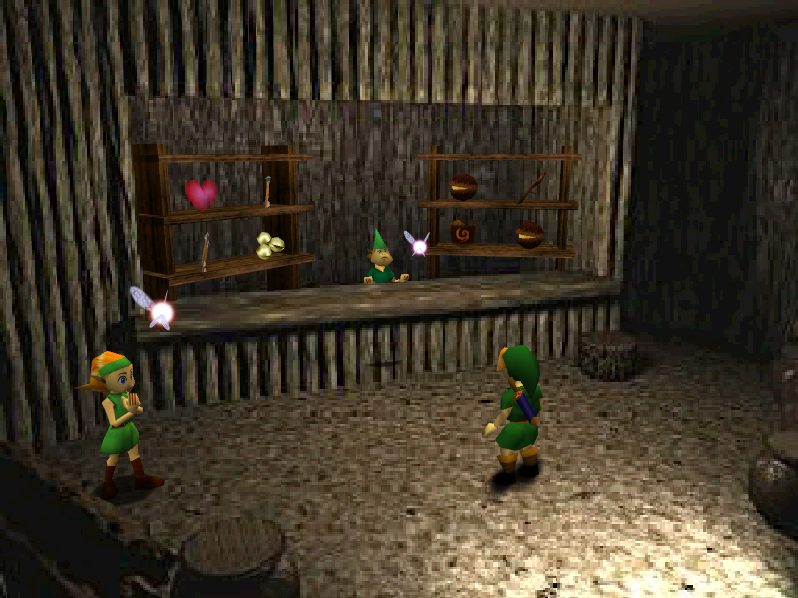
Twenty years. Two decades gone. Under a blanket, on my partner’s sister’s sofa, I meditate on the little Kokiri shopkeeper. He seems almost casually overfamiliar while also seeming uncaring. Maybe he’s distracted because he can’t stop bouncing to peek over the countertop at his customer. I love this lil’ guy.
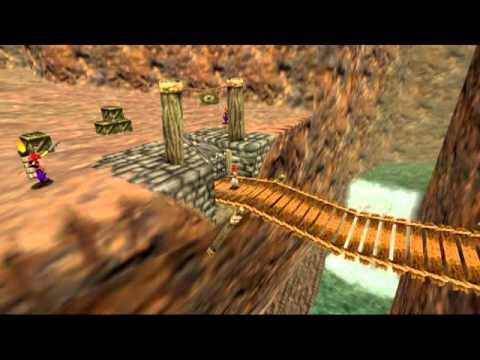
Remember how messy the river to Zora’s Domain is? This cavalcade of horrible eel-like geometry that you have to traverse to reach Princess Ruto, the King, Jabu-Jabu? They would repeatedly veer back and forth on how much of a Mario game should be in a Zelda game since. Geographically, it creates this place where as Din molded the earth into stone, some part of the earth grasped out against her.
I suppose what makes Ocarina of Time so difficult to grapple with is that unlike prior Zelda games, it no longer seems like an abstraction but a world. But unlike later Zelda games, its characters only have the basest desires and no driving ethos. The dollhouse comparison seems apt; it is a populated field with no life. It is a house without a home.
And then there’s the Happy Mask Salesman. The jogging man who just wants a worthy race. King Darunia’s Epic Boogie to Saria’s Song. The yellow-greens of the Lost Woods. That Gerudo Valley flamenco, that race’s uncomfortable fusion of Romani and Arabian culture. Ingo, the Waluigi of Lon Lon Ranch, that insidious younger brother who throws in with King Ganon.
I have been grappling with Ocarina of Time for twenty years. Two decades gone. I do not expect to answer its questions today. But, well. I’ve put its name in my mouth a lot these last eight years. I can take a little more time to put respect on its name.






 All My Friends