THE ONLY SON – Link Out To The Solute

THE ONLY SON
Dir. Yasujiro Ozu
1936
Criterion Channel

This piece originally ran on September 23, 2019 in The Solute. Please follow the link at the end of this preview for the full piece – there is no paywall.

“Life’s tragedy begins with the bond between parent and child.” 

The Only Son, Japanese director Yasujirō Ozu’s first talkie (and 35th film) u, opens with this brief, unattributed axiom. A brief prologue introduces us to Ozu’s famous  style and tone— shooting subjects head-on, looking directly into the camera to confront the viewer with their emotional culpability. But we also see a parochial pre-war Japan where a mother (Choko Iida) cannot afford to send her son to middle school. A visit from the elementary school teacher reveals both the son’s lie about his future and the impossible but  important task of adapting to a world that will change Japan very, very soon. 

So begins a tale of a simple drama — a mother gives her last remaining days of youth to support her son, and after graduating college, he doesn’t respect her enough to tell her when he gets married or when he has a child. His justification is that he hasn’t become successful enough as a businessman — he is living in shame, but his mother is far less hurt by his fiscal “lack of success” and more by the man he has become.

Read the rest on The Solute.

GEMINI MAN

GEMINI MAN
Dir. Ang Lee
2019

This is one of those rare movies where I get mad because the people who like it don’t like it enough for me. Gemini Man isn’t just “a well directed movie with a bad script.” Gemini Man fucking rocks. Gemini Man, directed by Crouching Tiger Hidden Dragon and Brokeback Mountain’s Ang Lee, is a combination of the high-octane masterpiece action he’s still maybe most acclaimed for with the sensitive humanist sentimentality of his adaptation of Sense & Sensibility or his masterpiece Eat Drink Man Woman.

Under another director, I don’t doubt the dialogue in this film would clang left and right. There is a lot of exposition required to tell the story of Henry Brogan, ex-US government assassin and now fugitive being hunted by his own youthful clone. The most obvious comparison for this movie is to Hideo Kojima’s Metal Gear Solid, a saga about genome soldiers, crossed allegiances personal and political, and full of the same ridiculous over-the-top bullet time action you see in Gemini Man.

This film excises Metal Gear’s famous extended political diatribes (for those who don’t play games, these basically play out like Donald Sutherland’s extended monologue in JFK, complete with archival footage) and places any monologue in the mouth of either Will Smith or Will Smith, the sole exceptions belonging to Clive Owen’s villainous Clay Verris. The Verris scenes largely play out like a more standard villain from a 90s film, though there are some pleasantly disarming moments where he can’t help but actually show some affection for his favorite experiment. It’s an interesting choice, the sort other directors would probably excise so he were easier to hate. Ang Lee understands that his villains are best when they have their weaknesses.

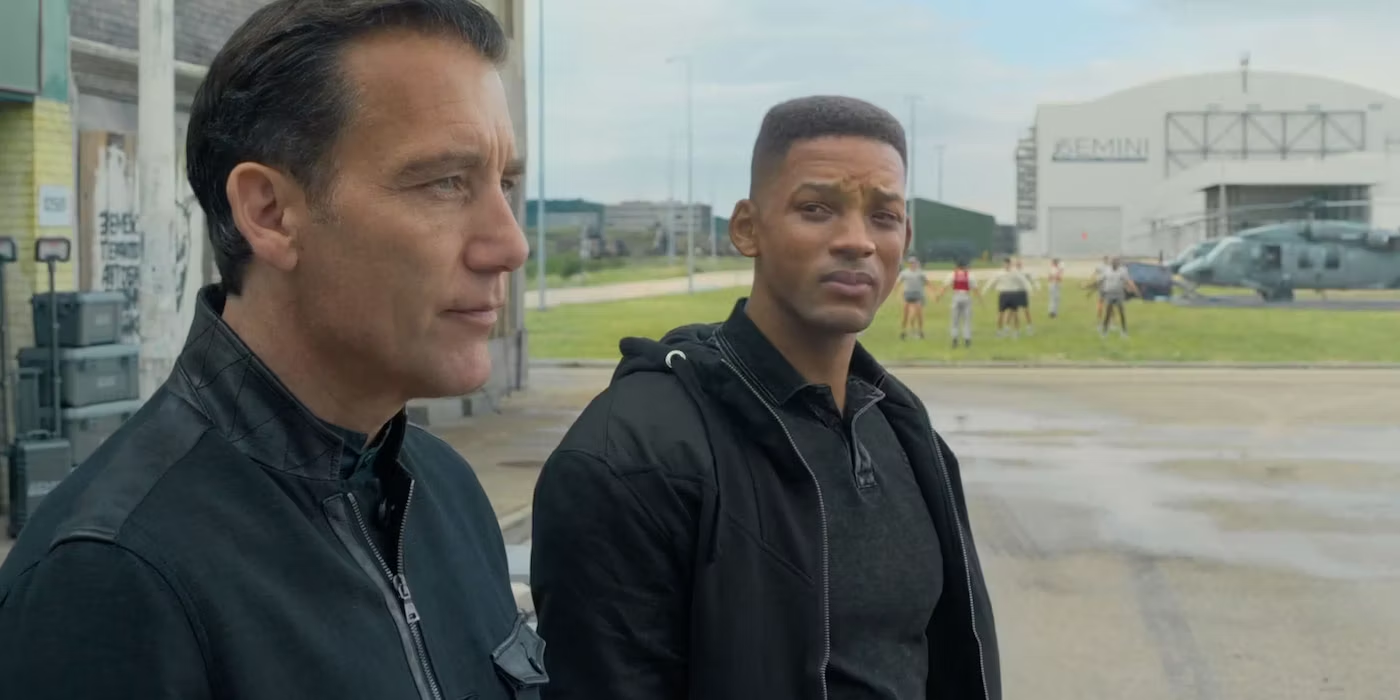
Jr. and the villainous Clay Verris.

The dual Smith performances are honestly pretty remarkable. Younger Will as Junior put some effort into playing him closer to Bel-Air; a famous anecdote claims Ang Lee told Smith he needed to “be a little more wooden, act worse” because the maturity of his portrayal was spoiling the effect. Older Will as Henry plays the disaffected glaze of an easygoing snark in a way always betraying the pain underneath. He doesn’t play it like a violent sociopath, either – it’s represented more personally, as someone who recognizes that their life choices led them to create a bubble of alienation and excess that never really provided room for intimacy or growth. The mask falls during a confrontation with Junior, and Smith plays the growing crescendo of doubt swallowing him whole.

That scene in particular is so fascinating to me as a representation of the way therapists talk about the therapeutic dialectic. The older Smith looks at his younger self and addresses every insecurity, every trauma, every happy memory and every impulse with the neutrality of an outside observer, and both performances are forced to reckon with how it feels to both witness and be witnessed at the same time. These are simultaneously the things that make them the same and yet the expression of them inherently divides them across a mass gulf in power and experiences. How do you talk to yourself? How does the inner voice that tells you these things treat you, and how do you respond as both audience and presenter? 

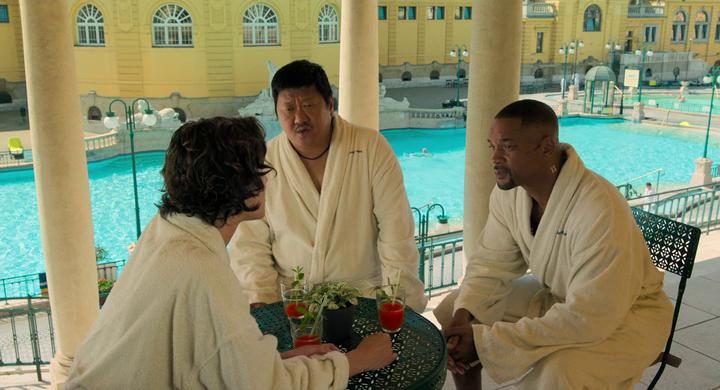
Poolside meeting, waiting for a Russian bioengineer.

There are other ways to dig into the ways this film says things about concentrations of power, abusive dynamics, denial, transactional relationships. Admittedly, they largely aren’t that deep – what they do is provide a structure to what is just whip-ass action. In their first big fight scene, one Will Smith throws a grenade and the other shoots it out of the air back at him. Later, one of them roundhouse kicks the other with a motorcycle. There’s a lot of really wonderful wirework in this film, and transposing it into the modern era results in a lot of Mom’s Dead Parkour. Lee’s direction of action is just so much better than so many of his contemporaries, and I’m surprised by the dismissal of this film on those grounds alone.

I unfortunately never got to see the film in True Ang-O-Vision, 120fps 3D 4K, but in 60fps it’s still pretty breathtaking stuff. The effect of the high frame rate and 4K capture has me looking at every action scene and going “how the fuck did they do that?” It serves the more dramatic conversations well, too, as Smith is so good at playing the growing microexpressions through a scene, and it obscures some of the uncanny of the de-aging. If you don’t have access to the 4K Blu-Ray for that 60fps presentation, we’ll have to watch it sometime.

WEEZER (Blue)

WEEZER (Blue)
Weezer
1994

Weezer’s self-titled debut turned 30 on May 10th, 2024, the day I am writing this first draft. This album is the mainstream companion to the nerdcore rising of Weird Al Yankovic, They Might Be Giants, and Barenaked Ladies. Enough of the songs have plausible deniability that you can play one or two of them without devolving into a conversation about Monty Python, Mel Brooks, or stale YouTube videos. Almost every band signed to Fueled By Ramen cites Weezer as an influence. If I made a playlist of “the good Weezer songs not on the debut,” it would run about an hour, and every one of those songs is only really good in a live concert setting. Bassist and songwriter Matt Sharp left the band after Pinkerton somewhat acrimoniously, and with him he took all the harmonic complexity that makes the Blue Album more than “catchy.”

I absolutely love this album despite everything. While its relationship to Pixies’ Doolittle betrays them as the commercial correction to Nirvana, Weezer’s appeal lines them up alongside The Cars, Cheap Trick, Kiss. On this album, they’re writing extremely crunchy pop music that sounds phenomenal loud. Sharp and Patrick Wilson (no relation) make a perfect rhythm section responding to Cuomo’s best hooks. And I mean best hooks by a lot – Cuomo never wrote anything quite as complex and interesting as “Holiday”’s soaring, interlacing chorus, very consciously modeled after The Beach Boys’ Pet Sounds but sung without any of the beauty of Al Jardine or the Wilsons. It’s yelled more than sung, the “Heart! Beat!” call and response – until the even more explicit Beach Boys breakdown, which is sung in a clean, low baritone.

He never wrote anything as pleasantly catchy as the “Buddy Holly” chorus, either. The verse is kind of a mess, a weird yelp over a fairly simple guitar part. But it builds perfectly into that chorus, the little “Ooh oohs!” setting up that “Ooh wee ooh!” so nicely. And then, of course, that iconic, corny, major key solo. Almost half of this album has been isolated and dissected into memes, maybe none more than “Buddy Holly,” and yet it can’t spoil the fun of just listening to the damn song for me.

Every year I end up relistening to this album and end up with different favorite songs. This time, “The World Has Turned And Left Me Here,” “Undone (The Sweater Song)” and “Holiday” jump out – sometimes, it’s “Surf Wax America,” “In The Garage,” “Only In Dreams.” It’s, admittedly, almost never “My Name Is Jonas,” though I love playing it in Guitar Hero! And it’s almost never “No One Else” though I dig its uptempo groove and the way Cuomo sings “Hou-ow-ow-ow-ouse!” but is Cuomo at his more toxic incel vibe. That ends up dominating Pinkerton, an album I spend very little time with, and then all edge is flushed out by The Green Album in ‘01, making music only for commercials afterward. As I said, there’s some catchy tunes left. But as far as I’m concerned, it’s basically this one album, an album you can warp into the dumbest configurations and then still come back and love. 

KEY TRACKS: “Undone (The Sweater Song)”, “Buddy Holly,” “Holiday”
CATALOG CHOICE: “All My Friends Are Insects,” “The Perfect Situation,” “The Greatest Man That Ever Lived”
NEXT STOP: Sincerely, Dude York
AFTER THAT: Little Busters, The Pillows

I SAW THE TV GLOW

I SAW THE TV GLOW
Dir. Jane Schoenbrun
2024
PVOD, may still be in theaters near you!

This piece alludes to spoilers for the film I Saw The TV Glow – CW for intense depictions of gender dysphoria.

I Saw The TV Glow is a horror fantasy film about two teenagers, Owen (Justice Smith) and Mattie (Brigette Lundy-Paine,) who bond over their love of a monster of the week TV show The Pink Opaque. Owen isn’t allowed to watch it because the show is broadcast past his bedtime, dictated not by overprotectiveness (this stays true into high school) but by a distant, controlling father. So Mattie leaves Owen VHS tapes of the show – the film plays the development of their relationship in gorgeous lighting and on-screen marker-work while a great original Caroline Polachek song plays. It is not the first or last great original song in the film. One night, Owen asks if he can stay up and watch the season finale himself. Owen’s dad asks him upon hearing the request, “Isn’t that a girls’ show?” 

When I was growing up, I was introduced to anime somewhere around the age of six or seven. I don’t actually remember which came first between Sailor Moon and Pokemon – they came roughly together. My parents applied zero “isn’t that a girl’s show” pressure around me watching Sailor Moon, they bought me the tapes. If anything, Mom’s shared with me that her attitude was always that they actively encouraged us to engage with entertainment in an ungendered way, to enjoy what I enjoyed so long as it was age appropriate. But by third grade, the boys in my cul-de-sac who would introduce me to internet porn a year later called it a girls’ show, and those tapes never came back out again.

Owen and Mattie first meet when Owen is in the seventh grade, played by Ian Foreman. The central three performances in this film by Justice Smith as Owen, Brigette Lundy-Paine as Maddy, and Ian Foreman as Owen in the first twenty minutes, are all astonishing. There’s an astonishing degree of trust and immersion in the day-to-day awkwardness of being a teenager that comes along with the deadly suffering of repression. Lundy-Paine gets to transform this over the runtime of the movie into a confidence, their final monologue one of the film’s few empowering and energizing scenes.

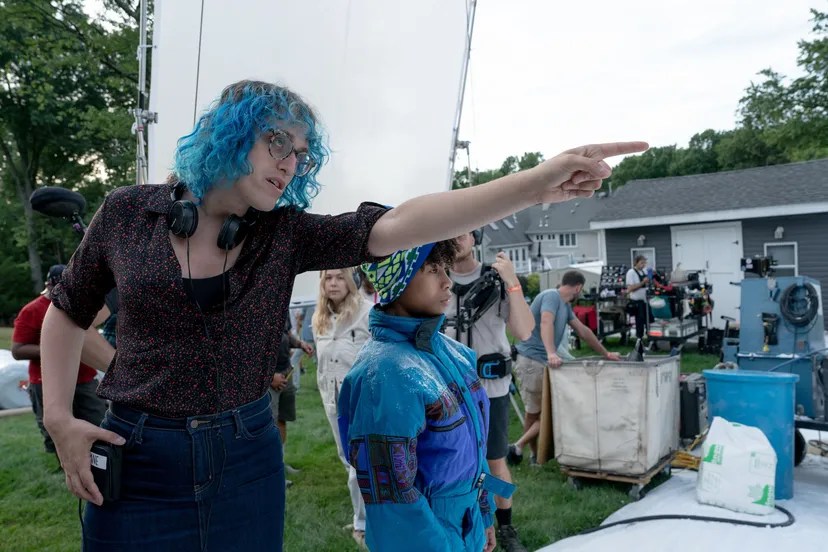
Jane Schoenbrun (left) directing.

I Saw The TV Glow is a film about gender dysphoria. It is about an oppressive world that hates you for who you may not even yet know yourself to be. This hatred plays out in Small Horror Ways, microaggressions and hard stares, and in Big Horror Ways, in makeup and special effects and blood and ooze. It is also about trying to find community over the smallest of connections and finding a friendship that feels like a home. It’s not all oppression and despair, but I would not call it a “fun watch” or “inspiring representation!”

Inspiration is still happening, though – director Jane Schoenbrun, talking to Jordan Raup, said “I’d say at about a third––if not half––of the screenings that I’ve been to with the film, some shy person has sauntered up to me afterwards and been like, “That was it.”

There are
now
many reviews that
are equal part film criticism
and processing
coming out.

I kind of can’t stop reading about this film, interviews with critics like Willow Maclay, Juan Barquin, and Charles Pulliam-Moore informing the writing of this piece. Alongside them, a chorus of trans viewers feel I Saw The TV Glow will save lives. When I tried to say those words to friends after my screening, I started breaking down crying again.

Justice Smith gives a performance I can’t stop thinking about. One of the most painful scenes in the movie is a scene where Smith gets to perform full slapstick comedy. He manages to make his body move like Scooby Doo at a moment where you desperately want him to face his fears. Another early scene, his first confession of his sense of difference, is an astonishing performance of vulnerability of evil thoughts directed at the self, presented like it’s normal because he’s only sort of sure that it isn’t normal and he’s not just being dramatic. This performance carries trauma the way Sheryl Lee carries trauma in Twin Peaks: Fire Walk With Me. It is in the body as much as the voice and the mind, but it is also normalized, casual, and deeply painful. The feelings he is carrying are so private that he is compartmentalizing them from himself, repressing as much as possible.

I came out as nonbinary to myself and close family and friends shortly after the election of Donald Trump. That night, the terror and overriding anger it made me feel, made me realize that the relationship I had to that man, and all men, was not one of shared identity and shame. It was a question I’d had lingering in the back of my mind for years as I found myself gravitating toward trans artists, writers, and style icons, and that pushed me over the edge. I tried using they/them pronouns briefly and found it hard to recognize people were talking about me – I moved back to he/him pronouns and, for the most part, I’ve talked about my identity a few times a year before putting it back on the shelf to deal with later. 

The overriding feeling of pain and the panic attack I had when the film cut to credits confused me. I didn’t have an egg to crack – what was happening? After taking a week to process, I’ve accepted that what I’ve been doing was grieving all the time I’ve lost. If this film had existed a decade ago, I might have confronted some of my insecurity, anger, and repression a lot sooner, before it led to lashing out at myself and loved ones. I might not have put my identity on a shelf rather than owning it, talking about it often, taking pride in who I am rather than regarding it like car repairs I’m putting off.

Schoenbrun’s previous film, We’re All Going to The World’s Fair, was in my roundup of the best films of 2022. I described the film foremost as about feeling small and childish in a room (the internet) where you suddenly realize everyone else thinks you’re acting out. That feeling of the judgment of others looms over huge swaths of I Saw The TV Glow, and it results in Owen losing weeks or years of time to a passive sense of “trans time,” as Schoenbrun calls it. There is a disconnection from everything because Owen’s own role in that life feels wrong. Like the sense of online immaturity in World’s Fair, I relate to this feeling of time slipping.

I can’t stress enough that this film is immaculate, gorgeous and inventive in cinematic language, funny and scary and beautifully acted. I also accept that I’m not going to be normal about this movie. This is the most impactful a new release has been on me in a decade. I can’t and don’t expect people to have the same reaction to it. The enormity of this film makes me feel small and childish, and maybe I will look back on this version of myself the way I have looked at the smaller, more childish versions of myself over the years. As Maddy insists, I will not apologize for it. We are always becoming new versions of ourselves – the film’s signature line is a chalk scrawl which reads, ”There is still time.”

FEZ

FEZ
Polytron
2012
All platforms

Fez is the first video game I had to start keeping a notebook to complete. On the surface, Fez is a classic pixel art puzzle platformer with a twist – all of its 2D environments actually exist in 3D, and by hitting the controller triggers, you can rotate the world to another perspective and see a new part of the level. The primary action is jumping around collecting golden cubes (or, for extra challenge, the purple anti-cubes.) Collect all of them and ascend into the monolithic hypercube for a light show akin to Beyond the Infinite from 2001: A Space Odyssey.

The world of Fez is a brightly colored collection of floating islands, the primary sensibility being comic. In the town where your avatar Gomez lives, his neighbors largely deny the presence of a third dimension, living a life unaware of a world beyond home (the door is on the back of the 3D island.) There is a factory zone where little billboards in some sort of cube language are accompanied by portraits of Gomez’s Doughboy-like kinsmen. Little pixel frogs ribbit and little pixel gulls caw. The animals, little machines, and bouncy mushrooms are all animated with the kind of charm that rewards attention to small details.

But whatever is Beyond the Infinite is encroaching on this world. Breaking into the third dimension seems to have broken something – as you continue to explore, more and more of the world crumbles into what seem to be black holes, tears in the fabric of reality that Gomez can disappear into. (The game is very forgiving with respawns, finding whatever solid ground you last set foot on and quickly depositing Gomez back to where he can stand passively.) The majority of the sense of peril in this game stems from the early career score by John Carpenter synth descendant Disasterpeace (It Follows, Mini Metro, Under the Silver Lake.) Some tracks are peaceful, others majestic, others energizing – but when he aims for horror, the sense of dread that envelops everything still chills me.

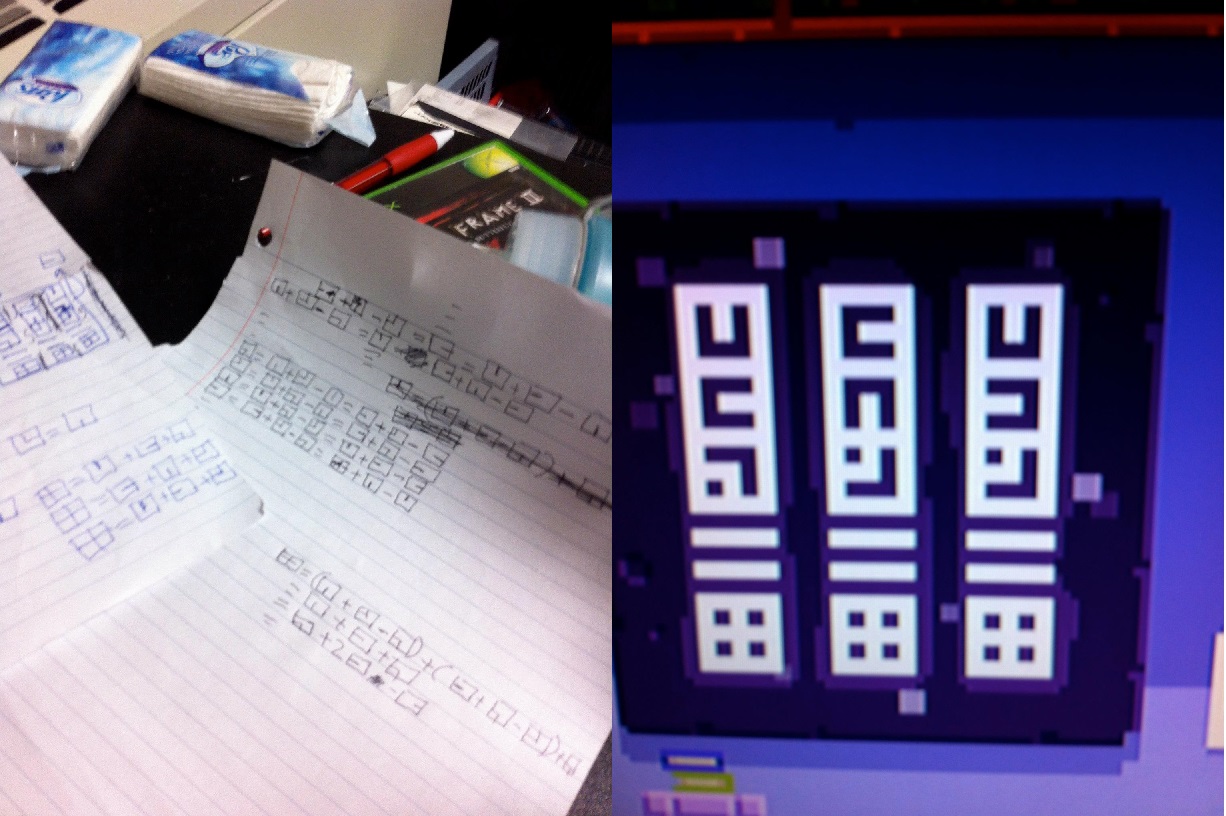
Math class.

After the credits, Fez loops back into a “new game plus” that offers a new first-person perspective and new rewards for earning all 32 golden cubes and all 32 anti-cubes. Doing so involves ascending into Fez’s true difficulty. Fez is not, at its core, a puzzle platformer. The game transcends into a game about archeology. It involves looking for ciphers and decoding ancient language. It involves reading ancient star maps to understand how ancestors looked to the stars. It involves, well, taking notes. The obvious comparison point for games critics in 2012 was Myst. But I haven’t played more than a half hour of Myst – when indie games center on this kind of meta-puzzle, like the brilliant Outer Wilds or this year’s Animal Well, I compare them to Fez.

There is something so immensely rewarding to me about this kind of language game. I’m bad at learning languages in real life – I think in English. I recognize our language’s many, many faults and confusions, but it is the system I understand. While Fez does have a literal language cipher (one that conforms to English directly) it also offers other, less linguistic symbols. Fez doesn’t just challenge the player to solve puzzles – it challenges the player to learn How To Learn. It invites you into a game world with very limited information, gives you everything you need to solve it and hands you the reins to pursue as much knowledge as you care to collect.

The maddening thing about a cipher game is that it is a one-and-done experience. I cannot un-ring the bell. Walking through Fez’s world, the solutions that were once obscure and required meticulous attention to detail are immediately obvious. Being in Fez’s game world is pleasant, listening to Disasterpeace’s score. Some of its platforming challenges are rewarding in the same way replaying a Mario game can be. There are moments of knowing I’ve solved something before but not remembering the exact solution. I used to consider Fez the greatest game I’d ever played. Not being able to recapture that experience will sort of always crystallize it as the best game I played when I was 20 years old.

Fez was a five year passion project, and one of the early examples of a breakout indie game. Unfortunately, Fez ended up being the end of a sentence for its developers rather than the beginning. Even before release, lead designer Phil Fish was considered by entitled gamers to be a blowhard who would never release his game. Then, Fez came out and was extremely buggy, resulting in dismissal from would-be fans (the game works great now.) And then Fish became one of the few male voices standing up to #GamerGate’s bigotry, eventually resulting in him exiting the game industry. Fish will likely never make a game again. The spirit of Fez lives on, but how quickly we silence our own luminaries.

DOPESMOKER

DOPESMOKER
Sleep
2003

I remember a high school night hanging out with an ex-girlfriend and her friends at IHOP till around two in the morning where one of the metalheads at our table invited me out to his car to listen to a song he was really excited about. The song was Dream Theater’s “Six Degrees of Inner Turbulence,” which he did not inform me was 42 minutes long. I got out around minute 10 to go back to my date, but I’ve never forgotten that introduction. I ended up seeing Dream Theater with him a few years later.

Let me inform you that while the original version of Sleep’s Dopesmoker (released as Jerusalem in 1997) broke its 52 minute runtime into six tracks, the version I know is a full eleven minutes longer and presented as one song. That ends up being more true to the listening experience anyway – while there are movements and instrumental breaks, the experience of Dopesmoker is largely one outstanding build, grooving on this one riff and a seemingly eternal drone. Some people might find it too heavy, too oppressive – as far as metal riffs go, I feel it maintains a level of pleasant record store noise. Avoiding harsh noise, blast beasts, staying in a guitar tone without the shrill soloing of Kerry King or Steve Vai – it’s not quite “optimistic” music, but it never signals doom, either.

That drone doesn’t get repetitive because Sleep is just so fucking conversational with their playing. They will introduce new notes, fills, and solos with such a casual approach to the spotlight. Because there is such consistency within the album’s sonic vocabulary, changes in time signature and in and out of sung verse come and go almost without notice. There’s a drum part that comes in around the 35 minute mark that electrifies the same guitar riff under an entirely new energy, and then just as quickly the drums back out and let the guitar charge some speed on their own. When the drums come back, they return to the rhythm the album began with, but the guitar has built new layers and the bass is filling new gaps. It progresses over the hour long runtime into something that Black Sabbath would envy.

The lyrics themselves, which tell the story of a modern stoner “weedian” being transported back to Biblical Nazareth and recreating the world’s image under the Weed Seed of Eden, are performed in a growling chant. The actual process of memorizing and recording this is an almost comical and nightmarish story of battling the equipment and finding that once they started playing, the song got slower, “freakier.”

David Rees referred to this album as like a “Mark Rothko painting hitting you over the head with a bag of hammers” in the New York Times. The album can either place you into a ceaseless meditation on a comforting surface or you can listen attentively for every textured brush stroke. I could honestly listen to another hour of Dopesmoker. I could loop this shit. It’s like sitting by a waterfall. Writing about Dopesmoker, I am both inviting you out to my car to hang out for an hour and fully aware that your date is back in the restaurant. Maybe instead we’ll just set aside an afternoon to sit in the sun and listen on a Bluetooth speaker.

CATALOG CHOICE: The Sciences (if you’re new to Sleep or sludge/stoner metal generally, I’d probably recommend The Sciences first!)

NEXT STOP: Mastodon, Blood Mountain
AFTER THAT:
Baroness, Yellow & Green

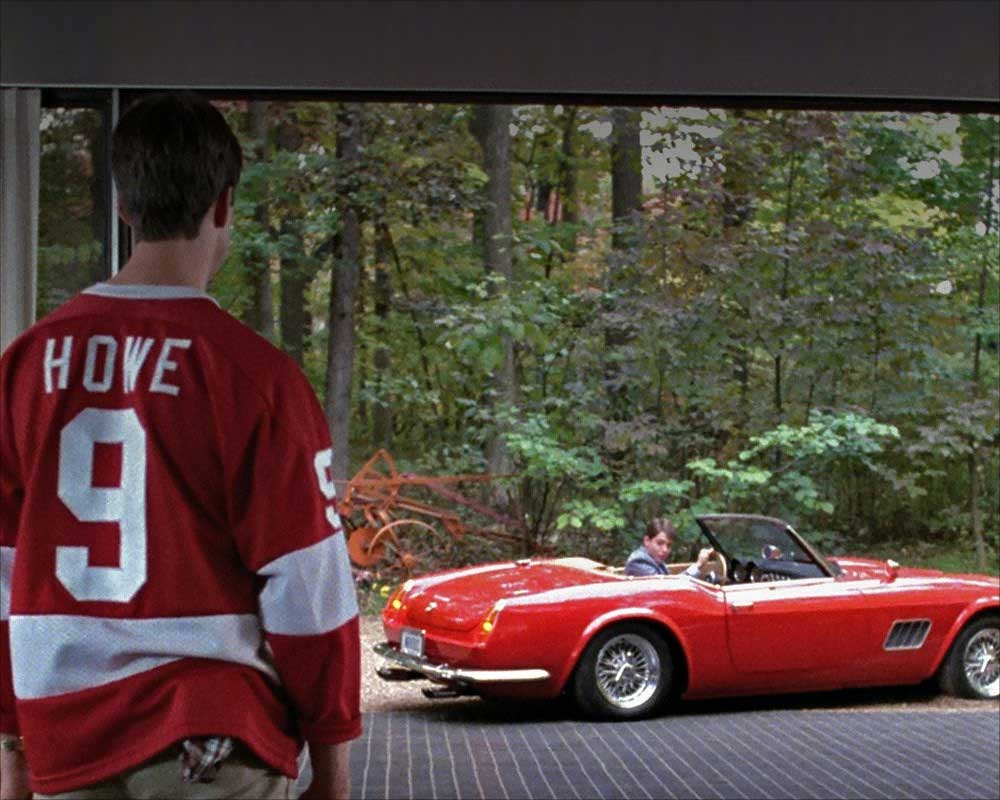
FERRIS BUELLER’S DAY OFF

Ferris Bueller’s Day Off
Dir. John Hughes
1986

It’s hard to overstate the dominance Ferris Bueller’s Day Off had over the entire rest of the 80s catalog growing up in the northwest suburbs of Chicago. Sick days, substitute teachers, pizza parties, Von Steuben Day Parade, school field trips to the Art Institute, this was as constant a companion as The Indian in the Cupboard or Newsies. I went to a talent show at Glenbrook North with a friend back in high school, and they were still constantly referencing Ferris in 2010. One of my mom’s OTs claimed he was “the guy who did the flip” during the “Twist & Shout” sequence. 

Until Mean Girls and Fall Out Boy, Ferris was our pop culture representation. And, frankly, he probably still overshadows either one when it comes to relating to one another. We love the Art Institute – we love Wrigley – we love our sausage and want it to overshadow any fine dining establishments we might have in the city. We don’t have an entire city of women as hot as Jennifer Grey and Mia Sara, but we celebrate those women where they exist.

Scolds have given this film something of a beating, insisting Ferris is a bad person. This line of criticism is noxious to begin with (Ferris is my friend!,) but it also misunderstands Ferris’s dramatic function. Ferris isn’t an audience cipher or a real person – he’s Bugs Bunny, set loose in a Looney Toon with Alan Ruck’s sad sack Cameron and the Fuddian Dean Rooney. If he’s aspirational, he’s aspirational the way a cryptid is aspirational. God forbid we have a little fun in this world.

I actually do think this is misunderstood partly because of other John Hughes films like The Breakfast Club or Planes, Trains & Automobiles, which are more humanistic approaches with deeply flawed characters. Hughes set out to make a hypercapable character who can handle anything who comes his way. He comes across as a funny sociopath, but he also really loves Sloane and Cameron. I love the guy. I wish I had that spark. The film teaches you how to watch it, too – it makes space for people who can’t stand Ferris from the start and then asks you what harm he’s really doing.

This film also employs one of Hollywood’s greatest cinematographers of all time, Tak Fujimoto. Fujimoto’s first credits include Terence Malick’s Badlands, exploitation greats like Switchblade Sisters and Death Race 2000, and the original Star Wars – he became famous for his collaborations with Jonathan Demme on films like The Silence of the Lambs and Philadelphia and his later work with M. Night Shyamalan on The Sixth Sense and Signs. There is an incredible tactility to Fujimoto’s choice of lighting and lensing in every shot of this film, and the framing he chooses to match Hughes’ blocking makes the Art Institute sequence one of the most beautiful in film history. A moment like Cameron looking at Seurat’s A Sunday on La Grande Jette is, for my money, an instant admission to the all time hall of fame. 

Ferris Bueller’s Day Off is a home for me. I have so many memories both of watching the film itself and of being in the places it depicts. I remember old friends and their families. Revisiting it always brings me a lot of joy, and I get the stupid “Oh Yeah” Yello song stuck in my head every time. If someone asked me if I wanted to get some Portillo’s and throw it on this minute, I’d do it in a heartbeat. Sounds like a great afternoon.

DEPRESSION QUEST

DEPRESSION QUEST
Zoe Quinn
2013
PC

Depression Quest is a twenty minute narrative game that exists in text, a few scanned polaroids, and some sparse music. You read an account of living with debilitating mental illness and select responses the way you do at the end of a page in a choose your own adventure book. The development software, Twine, simplifies the process of flipping to page 94 by keeping all the threads invisible to the player. It’s very easy to work with, to the point where I’ve developed a couple of very short games in the system (none of which are currently online.)

The game’s primary innovation in the interactive fiction space is crossing out and making inaccessible some of the “healthier” responses to stressors or anxieties of daily life. It communicates very effectively the cognitive dissonance mental illness sometimes creates, where you know it would be better to call and cancel plans but conflict avoidance results in you just lying in bed until you get the “dude wtf” text. It would be better to take a shower and make a meal that actually has some real nutrition, but drinking too much beer is a lot more accessible right now.

There are other, equally brilliant games in the Twine space. One of my favorites, my father’s long long legs, is a fun horror short story similar in tone to some of Stephen King’s best. Another, With Those We Love Alive, combines folklore and fantasy storytelling to aim for a more literary direction. I spend a lot of time on itch.io, playing the free games that float to the top of their recommendations. Most are just fun little mechanics explored in a small game, and occasionally there’s some really wonderful narrative play happening.

A world outside of commercial video games used to be a lot more exciting. Just before the fall, it was chronicled in Anna Anthropy’s Rise of the Video Game Zinesters, a narrative of queer and feminist indie game developers creating new and exciting small games that cannot exist with the purpose of generating profit and appealing to the masses. Both Anna Anthropy and the author of With Those We Love Alive have since been credibly accused of abuse. The Video Game Zinesters are maybe the most fractured creative art scene I’ve ever followed. Most retreated from the public gaming sphere entirely when #Gamergate set its ire against them pretty directly, the movement stemming from a positive write-up of Depression Quest on Kotaku.

These small games I love are still being made, but the effort it takes to get people to play them is growing every year. The rise of gaming blockbusters like The Last of Us, God of War, Alan Wake, and my beloved Like a Dragon games have led to games as narrative artistry looking more like soap opera TV and cinema. Even some of the people who grew out of this scene, like Sam Barlow of Immortality and the post-Telltale effort of Campo Santo, have moved bigger and farther away from mechanics first storytelling. It’s not that I want these specific people back making the games again. But replaying Depression Quest is a reminder of a time where the future of games looked unpredictable because the possibilities were endless rather than because the arms race of the mass market was simply unsustainable.

EMOTION

EMOTION
Carly Rae Jepsen
2015

Poptimism’s original incarnation won out of self-evidence. The original concept of poptimism is that pop music (as defined less by radio format and more by its relationship to disco, Max Martin and Madonna) is worth taking seriously in the same way as rock music. First coined in 2004, poptimism flourished with the early careers of Beyonce as a solo artist, Rihanna, Robyn, Lady Gaga – these albums are phenomenal, the songs enduring, the standards high. We’ve now hit a second wave that establishes that anything commercially successful must have inherent critical esteem. With maybe the sole exception of Maroon 5, who may be too crassly commercial and anonymous to defend, I’ve seen vociferous defenses of just about every artist with a radio hit this past decade. It’s frustrating because I want to find good music and want to know who to trust.

The rock critics who’ve integrated some pop music have kept space in their hearts for Carly Rae Jepsen, making her a borderline automatic answer for what “good pop music” someone might want to listen to instead of [insert musician people are going to yell at me for saying they made a bad album.] Her reputation for making more thoughtful, higher quality dance pop began with Emotion, or more specifically with the release of “Run Away With Me,” a song with a saxophone intro riff that served as her call to action. Within a year, she was the favorite new pop star of podcasters, rock critics, and millennial gays – but, with the exception of “Cut to the Feeling,” a song she made for children’s animated film Leap/Ballerina, she never really charted again. It feels just as contrarian to argue the market got this wrong, that the post-Robyn yearning of Dedicated or the 70s throwbacks of The Loneliest/Loveliest Time should have made her a superstar. But I can still feel strongly that “Too Much”, “The Loneliest Time,” and “Boy Problems” are all way better than [okay okay stop throwing things at me this is the problem i know i know]!

P.S. To be honest, sitting down to write this one, the first thing I want to talk about is the damn sweater. The original is a 1973 Valentino sweater, though in 2015 they reissued it. I’ve been fixated on it as a favorite garment for almost a decade now. If I could get something similar, it’d be my go-to pride gear until I wore it to shreds. The Chevron, the sleeve asymmetry, the lack of clearly identifiable pattern in the color sequencing – pop music demands an aesthetic, and that sweater is as sticky as many of the songs themselves.

Emotion betrays a lot of the standard practice of modern pop songwriting. It’s not edgy or especially personal in subject matter. Most of the songs have a minimum of four songwriters between music and lyrics. The songs are silly, very clean, mostly a lot of fun. There’s a couple that are hornier than others (“All That” with music by Blood Orange’s Dev Hynes, bonus track “Black Heart”) and a couple that are more general audiences in their aim (“I Really Like You,” lead single with a Tom Hanks music video, “Boy Problems”.) On paper, it’s the album for everybody and nobody designed by committee in the 2010s.

The secret to that formula is just getting a really great committee. Jepsen didn’t necessarily need to keep making pop music, working on Broadway as Cinderella in a Rodgers + Hammerstein production. “Call Me Maybe” gave her the clout and freedom to make whatever she wanted. As a result, she exhibits the creative control in choosing collaborators she actually admires, from Hynes to Ariel Rechtshaid (“Climax,” “Ring Off”, “Take Me Apart”) to Rostam (Vampire Weekend). It’s an organic collection of really smart people who contributed something alternative.

I can’t think of a better nine track run in pop music than the first nine songs on Emotion. Every summer, I have different favorites. When we were doing Maintained Madness, I recommended the title track as our entry because it has moments echoing almost every great moment of the album. The synth beat is delightful, the crescendo from verse to chorus is rousing every time, and Carly’s voice is as bright and energetic as anywhere else. But I love just as much the melancholy of “Gimmie Love,” a song which presages some of the sound of Dedicated. Today, I’m really enjoying “Let’s Get Lost,” which brings back the saxophone from “Run Away With Me” for a more 80s solo riot, a little bit sitcom, but a lot of fun. I’m still not tired of any of these songs. I suspect I never will be.

KEY TRACKS: “Run Away With Me,” “Emotion,” “All That”
CATALOG CHOICE: Dedicated, The Loveliest Time
NEXT STOP: Freetown Sound, Blood Orange
AFTER THAT: Women in Music Part III, Haim

CATCH ME IF YOU CAN

CATCH ME IF YOU CAN
Dir. Steven Spielberg
2002

This past Christmas, unable to split the difference picking a holiday movie, I threw on Catch Me If You Can, a film which centers its core relationship between youth con artist Frank Abignale Jr. (Leonardo DiCaprio, maybe never better used for his charisma and ability to play nervy anxiety) and FBI Fraud Agent Carl Hanratty (Tom Hanks) on Christmas correspondence. While it spends a lot of its runtime in sunny Miami, Louisiana, and Georgia, this only drives into the stark relief the cold Christmas toward the end of the film set back in New York City

Really making the space to watch this as a “Christmas movie” helped really make the isolation and grief Frank has in deciding to be independent far too young. He’s a boy who saw his parents’ marriage fall apart and decided he’d use his skills to give them the resources and excuse to come back together. Watching it after Spielberg’s The Fabelmans, it’s almost impossible not to see how much of himself he poured into his portrayal of Abignale Jr. That’s true even before you read the real Frank Abignale’s account of the film, that the FBI chase was very accurately portrayed and the family relationship was almost entirely fictionalized.

Catch Me If You Can is one of Spielberg’s most vulnerable films – the (also fictional) scenes between Abignale Sr. (Christopher Walken, maybe at his career best) and his son give love and dignity back to a man whose role in the original story was to be a failure who lost touch with his son entirely. Walken plays these scenes with a recognition that the fantasy Jr.’s maintaining to honor Sr. as a father figure is a mutual charity – when it finally explodes, the anger at the condescension never stops betraying the pain.

Frank walking with his Pan Am entourage.

But this is also one of Spielberg’s most electric and fun films, too. Frank’s fraud is consistently played as a farce, his scenes with Hanratty crackling with Golden Age Hollywood repartee and beautiful deadpan from Hanks. The score is one of John Williams’ liveliest in the 21st century, brass and piano playing cat and mouse and setting the 60s milieu alongside the wonderful production design and costuming. Janusz Kaminski shoots the film fairly modern, which allows for an athletic departure from the cinematic language the film’s 60s world would match, and it keeps the pace racing.

One of life’s great pleasures is the film that holds up. Some films are too exhausting to want to revisit, and others are too light on substance to keep being rewarding. I don’t think Spielberg is immune to either problem, but his best films are remarkably light on their feet while also offering layers and layers of character psychology and structural meaning. Spielberg opening his heart with this film gives it that extra push it needs to combine the dance and the brain into an enduring masterpiece.