M

M
Dir. Fritz Lang
1931

As a teenager, I felt the most generic form of entertainment that existed outside the reality TV show was the crime procedural. Law & Order, Criminal Intent, SVU, Monk, Psych, Murder She Wrote, Columbo, Matlock, Poirot, The Closer, even the ones I didn’t watch like JAG and NCIS and CSI – these are more familiar formats to me than even sitcoms ever were. Fritz Lang’s M foretells a century of crime procedurals, a series that has spawned several official remakes and thousands of imitators.

Before M, the mystery story and investigation thriller were popular formats – but they tended to follow private investigators or super sleuths like Sherlock Holmes or Sam Spade. As a result, M actually has to lay an extended groundwork for the intensive labor of a manhunt. An early section of the film lays out the concepts of scouring a perimeter, having hundreds of officers interviewing self-reported witnesses, introducing the concept of fingerprinting and handwriting analysis. In modern procedurals, we accept these ideas because we’re so inundated with this story – M has to actually introduce them to a public who may never have learned about this kind of police work, and simultaneously invents the cinematic language that will be used to depict them for the next century.

The reason M survives as a masterpiece, however, is its cultural commentary and intelligence. M was the final film Lang released in Germany before fleeing the Nazis, his next masterpiece The Testament of Dr. Mabuse banned by Goebbels’ ministry of propaganda. The tension Lang feels about being a citizen in a police state is present in the film – while he does not openly portray the police as corrupt or fascistic, he does portray them as completely unable to combat the murderer. In fact, all they can do is create a public nuisance, harassing “the usual suspects” until the mob decides they’ll catch the killer themselves. Rather than a film about police justice, M becomes a film about the allure of mob mentality and how quickly natural citizens will give over to fascism and capital punishment. Without spoiling the climactic ending for anyone who hasn’t seen it, the theater which plays out at the trial of the killer is still queasy, exciting, and iconic. The film’s ending, on mothers declaring “No sentence will bring the dead children back,” is as thoughtful and reflective a final statement on the nature of criminal justice as the end of Kurosawa’s High and Low or Scorsese’s Killers of the Flower Moon.

Peter Lorre is largely considered to have broken out with M, previously a comedic character actor in small roles, and while I love later turns in The Man Who Knew Too Much, Mad Love, and The Maltese Falcon, he may never have been better than as this film’s killer. He haunts the film with his whistling of “In The Hall of the Mountain King,” a thoughtful early use of music in the still-nascent sound film format. During the film’s chase scenes, his face catches the expressionist light and shadow of this film to look both pathetic and a monster, his bulging eyes leaping off the screen. He is nowhere near cinema’s first great villain – Georges Melies played too many devils for anyone else to claim the role – but he is still a personal favorite of mine.

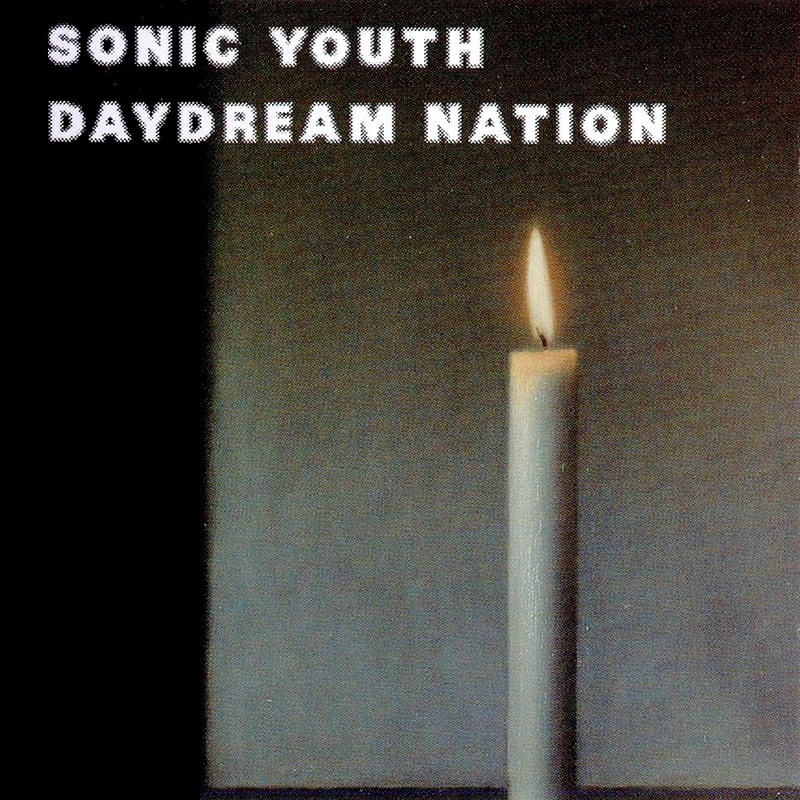
DAYDREAM NATION

DAYDREAM NATION
Sonic Youth
1988

I think for the first ten years I owned this album, I would listen to “Teen Age Riot,” to me the perfect rock song, and then shut it off maybe one minute into “The Sprawl.” I can’t help what I wanted, and what I wanted was The Stone Roses. There was more I would’ve liked at the time, even just finishing “The Sprawl” or listening to songs like “Total Trash,” but I didn’t have the appetite for something as burned out and adult as “Silver Rocket.” Hell, I barely had patience for long instrumental sections – so much of my enjoyment of music for so long was built on singing along, I’m not sure I would’ve stuck through anyway. I got my fill through so many bands inspired by Sonic Youth, from Yeah Yeah Yeahs to The War on Drugs.

I started Sonic Youth from the beginning when I started getting really into the less radio friendly side of Pixies, looking to recapture the distortion and feedback of being in my twenties at the Majestic in Madison and blowing my ears out. Coming back to Daydream Nation after listening to their 80s output, it’s so much clearer why this is considered their landmark album. They’d mastered noise rock with evil lyrics a few years prior, Bad Moon Rising culminating in the extremely uncomfortable “Death Valley ‘69,” making music for the end of the world. Daydream Nation instead comes out of making longer instrumental jams, and those jams resulted in much more melodic guitar parts with a lot more texture. Without that context, I was under the impression the darkness was overwhelming melodic beauty – now, I understand instead that the distortion and uptempo rage was the starting point.

I’ve been reading through William Gibson’s Sprawl trilogy this past year or so, and Sonic Youth’s “The Sprawl” came out two weeks before the publication of the third novel, Mona Lisa Overdrive. Where Neuromancer cohered into pretty cogent worldbuilding and rage about our increasingly transactional reality, the second novel Count Zero is 90% fun action and vibes and 10% conspiratorial agitprop. It’s hard not to joke that “The Sprawl” also borrows that structure, with maybe two minutes of fairly enjoyable and poetic reflection on transactional sex, imposter syndrome, and a decaying, rusting home and then six more of absolutely gorgeous guitar interplay.

A lot of the lyrics on this album are window dressing on top of a massive instrumental jam. “Candle” is a pretty simple reflection on feelings of fatalism at a young age, but any sense of anger or resolution is really only told through the dark riff under the verses or the noisy instrumental break. This still isn’t a pop album, but it represented the breakthrough into popular critical acceptance and college radio airplay that Sonic Youth hadn’t found yet. Their next album, Goo, would include more radio friendly dance music and fewer songs over 7 minutes long. It also amped up the political and pop culture references, a little less vague and poetic.

The signs of that change are in that song I loved so much as a teen, “Teen Age Riot.” That song was originally titled “J Mascis For President,” and Dinosaur Jr.’s frontman is still in there with his Marshall stacks. The opening, Kim Gordon’s “spirit desire” intro, is so funny – whatever its original intent, it comes across now as a lampoon on the post-hippie new age radicals and manifestation as resistance. Then, the power pop arrives, the perfectly tuned guitar tones of Thurston Moore and Lee Ronaldo in conversation with one another, chunk and clean. The remainder imagines a revolution with a charismatic alt-rock hero, and it ends still on the riot trail. I think there’s enough humor to the song to understand that this may be some “meet the new boss, same as the old boss” bullshit (“He acts the hero/We paint a zero on his hand”) but it doesn’t give in to that defeat. Taken out of context, that might sound like cynicism swallowing a dream – but, again, this is the daydream of the people who’ve put out some of the darkest no-wave noise rock of the 80s, so maybe it’s the start of believing in something.

KEY TRACKS: “Teen Age Riot,” “The Sprawl,” “Total Trash”
CATALOG CHOICE: Bad Moon Rising, Goo
NEXT STOP: Bossanova, Pixies
AFTER THAT: A Deeper Understanding, The War on Drugs

ROLLERCOASTER TYCOON 2

ROLLERCOASTER TYCOON 2
Chris Sawyer
2000

I can’t remember how exactly I wound up playing Rollercoaster Tycoon, the independently developed first entry aimed at Scholastic Book Sales and cereal boxes – if it came into the house through the intended method, or if my dad (who was a PC gamer unlike me) had read about it and decided to take a crack at it himself. I loved Disneyland at that age but hadn’t been old or tall enough to really ride rollercoasters or most rides scarier than Dumbo. When I finally did get a season pass to Six Flags about four years later, I was terrified of each impending step up the rollercoaster intensity ladder. My motivation to keep going came from a love of the damn rides (I’m thankful I still enjoy them now!) and memories of playing so much RollerCoaster Tycoon 1 & 2 as a kid.

I came back to the management sim as an adult after picking up RollerCoaster Tycoon 2 in a Steam sale during the pandemic. I often struggle with sim games and creativity canvas games – RollerCoaster Tycoon combines the two. Each park template comes with a scenario goal, such as attracting a target number of guests before a certain date, or to achieve a certain park value in fixed assets built into the park. As a kid, I found many of the more difficult goals arcane, unbelievably high, too distant to achieve. Now, the goals are almost ancillary to just designing a park I’d enjoy spending time at for a day.

While the game’s many “flat rides” (here meaning rides without tracks, such as a ferris wheel, merry-go-round, or swinging ship) offer some prefab parts you can slot together to get started, designing a fun, profitable park involves building some damn roller coasters. When I’m designing a ride, I spend time mentally imagining how it would feel to ride. I have enough sense memory of certain top speeds and G-forces to be able to consider (even if probably not 100% accurately) how the turns, rattles, airtime, and inclines are for the passengers. The game’s evaluation of whether or not a ride is fun is pretty smart, but I’m only really satisfied when I make something that I think I’d enjoy.

I follow a couple of different YouTube channels that produce really high quality RollerCoaster Tycoon content to this day. The first, Deurklink, is focused on using in-game scenery, rides, and shops to create beautiful, detailed parks, the way people build scale model backdrops for their model railroad kits. The second, Marcel Vos, is an expert of the game’s programming and design, testing the absolute limits of what the game can simulate – rides that last simulated eons, theme parks with no rides that can attract thousands of guests, parks that occupy two in-game squares. This degree of expertise partly comes out of the fan-made OpenRCT2 app, which basically operates as an enhanced version of RollerCoaster Tycoon 2 you can only run with a proper installation of the game. RCT2 has an extremely dedicated fanbase I’d been unaware of for twenty years, and I’m blown away by all the work they’ve done and continue to do.

I remember listening to the Idle Thumbs podcast, a show run by game developers, discussing the intentional “game design” of theme parks. They talked about visiting Disneyland with a lot of attention toward “the intended experience.” This is, to some extent, true of all architecture, but unlike more purely functional landscapes or buildings, the theme park is meant to provoke the broadest, most directly accessible form of “fun.” Unlike Disneyland, RCT2 is at its most fun when you honor the natural landscape to guide the design experience rather than flattening everything to match your design, so simulating the economics only better facilitates the play.

I imagine most people learning the game focus first on just learning the mechanics of making a profitable park which can complete the game’s goals. But you don’t have to become a wizard at exploiting the game mechanics to reach the point where it’s more rewarding to turn the game into a canvas. I haven’t been able to get into more abstract creative games like Minecraft or SimCity – it helps me a lot to have the sound of a roller coaster chain lift, the screams of joy from guests getting soaked on a log flume, imagining adolescent summers where I learned to conquer the Raging Bull’s 208 foot drop.

NIDHOGG

NIDHOGG
Meshoff Games
2014

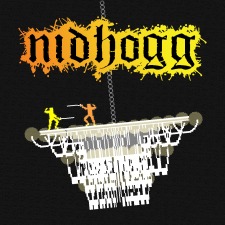
Two duelists meet in the battleground. Sometimes it’s a castle – sometimes a waterfall – sometimes Valhalla. They jab, deflect, jump, dodge, and spar until death does them part. This is the “normal” part of Nidhogg. Then they run.

Nidhogg is fencing football. The player who’s most recently won in a duel takes possession of the screen and sprints toward the opponent’s goal. Whoever makes it there first is swallowed by the titular world-devouring serpent for an audience of cheering fans. The other player will be reborn every few seconds to make a valiant defense and stop them, and if they win, they take possession and start running.

This ends up making for some of the most frantic twitch gameplay I’ve ever seen. It’s easy to pick up and play for two people who have never played before, but it’s also full of details  that make it difficult to master. The duelist can hold the sword at three different elevations – holding your rapier at the same height as your opponent’s thrust can block attacks, but raising or lowering your blade over the opponent’s sword can knock it from their hands. Holding the sword up above your head leaves you defenseless, but it also allows you to throw the sword at your opponent. After deflection or a throw, you can run faster, but your only defense is a smartly timed kick.

All of this is rendered in crazy pixel graphics. Your technicolor duelist bleeds their color all over the battlefield, leaving a paintball arena of battle spoils as you run back and forth over the course of a match. The animation is so precise and well-animated that each action feels snappy and responsive while also feeling expressive and surprisingly violent. The music by indie musician and producer Daedelus is synchronized to player action, so every game has its own unique soundtrack. It’s a simple game that’s easy to read – playing with friends makes for a great pass and play game.

Video games are so cool, man. I play the sequel, Nidhogg II, at I/O Arcade Bar every time I go – in the sequel, your dudes are nastier, the game offers a bunch of different weapons, and there are even more crazy stages to fight on. I still prefer the simplicity of the original game at home, but the madcap experience of playing with friends hasn’t gotten old a decade later.

MALCOLM X

Malcolm X
Dir. Spike Lee
1992

I was thrilled when Madison film critic, programmer and friend Jason Furhman held a screening of Spike Lee’s Malcolm X as part of his Madison Library Cinesthesia screening series earlier this year. It’s a film I’ve adored since I first saw it in June of 2016, with Spike Lee having grown to be one of my all-time favorite filmmakers, but I especially appreciated watching it while so much conversation centered on last year’s biggest surprise hit, Christopher Nolan’s Oppenheimer. To be able to compare and contrast these epic length biographical films, whose stories as central American political figures were swallowed up for decades by slander and misrepresentation, was to me a unique and thoughtful programming choice. If we can convince Jason to start putting his program notes online, I’ll update this piece to include a link to them – he very comprehensively laid out the history of this film’s production and reception, and I’d feel foolish trying to sum up his work here.

Spike Lee’s Malcolm X is the ultimate example of my “cathedral” model for masterpieces. The film takes you past grand images of seemingly isolated frescoes and gives you the space to really linger in them, either relishing in the details or taking in the grand effect. I found myself focusing on the big picture on this watch – there is absolutely an effect to watching so many consecutive scenes of Malcolm’s ascent from street preacher to national preacher, so many consecutive scenes of Baines converting him, so many consecutive scenes of the violence his family was threatened with. It creates the sense of his total devotion to the cause. If the audience struggles to sit with it for an hour, imagine the conviction it took to live it for twelve years.

Contrast this with the propulsive structure of Nolan’s Oppenheimer. Nolan manages three separate timelines throughout the film, cross-cutting across decades to synthesize meaning, creating one linear thematic jist out of three nonlinear ellisions. The emotional weight of that film is reaching across time, allowing our feelings about Oppenheimer’s trial to reach back to our feelings about the Trinity Test itself. Here, Lee instead uses a cumulative emotional weight, guiding us through the story as it happened, giving the audience the responsibility to link repeated themes into syllogism. You may not have the full symbolic meaning of Delroy Lindo’s false idol of charismatic organized crime when we first see Malcolm jailed, but the image sticks in the brain long enough to start seeing parallels with Al Freeman Jr.’s Elijah Muhammad.

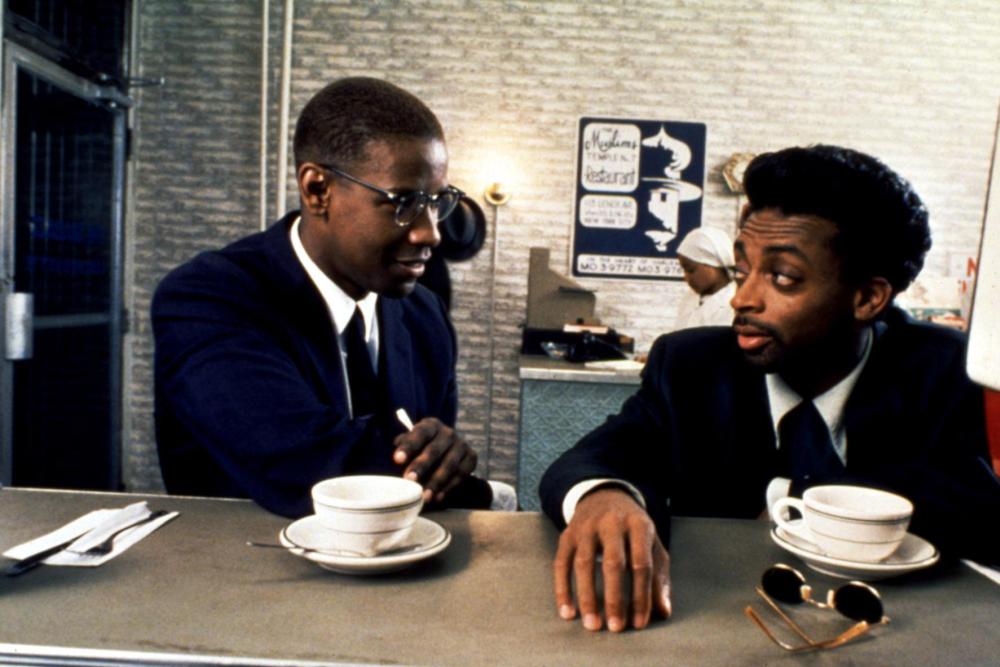
Malcolm talking with lifelong friend Shorty (Spike Lee.)

I find myself surprised at the resistance some film fans have had to embracing Spike Lee as one of the great American filmmakers. Do The Right Thing has fully arrived, for sure, but I feel the rest of his work is often still seen as homework, uneven, unfamiliar deep cuts. It’s maybe never been more obvious than the gap between critics and general esteem for Da 5 Bloods, once again starring Lindo, a film too few saw. Malcolm X is one of those films that breaks through partly because Denzel Washington, the greatest living movie star, gives his most beloved and iconic performance in the title role. He gets to be everything – a cult of personality, a sex symbol, the kindest man you’ve ever seen, a messiah sending himself to absolution, an angry spirit of vengeance, a funny firebrand, a wilting flower. To say everything there is to say about Washington would reward a scene-by-scene breakdown of exactly what he’s doing and the way he strings incredible continuity over the entire film.

I chose this film for the birthday project on April 24th, one week into Columbia University students camping in protest of Columbia University’s ties to the genocidal Israeli government and the ongoing annihilation of Gaza and Palestine. I find myself starting this piece on May 3rd, after a week of disproportionate police abuse of those protesters, Zionist counter-protestors at UCLA assaulting the Free Palestine encampment with fireworks and bricks, and our own UW-Madison calling MPD on the student body. I did not, at the time, foresee the renewed conversation about “peaceful protest” and police violence reaching the height that it has. Any study of Malcolm X will once again reveal that even peaceful protest will be slandered as violence, that malfeasance can be manufactured, that “progressive” is not a linear stamp where the powers that be let difference in opinion live.

UFOs

CW: FLASHING LIGHTS, STROBE EFFECTS

UFOs
Dir. Lillian Schwartz
1971

The last weekend I visited my dad, he showed me his mind machine. It was a shoddy looking piece of tech strapped onto a pair of goggles. He told me that in order to use it, I’d have to close my eyes. The homemade headset would flash lights in psychedelic patterns over your eyes, which of course you kept shut. I used the machine for twenty minutes when I was 17, about six weeks before he died. I have no idea if he made it himself or got it from a friend of his. 

Lillian Schwartz’s UFOs is widely considered one of the very first computer animated films. Her collection, including Pixillation, Olympiad, and Enigma, are largely similar experiments in color and light, exhibited as museum films and now living almost exclusively online. It is the kind of experimental work that, for many, will serve only as a historical oddity, something for academics and archivists and no one else.

An image of UFOs, light and color for those who cannot watch the film.

I admire the film’s choice of compositions. The strobing circles that make up the majority of the runtime, the flashing rim of a flying saucer, are alienating. The rippling strokes create a very cool liquid motion effect that would be hard to successfully capture in digital effects for some time afterward. The sea of lines create such an abstract darkness that it captures the oceanic more than the extraterrestrial – though obviously many would cite terrors of the deep as more likely to be met in our lifetime than someone out there. While the fear of the unknown is on mind with this film, I don’t find its portrayal of the other as threatening so much as neutral. Confronting that discomforting fear in a safe setting feels healthy.

I am not the only person who has found this film very personally comforting and beautiful. One mutual of mine found it to capture something spiritual – another writer found it to be the ultimate overstimulation. This film reminds me of my father – it reminds me of how firm his bed was, how his brined oven baked chicken tasted, of his rat tail hair and the story he told of getting LSD from a coworker at his Starbucks cafe.

Today, writing this [April 25,] I am laid out with a sinus infection [it was COVID.] I recharged the Oculus Quest I received from Mom a few years ago, loaded up the Internet Archive video of UFOs, and shut my eyes. I saw the sort of flashing colors I remembered from all those years ago. I wondered if Schwartz ever experimented with drugs. Her work is currently exhibited at the Henry Ford Museum in Dearborn, Michigan. Maybe someday I’ll go – I wonder if I’ll feel Dad as close as I did this afternoon.

LOW

LOW
David Bowie
1977

I lifted the format of these writeups directly from Tom Moon, author of 1000 Recordings to Hear Before You Die, as he was essentially my bridge between Guitar Hero and actually enjoying multiple genres of music. In his introduction to 1000 Recordings, Moon writes, “Finding renegade jazz pianist Cecil Taylor next to sensitive singer-songwriter James Taylor, who abuts the Russian composer Tchaikovsky underscores the astounding range of musical expression available, while subtly discouraging people from hanging out in their genre neighborhoods (ghettos?) they know best. This journey taught me that there’s great treasure waiting on the other side of wherever you draw your territorial lines.”

Few figures in music history underscore that philosophy more than Brian Eno, whose collaborators range from John Cale to John Cage, Sean Kuti to Sinead O’Connor, and perhaps most famously David Byrne to David Bowie. Eno’s influence is bringing ambient and classical into pop, African polyrhythm into rock, and subverting listener expectations in ways that enriched the quality of pop songwriting in ways we might now take for granted. While Bowie is quick to point out Eno is only a contributor and not a co-producer on his experimental Berlin Trilogy, Eno’s contributions help define what makes Low so different from Bowie’s Thin White Duke era of funk-infused pop.

The Man Who Fell To Earth, Bowie’s first starring role, was originally supposed to be scored by a version of the album that became Low – Nicolas Roeg rejected it and opted for a more traditional score from John Phillips of The Mamas and the Papas. Bowie was coming off Station to Station and the Thin White Duke, a persona defined by snorting coke and saying fascist bullshit. The plot of The Man Who Fell To Earth is that of an alien who becomes addicted to fame, alcohol, and TV before being imprisoned by the government – there’s temptation to apply that template to Bowie’s own decline (not to mention Bowie’s own Ziggy Stardust, whose “Rock N’ Roll Suicide” culminates the most iconic and beloved of all Bowie’s albums) but there’s no reason to read Bowie’s dependency as managed by outsiders or brought upon by anyone but himself.

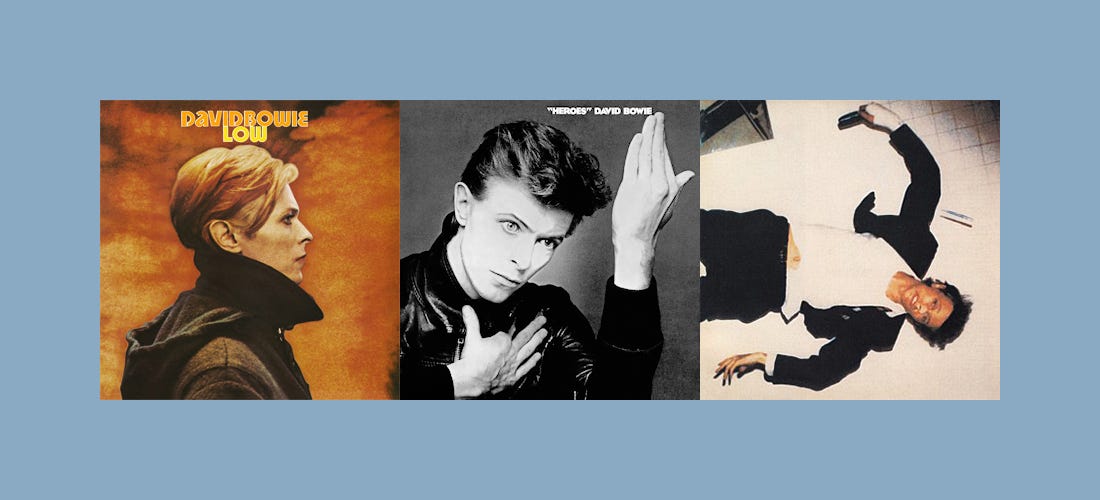
Bowie’s Berlin Trilogy, Low, Heroes and Lodger.

Low reflects this fragmented place in life. The first half of the album, through “Always Crashing in the Same Car,” is a series of wonderful song fragments. They’re equal parts funk, blues, rock, maximalist decadence of layers upon layers and minimalist anti-pop with vocals that crash in with forty-five seconds remaining on the track (if at all.) For an act often defined by Bowie’s yelp and star persona, Low is a spotlight of Bowie the multi-instrumentalist, trading parts with longtime guitarist Carlos Alomar and session musician Ricky Gardiner. Without looking at liner notes, it’s easy to miss where Bowie fits into some of these tracks at all (sometimes, it’s mostly saxophone!) This album bops along through the transition of “Be My Wife” and “A New Career in a New Town,” slowing slightly and becoming more traditionally rock, “Be My Wife” a song that would have fit just as well on Diamond Dogs or Hunky Dory.

On the second side of the vinyl, Low shifts to “nighttime,” Bowie’s largest adventure into the Eno-esque ambient. It’s easy to imagine “Warszawa” or “Subterraneans” scoring The Man Who Fell To Earth – the jaunty funk of side one for the narcotic highs, the droning despair of “Art Decade” filling the scenes of isolation and dependency. This is, for me, where Bowie lays out the future that leads to The Next Day and Blackstar. He’s creating an eerier sense of drama than the pomp (fun) of “Five Years.” In confronting his own darkness, Bowie’s found something more honest, and it’s something harder to look at directly.

KEY TRACKS: “Sound and Vision,” “Warszawa”
CATALOG CHOICE:
Heroes, Scary Monsters & Super Creeps
NEXT STOP: Who Is William Onyeabor, William Onyeabor
AFTER THAT:
Surf’s Up, The Beach Boys

DIG ME OUT

DIG ME OUT
Sleater-Kinney
1997

My first riot grrl song was Bikini Kill’s “Rebel Girl,” a song I totally rejected as a high school choir boy who did not get it. I came back around with the release of Gone Home, a for-its-time narratively ambitious queer adventure game that heavily used Bratmobile’s “Cool Schmool.” I started reading feminist literature and came around on Kathleen Hanna. I added a few singles to my playlists. This is a self-flattering version of this story. A couple years later, Sleater-Kinney reunited and released No Cities To Love to near-universal acclaim. St. Vincent said the reunion album was her favorite Sleater-Kinney album yet, signaling the beginning of the end of the band as it had existed for twenty years.

1997’s Dig Me Out was the first album after drummer Janet Weiss replaced Lora MacFarlane. According to Corin Tucker, “Musically, she’s completed our band. She’s become the bottom end and the solidness that we’ve really wanted for our songwriting.” Listening to their prior album, Call the Doctor, you can hear the difference – MacFarlane is a much more straightforward 90s rock drummer, with Weiss invoking borrowed fills from 60s girl groups and the British rockers who covered their hits. There’s a sense listening through Dig Me Out that every song is equal part fill and main beat – her style gives a texture that fills each song, already short, with novel grooves.

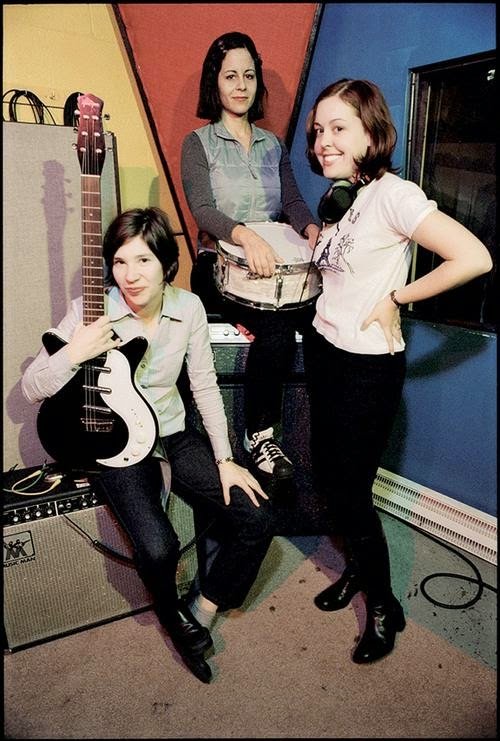
From left to right: Carrie Brownstein, Janet Weiss, Corin Tucker

That same approach to providing new stimulus grew in the songwriting by Tucker and Carrie Brownstein, too. Corin and Carrie’s vocal harmonies and guitar lines weave in and out constantly throughout the album. While you’d never confuse Corin’s powerful, intense vibrato for Carrie’s clean, more traditionally punk vocal, songs like “Words and Guitar” and “Heart Factory” trade lead and counterpoint often enough that (similar to some great Beatles songs) you can’t easily assign “this is a Corin song, this is a Carrie song.” The intense distortion on the guitars, set in alternative tunings, and Corin’s vocal power help mask some of the more delicate pop origins of some of their techniques.

The Beatles comparisons don’t stop with the harmonies. “One More Hour” tells the story of Carrie and Corin’s breakup, a gay Rumours descendant people don’t talk about enough. Coming up together as young twenty-somethings, Sleater-Kinney burned hot for a little over a decade before Carrie and Corin hung up the band to heal emotionally and spend time on other projects. Carrie had launched Portlandia by the time No Cities to Love came out. Writing The Center Won’t Hold, Carrie and Corin informed Janet that she was no longer an equal creative member of the band. While she’s been nothing but polite in public, she told them to fuck off. Their new music sounds like music by forty somethings – the tempo is slower, the riffs are synthier, there are ballads. They’re too old to write greatest-of-all-time songs about getting head. Corin’s a mom now, so “Little Babies” got taken off the setlist.

I’ve seen Sleater-Kinney twice in concert, both times since Weiss departed. For whatever reason, their new drummer, Angie Boylan, has never quite ascended to full membership in Sleater-Kinney. Sleater-Kinney is the first band I feel like I’ve gotten into right as they got too old to be the band in people’s brains. The first of those shows was rejected by the largely geriatric season ticket holders at the Ryman in Nashville – Carrie invited everyone to the front of the auditorium because it got lonely up there. But they seem to have found their new audience now, their show at The Sylvee a riot of people just as into the music from The Center Won’t Hold and Little Rope as they were “Dig Me Out” and “One More Hour.” I’ll probably keep seeing Sleater-Kinney until they’re too old to keep touring. I love this band a lot. 

KEY TRACKS: “Dig Me Out,” “One More Hour,” “Words and Guitar”
CATALOG CHOICE: The Hot Rock, No Cities to Love
NEXT STOP: Germfree Adolescence, X-Ray Spex
AFTER THAT: Rat Saw God, Wednesday

THE YAWHG

THE YAWHG
Damian Sommer, Emily Carroll
2013
PC

A great, impending doom is coming – when the season ends, The Yawhg will come, bringing untold death and destruction. The players each choose a character and, by choosing where to spend their time when, they tell a story of the last season before the great change comes. Each turn involves reading a short story prompt, making a choice, and then seeing the consequences. After everyone’s taken enough turns, the game ends, and you see how your characters lived.

This story is told with a sense of humor. There are vampires, drinking contests, streetwise burglars and vigilantes, potions gone wrong. While there is occasionally peril, your character is not going to die before The Yawhg arrives. The game luxuriates in strange, non sequitur experiences, like meeting an old man who asks you to stand against the sun and provide him some shade for a nap. Moments like these keep the game light and award all kinds of play. Tell your story – and tell it again differently next time.

The Yawhg released into a climate experiencing an independent multiplayer boom scattered across tabletop RPGs, board games, and video games, and it combines elements of all three. The branching narratives of The Yawhg invoke the Twine interactive fiction boom and matches games like Johann Sebastian Joust or Spaceteam. Its beautifully drawn art by Emily Carroll and its short playtime (a four person game of The Yawhg takes about 30-45 minutes) remind me of games like Tokaido and Agricola.

But the game The Yawhg reminds me most of is the tabletop RPG The Quiet Year, a map-drawing game where players take turns in a fantastic settlement drawing random events from a deck and, ultimately, facing down impending doom, the arrival of The Frost Giants at the end of the year. The two games are similar in their concept of offering more life in the settlement than just preparation for the End of Days. The taking of turns, drawing of cards as random events, and building of a collaborative story are kismet – the two games released at roughly the same time and appealed to many of the same people.

But what differentiates The Yawhg and The Quiet Year, apart from The Yawhg automating the process and taking about a quarter of the play time, is that The Yawhg centers on its characters whereas The Quiet Year is built around the community. The Quiet Year actually makes specific rules around not picking particular characters for each player – while you’re allowed to return to pet themes and storylines, The Quiet Year positions the players as responsible for both introducing the characters and creating the friction in their lives. The Yawhg uses its perspective within the characters’ shoes to automate that narrative friction and let the players imagine personalities without feeling responsible for eventually tearing them down.

The two games make beautiful companions for one another. Between them, I see a powerful understanding of the possibilities in the medium. Understanding the two next to one another creates dialogue about intention in design and tone management. I understand this reason for loving these games sounds so niche and dorky. I really appreciate having two variations on this idea, one aimed at the highest level of RPG players ready to create a story world together and take seriously its politics, economy, and characters, and one aimed at all levels of roleplay designed to laugh, look at some beautiful art, and relish in someone else’s great work.

THE LEGEND OF ZELDA: TEARS OF THE KINGDOM – Play Diary

THE LEGEND OF ZELDA: TEARS OF THE KINGDOM
Nintendo
2023
Nintendo Switch

Tears of the Kingdom’s greatest strengths are in its use of mystery to drive plot, in lost time to create pathos, and its incredible mechanical depth to enhance the gameplay of Breath of the Wild. I found the eventual storyline regarding Princess Zelda to be quite moving, and the dungeons at the centerpiece of this game’s five major temples are clever and concisely designed. Songs like “Lookout Landing,” “Water Temple,” and the new “Main Theme” prove Manaka Kataoka (who got her start writing the iconic “7 P.M.” theme from Animal Crossing: New Leaf will be one of the greatest composers in gaming history. Rather than share the same sort of post I typically do regarding Tears of the Kingdom, an enormous and gorgeous game which could merit an entire playthrough diary and a book’s worth of criticism, I’ve decided to share the diary I wrote during my first days with the game. 

5/14/2023

I’ve decided to start keeping a diary of my sessions playing The Legend of Zelda: Tears of the Kingdom. There are a number of root causes, but the primary is pretty simple – I want to track my own understanding of the game’s world and lore, exploring the narrative empty space the game offers. It wouldn’t be the first time that I started expanding on a narrative throughline and had it collapse by game’s end. Skyward Sword’s Groose, in a heroic sacrifice, seals Demise within himself and becomes the Demon King Ganondorf, destined to battle his friend Link generationally and lose every time, maybe intentionally. Or…not. But that empty space I filled in still feels thematically relevant and possible, informing how I think about the game’s text. Maybe that misdirection was always in place.

Tears is full of empty space, literally and figuratively, for the player to try to piece together a mystery. A being what look like Zelda keeps being spotted throughout Hyrule, only she doesn’t really behave like Zelda and seems capable of some kind of teleportation or projection. My theory, right now, is that this is The First Zelda, Queen of Hyrule, the Sage of Time (so named by the Sage of Wind) who has projected forward to aid (or threaten) Hyrule’s people. Documented so far, I’ve spotted her:

-Silently blessing Link’s arm with Recall, in the body of a Golden Tear.
-Receiving the Master Sword from Link, presumably back in the past.
-Standing on Hyrule Castle’s ruins before floating away in golden light.
-The Blood Moon rises, with new, more confident, slightly fear-inspiring dialogue.
-*REPORTED*: Zelda came to Kakariko Village after the Upheaval dropped the Ring Ruins. After inspection, she told Purah and her team to stay away from one particular floating ruin. (I can’t airdrop onto it – maybe an angle where pictures can help?)
-Spotted in Rito Village, though no mention of her doing anything but floating away.
-Spotted on Stormbringer Ark, just walked forward and disappeared (no floating.)
-Seen in Memory of the Sage of Wind, where she’s called “The Sage of Time” and in which she predicted Link’s quest.

Zelda in front of the Blood Moon.

Any of these appearances could hypothetically be “Our Zelda” (would like to come up with a name for her. The Archeologist?) or The Sage of Time, or even any Zelda in between those two. So far, none of the Zeldas I’ve seen since separating in the Tomb Depths acts like our Zelda. She’s more direct, mostly, with the rest being on the marginalia. Our Zelda is prone to tangents, repetition – she’s a little nerd and we like that for her. She’s also much more timid. I believe these are appearances by The Sage of Time, and Our Zelda is still somewhere else.

The Stormbringer Ark legend is a curious one. Why did the Rito return to Hyrule? Did they first reach the Stormbringer during The Demon King’s first invasion? The memory of the Sage of Wind indicates so. No other reference to an upheaval is mentioned during the Sky Temple. Did the Rito people simply not participate in the Imprisoning War? Was the Stormbringer (armed with cannons) used as the lead battleship in an aerial fleet? Many questions still to answer. Winter has thawed with Colgera defeated. I’m a little melancholy to have fully reset the region so quickly, but I don’t actually love snow areas in these games, so I’m more likely to dig deeper.

Other threads to pull on in the next sessions:

-Kakariko Village’s Ring Ruins. Still don’t know what these are. One story about the six sages found so far. Might have to make a priority here.
-Hateno Village’s Mayoral Election. The fashion lady is obnoxious. I’m helping Reese. I do really like the hat she designed, though.
-Lurelin Village’s pirate invaders. They’ve taken over my favorite town in the whole game. I’ll have them longshanks. I wonder if you’ll have to go around and find all the citizens who’ve left, or if word will travel for you.
-How long has it been since BOTW? Seemingly, at least a few years. Zelda built a school in Hateno and took over Link’s house. Tulin has come of age, from childhood to becoming a warrior. Paya is now a young adult.
-Impa’s pilgrimage. She left with someone and put Paya in charge to search for something. I wonder if we’ll find her out there.
-The Chasms and Sky Archipelagos. If there is some broader narrative to explore above or below, I haven’t found it yet. No quests are really sending me up or down to explore yet. I know the Yiga Clan is in the depths somewhere, though. I need to hunt for some sky quests. Maybe then I’ll be able to upgrade my power supply.
-The Lucky Clover Gazette. Stable questline. Maybe the first thing I’ll do is warp around to different stables and progress those questlines ASAP. Give myself some more direction.
-Lookout Village. Haven’t really dug deeper into the castle or what’s going on in the village. Supposedly, after the first Temple is completed, stuff opens up in Lookout. I’ll have to stop back.
-Bubblefrog Caves. No idea who to trade the snowflakes to. Satori gave me a clue to look for caves. I wonder if that’s still online, or if it’s been long enough that I’d need to return to the mountain to extend the blessing.
-Din’s dragon. I’ve seen Farrosh and Lanayru. No sign of the red dragon yet. I haven’t been north of the castle except for the Rito questline.

I’ve visited three of the major towns and activated their warps. That leaves five more, right?
-Tarrey Town
-Gerudo Town
-Death Mountain Town
-Zora’s Domain
-Lurelin Village

Lurelin is next. After that, I’ll have to start poking around. I did see that Hestu is apparently northeast of Lookout Village, so I’ll head that way in the hopes of expanding my inventory.

Hestu in Tears of the Kingdom.

5/15

Okay, I made very little lateral progress (just getting east of Lookout slightly) but I made a ton of progress on many of these questions. It’s crazy how much of this game is just laying about in open fields to surprise.

-Bubblefrog Caves. I’m headed for Woodland Stable to meet the “old couple” there who collect Bubblefrog medals.

-Lookout – Things didn’t open up *that* much after the temple. Hestu’s arrived, thankfully. The hidden passage under the castle has a Demon Statue and a little loot down there, but until I can break black blocks, I’m not getting any deeper. (Diamond weapons? Eldin power of summoning?) I’ve unlocked the next phase of Josha’s Chasm questing, to find an underground temple and get a power there (Auto-Build?)

-Impa’s pilgrimage. Sure enough, she was right on the path from Lookout to Rito, investigating the Geoglyphs. This was probably the most impactful bit of lore I got all session – the Geoglyphs each carry one of the Dragon’s Tears, which unlock a memory of Our Zelda’s experience on the other side of her time jump. She definitely is operating in the past! And it seems I was wrong about The First Zelda. If the Sage of Time is not Our Zelda, then she’s also not the First Queen of Hyrule. The First Queen of Hyrule, Rauru’s wife, is a Hylian named Sonia. Each Geoglyph has a memory (found in a small water pool on the design). The next phase of Impa’s quest, where I can presumably find the locations of all the designs and add them to my map, is in a cave in the Hebra trench.

-Lurelin Village’s pirate invaders. Zonai Monster Control have been sent to contest the pirates. I’m headed that way next *for sure* after the Woodland Stable (lol).

-Ancient Hylian text crashed down into the Lookout, sending Wortsworth the Lore Expert to Kakariko Village. Maybe this will allow the questline to progress?

-A construct merchant crashed just north of Lookout, offering a trade of 100 crystallized ore (or whatever currency) for 1 energy cell. Thankful I’ve got that all sorted now!

-Found some brightcap hunters and shield surfers all headed toward the Hebra region. And a cave with a “white bird’s treasure” north in Hebra. If I need to make some cash and find new weapons, I should probably explore northern Hebra.

-Hit 8 hearts, so I’m headed for my first stamina ring. Will switch back to hearts till at least 16 i think after that?

-The Lucky Clover Gazette questline seems to have pointed me toward a vision of Zelda riding some great beast. The images look unfamiliar – maybe this game’s interpretation of Dodongo, but otherwise not recognizable to me. (Dodongo are one of the Zelda 1 enemies still not interpreted in this game, so they’d make sense! There are too many not included to list, though, and they certainly won’t add all of them.)

Main quest stuff: I’m surprised, but returning to Lookout has definitely pointed me toward Eldin next. They’re battling a Gloom crisis on Death Mountain, turning Gorons hostile, but the land is temperate and the need for fire-resistant armor is temporarily eliminated. I’m sure once I clear the Gloom it’ll be back in full swing, though…maybe will buy the armor before I complete that questline.

Lurelin calls, though.

Impa’s blimp overlooking the Geoglyph.

5/16

Lurelin draws even nearer! I’m overlooking the swamp now, with an awful Thunder Gleeok visible overlooking the path into Lurelin. I found a pirate ship on the coast as well, so I know I’m getting close. (Unfortunately, given every enemy appears to be a black or blue foe, I may be here waaaaay too early.) Some headway on other questlines as well.

-The “odd couple” collecting bubbulfrog medals is Kilton and his brother. I never really interacted with Kilton in BOTW, and it feels like he’s got a different vibe.

-We are close enough in time to the Upheaval that a sidequest where borrowing farming tools from a stable is close enough to be a misunderstanding. Maybe a few months.

-Found my first Gloom monsters east of the castle. That was…terrifying oh my god!!!! They can take a lot of damage!

-The Yiga Clan have set up shop on the Great Plateau. I got a Yiga mask after setting free a designer. They also outlined on a map three other locales – they’ve kept their primary base in the desert, but also set up north of the castle in Hebra and even further east of Death Mountain in Akkala.

-The Great Plateau also had by far the most powerful shield I’ve found so far.

-I’ve found the musicians and the first Great Fairy! The others are marked on the map, and they’ll require musicians of their own. You can meet the musicians outside of the band’s tour, you just have to figure out where they went. The drummer is somewhere north of Kakariko, the flutist is at the Horse God’s old stomping ground stable.

-Speaking of the Horse God, a nap revealed that it can be found at a stable in Akkala. People looking for the Horse God think they can find the White Stallion.

-The journalism questline so far has been fairly relaxed, but hasn’t helped me find much of anything about Zelda. The Great Fairy seems to think the blonde figure who looks like Zelda isn’t her.

I also found another couple memories. The first was mostly just showing Rauru’s sage power – big fire of lasers, but also saw Ganondorf’s Gerudo forces (and his summoning of the molduga.) The second was more important – it depicts Sonia’s grave (the mural in the intro also depicts Ganon taking the Secret Stone from Sonia, presumably killing her) and Zelda confronting Rauru about their demise. He mentions “his hubris” leading them to that point. His hubris…maybe Ganon came looking to make a pact? Or maybe just peaceful conquering.

Almost to my goal. Almost rescued my friend from pirates.

The south Thunder Gleeok.

5/17/2023

LURELIN IS SAVED!

That’s really the only major event in this session that I saved. Bolson is there and is going to help rebuild the time – 15 logs and 20 hylian rice. That was one long fucking fight.

I also did fight my way through the black bricks in the Hyrule Castle-bunker passage. It was a fun run! It leads basically into the bottom of the castle, what’s left after you shoop half the castle into the sky. I did one more major event. I leapt under the chasm under Hyrule Castle…and, yeah, unsurprisingly, that leads into the endgame. It’s a long series of tunnels, full of black horriblins, shock like likes, shock keese, ice varietals of both of those, and a white lynel. All of the above are covered in gloom. And then you eventually make it back to the tomb from the beginning. The mural – it reveals that using the monster sword, they can summon a great dragon to battle Ganon back. Past that, you jump down into the heart of the gloom, where a cutscene plays and you fight a full horde of Ganon’s army alongside any sages you’ve gotten secret stones. Since the spoilers abound (I already know too much about the dragon being summoned, for example) I figured I’d find this out sooner rather than later anyway, and thankfully now I know how difficult it is to accidentally stumble into the endgame. (How many people accidentally found themselves battling Calamity Ganon in BOTW? This is way more obvious and requires way more intentional travel. Though…maybe there’s a shortcut I haven’t found.)

Lurelin is saved. 🙂