THE PHOENICIAN SCHEME

THE PHOENICIAN SCHEME
Dir. Wes Anderson
2025

I have now said for years that I would happily go to a theater simply to see a montage of Wes Anderson costumes and production design ideas, and that the movies are good just happens to be a nice bonus. I advance the argument that Anderson should be considered among the most iconic and influential visual artists of the 21st century, alongside figures like Richter, Murakami, or (ugh) Koons. We see a version of his aesthetic, set in amber by The Royal Tenenbaums and Moonrise Kingdom, permeating public spaces and being cyclically imitated on social media. The infamous signifiers, the collections of kitsch arranged as storytelling, the orderly, clean lines throughout a space framed as a symmetrical image, and the emphasis on uniforms and dress tweed are more widely recognized than the visual iconography of any other live action filmmaker.

The Phoenician Scheme marks some noticeable changes in this aesthetic toolbox. Alexandre Desplat’s original music is largely variations on one moody, portentous theme, and the needle-drops trade Serge Gainsbourg and The Kinks for Stravinsky and Beethoven. Longtime cinematographer Robert Yeoman (who has shot every prior live action Wes feature, and many of the shorts too) takes this movie off and is replaced by Bruno Delbonnel, whose signatures often include strong green tones and more muted colors. These are never more feature-forward than in one of the film’s opening scenes, in which our lead Zsa Zsa Korda (Benicio Del Toro) meets his soon-to-be-cloistered daughter Liesl (Mia Threapleton) in the great foyer of their palazzo. It is an enormous, cold room, with nothing but a few paintings breaking up the slabs of gray-green, and more paintings sitting on the floor. Delbonnel gives the majority of The Phoenician Scheme this more muted palette, though later scenes are still sometimes flush with color.

Symmetry is broken at the start of The Phoenician Scheme rather than at the midpoint, when Zsa Zsa’s plane is blown open (with a blood splatter that made most of my audience immediately start cackling) and he’s forced to make a crash landing. Zsa Zsa is an unkillable cat and an unbeatable cad, the most ruthless and callous ultra-rich arms dealer in the world, and a combination of private and government interests will stop at nothing to see him either penniless, jailed, or dead. But even from the start of this film, he’s no longer capable of maintaining the rigid order that’s put him on top of this world, too physically beaten up and personally shaken down to keep the train on track. That’s reflected in his face, too, like in Bottle Rocket and so many Wes films before, cut up and bruised throughout the film.

Zsa Zsa Korda in the film’s opening credit sequence.

So, what is The Phoenician Scheme? Loosely, it’s a corporate “public works” investment built on exploitation and swindling (the film is unafraid to confront Zsa Zsa’s intent to use slave labor) that will, in 150 years, provide a resource-rich base of operations for Korda’s military-industrial empire. Unfortunately, Zsa Zsa’s enemies have successfully created an unstable market for investment, and the film is spent watching Zsa Zsa, Liesl, and oddball assistant Bjorn (Michael Cera) travel from investor to investor and solicit the funds necessary to cover “The Gap.” It sets up a satisfying episodic structure for the film, though maybe none of the episodes delighted me so much as the first featuring Riz Ahmed, Tom Hanks and Bryan Cranston. This episode in particular is so delightfully well-done, with so many perfectly timed jokes and such a strong commitment to not overstating any punchline, that I think it’s worth the price of admission on its own.

Anderson borrows a lot from the comedic language of his animated film Fantastic Mr. Fox here. There are deadpan repeated lines, a silent cartoon shrug repeated by multiple characters, and when action does arrive, the straight on close-ups and movement are so similar to the fight between Mr. Fox and The Rat that I immediately felt at home. Fans of the film are going to be repeating “Help yourself to a hand grenade./You’re very kind,” “Myself, I feel very safe,” and “Damnable! To hell!” in much the same way Fox encouraged “Take this bandit hat” and “Are you cussin’ with me?” to worm their way into your phrase book.

Like Fantastic Mr. Fox, I think that aesthetic sensibility supports the film’s emotional core. The relationship between Zsa Zsa and Liesl, and Zsa Zsa with his own peace, is a rich one, forcing them both to accept parts of themselves they’d rather push away without ever turning blame or judgment on Liesl for her reticence. Zsa Zsa’s been a poor father – hardly Wes Anderson’s first – but he’s also been a horrible person. Liesl, from the beginning, confronts Zsa Zsa with suspicion that he killed her mother, one of many women he’s reared children with (he has a horde of ten or so misbehaving, unwanted sons, some wanted and some not, a throng raised down the street except on Saturdays) and he furiously denies it. Over time, he comes to grips with his role in her demise, while also facing near-death visions of an afterlife where his soul is not measuring up to heavenly standards. Many have made comparisons to Powell & Pressburger – I don’t disagree.

Zsa Zsa, Liesl and Bjorn meet with two of the investors in The Phoenician Scheme.

There’s also the question of the film’s political angle. While many describe Wes Anderson movies as “not really about anything” except for being beautiful or funny, his last five or so films are quite political. The Phoenician Scheme is less about “politics” rather than the realpolitik of hypercapitalism, and Anderson uses securing funding as his mechanism for exploring that. I’m sure it’s quite relatable to Anderson, whose films manage to be made with incredibly star-studded casts for fairly low budgets and filmed where he can catch tax breaks for the arts. He portrays this world as being built almost entirely on interpersonal values and the merit of one’s word – Zsa Zsa doesn’t ever successfully find a contribution to The Gap by sweetening the pot or finding a mutually beneficial deal, he does so through emotional, interpersonal appeals. It’s unclear whether or not the near-death experiences and confrontations of his soul have changed his tactics, his execution, or his follow-through, or if the money’s always been this fake.

This review is built on examining the film in this more serious way because, well, I want to push back on the idea that this is a Minor Wes Anderson film, or that Wes Anderson films are all fluff. It’s a supremely funny film, and most people will come out of it laughing about Michael Cera’s incredibly funny character performance as Bjorn the assistant/insect tutor, Ivy League sweats, or the deadpan of Del Toro and Threapleton’s mile-a-minute dialogue. From the opening credits set to Apotheosis from Stravinsky’s Apollo, It’s a real treat of a movie, and I don’t mean to diminish that. I just have spent the last three days thinking about it on more than just those terms, and look forward to doing so for quite some time – and I wanted to put a rave out into the world before it leaves theaters.
BLUE PRINCE

BLUE PRINCE
2025
Dogubomb
PC, XSX, PS5

Based on seeking and giving hints to navigate the twisting halls of Mount Holly, I believe I am roughly halfway through Blue Prince, this year’s most resonant independent game. The game offered an off-ramp about twenty hours ago, after rolling credits and reaching Mount Holly’s mysterious Room 46. It was already immediately apparent there was far, far more to do.

The game’s setup is succinct. Your character, Simon P. Jones, is the named heir of his recently deceased great uncle Herbert S. Sinclair, Baron of Mount Holly. Sinclair was also known as a fiend for puzzles, and his will contains a conditional statement. “”I, Herbert S. Sinclair, of the Mount Holly Estate at Reddington, do publish and declare this instrument my last will and testament, and hereby revoke all wills and codicils heretofore made by me. I give and bequeath to my grandnephew, Simon P. Jones, son of my dear niece Mary Matthew, all of my right, title, and interest in and to the house and land which I own near Mount Holly. The above provision and bequest is contingent on my aforementioned grandnephew discovering the location of the 46th room of my forty-five-room estate. The location of the room has been kept a secret from all the staff and servants of the manor, but I am confident that any heir worthy of the Sinclair legacy should have no trouble uncovering its whereabouts in a timely manner. Should my grandnephew fail to uncover this room or provide proof of his discovery to the executors of my will, then this gift shall lapse. In witness whereof, I have hereunto set my hand this 18th day of March, 1993.”

The game’s core gameplay conceit is that when Simon opens a door in Mount Holly, he draws three room cards from a drafting pool and selects one. Each room has different properties, such as a security room which controls electronic doors in the house or a bedroom which offers Simon extra energy to navigate the house, and a different number of additional doors to continue exploring. A run involves managing Simon’s energy and resources to explore as much of Mount Holly as possible until you hit too many dead ends and need to “call it a day.” When Simon wakes up the next morning, the house has been cleared of all its drafted rooms, allowing Simon to start fresh and make another effort.

The primary gameplay loop is more centered on gathering information than immediately solving puzzles. From the start, the game points you toward one permanent antechamber, at the top of Mount Holly’s 9×5 grid, as an essential goal toward Room 46. Forgive this mild spoiler, but even though getting to the antichamber will be the game’s first challenge, that’s ultimately nothing compared to actually “entering” said antechamber, let alone finding Room 46 once you’ve gained access.

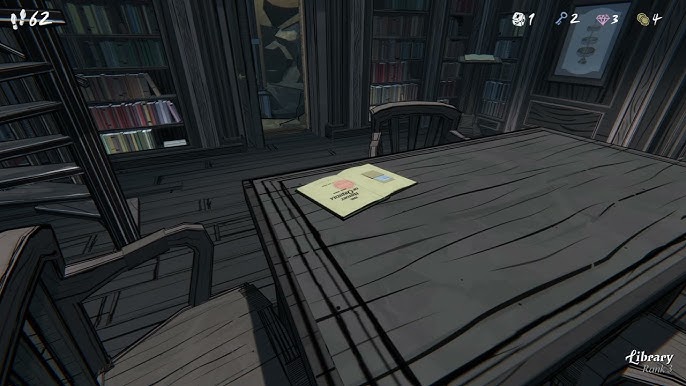
Blue Prince’s library, which offers the player the ability to borrow books and draft rarer rooms off its one door.

While there are permanent upgrades and new rooms to draw, progress in Blue Prince is never linear. Any given day of Blue Prince may offer bad luck in room draws, a lack of resources like keys and gems required to keep advancing, and yet still contain vital clues to succeed on your next day. The house is full of paintings, sculptures, notes and books to read (and inspect more closely if you find a magnifying glass.) These clues often do not have a clear meaning until hours after you first spot them, but generally speaking, most puzzles eventually have a direct hint toward their solution. Thus far, I’ve really been satisfied with almost every puzzle solution in the game – there’s a good chance they’re just going to take you more time rather than require a degree of intellect or lateral thinking you’re not capable of achieving. I’ve been anticipating an eventual skill gap – somewhere that the puzzle is still fair but is simply beyond my capability to comprehend. At 51 hours, I still have not hit that gap, and I continue to be shocked at the game’s ability to open new puzzles under my feet that I am capable of solving and just hadn’t observed were being clued yet.

Annie and I play Blue Prince like we played Lorelei and the Laser Eyes last year, me holding the controller and her holding our notebook – she’s often more responsible for solving any given puzzle than I am. The initial gameplay requires developing your skills as a deckbuilder, managing randomness and resources to successfully get access to information. It also rewards your skills as a strategist, recognizing your identified goals and effectively prioritizing them. But, ultimately, Blue Prince is a game about observation and reading comprehension, a puzzle game akin to Myst or Fez or Outer Wilds. And like those games, the information density is really intense in Blue Prince, and figuring out what degree of info is “relevant” can be very challenging.

Fans of that kind of game have sometimes bounced off Blue Prince’s randomness, complaining that nothing feels worse than picking up a hunch and having to wait several in-game days to try to implement your gambit. I believe strongly that patience demand is at the heart of Blue Prince’s design. This is a lonely, low-key game, one telling stories of years-long investigations and years-long declines, of historical intrigue and mysterious death and disappearance, and of determining how much work you want to put into your day to day life. Blue Prince demands players keep their eye on the bigger picture, savor whatever morsel of productivity they’re able to derive from each day, to play to their outs and be ready to adapt when a door closes or another opens. If you begin each in-game day with three or more open threads you’re ready to pull, it’s hard to come up shy.

A couple pages from a drafting magazine.

That loneliness extends to the game’s aesthetic, too. There is a heavy emphasis on portentous piano dirges in the game’s score, and when the pace or tone lighten up, it’s an immediate uplift. (A favorite track of mine is the theme “Westwardly Winds”, a wistful sunset tune with a lovely bass clarinet solo.) When you see a cutscene with character animation, it is incredibly limited in expressivity, and no human life is ever sen during gameplay. The game’s premise promoted comparisons to House of Leaves, but Mount Holly’s emptiness isn’t sinister so much as bereft. This is a time of mourning, of people dead or otherwise gone. This is a game about the messages they left behind for Simon before he takes charge of his own life.

I think, thematically, this is a game trying to teach us something about plans measured in years. It is about learning to tolerate momentary frustration and keep your eye on the bigger picture. It’s also a game about honoring your personal feelings, your setbacks and discomforts, your joy and your greed. Blue Prince doesn’t have a lot of characters, but the ones they choose to give additional depth (including Mount Holly’s disgruntled gardener) are often surprising, funny, thoughtful. I will inevitably return to write about this game in more detail and with more spoilers at the end of the year – whatever “best games of 2025 list” I write, this will make the cut. Having as much game remaining as I currently do, I have a lot of questions about the game’s story, where we finally wind up with its conclusion, and how some of these larger puzzles are actually resolved. For now, I encourage you to start the journey early, as if you’re willing to chase the rabbit down the hole, Wonderland is a vast place. 

GOOD KID MAAD CITY

good kid, m.A.A.d. City
Kendrick Lamar
2012

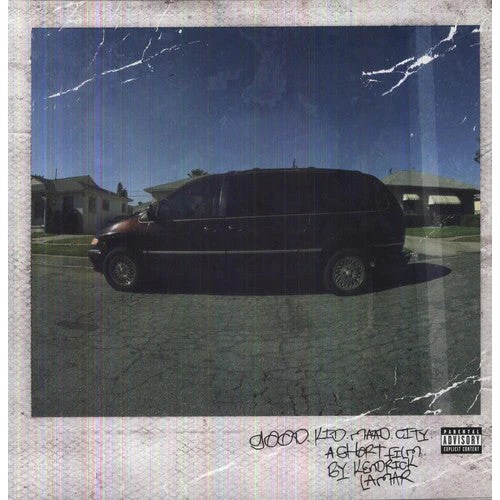
I wrote about good kid, m.A.A.d. city back in 2013 on my old blogspot – I gave it a 4/5, and the details beyond that are lost to time. Instead, what I remember is the first time my brother put Kendrick Lamar on in the car, playing “m.A.A.d. city” and “Swimming Pools (Drank)” for me, to which I said, “Jesus Christ, this guy has the worst voice I’ve ever heard, turn this shit off!” In the twelve years since, Kendrick hasn’t stopped doing voices and making silly noises – if anything, he became one of the first to break out of the very 00s conception of “great rap” as smooth, clean, always sounding cool and in-character with his willingness to scream, gasp, try on accents, use voice filters, and so on. I still think it was probably a bad first impression.

Kendrick’s rapping over a collection of great beats, largely by producers who hadn’t yet released a more iconic beat than the one which shows up on GKMC. He veers between beats which emphasize a jazzy, soulful vibe (like on “Sherane” or “Sing About Me, I’m Dying of Thirst”), beats which capture the more recent trap-adjacent gang beats (like “Backseat Freestyle” or “m.A.A.d. city,”) and beats which lean into pop production (like “Bitch Don’t Kill My Vibe” and “Swimming Pools (Drank).” He’s synthesizing twenty years of history in an album and only introducing explicit nostalgia once or twice – nothing hits harder than the almost parodic beat switch on “m.A.A.d. city,” a full-blown g-funk pastiche that highlights how much he’s avoided that exact sound while telling this Compton gang story.

GKMC occupies an interesting space in Kendrick’s discography – it’s his first unquestioned masterpiece, an album that has only grown in esteem since its release, and yet it’s also been overshadowed by his follow-up To Pimp A Butterfly, pretty inarguably the most acclaimed rap album of the 2010s. That album is Kendrick’s great poetic project, centered on a spoken word poem eventually placed in conversation with archival recordings of Tupac. He’d win the Pulitzer for the next album, DAMN., which balances ambitious structural poetry and intense political commentary with radio friendly pop.

By contrast, GKMC is much more cinematic in its structure. It relies heavily on skits which tell a pretty clear narrative story, albeit a nonlinear one, about a young Kendrick going out with gang-affiliated friends and getting involved in gang violence. After the narrative concludes on “Sing About Me, I’m Dying of Thirst,” there’s a coda in “Real” and a sort of pop credits song in “Compton.” The album has a few explicit story songs – two of the first are “Sherane A.K.A. Master Splinter’s Daughter” and “The Art of Peer Pressure,” which highlight the album’s ability to use specificity rather than the abstract to bring forward thematic depth. This is hardly new, but there are times the album is trying to gesture at the universal or existential, and these moments often grab less than just the story of Kendrick meeting a girl.

Almost nobody in rap has a more detailed collection of Genius pages than Kendrick Lamar, so I won’t do the work of dissecting the thematic range of this album. To be honest, that also isn’t a huge part of the album’s appeal to me. Kendrick has ascended to a top shelf rapper with GKMC, but compared to where he’s heading, he still too often gets caught up in showing off, making refrains of wordy, somewhat obvious images. The criticisms of Kendrick as self-appointed martyr have to start here, at least by the verse ending line “I was straight tweakin’, the next weekend we broke even/I made allegiance that made a promise to see you bleedin’/You know the reasons, but still I’ll never know my life/Kendrick a.k.a. “Compton’s Human Sacrifice,” on “m.A.A.d. City” – but they should probably start earlier, too. At some level, Kendrick doesn’t have his balance of subtext down yet, and focusing too much on this album’s thematic depth has always set it at odds with how I think it’s best enjoyed.

Kendrick Lamar at Bonnaroo, 2013

The fact is that no matter how wordy the choruses get to be, he has already mastered the sonics of lyricism. His choice of words on paper is occasionally precocious – but in the ear, it flows so smoothly. He creates rhythms and grooves in the flow other rappers can’t come close to matching. This is the masterstroke of fan favorite “Money Trees,” which is simultaneously a recap of the four previous tracks, a song which skates through all their thematic concerns with confidence, and yet never feels redundant or overstuffed because it’s just pure pleasure. He’s playful on this song without having to lean into a stunt or high concept, and while the high concept of a song like “Sing About Me, I’m Dying of Thirst” obviously captures the critical opinion, there’s a reason a song like this became such a fan favorite.

Now. That’s not to say I don’t love “Sing About Me, I’m Dying of Thirst.” This song combines every strength Kendrick’s taken advantage of throughout the album. The first half of the song uses the specificity of story songs to bring out an incredibly well-observed series of grievances and reflections. Three verses from three perspectives reflect on the battle between wanting to be taken seriously and remembered vs. the insecurity and threat being captured offers. Maybe none are better than Keisha’s sister’s verse, where she lays into Kendrick for the judgmental, inexperienced verses of his mixtape/studio debut section.80, frustrated with Kendrick trying to profit off her late sister’s life and projecting his own judgments on her. Kendrick reuses that structure on “Reincarnated” on GNX, Kendrick’s newest album and maybe his most purely pleasurable album thus far. “Sing About Me, I’m Dying of Thirst” has two beats that are as strong as any on the album, and these stories continue to offer the same control of voice that keeps Kendrick’s verses sonically textured and rhythmically complex. It is, without much contest, the most ambitious song on the album, and it shines.

Kendrick has remained rap’s greatest storyteller, both on and off the mic. His victory in the war on Drake came from his ability to control the narrative, even as people rightfully question his willingness to continue to work with abusive men as credibly dangerous. He’s walked this narrative of the rap poet laureate along the way, but for many people, what he lost after good kid maad city was his ability to just also make fun, accessible music, writing more for critics and intellectuals than for the streets he purports to write about. I feel like GNX is a full circle moment for that reason, eschewing the cinematic storytelling of good kid maad city and focusing fully on delivering great songs, some of them just silly and fun, some of them more emotionally resonant. I love Pulitzer Prize Winner Kendrick Lamar, but I can’t imagine fans of this album aren’t glad it finally feels like he’s home again.

KEY TRACKS: “Money Trees,” “m.A.A.d. city,” “Sing About Me, I’m Dying of Thirst”
CATALOG CHOICE: To Pimp a Butterfly, GNX
NEXT STOP: Alligator Bites Never Heal, Doechii
AFTER THAT: The ArchAndroid, Janelle Monae

WORLD OF HORROR

World of Horror
Panstasz, LLC
2023
PC, Switch, PS4

Dark gods unleash eldritch horrors on Shiokawa, a small Japanese coastal town, and your survivor is one of several young people who feel responsible in some way to stop the horror before it’s too late. There’s Haru, a young criminal who robbed a haunted mansion and now seeks to defeat the evil that killed his accomplices. Kouji’s a young photojournalist who’s trying to stop a government cover-up. My favorite is Mimi, the nursing student (?) whose obsession with the macabre makes her think battling these monsters is a great opportunity to put her “medical skills” to use. Most of these characters have a featured “challenge” run, which amps up their characterization while also amping up their weaknesses – “Mimi’s Little Project” features her experimenting on her own body to try to, uh…well, it’s not always clear, but the results are never wholly good for the player.

World of Horror plays out as an adventure game combined with a turn-based RPG. Upon starting each playthrough, you receive 5 of the game’s 22 mysteries, short adventures you’ll play through in Shiokawa and the surrounding area. You move from location to location, checking out shops or seeking resources, before hitting the explore button. Explore draws a “card” from the event deck – these can be a fight, a skill check, a choice, or sometimes just sheer bad luck. Collecting items, spells, and allies will help you battle the game’s greatest foes or survive the game’s numerous challenges. Combat is a little confusing, with weapons being defined by their lead stat and certain moves being defined by their own, but after some trial and error it becomes simple enough.

Not every mystery ends with a boss – learning the mysteries offered can result in smart play. “Eerie Episode of Evolving Eels,” in which you and your neighbor Kana investigate a third weird neighbor’s apartment, ends up being a major boon to take early, as Kana can become a permanent ally reducing all combat damage by -1. “Perilous Parable of the Peculiar Painting” can either be one of the game’s most dangerous mysteries, ending with an extremely challenging boss fight, or it can be very safe and earn you one of the game’s best weapons.

Aiko battles against an ANIMATED HEAD in “Vicious Verses of a Violent Vigil.”

The danger of these mysteries pairs perfectly with the horror of the game’s art. Drawn entirely in MS Paint in designs that are legible in 1-bit monochrome (the game also offers two-tone color palettes), World of Horror is full of great 80s fashion and horrible scissor-beasts. It’s among the best works of pixel art I’ve ever seen. There’s very little animation, which is why I can’t nominate it in that category, but when it does appear, it’s striking. The game’s soundtrack has been haunting me since release – when I read Junji Ito’s Uzumaki last year, I put on this game’s soundtrack as my background music.

It’s hard for me to pick a favorite mystery, but “Vicious Verses of a Violent Vigil” is a break in form that’s really successful. The intro reads: “You’ve received an official-looking letter. What does a law firm from Tokyo want from you?… ‘We regret to inform you of the passing of our client and your grand-uncle. His funeral will be preceded by an overnight vigil as per the client’s request.’ There’s an address and a list of people expected to arrive. You don’t recognize any of the names… Intrigued, you decide to check it out, what’s the worst thing that could happen?” Shortly after beginning to explore, you receive a pamphlet containing the rituals of this funeral. Following them serves someone – not following them someone else. Midnight rolls around, and (shock and awe) things get dark!

World of Horror takes the basic structure of Fantasy Flight’s Arkham Horror card game, smartly simplifies its rather archaic structure, and colors the core with aesthetic and narrative inspirations from Junji Ito’s Uzumaki to Sion Sono’s Suicide Club. It is perhaps the definitive J-Horror anthology video game, combining the popular rumor-based ghost stories of early internet BBSes with the bizarre and powerful monster designs of horror mangaka. It’s a remarkable, weird game, one that still has unimplemented storylines waiting for developer Panstasz to return and expand on. My understanding is that he now works at a dentist’s office, occasionally plugging away at this game privately, updating us when he has something new to share. If he never does, hopefully someone else can take the lessons of this game and make something just as strange and tense.

THE BLACK PARADE

THE BLACK PARADE
My Chemical Romance
2006

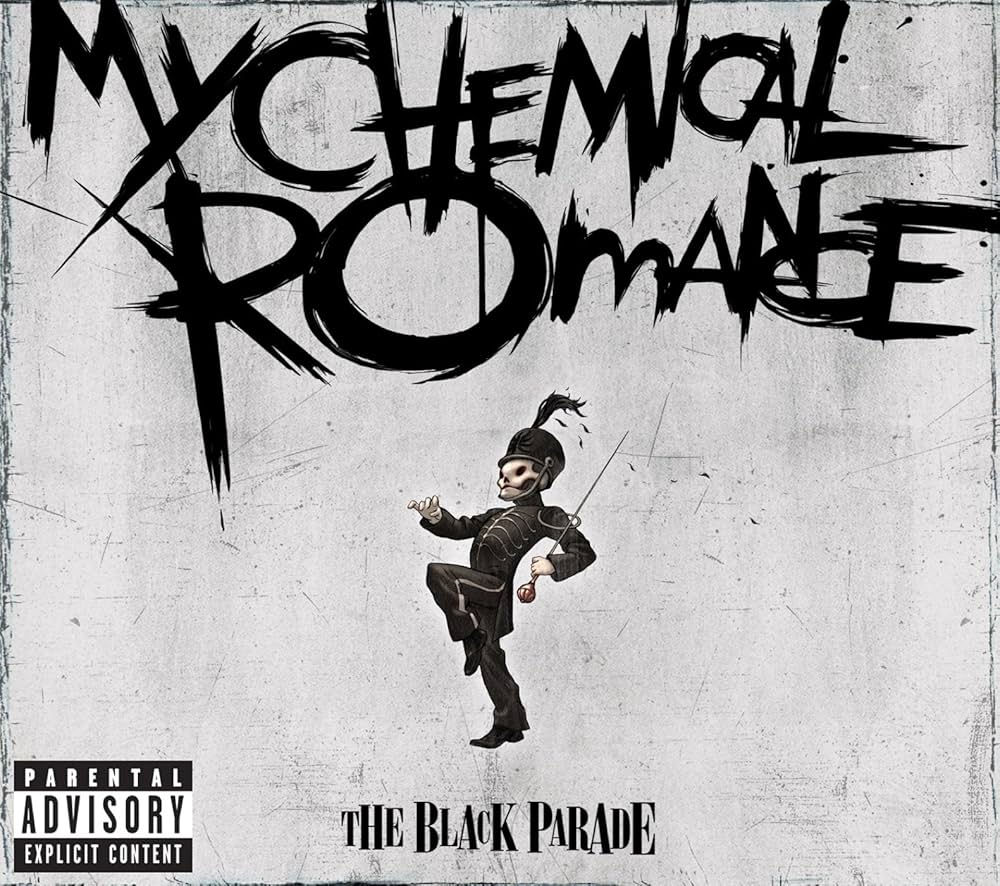
Maybe the second “new” album I actually listened to by my own choice (after Green Day’s American Idiot a couple years prior,) The Black Parade appealed directly to my classic rock-ist sensibilities, to my nerdy teenage angst, and to my taste in the women who also liked the album. At the time of release, critics quickly compared it to the bombast and pop art classicism of The Beatles’ Sgt. Pepper’s Lonely Hearts Club Band and Queen’s “Bohemian Rhapsody.” I liked that as a dork who thought The Beatles were the greatest band in the world and who kept Queen’s Greatest Hits compilation in the rotation for four straight years of high school.

But, to be honest, I’m not sure that comparison actually means anything other than “Welcome to the Black Parade” being anthemic and dramatizing the parade. It’s not that these bands aren’t part of My Chemical Romance’s DNA – if anything, their most Beatles-y song is “I’m Not Okay (I Promise,)” a mall goth perversion of “She Loves You” that steals the “Yeah, yeah, yeahs” for its own chorus. The melodic guitar solos of Ray Toro certainly sometimes bear comparison to Brian May’s for Queen, especially on songs like “I Don’t Love You” and “Dead!” Anyone who was claiming “rock was dead” in the 2000s just didn’t like the aesthetics, because the musicianship was obviously still carried forward.

But those comparisons are, based on my own teen self, an attempt to separate My Chemical Romance out of the pop emo they came from, to elevate them out of their subculture. The Black Parade album is, for the most part, a sibling to Fueled by Ramen’s roster, just as glossy and carefully written, just as poppy and pleasant. A song like “This Is How I Disappear” is just a perfect pop song, harmonic and huge, danceable and soaring in the chorus. These songs musically slip perfectly into emo night alongside Paramore, Fall Out Boy, and Panic! At The Disco songs of this era.

But unlike those songs, Gerard Way has a project, and that project is grief. This album’s lyrical content and vocal delivery are what separate the ambition of The Black Parade, generally understood as a rock opera (complete with two almost-showtunes in “The End” and “Mama”) about a dying man looking at his life and disease. But it’s a messy one, not nearly as plotty as rock operas like Tommy or The Wall, and the songs are allowed to operate mostly independently. Again, this feels like an overemphasis on appeals to classic rock authority rather than allowing it to exist as a more modern concept album, just a collection of meditations on a theme. The teen fans of message boards and Tumblr accelerate this from another direction, the desire for lore and OCs as sources for fanart. To be fair, “The Patient” as a character wasn’t invented by critics or fans, but by Way himself, who before My Chem was a comics writer. I think it’s telling, though, that his narrative structure here is so different from his comics work, not even so much episodic as epigraphic. 

Coming back to it as an adult, though, I’m just so taken with the musicianship. The band identified their time at the Paramour Mansion composing and recording the album as a troubled one both creatively and mentally, but you wouldn’t know it from the harmonic interplay throughout the album. A song like “House of Wolves” really highlights how the moment Bob Bryer’s drumming needs to be showier, everyone else is happy to pull back and serve the rhythm. A song like “The Sharpest Lives” feels like the entire band is one instrument, a sonic wall behind Way’s vocal. When Toro and Iero come together for the “Dead!” solo, it’s a firestarter, and over just as soon as it starts. This is a band that has come together to serve Way’s great songs, and everybody gets a chance to shine. While Danger Days was always a perfectly fun follow-up, this remains their peak of consistency and ambition. I’m glad they’re back touring again, but I almost would rather remember them here.

KEY TRACKS: “Welcome to the Black Parade,” “Sleep,” “Famous Last Words”
CATALOG CHOICE: Three Cheers for Sweet Revenge
NEXT STOP: From Under The Cork Tree, Fall Out Boy
AFTER THAT: Sam’s Town, The Killers

Happy Birthday 2025

Dirtbike and Faraday have been especially chummy.

Hi, gang! I’m 33 today!

Last year, I celebrated my birthday by publishing 60+ write-ups about my favorite movies, albums, and video games. It’s one of the most rewarding creative projects I’ve ever taken up, and I look back at those pieces with pride and share them when a friend picks up something I love. On top of just having enjoyed the process of publishing so many words, I enjoy having the pieces to look back on themselves, a testament to my thoughts and feelings about a work, maybe not the totality of what I want to say about something I love but a representation of some of that love.

I aspired to do the same project this year, and every year moving forward. Depression and motivation got away from me. Some of that writing energy went into Horizon Line, which I’m very proud of writing each week, and I also accept that it’s taken up some of my creative energy to maintain. I have far fewer pieces ready today than I did in 2024.

Rather than abandon the project entirely, I’m adjusting the timeline. Last year, I published 60 pieces in 30 days – this year, I’m committing to spending at least 20 minutes per day writing, probably with an interruption or two related to work or celebration, until I hit at least 60 pieces. That may take the summer – that’s okay! I’d rather have the gift to myself of celebrating my favorite works than cut myself the slack, and the timeline will matter less than the reward.

Anyway, expect to see me post a new piece to my site every few days for the rest of the summer. I have eight pieces drafted so far. I’ll publish one per day for the next week and see where we go from there. If you’re reading what I’ve written and enjoy it, please let me know! The encouragement will help with the motivation, and I’m sure I’ll be happy to tell you about the stray thought I had the day after publishing that didn’t make it in the piece.

As these articles go up, they’ll continue to be linked from this landing page. The ones I have written out but not linked are still in the drafting process.

MUSIC:

  1. The Black Parade – My Chemical Romance
  2. good kid, maad city – Kendrick Lamar
  3. People’s Instinctive Travels and the Paths of Rhythm – A Tribe Called Quest

MOVIES:

  1. Paprika
  2. The Phoenician Scheme
  3. The Tree of Life
  4. Princess Mononoke

GAMES:

  1. World of Horror
  2. Blue Prince
  3. Katamari Damacy

PAPRIKA

PAPRIKA
Dir. Satoshi Kon
2006

Satoshi Kon, whose life ended prematurely to pancreatic cancer at 46, attained a legendary stature directing four films and one television series. His most acclaimed film is Perfect Blue, his debut, a gnarly thriller about pop stardom and internet stalking, an outrageously prescient work, and it carries his trademark mastery of character motion and facial expression. When a character eerily moves too quickly, too lightly, it alerts the sense of wrongness quickly. He takes that skillset next to Millennium Actress, a dreamlike “biopic” of a fictional actress inspired by Setsuko Hara, using abstract fantasy to bring narrative propulsion and metatextual emotional depth. Recently reclaimed (after a much better translation to English) is his Christmas film Tokyo Godfathers, which celebrates found family with a flair of more cartoonish animation. And his television series, Paranoia Agent, was likely the introduction for many people my age who saw the show on Adult Swim, a mystery show about serial assaults by a young man with rollerblades and a bat. Its shockingly episodic structure and willingness to dramatically change tone from episode to episode create a memorable and challenging arc, and it represents Kon’s most dreamlike narrative thus far.

Kon’s career concluded with the film Paprika, in some ways a summation of every piece of Kon’s filmography thus far. Paprika is a dream therapist, using a science fiction technology called the DC Mini to participate in psychiatric clients’ dreams and record the encounter, working through repressed anxieties and symbols to identify traumas or needs. Paprika is also the alter ego of scientist Dr. Atsuko Chiba, one of the lead scientists of the DC Mini development team, who is using the device before it’s officially market tested and fully “safe” to use. When it appears that terrorists are using the DC Mini to invade people’s dreams and cause nightmares, delusions, and havoc, it becomes the DC Mini team’s responsibility to track down the people abusing the technology before the program is shut down permanently.

The film begins with an extended dream sequence with one of Paprika’s clients, Detective Toshimi Konakawa, who is experiencing debilitating panic attacks he believes may be related to the murder case he’s working. This dream contains elements recognizable to film fans – the film draws attention to Tarzan, but it also quotes The Greatest Show On Earth, and, most directly, From Russia With Love and Roman Holiday. When Paprika asks Konakawa about movies because of these references in his dream, he shuts down, even more than when discussing the murder – his trauma lies there, and he’ll need to be pulled through his own past to remember why he’s so stuck.

After Konakawa’s dream, the opening titles play. If you’ve never seen them, you can watch them now.

I have probably watched these opening titles a hundred times outside of the movie. For my money, this two minute sequence might be the single greatest work of cartooning in animation history. There are so many emotionally thoughtful ideas expressed with incredible economy. The way Paprika can transport and transform herself by way of images is a delightful power fantasy, the ecstasy of the digital pen giving her flight, teleportation, transmogrification. She is omnipotent but not entirely infallible – we see her caught off guard by rushing cars until she can stop them. I love the detail of Paprika putting the jacket back onto the sleeping office worker, whose desk has photos of the woman he loves at home – this all-powerful being is a healing spirit. But then she also doesn’t have time for boring, boorish men, and the image of her four reflected, increasingly disgusted reaction shots is only outmatched by her heading out to the street to coast away on the t-shirt of a rollerskater. I love the music by Susumu Hirasawa, music that is optimistic and futuristic, music that is a little off-putting but also catchy. And, lastly, I love that the transformation of Paprika back into Atsuko happens gradually across multiple cuts, communicating their different personalities before Atsuko speaks a single word. 

All of these emotions are brought forward into the film, a film whose plot is hard to follow on a first viewing but whose emotions and vibes are immaculate. Elements of the shared dreaming were later made more familiar to American viewers by Inception, but it is otherwise a very different film – where Inception views dreams as a magic trick that works best as convincing its targets that the dream is really happening, a heist performed by experts looking to fool their client into believing the pitch, Paprika instead embraces the artifice in search of something grander. Postmodernism is often applied to works about dreams because their inherently abstract plotting bring to mind questions of identity and The Cogito, but Paprika goes a step further to embrace the communal and political aspect of postmodernism. If modernism is defined by the death of institutions, Paprika’s vision of postmodernism proposes that as the foundation for building the impossible.

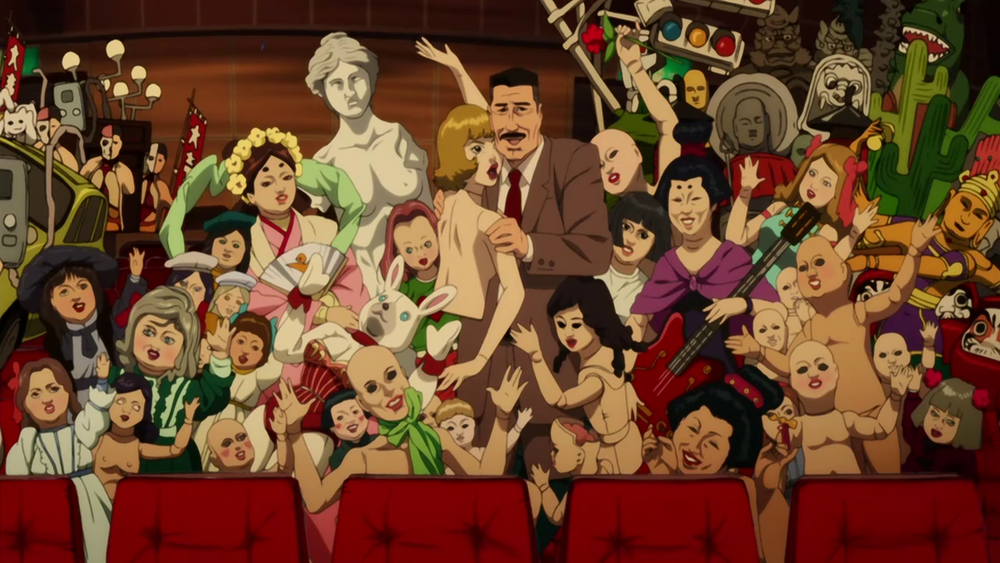
Maybe the most iconic dream image in Paprika is the “dream parade,” the dream of a delusional patient where a parade of toys marches toward some unknown goal. The parade has its own terrifying electronic theme song. It also has a trademark nonsense poetry, one which starts somewhat incomprehensible but becomes a rhythmic series of absurdist social commentaries over the course of the film. The collection of toys represents different eras of traditionalism, from daruma and hina dolls to retrofuturistic robots and anatomical dummies. Eventually, cartoon characters and yokai join the mix – the clash of the Golden Age of Hollywood references and the electronic music of the postmodern title sequence returns again in the parade dream, and the battle between progress and conservation ends up being essential to understanding the film’s mystery.

Detective Konakawa, caught in a dream parade.

This might make the film sound really intellectual and, well, boring – again, like the title, these ideas and emotions are generally presented simply as part of the action rather than in the endless dialogue of other philosophical films. These dreams are seen in thriller scenes of investigation and action, Atsuko exploring potential sites of danger, Paprika trying to identify potential dream invaders and fighting them off in fantastical chase sequences. The more impactful dialogue in the film is emotional – one wonderful scene between Konakawa and Paprika’s boss is them reminiscing over being in college, “when we used to talk about our futures.”

I’m going to wrap up this section because I’ve got a spoiler wall coming. Paprika is, since Tokyo Godfathers’ recent translation, often the bottom ranked of Kon’s films. I’d say this owes to two primary criticisms I’ve seen – the first is related to its portrayal of Dr. Kosaku Tokita, the primary inventor of the DC Mini and a very obese and childish character. While I have come to peace with Tokita’s character, there are undeniably jokes about his body that are fatphobic and meanspirited – Kon’s biggest flaw, across all his work, is how he handles unconventional bodies, generally marrying psychology and body in ways that can feel cruel. The second is general criticisms of the film’s plot and final act, which are confusing and can feel loose. In the spoiler section, I’ve identified a reading of the film that helps me understand both of these aspects, and I hope they help those of you who’ve seen the movie and are scratching your heads. But outside of the film’s relatively divisive final act, the very final scene of the film, which closes on Detective Konakawa, is one of the kindest and most wonderful endings to a film I’ve ever seen. I love Paprika. Rest in peace, Maestro.

SPOILERS FOR PAPRIKA

Let’s talk about the very climax of Paprika – we see the dream parade arrive in Tokyo. Paprika has been swallowed by the toy robot Tokita, and Detective Kanakawa has allied with the Radio Club bartenders, who have come to the real world through the spread of the dream. Kanakawa and the bartenders come across the great pit of despair.

Just before the Chairman emerges in his dark hole, Atsuko appears to Tokita to dream. She dreams of finally confessing her love for him, that the fact that he “swallows everything” is what makes him so much fun. Her coldness and cruelty at his childishness and obesity is what she thinks she’s “supposed” to feel about this genius savant. But in her mind, there is no one else. The dream then continues on, once the chairman appears, and Atsuko becomes the child who swallows everything. Through this dream, she vicariously experiences the thrill of eating it all up, the muck and the dreams, until she grows back to her adult, complete self. Finally completing this fantasy, when they wake up, Atsuko can finally be warm and loving toward Tokita, and they announce their marriage just before the credits roll.

It’s through this dream that Atsuko is able to finally make peace with herself and love Tokita. There is a subliminal thread of crosswired jealousy and romantic feeling throughout the DC Mini team. Tokita is at the center of the team, and his childishness allows him to focus on his creations, but he is also approval-seeking when it comes to Atsuko. Himuro is not envied by anyone, and we never hear his character’s true voice, but Osanai claims Himuro is jealous of Tokita as the head inventor – Himuro is also covetous of Osanai’s romantic affection, with Atsuko calling out Osanai “selling his body for the DC Mini” to him. Osanai himself is sexually fixated on Atsuko, but also is jealous career-wise of both Atsuko and Tokita, stating as much openly, even in his colleague persona. Chief Torotaro is in love with Paprika, and finds himself torn between his allegiance to Atsuko and her alter ego. But Atsuko herself only really thinks of Tokita, and her frustration, affection, admiration, and envy can only be sorted out by her experiencing a dream of his euphoric gluttony, much the same way Detective Kadokawa can only process his guilt by defeating the trauma in the dream.

This lingering thread also finally helps me close the loop on Tokita’s obesity. The romance between these characters never quite clicked for me, and the resolution of this nightmare image that goes unremarked upon really left me grasping for meaning and coming up short. Now, the understanding of this physical rejection as a barrier for Atsuko’s unspoken feelings about Tokita’s contradiction helped anchor his obesity as more than just a joke. Atsuko can’t see for herself the sort of therapeutic observation that Paprika can offer her clients – that she’s diverting a vulnerable, kinder feeling by affecting a societal cruelty against Tokita and herself. We’ve seen Konakawa resolve his arc just before the dream crashes into reality – I now understand the way the remainder of that dream concludes Atsuko’s.

But what about the rest of it?”

After Atsuko saves the world, Konakawa receives Atsuko and Tokita’s wedding notice with a laugh. He’s already resolved. He leaves work and sets off for something to do. Posters for Perfect Blue, Millennium Actress, Tokyo Godfathers, and Satoshi Kon’s unmade The Dreaming Machine decorate his walk. This scene, to me, is an impossible dream of imagining how we can reclaim our lives, the real power fantasy being the belief that we can, in fact, be anything, do anything, and find community. It imagines, after all the fantasy we’ve seen, that an equally powerful fantasy to saving the world is saving ourselves. Just before the film cuts to credits, Konakawa walks up to the box office and requests: “One adult, please.”