Sunset Visitor
2024
Nintendo Switch, PC
I really struggle with comparison hyperbole in the games space. It breaks my heart to see games critics, people who are smart enough to know better, say that a game’s story is “as good as any book,” that a video game performance is “Oscar worthy,” that anything is “the Citizen Kane of video games.” The reason for this is twofold – one is that it is almost always transparently false to anyone who actually participates in a balance of art across media. But the second reason is the reason for the first – it misunderstands what games are capable of doing to assume parity on parallel lines rather than understand what makes them powerfully different.
1000xResist is, on its surface, a game that is “light on gameplay.” It is a sprawling science fiction story about faith, authority, memory, generational trauma, and many more things – the gameplay consists largely of walking around spaces and talking to other characters to progress the story. The developers at Sunset Visitor, an art and theatrical troupe, began development of 1000xResist during COVID quarantine, when the group could not tour dance or theater – this is their first ever game project. But 1000xResist would not be “just as good” if it were a stage performance – rather, I believe one of many things that makes 1000xResist so special is that Sunset Visitor seems to have seriously considered what kind of story could only be told as a video game. In that way, it reminds me of Shinya Tsukamoto’s Tetsuo: The Iron Man, the first feature film by his experimental theater troupe Kaiju Shiata, and the way that outsider perspective often leads to evolution in the medium. So far, unlike Tetsuo, the band at Sunset Visitor still seems happily together after finishing their game.
Here is my attempt to offer a relatively spoiler-free synopsis of 1000xResist’s premise that will not rob you of the game’s many discoveries. A post-apocalyptic society of clones survives in a religious enclave worshipping the ALLMOTHER, their genetic originator and the last human survivor of a worldwide pandemic. You play as Watcher, one of the leaders of this clone society, whose role is to witness and record the behavior and story of her sisters. Watcher also has access to a memory technology called “communion” – in communion, Watcher and one of her sisters can observe a memory passed down from the ALLMOTHER, who we come to know also a Canadian girl named Iris Kwan, who was difficult to the people around her before the apocalypse.

The first thing we see in the game is Watcher murdering the ALLMOTHER. The next several hours are spent working through the time before this heresy was performed so that we might understand what drove Watcher to act. We see her say goodbye to Fixer, her girlfriend, as she goes to join the ALLMOTHER on “the other side.” Shortly afterward, we see Watcher’s status quo in The Orchard begin to fracture as she begins to engage in these communions.
In a communion, if the host (Watcher) is participating in a scene, she is seen by other people in the memory as the ALLMOTHER. So we walk around as Watcher, through these memory spaces, occasionally moving forward and backward to see if we can navigate new scenes. But in communion, she is always addressed as Iris – though, sometimes, too, there is an Iris that we see from outside. When we play in these spaces, are we recreating Iris’s actual actions, or is this some sort of simulation shaped by things Iris remembers? Iris, too, seems so different from the ALLMOTHER Watcher knows now – but, of course, she’s also never actually met her, so who does she know? Early on, during a communion, we also shift out of Iris’s perspective entirely, and are suddenly seeing things Iris wasn’t around for through Iris’s mother’s perspective. How did she come upon this memory? Is this something she imagines happened? Is this magical technology capable of filling in gaps in ways we don’t understand yet?
This muddying of perspective is invaluable to the story 1000xResist is telling. When we play the game, we are attaching ourselves to multiple perspectives at once. The player’s identity is not always clear, and we are not always in control of when we’re shifting. The game’s relatively simple challenge is essential to maintaining this disembodiment – a combination with precise action reflexes or challenging puzzles that dissolve the pacing would shatter that character relationship. And this disorientation is precisely something that can only be achieved this way through gameplay – even a similarly revolutionary approach in RaMell Ross’s Nickel Boys, which immerses viewpoint and uses changing perspective to disorient the viewer, cannot have the viewer embody all those characters as “me.” Watcher becomes Iris becomes ALLMOTHER becomes Iris’s mother becomes etc. – and if someone asked “who’s that on the screen?,” the player’s instinctive response is “that’s me!”
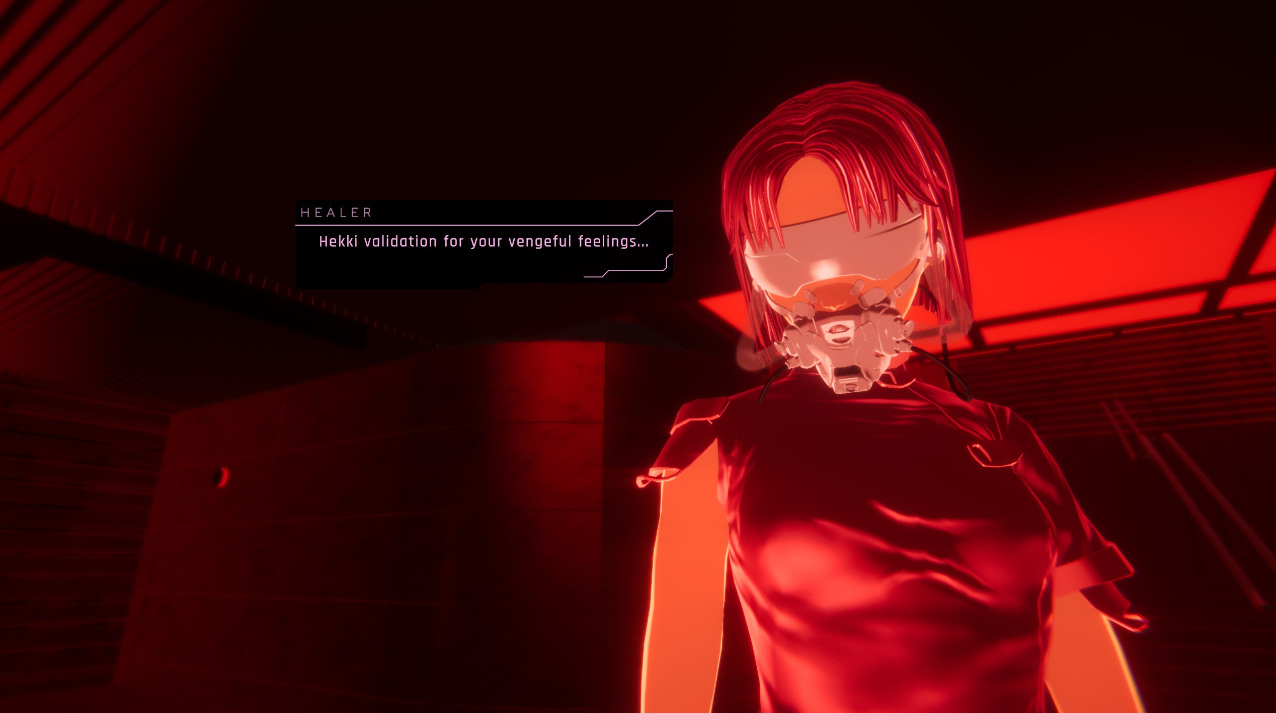
The game’s themes embody this throughout the story. Unsurprisingly, a story about clones is a story about the signifier vs. the signified – a game about a clone religion worshipping the “origin point” is engaging with questions about the self vs. the collective – a game about sharing memories engages with questions about where self-image and real, lived identity break down and diverge. This is a game that wants to talk about collective action, and one that directly references the Hong Kong protests of 2019. This is a game that wants to talk about how to maintain values in an institution without religion.
This, notably, is also a game about doomed lesbians, about knock knock jokes, about “songs to make it through the fighting.” It’s a game where one of the developers typoed “hello grace” as “hekki grace” in the work groupchat and so hekki becomes both “hello” and “amen” in the game. I love so many of these characters. Iris’s father is perhaps the most grounded, optimistic character you meet, and while his insistence that “the family that eats together stays together” sometimes feels naive, there’s truth in everything he does. That includes the truth in his pain, which is so well observed and honest to the life they wrote him. Watcher’s sisters Healer, Bang Bang Fire, and Knower have such immediate and distinct personalities, ones which have a relationship with their plotlines without becoming stereotypical or boring. Hell, I’d welcome all those characters into the cast of the next Like a Dragon game – when the story ended, I was very satisfied with its conclusion, but I was so sad I didn’t get to spend more time with these characters I love.

Sunset Visitor understands well how to weaponize its strengths and its challenges as a first time developer. Animation is difficult, and facial animation is worse – but if 90% of the characters are clones, then they can all have the same face, and the apocalypse has led to the characters always wearing masks, meaning they usually don’t have visible mouths that have to move. But as actors and dancers, they do understand performance, and the performances in 1000xResist are remarkable. Most of the cast has a very subdued approach to performance, with emotion repressed and occasional snide awkwardness leaping forward rather than affection. When that affection really surfaces, though, it’s all the sweeter for the contrast. They understand cinema, too, and the way the camera places itself in the game’s more dynamic cutscenes is striking and affecting. Maybe one of my favorite moments is the stage play setup we get for the Communion with Healer, which makes use of a diorama view to dramatically work through the origin of The Ancient Sin, for which the sisters fell from ALLMOTHER’s grace.
1000xResist is the Game of the Year for all the reasons I can’t say outside of a spoiler piece at a later date. It is a game so dense with storytelling, presentation, and perspective decisions that it tells itself faster than I can recap it. Even if I were simply communing with my fellow sisters who have beaten the game, it would be too difficult to capture everything this game triumphs at without becoming a Norton Critical Reader and going line by line.
I love 1000xResist, but I maybe don’t love it as much as my wife, who wrote this when we finished it.
““we are speaking their language now. is that not a form of death?”
it’s 1000XRESIST. it’s the best game of 2024. it’s about cultural assimilation. it’s about daughters as the revenge of the mother’s mother. it’s about high school lesbians. it’s about a pandemic. it’s about being the first-gen child of immigrant parents. it’s about survival and who gets to survive and who can be forgiven for transgressions made in the name of survival. it’s about a weave that can be unpicked. it’s about a you that remains and remains and remains. it’s about a choice, and we will not make it.
hekki grace.”
 All My Friends