STREET FIGHTER III: THIRD STRIKE

STREET FIGHTER III: THIRD STRIKE
Capcom
1999
PC, Xbox, PS4, Switch (part of Street Fighter 30th Anniversary Collection)

If you’ve never seen it before, watch the embedded clip.

Street Fighter III: Third Strike is partly notable for its parry system. By flipping the control stick toward your opponent at the right moment, you can deflect all damage from an attack. This is a little risky, because hitting the opposite direction will block the attack whether you’re too early or not, more safely allowing you to defend 75% of the damage. Parrying also allows you to much more quickly launch your own counterattack, preventing your opponent from having time to guard themselves. In the above clip, Daigo Umehara as Ken at the very bottom of his health bar parries every hit in Chun-Li’s fifteen hit super combo, with each parry offsetting the timing for the next hit, before launching his own surprise super and winning the fight against Justin Wong. Daigo went on to win the tournament (a Street Fighter fan corrected this failed memory – he made Grand Finals, but lost to Kenji Obata!) and become known as the greatest fighting player in the world for the next decade.

One of the complaints that comes up around learning some Street Fighter games is that they’re too simple, your responses to your opponent’s strategy too programmable, and that leads to a game that can feel kind of stale. This is part of why it’s become a popular learner’s game – one of the best intro to fighting games primers I’ve read centers first on the most basic match, Ryu vs Ryu, and argues that this mirror match basically makes up all variations on the game’s strategy questions. A lot of Street Fighter’s core design is a triangle of decisions – you can guard to try to mitigate damage, you can attack and risk getting hit, or you can move and try to improve your position. Within each miniature situation, variations on this triangle will play out – attacking high, low, or from the air – attacking with projectiles, punches, or grappling through guards – blocking high, low, or jumping to dodge. Those nested triangles break apart what otherwise might play out as a rock-paper-scissors game, like the Mushi-King arcade cabinets in Japan.

The parry breaks apart these triangles by offering a new gamble. Because you can take that risk to avoid all damage and counter more quickly, all courses of action become a little more dangerous, leading to a series of choices that open up that triangle (into more than just a square!) Where your opponent across the screen might have felt safe throwing fireball after fireball because the only way for you to approach him would be to safely jump over each one, opening you up to a big uppercut, now you can walk forward, parrying each projectile, advancing while maintaining your own momentum – provided your skill at parrying is high enough to not open yourself up to punishment.

I knew I wanted to get a fighting game in here, mostly because I love them but rarely play them these days. When I was in college, my roommate Jake and I could sit for hours getting one more match in of Super Street Fighter IV, Marvel vs. Capcom 3, or Third Strike, learning more against one another than against any other opponent. Jake would drill combos, watch videos, read strategies, learn advanced techniques in the lab. I rested on my fundamentals, learned my handful of characters, got as in-tune with their capabilities as possible.

Coming back to Third Strike a decade later, the only two characters I even remotely remember are Ryu (who I play in every Street Fighter game, including the quite excellent Street Fighter 6) and Elena. Elena represents what I love most about Third Strike – she’s a lanky capoeira fighter whose moves flow comfortably into one another without becoming long dial-a-combos I had to master in hours of practice. While she’s unpredictable and difficult to manage for new players, she’s actually one of the weaker characters in Third Strike – her moves require very perfect timing or else trap the player in relatively lengthy animations that are easy to defend against. But her unique fighting style, bubbly personality, and shock white hair make her a memorable part of the Third Strike ensemble.

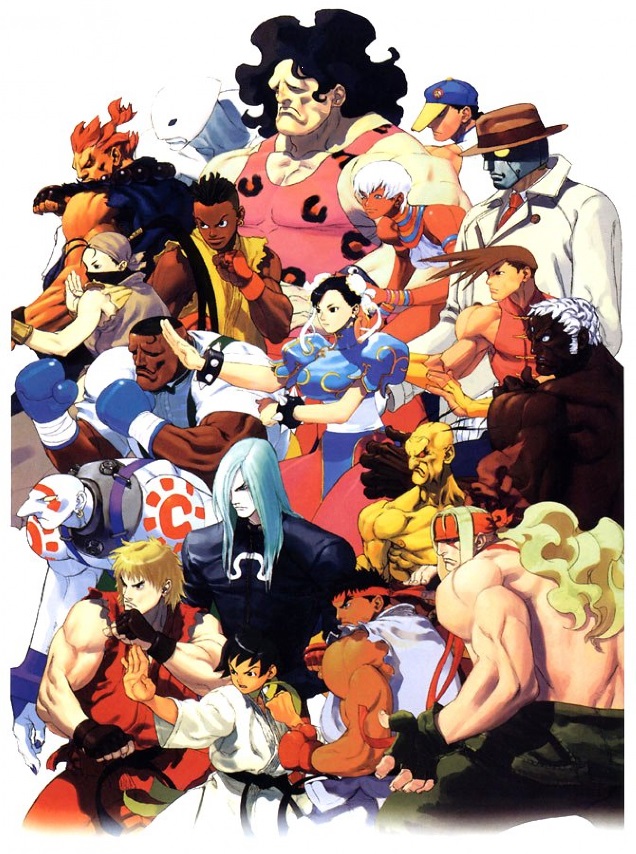
Street Fighter III famously brings back almost none of the iconic Street Fighter II cast – Third Strike’s nineteen character cast makes a concession by bringing back Chun-Li alongside Ryu, Ken and Akuma. Only a few members of that cast have come back in future entries and only in re-releases or DLC expansions, meaning most of them are best learned in Third Strike itself. The new cast is a little less superhero-comics oriented than Street Fighter II’s – whether that comes in the form of cool, hip designs like Sean or Yang or the horrific oddity of characters like Oro or Necro.

All this is realized in a pixel art aesthetic that remains unmatched. The animation on character movement is so fluid and expressive without requiring the outsized toon faces of something like Metal Slug. The backgrounds include empty streets, rainy rooftops, and grimy subway stations, giving the game a real backstreets, underground spirit. The soundtrack combines breakbeat and instrumental hip-hop better than almost any game since, a dealer’s choice of cool sonics that also lay a foundation for any number of melodic approaches on top, whether that’s needed to capture a runaway shinobi’s melancholy or to just launch into a perfect jungle breakdown. I couldn’t possibly tell you the story of Third Strike – Street Fighter lore is immensely detailed and requires playing hundreds of hours of mediocre single-player gameplay when it doesn’t also require reading addendum comics. But I can tell you this world feels a little dangerous, a little like the few heroes of its past that still walk its alleys get assailed by private detectives and snot-nosed kids with a mean right hook.
Most of my experience with fighting games these days is watching tournament and stream highlights. I’m in the iconic fighting game Hard Drive dead zone, and I have neither the free time nor the drive to get better. Tournament highlights from Third Strike are always enjoyable because the game’s unique cast is still complex enough to reward playing the vast majority of its characters and the game’s pace is not so fast that the combos are unreadable. The animation clarity is smart, too. The hits that deal the most damage look like the hits that do the most damage. The supers zoom in and let you know when something serious is about to happen without interrupting with a long canned animation. It’s just so many small, intelligent decisions like these being made to make a game that’s lasted twenty five years.

Daigo Umehara still plays regularly, but he’s fallen to the wayside over the past twenty years. Justin Wong actually has maintained a better overall win percentage across more games, his fundamentals allowing him to transfer his skills to games like King of Fighters, Marvel vs. Capcom, and Mortal Kombat, but Wong still finds himself streaming Third Strike regularly. It still gives me pleasure every time I see someone square up against Justin Wong’s iconic white Chun Li hoping to reclaim the greatest moment in fighting game history.
MESHES OF THE AFTERNOON

FYI – this film is also available on Criterion Channel in higher quality.

MESHES OF THE AFTERNOON
Dir. Maya Deren, Alexander Hammid
1943

Elliptical haunting nightmares inventing new dream logic. There’s a lineage of the dadaist and surrealist imagery of the early 20th century. I unfolded a greater understanding when I watched Jean Cocteau’s Blood of a Poet, Wladyslaw Starevich’s The Cameraman’s Revenge, Man Ray’s Return to Reason. I saw Meshes of the Afternoon early in this journey, directed by reference to my love for David Lynch. Unsurprisingly, I didn’t “get it” then, appreciating some of the imagery but only able to make reference to things I had already seen.

I’m still nowhere near an expert on abstract or experimental cinema, having largely seen only the most acclaimed and beloved films or museum pieces I happened to have someone else program. I find it hard to engage with abstract cinema at home, especially anything longer than a few minutes long. Something like Bruce Baillie’s Quick Billy is hard for me to keep in my head with streaming video quality and phone notifications. So, please consider my love for Meshes of the Afternoon a pledge that you, whoever you are, can enjoy it too.

The story, told simply, is a cat & mouse between our heroine, a dreamer, and a mysterious stranger with a mirror for a face. She chases the mourner/reaper and finds it carries a knife. Parts of the chase keep recurring, both lived and observed from afar, omens of violence rising until a desperate conclusion. As much as I love the more daring shots, some of the most impactful are the mundane images. Closeups on her falling asleep in the chair or running to follow the mourner, those are such incredibly daring and modern images. The tension still gets me, the uncomfortable feeling of impending doom.

Meshes of the Afternoon is a late silent film, though Deren’s third husband Teiji Ito wrote a classical Japanese score (embedded above.) I’ve watched it with Ito’s score, in silence, with a faux-Badalamenti score, with Liturgy’s Aesthetica. My tip for watching silents at home, if you cannot find a score that works for you, is simply to put on music you feel like listening to. There are unexpected synergies to whatever you can choose, from Outkast to Buckwheat Zydeco. If it makes it easier to commit your attention, it’s the correct choice for that day.

I had to train myself to watch and enjoy silent film. It took about a year of learning how to watch what I was looking at, and many of my early Letterboxd reviews document growing pains in that process. I lack forgiveness of myself for failing to be a better critic sometimes. There’s a decent chance that ten years down the line, I’ll read most of what I’ve published in this birthday project and go, “ah, damn, what a naive kid.” I think writing about perspective in Meshes of the Afternoon is putting me both in the mindset of the dreamer and the mourner, looking to future’s past. While I take great pleasure in Meshes of the Afternoon, this film still stumps me. Let this be an engraving of humility, reminding me how much more room there is to grow.

SYRO

SYRO
Aphex Twin
2014

Richard D. James, better known as Aphex Twin, referred to his most recent full length album as his “poppiest album yet.” I don’t know that I necessarily think anything here is more accessible or friendlier than “Alberto Balsam” or “Windowlicker,” but relistening to Syro, I’d forgotten just how melodic and beautiful the album tends to be. The earworm that’s been in my brain for a decade is “180db_[130]”, maybe the album’s most frantic dance cut, high drama that fits voguing or an evil movie nightclub more than an actual night out. When I spend time away from Syro, that harsh synth melody overtakes the more austere beauty of “XMAS_EVET10 (thanaton3 mix)” or “”syro u473t8+e” (piezoluminescence mix).”

You’ll also notice, if you’re unfamiliar with the album, that unless you’re listening to it so frequently you’ve got these titles memorized, that the album resists identifying individual tracks. According to James, the album consists of ideas written over six or seven years, none he considers forward-looking experimental music, all of which he considers ruminations on the past. The variation on this we might be more familiar with are letters and poem series, titled by date or sequence rather than by something more poetic and evocative. Most interpretations of the track titles here are descriptions of gear and technical detail – “minipops 67 [120.2]” refers to the MiniPops drum machine, likely take 67, set at 120.2 BPM, lord knows what a source field mix is. The album cover includes a record of the album’s production and promotional costs. Despite being a “pop album,” this is a documentation of a period of time more than a Concise Statement.

I’m as far from a scholar of electronic music as they come. I hear stuff, like what I like, integrate it into my playlists, and roll on. So when people say this is a culmination of thirty years of electronic music history, I believe them. I hear playful reverie, memories of holidays past, reflection on a quiet afternoon. I hear the soundtrack to a nightmare movie rave. I hear a feeling that the form has been mastered and now it’s simply about the pleasure of creation. These thoughts are abstract, and I’m not sure I could map them for you directly to a timestamp or even a track title. By disconnecting the music and its context, James has created a throughline from electronic instrumental music back toward the sort of classical roots. This album exists because the studio and equipment to create it existed and demanded to be played.

James has continued to make music, releasing EPs every few years rather than full length albums. He’s toured once in that time and played sporadic festivals as well. Based on the teaser timeline set last year leading to the EP “Blackbox Life Recorder 21f/in a room7 760”, he’s due to disappear for another couple years before giving us another bite sized update. Between Syro and the previous full length album, Drukqs, James claimed he’d written six unreleased albums. It’s possible that like some classical composers before him, there are hundreds of recordings we won’t hear until a century has passed. I hope selfishly to get to hear some of his beautiful sounds sooner.

KEY TRACKS: “minipops 67 [120.2],” “XMAS_EVET10 (thanaton3 mix)”, “180db_[130]”

CATALOG CHOICE: …I Care Because You Do, Richard D. James Album

NEXT STOP: Black Origami, Jlin

AFTER THAT: Flamagra, Flying Lotus

BLUE VELVET

BLUE VELVET
Dir. David Lynch
1986

The short films David Lynch made in art school, as well as Eraserhead, contain his intense visual horror flair and his otherworldly treatment of sound and light, but they’re deeply angry films, a young man railing against societal failures and expectations. The Elephant Man and Dune are adaptations, Lynch putting his distinct style onto other people’s work. But they also soften his edges quite a lot – Dune marks what I think his first real mature work showcasing empathy and friendship, the relationships between Paul Atreides and his friends full of liveliness. It’s the first time watching a David Lynch project I feel like you can really fall in love with some of the characters.

It’s also the last time Lynch would ever work on something that massive in scale, even accounting for Twin Peaks: The Return. The degree to which Lynch poured his heart into the film, the time he spent with Frank Herbert (who largely liked the film) undermined in post-production by the De Laurentiis family, ended Lynch’s desire to work on big-budget films going forward. Creative control came with a lower asking price – according to producer and Lynch collaborator Sabrina Sutherland, that approach is still getting pitches into board rooms as long as they aren’t about mythical Snoots.

The lessons he learned making Dune are visible in Blue Velvet, not least of which through the return of Kyle MacLachlan as Jeffrey Beaumont, another precocious golden lion-boy quickly corrupted by exposure to a world where naivete can become egomania. While Blue Velvet was conceived in 1973 alongside Eraserhead, it lacks that film’s sour edge and general misanthropy. The film is still on the knife’s edge of thriller and horror, depending on how unsettling you find its darkness, but it comes to that darkness through a deep love of its characters. Jeffrey is presented from the start as a character more like one of the Hardy Boys than Jack Nance’s Eraserhead Henry Spencer, and while he does find some unseemly, voyeuristic desires and a penchant for manipulation in himself, his conscience also always seems aware that these things are wrong.

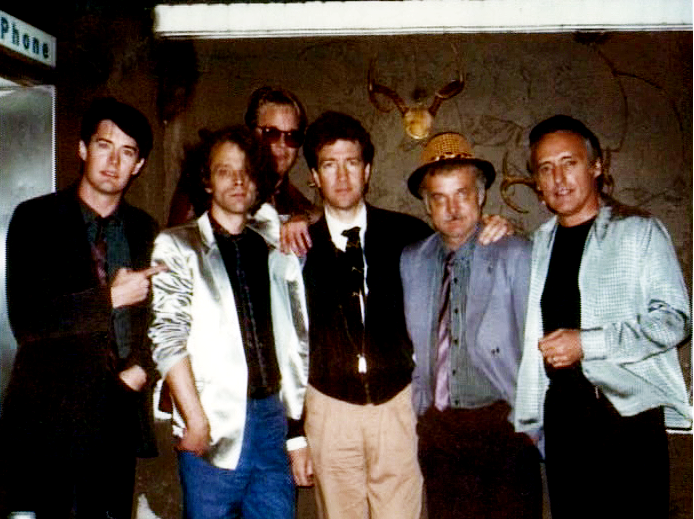
Lynch (center) and the boys (from left to right, Kyle MacLachlan, Brad Dourif, J. Michael Hunter, Lynch, Jack Nance, Dennis Hopper)

That melodramatic empathy with these characters is, to me, the real heart of the Lynchian ideal, as it combines tropes or familiar, mundane elements with intense tragedy or darkness. Some people take this to mean something as simple as “the radiator is menacing” – while I think that’s certainly true of Lynch, it’s also true of iconic images like the telephone on the stairs in Maya Deren’s Meshes in the Afternoon or the basement in Charles Laughton’s The Night of the Hunter. I think what really makes the Lynchian whole is the juxtaposition of menace and love, and just about every Lynch work from Dune onward is embodied by that ideal.

It’s certainly the primary iconic juxtaposition of Blue Velvet, Bobby Vinton playing over a suburban lawn until the grass leads us back to a severed ear. Isabella Rosselini’s Dorothy Vallens is tragic but also erotic, and her trauma response cycles between despair and desire in the flash of a moment. Frank Booth is a terrifying villain, and that villainy never comes forward more uncannily than watching Dennis Hopper sob over the performance of the woman he brutalizes. Even Dean Stockwell’s terrifying pimp Ben is given the Roy Orbison “In Dreams” solo, creating a dynamic of traditional American beauty and violent blood running under the surface. The only person spared this conflict is Laura Dern’s Sandy, whose only exposure to the darkness is to see it crashing down upon her lawn in the film’s crushing climax of melodrama.

David Lynch’s work has meant a lot to me for the past ten years or so, since I first met Twin Peaks and Eraserhead. Annie and I originally bonded over talking about Twin Peaks, and his films have been a source of many beloved memories of mine. Last summer, when we moved back to Madison, the first film we saw at the UW Cinematheque was Blue Velvet, and there I reunited for the first time with friends I met maybe six months after my first time watching Twin Peaks. It’ll remain a special experience to me for a long time.

MINI METRO

MINI METRO
Dinosaur Polo Club
2015
PC, iOS/Android, Switch, PS4

Most games that get cited as “perfect” are either so purely gameplay that they can be modified to fit any aesthetic you want or require such a bizarre cocktail of ideas that they cannot be replicated in any other medium. Tetris is a beautiful game of mechanical perfection – the two best Tetris games of the 21st century, Tetris DS and Tetris Effect, transform the game in wildly different ways. The former, Tetris DS, is a celebration of Nintendo history with a Capsule Corporation menu aesthetic, borrowing sprites directly from NES classics including The Legend of Zelda and Metroid. The latter, Tetris Effect, sends Tetris into the new age stratosphere, with a sea of stars and a pulsing electronic soundtrack, a vibe somewhere between Burning Man and cult imagery. Alternatively, you can have the Super Mario franchise, where you have to cohere overall plumbers, giant turtles, extreme anime pop visuals, and ragtime or big band soundtracks – there is no dramatic “genre” or “mode” that this fantasy obviously fits, no game we play in real life that this matches beyond “pretend.”

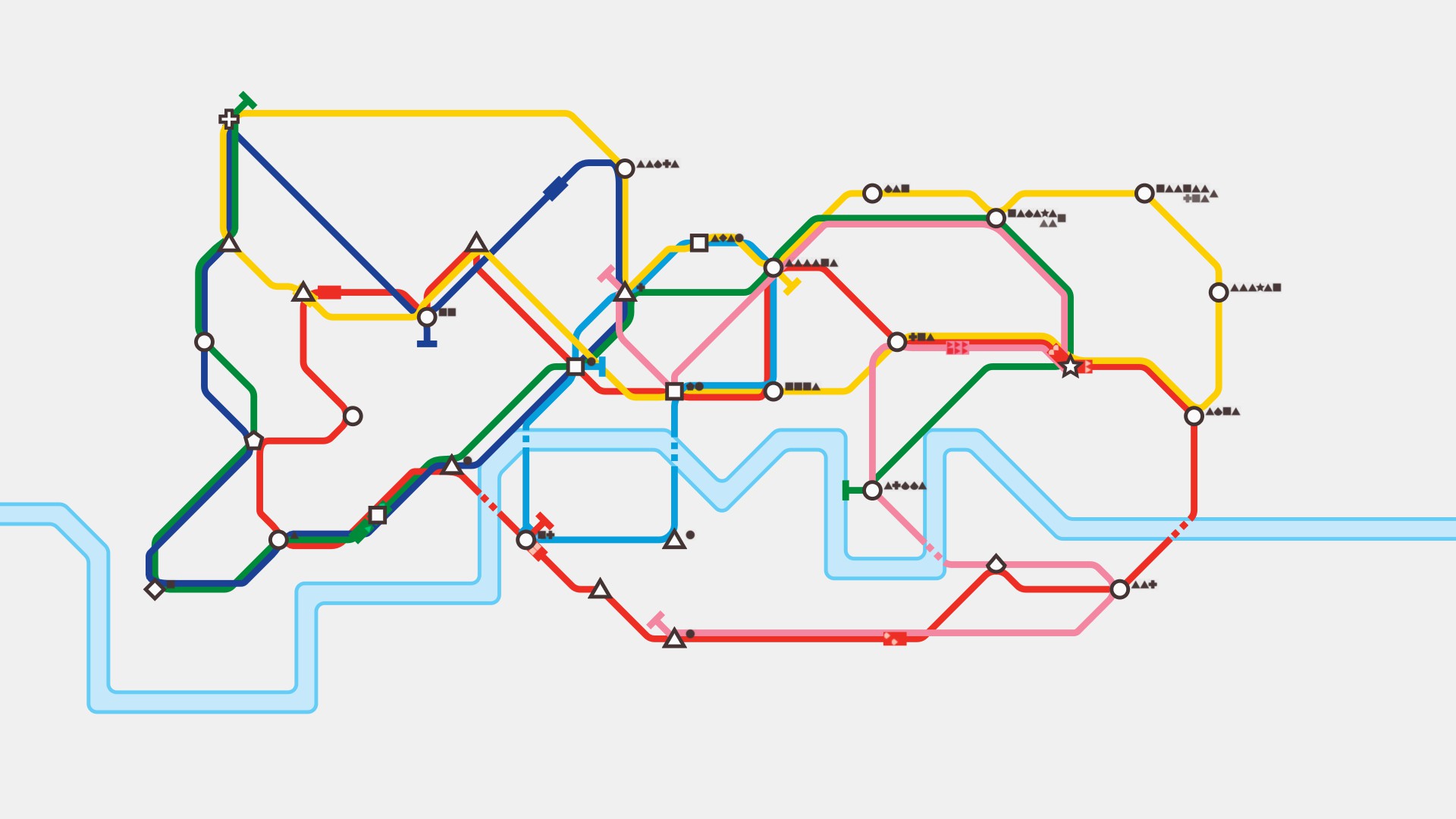
Mini Metro illuminates the gap in this contrast by combining its pure gameplay with an immediately identifiable aesthetic that instantly teaches the player how to play it. The game takes place on a topographical railway map. Different shapes appear over time representing stations – each station starts receiving customers, represented by the station shape they’re trying to travel to. You draw rail lines between these stations (with just a drag and drop, easy as can be) and immediately trains start trafficking them along your drawn railway. Your goal is to keep the system running as long as possible before a station’s capacity overflows.

Drawing an effective railway is not simulated purely by distance, but also by the order you’ve drawn your stops – rerouting a line may result in a cleaner pathway that allows the train to take a turn smoothly rather than having to stop at a 180 and build speed again. Each in-game week, the city invests a little more funding – this can take the form of tunnels and bridges for crossing water features, additional trains to travel your rail lines, or additional lines of travel, each represented by their own bright color. The game comes down to drawing smart, efficient lines, and managing your choices in investment to protect yourself from accidentally hitting a dead end. 

Designers could complicate this system and add currency for each rail line, add structural concerns for bridges about how long a carriage can cross safely, include “quality evaluations” along the way for earning extra bonuses from investment. But every decision in Mini Metro stems from the core concept of the aesthetically minimal topographical railway map. These ideas are not those represented visually on the map, and so they’re never introduced. Even the game’s soundtrack (by It Follows/Fez composer Disasterpeace) exists only in the forms of tones which play when passengers arrive or depart from a station. 

A London run at its conclusion.

What separates Mini Metro from other “perfect” video games in my mind is the fact that it so directly looks at a real world concept and adapts it into a compelling and legible game. For comparison, Tetris began as an imitation of a pentomino puzzle game – in a sense, that relates back to Tetris, but the game is also an imitation of other box filling games, not a real world phenomenon. It’s a signifier of a signifier, never quite reaching back to whatever the original meaning was. Shigeru Miyamoto came up with the concept of the Pikmin series because he’d gotten into the habit of gardening and liked imagining a little world in his garden – but the experience of commanding Pikmin as a small military and using them to perform a long-term scavenger hunt has almost nothing to do with gardening. 

Development on this game started after a trip on London’s Underground – even if it hadn’t been London, it’s hard to imagine this game starting any other way. I’ve only encountered city train systems while traveling, and I still can so quickly understand what’s happening in the game because the gameplay is so well communicated by the iconic aesthetic. The railway map design allows the game to abstract more literal simulation without losing focus on the game’s actual intent, which is managing and designing an effective transit system. It’s a motivating game design philosophy, a reminder that play can be right in front of our noses rather than requiring the imagination to create a funny little plumber who shoots fireballs at kappa. Mini Metro is ingenious in the same way the George Dow and Harry Beck transit map model itself is ingenious, communicating where the trains go without literal geography, using easily recognized symbols to communicate importance, and using attractive bright colors that catch the eye and linger in memory. 

LIFE WILL SEE YOU NOW

LIFE WILL SEE YOU NOW
Jens Lekman
2017

I can’t remember if I found “How We Met, The Long Version” through Spotify’s recommendation algorithm or Pitchfork’s Best New Music – I read it regularly, having just started my tradition of making seasonal playlists and needing more new music than I ever had in my life prior. It’s an extremely catchy groove, but it’s heavily playing off the sample of Jackie Stoudemire’s “Don’t Stop Dancin’” with a Daft Punk style production (think “Harder Better Faster Stronger” and its relationship to “Cola Bottle Baby.”) What makes “How We Met, The Long Version” a Jens Lekman song is the lyrics, which tell the story of the start of a romantic relationship – dating back to the Big Bang. It comes across as a maybe tongue-in-cheek observation in isolation, to romanticize a love story that starts with borrowing a bass guitar by syncing about trilobites and crustaceans evolving to the point where love is possible – but, I think, to assume that it’s in anyway less than genuine is to misunderstand Lekman’s lyrical project.

Life Will See You Now is, by and large, a series of relatively mundane anecdotal story-songs set to disco and new wave pop. In “Our First Fight,” a song with a tripping samba rhythm, Lekman’s conversational baritone delivers “I love you” and “No, I haven’t finished Season 3” in the same beautiful, neutral vocal tone, though that doesn’t stop a playful “Woo-hoo!” from taking center stage in the song’s climax. On “To Know Your Mission,” Lekman tells a story of meeting a Mormon missionary and telling him that he knows his mission – that “in a world of mouths, I want to be an ear” – that writing these songs and sharing these stories is the highest purpose. I think, for that reason, Lekman generally removes drama from the music and his singing, instead allowing the lyrics to build narrative momentum over music that remains playful and agile.

That’s not to say there’s no musical build-up, though. The way “Evening Prayer” or “Hotwire the Ferris Wheel” (in my book, the two best songs on the album) build from humbler sonic beginnings to their final harmonies overwhelms me to the point of tears. “Evening Prayer” tells the story of two men meeting for beers after a successful cancer treatment, melts me. It chooses the friend instead of the cancer survivor Babak as its perspective character, who sits in deep anxiety about whether or not he and Babak are actually close enough friends for it to not be weird how deeply he worried for his sick friend. The eventual resolution is a tearjerker, and Loulou Lamotte’s harmonies in the final chorus send it home swinging for the fences.

“Hotwire the Ferris Wheel” sounds, more than anything else, like the Wii Sports theme song, and tells the story of comforting a struggling friend by literally breaking into the carnival. It slowly builds up to the title, a chorus which soars as an anthem, and then reaches its real confessional. Feature singer Tracey Thorn comes in to beg Jens, “If you’re gonna write a song about this, please, don’t make it a sad song.” Whether or not this is entirely fictional or, to any degree autobiographical, I think Lekman is once again returning to the confessional of “To Know Your Mission” – whether the stories are true, the feeling of what it means to listen and share stories is intimate, at times uncomfortable.

One of my other favorite moments on the album comes in “Wedding in Finistère” (I should mention, Lekman is Swedish, occasionally apparent from pronunciation more than from the lyrics.) The song tells the story of a somewhat sardonic exchange at a wedding, joking that it feels like getting married is where life ends when it’s supposed to be where it begins. But, then, suddenly, in the chorus, the sense of perspective zooms out, to generations watching the generation prior disappear into reverie.

Five-year-old watching the ten-year-olds shoplifting
Ten-year-old watching the fifteen-year-olds French kissing
Fifteen-year-old watching the twenty-year-olds chain-smoking
Twenty-year-old watching the thirty-year-olds vanishing

This section is sung at almost double-tempo of the rest of the song (hell, the rest of the album,) flying into a propulsive hand clap game. Lekman claims he wrote this the day after a longtime friend told him she was pregnant, which made him feel the weight of time and his own sense of immaturity compared to where she was at in life. This moment reminds me so much of a moment in Genzaburo Yashino’s “How Do You Live?” in which our protagonist, a boy named Copper, realizes for the first time that the hundreds of cars driving back into Tokyo are, in fact, people, who all have their own lives and their own families and their own uncles. That when he and his uncle drove to the building he’s watching from, they may have been watched by someone from that very building, and this sudden sense that he is a part of the world and not its center makes him feel like a droplet in the tide. In the world of drama, the world of music, these are small revelations. 

KEY TRACKS: “Evening Prayer,” “Hotwire the Ferris Wheel,” “Our First Fight,” “Wedding in Finistère”

CATALOG CHOICE: CORRESPONDENCE, The Linden Trees Are Still in Blossom (or, if you can find the original 2007 version with the samples, Night Falls Over Kortedala)

NEXT STOP: American Utopia, David Byrne

AFTER THAT: Why Does The Earth Give Us People To Love?, Kara Jackson

CELESTE

CELESTE
Maddy Makes Games
PC, Switch, Playstation, Xbox

I Was Born For This.

“It was her dying wish.”

“I have to do this.”

The mountain is joining the pantheon of quests in games, alongside a princess in another castle, an alien outsider threatening planetary destruction, and, yes, revenge. There is a mountain; we go to the mountain to climb it. In Journey and God of War, much of that journey is just in getting to the mountain. It is always visible in the horizon; sweeping vistas after long climbs show us that we have “gotten closer,” but not close enough to tell how far the mountain really sits. After a time underground, both games find the base entry point, the snow falling to our character’s face, tassels and scarves flowing in wind.

Celeste too is a game about a mountain. Like the prior year’s Getting Over It with Bennett Foddy, it is a game that starts at the bottom of that mountain from the beginning, teaches you the base mechanics of its precision platforming, and sends you on your merry way. And I think Celeste uses that mountain as a similar concept to Foddy’s as a reflection of the player’s own potential depression, insecurity, and need for a hard fought victory. These are, I think, perhaps the two best platformers of the decade in that they introduce new platforming mechanics while using expert intentional level geometry to communicate themes and an idea.

“Introduce” is, in some ways, a tough verb for Celeste, which to an outsider familiar with Matt Thorson’s prior game Towerfall might look like an actual ROM hack of that game. Its movement and airdash were immediately familiar to me, as I’d spent hundreds of hours playing what I’ve (obnoxiously) called “the Best Smash game, bro.” (Towerfall will get one of these columns someday soon, too, when I have a chance to get everyone together and play it for an afternoon.)

Celeste then does something better, that thing our favorite platformers do. Each chapter of Madeline’s story introduces new mechanics. Elevators that move on touch, blocks of starstuff that shoot Madeline forth like she’s cutting through jelly, feathers for Dragon Ball’s nimbus flight; each is quickly explained, quickly understood, and a project to master. These mechanics are then still remixed into later stages, but carefully and thoughtfully and not “because we were afraid it would be disappointing if we left it behind.”

And then it does something even better. It tells Madeline’s story of depression and isolation, and of her willfulness to climb this mountain. It meets Theo, who is kind, aloof, and feels like a real friend, whose musical theme is cozy as James Taylor. It introduces Madeline directly to her other self, who injects the game with as much humor as she does pain. And it does this all with the lightest of touches…except for the brilliant score by Lena Raine (plus credited remixers for the truly difficult B-Sides) which is a natural, exhilarating fit for the game.

Celeste also has no trouble breaking out of its “mountain” theme to play with color.

Lastly – Celeste’s Assist Mode is a hallmark for accessibility in games. That a game so openly confident in its difficulty, so inviting to be compared to “masocore” games and ripe for speedrunning, also is so kind to its player and wants to avail itself to disabled gamers who might gain something from Madeline’s story? It’s just the whole package. They made what they wanted, and made everything they wanted.

Celeste is maybe most iconic for its creator, Maddy Thorson, using the game to come out and transition, to mild outrage from anti-woke chuds and celebration among queer gamers desperate for icons in a dude-heavy landscape. It is not the first queer game by a trans developer, nor is it the most outwardly queer game. However, prior landmark queer games are largely dialogue-heavy adventure games or visual novels, or the comedy short-form experiments of developers like Robert Yang or Nina Freeman. Celeste takes advantage of a gap in the market – a game aimed directly at the heart of the speedrunning hardcore gamer community. Anyone who’s ever watched Games Done Quick knows just how overwhelmingly queer the speedrunner demographic seems to be – Celeste manages to combine queer aesthetics with a gameplay-first design, executing a precise shot at a previously unfulfilled niche. It’s become a landmark “most important” game for that reason – thankfully, it’s a great example of where “most important” and “most fun” meet.

DAYS OF HEAVEN

DAYS OF HEAVEN
Dir. Terrence Malick
1978

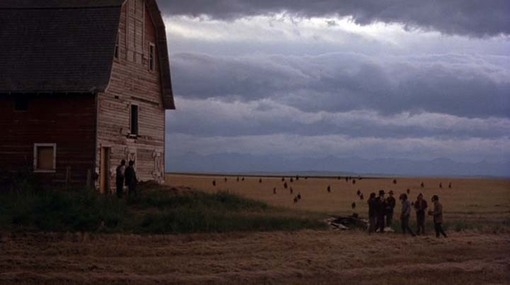
After an opening credits set to archival photos of pre-WWI urban Americans, one of the first images we see is of glowing, hot fire. Bill (Richard Gere) works in a steel mill, and we see molten molding as our first major elemental power. This film luxuriates in vast expanses of the classic elements, on fields of wheat and riverbeds, on major storms and hair in whirling wind. Days of Heaven is most famous for its golden hour sunlight, fought for in protracted production to get twenty minutes of shooting done to get the rich colors captured in this film’s photography. But Days of Heaven never comes alive quite like it does in front of fire, which we see as the opportunity both to give life (such as at the final workers’ hoedown bonfire, sparks shooting off the central flame around the fiddler and the dancing) and to create hell.

I’m maybe lucky that my first Terrence Malick film was To The Wonder, the beginning of his autobiographical sequence I’ve seen people call “The Twirling Trilogy,” films extremely light on plot or consequence, heavy on reflective, poetic narration and beautiful people shot in beautiful lighting. After enjoying that introduction, I take any amount of conflict, plot, or Big Cinematic Beauty as its own reward. Knowing the hellfire that’s coming at the end certainly gives the preceding hour incomparable tension.

A good thirty minutes of Days of Heaven is mostly spent watching labor. After Bill gets in a fight and kills his steel mill boss, he takes his sister Linda (Linda Manz, who narrates the film) and his “sister” Abby (Brooke Adams, in an incredible double-header year where she also dominates Invasion of the Body Snatchers) to work on a wheat farm in the Texas panhandle and hide out from the law. The work of shucking wheat and collecting hay is shown in detail, repeatedly, broken mostly by moments where Linda is able to play with an unnamed friend. Annie referred to the pace as “a glacial 94 minutes” – I prefer the term “meditative,” but I’m a sicko for this stuff.

It helps that the golden hour photography makes the panhandle look like paradise. There are funny, storybook-like shots in the montage of the arrival to the farm. One shot of a train crossing a bridge in front of a bright blue sky immediately brought to mind Wes Anderson – a later scene at a river dock brought to mind Martin McDonagh. The definitive look of Malick’s modern films is shaped entirely by his collaboration with cinematographer Emmanuel Lubezski, and together they create deeply personal images which make me understand the appeal of sacred geometry. They are largely shot in immersive, close-up long takes, the camera’s sweep lively documentarian when people are in frame and methodical when shooting still images. His first two films, shot by (among others) Tak Fujimoto, Nestor Almendros, and Haskell Wexler, are no less gorgeous, but they present images in a more classical manner. The flashes of the future are here in shots of wildlife, from the rabbits and pheasants around the farm to the dread-inducing shots of locusts which threaten Texan Eden. And they are here in one riverbed conversation between Bill and Abby, an uncomfortable proposition that uses montage to show reconciliation.

The farmer (Sam Shepard) falls in love with Abby, and the drama progresses. In the latter part of the film, we see traditional dramatic acting in the triangle, and all three are so great at communicating their characters through body language and their facial expressions rather than through extended dialogue. But in the early part of their relationship, almost all interiority is only understood through Linda’s narration. Manz is somewhere between a real street urchin and a trained actor, having attended at least some classes but having run away for most of them. Because the film was largely shot in improvisation, Malick made a wonderful decision to let Manz narrate in post-production, apparently just a stream of consciousness improvised by Manz watching the movie herself. Her observations are so funny and so sincere – it truly creates the impression that they plucked this character out of a Faulkner novel and started rolling.

The great conflagration at the film’s climax feels like it could be where the film ends. It continues on another fifteen or twenty minutes, laying track for our “heroes’” fates, drawing some fairly clear delineation on what will or will not change. This decision feels mildly uncinematic, closer to the way a Great Novel ends, and filmmakers inspired by Malick (first thought in mind is Ryusuke Hamaguchi’s Evil Does Not Exist, but also Alejandro Gonzalez Inarritu’s The Revenant or Jeff Nichols’ Take Shelter) often cut to credits right at that moment of Great Emotion. But that landing runway takes suit after his beautiful, surprising ending to Badlands, and predicts the iconic beach sequence that concludes The Tree of Life. Denouement is an essential part of Malick’s storytelling – it gives the story space to exist in context, to merely be where the curtain closes rather than where meaning dies.

KIKI’S DELIVERY SERVICE

KIKI’S DELIVERY SERVICE
Dir. Hayao Miyazaki
1989

Of all the Hayao Miyazaki classics, Kiki’s Delivery Service is the one where I hear criticism and find myself becoming defensive. My favorite, The Wind Rises, is a challenging film about a morally ambiguous, naive romantic – I have a hard time blaming people for bouncing off a film dwelling on World War II that finds the nature of war itself abominable. But with Kiki’s Delivery Service, I feel the frown start to set in as it slips down the rankings below Porco Rosso, Castle in the Sky, or Howl’s Moving Castle, which are all films I love.

I think it’s because Kiki feels central to Miyazaki’s protagonists. In his book Turning Point, Miyazaki describes Chihiro of Spirited Away as “a brat, frankly,” and the purpose of the film is watching her grow up. By the end of the film, Chihiro’s kindness, independence, and sense of empathy in her relationships comes close to where Kiki starts Kiki’s Delivery Service. In Kiki’s Delivery Service, we watch Kiki grow from a kind, independent, but naive and somewhat insecure girl into a self-motivated hero like the titular Nausicaa. These stories of maturation are intended to encourage those on the precipice between dependence and independence, and Miyazaki gives a bit of the game away that Kiki’s Delivery Service was partly made to encourage Studio Ghibli’s own younger staffers who were trying to find their place in adult society.

Kiki and Ursula, looking at Ursula’s art.

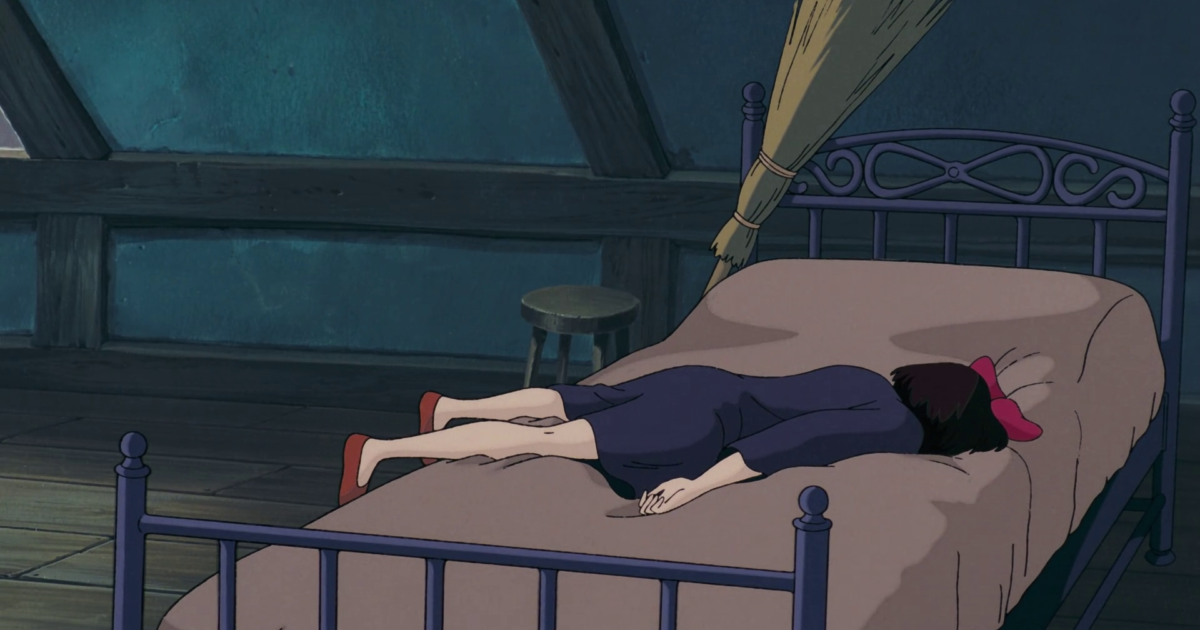
So we begin Kiki with her moving out from her parents’ home and moving to the city, getting a job, and finding fulfillment in that job. These are the rhythms Kiki has been taught how to do – to ply her trade, in a maybe unconventional way, and put down roots. She adores the old lady who makes artisan pies for her ungrateful granddaughter. She admires the artist who has achieved the self-motivation Kiki lacks. And the film’s primary drama arrives only when she experiences her first setbacks – she catches a mild pneumonia, and after she recovers, she becomes deeply depressed after an awkward social encounter with her friend Tombo.

The depressive episode, like the peril in My Neighbor Totoro, is unconventional for a children’s fantasy film. Both films explore the encroaching of real adult concerns in a direct and nonsymbolic way – I’d contrast with the extreme abstraction of The Boy and the Heron’s fantasy world or the slime Howl gag in Howl’s Moving Castle. Kiki’s depression means she can’t fly, that she can’t talk to her cat. The magic doesn’t create the drama – the magic disappearing creates the drama.

I think about Kiki a lot. 

THE SOFT BULLETIN

THE SOFT BULLETIN
The Flaming Lips
1999

Not one of the eight Flaming Lips albums before The Soft Bulletin is a bad album. They’re all very solid indie rock. The base pleasures of Wayne’s singing and their riff-writing maintain a solid development period. But the best Flaming Lips songs prior to The Soft Bulletin are fun diversions, often intentionally so. “She Don’t Use Jelly,” “This Here Giraffe,” “Turn It On,” these are fun songs (and in fact, I miss some of that Primus-adjacent spirit of “Turn It On” in their later years!) but they aren’t anthems.

The Flaming Lips ascend to the mainstream with The Soft Bulletin, its more complex musicality rivaling the intricacy of Radiohead’s OK Computer in a format more accessible than the four-LP experiment of Zaireeka. But, really, I think it’s less the complexity that attracted the mass attention that would allow them to blossom into one of America’s great rock bands with Yoshimi Battles The Pink Robots and instead the escalation of stakes in their music. This happens lyrically, but it also happens sonically – the melodies are soar, and those new instrumental layers and drum machines arrive in sequence across each track’s runtime. This is not the maximalism of the 70s brought back directly – it’s repeatedly stripped back across the album down to the sound they mastered as indies.

I get that some people will never enjoy Wayne Coyne’s voice. It’s almost impossible to express how inescapable “Do You Realize??” was when I was a teenager. In the time right after Limp Bizkit and alongside James Blunt and Mika, I got very used to his thin, often pitchy lead vocals. I think it never sounds better than on The Soft Bulletin, where on a song like “The Spiderbite Song,” it disarms the Queen-like piano and drum arrangement and keeps a sense of humor around the lyrics. It makes him sound small enough that these near-misses with death could have destroyed him. That his final verse avoids talking about his own father’s death feels like he understands the character he’s built on The Soft Bulletin.

It’s this juxtaposition of soft-and-strong that makes The Flaming Lips a perfect anthem band for 1999. It lends a sincerity that the adult contemporary bands of the early 2000s like Coldplay and Train never bridged. Stripping back to the quietude of “What is The Light?”’s piano and bass drum intro or allowing nearly two full minutes of “Feeling Yourself Disintegrate” to pass before allowing any percussion to re-enter lends indie cred that kept The Flaming Lips cool. Well – sure, critics and audiences thought they were cool, but I just mean that I think they’re cool too.

KEY TRACKS: “Race for the Prize,” “The Spiderbite Song,” “Waitin For A Superman”
CATALOG CHOICE: Clouds Taste Metallic, Yoshimi Battles the Pink Robots
NEXT STOP: Go Farther In Lightness, Gang of Youths
AFTER THAT: The Man Who Sold the World, David Bowie