EMOTION

EMOTION
Carly Rae Jepsen
2015

Poptimism’s original incarnation won out of self-evidence. The original concept of poptimism is that pop music (as defined less by radio format and more by its relationship to disco, Max Martin and Madonna) is worth taking seriously in the same way as rock music. First coined in 2004, poptimism flourished with the early careers of Beyonce as a solo artist, Rihanna, Robyn, Lady Gaga – these albums are phenomenal, the songs enduring, the standards high. We’ve now hit a second wave that establishes that anything commercially successful must have inherent critical esteem. With maybe the sole exception of Maroon 5, who may be too crassly commercial and anonymous to defend, I’ve seen vociferous defenses of just about every artist with a radio hit this past decade. It’s frustrating because I want to find good music and want to know who to trust.

The rock critics who’ve integrated some pop music have kept space in their hearts for Carly Rae Jepsen, making her a borderline automatic answer for what “good pop music” someone might want to listen to instead of [insert musician people are going to yell at me for saying they made a bad album.] Her reputation for making more thoughtful, higher quality dance pop began with Emotion, or more specifically with the release of “Run Away With Me,” a song with a saxophone intro riff that served as her call to action. Within a year, she was the favorite new pop star of podcasters, rock critics, and millennial gays – but, with the exception of “Cut to the Feeling,” a song she made for children’s animated film Leap/Ballerina, she never really charted again. It feels just as contrarian to argue the market got this wrong, that the post-Robyn yearning of Dedicated or the 70s throwbacks of The Loneliest/Loveliest Time should have made her a superstar. But I can still feel strongly that “Too Much”, “The Loneliest Time,” and “Boy Problems” are all way better than [okay okay stop throwing things at me this is the problem i know i know]!

P.S. To be honest, sitting down to write this one, the first thing I want to talk about is the damn sweater. The original is a 1973 Valentino sweater, though in 2015 they reissued it. I’ve been fixated on it as a favorite garment for almost a decade now. If I could get something similar, it’d be my go-to pride gear until I wore it to shreds. The Chevron, the sleeve asymmetry, the lack of clearly identifiable pattern in the color sequencing – pop music demands an aesthetic, and that sweater is as sticky as many of the songs themselves.

Emotion betrays a lot of the standard practice of modern pop songwriting. It’s not edgy or especially personal in subject matter. Most of the songs have a minimum of four songwriters between music and lyrics. The songs are silly, very clean, mostly a lot of fun. There’s a couple that are hornier than others (“All That” with music by Blood Orange’s Dev Hynes, bonus track “Black Heart”) and a couple that are more general audiences in their aim (“I Really Like You,” lead single with a Tom Hanks music video, “Boy Problems”.) On paper, it’s the album for everybody and nobody designed by committee in the 2010s.

The secret to that formula is just getting a really great committee. Jepsen didn’t necessarily need to keep making pop music, working on Broadway as Cinderella in a Rodgers + Hammerstein production. “Call Me Maybe” gave her the clout and freedom to make whatever she wanted. As a result, she exhibits the creative control in choosing collaborators she actually admires, from Hynes to Ariel Rechtshaid (“Climax,” “Ring Off”, “Take Me Apart”) to Rostam (Vampire Weekend). It’s an organic collection of really smart people who contributed something alternative.

I can’t think of a better nine track run in pop music than the first nine songs on Emotion. Every summer, I have different favorites. When we were doing Maintained Madness, I recommended the title track as our entry because it has moments echoing almost every great moment of the album. The synth beat is delightful, the crescendo from verse to chorus is rousing every time, and Carly’s voice is as bright and energetic as anywhere else. But I love just as much the melancholy of “Gimmie Love,” a song which presages some of the sound of Dedicated. Today, I’m really enjoying “Let’s Get Lost,” which brings back the saxophone from “Run Away With Me” for a more 80s solo riot, a little bit sitcom, but a lot of fun. I’m still not tired of any of these songs. I suspect I never will be.

KEY TRACKS: “Run Away With Me,” “Emotion,” “All That”
CATALOG CHOICE: Dedicated, The Loveliest Time
NEXT STOP: Freetown Sound, Blood Orange
AFTER THAT: Women in Music Part III, Haim
CATCH ME IF YOU CAN

CATCH ME IF YOU CAN
Dir. Steven Spielberg
2002

This past Christmas, unable to split the difference picking a holiday movie, I threw on Catch Me If You Can, a film which centers its core relationship between youth con artist Frank Abignale Jr. (Leonardo DiCaprio, maybe never better used for his charisma and ability to play nervy anxiety) and FBI Fraud Agent Carl Hanratty (Tom Hanks) on Christmas correspondence. While it spends a lot of its runtime in sunny Miami, Louisiana, and Georgia, this only drives into the stark relief the cold Christmas toward the end of the film set back in New York City

Really making the space to watch this as a “Christmas movie” helped really make the isolation and grief Frank has in deciding to be independent far too young. He’s a boy who saw his parents’ marriage fall apart and decided he’d use his skills to give them the resources and excuse to come back together. Watching it after Spielberg’s The Fabelmans, it’s almost impossible not to see how much of himself he poured into his portrayal of Abignale Jr. That’s true even before you read the real Frank Abignale’s account of the film, that the FBI chase was very accurately portrayed and the family relationship was almost entirely fictionalized.

Catch Me If You Can is one of Spielberg’s most vulnerable films – the (also fictional) scenes between Abignale Sr. (Christopher Walken, maybe at his career best) and his son give love and dignity back to a man whose role in the original story was to be a failure who lost touch with his son entirely. Walken plays these scenes with a recognition that the fantasy Jr.’s maintaining to honor Sr. as a father figure is a mutual charity – when it finally explodes, the anger at the condescension never stops betraying the pain.

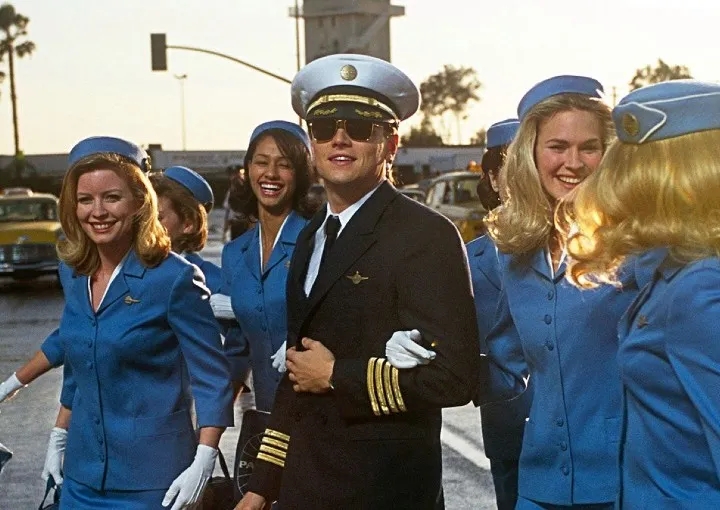
Frank walking with his Pan Am entourage.

But this is also one of Spielberg’s most electric and fun films, too. Frank’s fraud is consistently played as a farce, his scenes with Hanratty crackling with Golden Age Hollywood repartee and beautiful deadpan from Hanks. The score is one of John Williams’ liveliest in the 21st century, brass and piano playing cat and mouse and setting the 60s milieu alongside the wonderful production design and costuming. Janusz Kaminski shoots the film fairly modern, which allows for an athletic departure from the cinematic language the film’s 60s world would match, and it keeps the pace racing.

One of life’s great pleasures is the film that holds up. Some films are too exhausting to want to revisit, and others are too light on substance to keep being rewarding. I don’t think Spielberg is immune to either problem, but his best films are remarkably light on their feet while also offering layers and layers of character psychology and structural meaning. Spielberg opening his heart with this film gives it that extra push it needs to combine the dance and the brain into an enduring masterpiece.

KNOTWORDS

Knotwords 
2022
iOS, Google Play, Steam

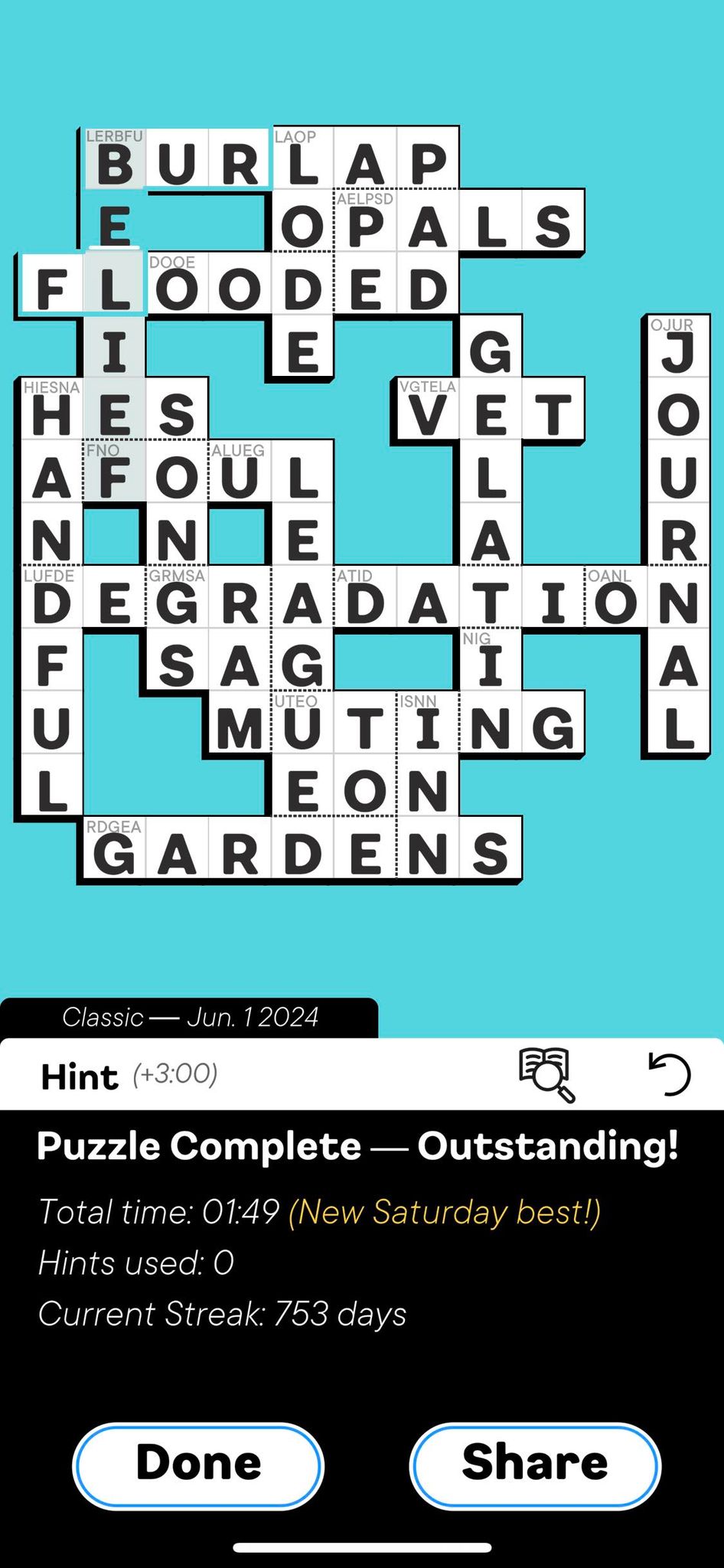
Game designers Zach Gage and Jack Schlesinger’s (Good Sudoku, Spelltower) greatest game is Knotwords, their take on crosswords. Unlike the New York Times crossword (or most cryptic crosswords you’ll find), the game does not rely on definition clues or puns to give you the word. What Knotwords uses to clue players toward solutions is zoned areas – outlined sections of anywhere between two and six squares, and a clue showing what letters will be used in that section. The clue also clarifies any doubles you might need – you might get a three-letter clue that spells “OFO,” for example, and those three letters might contribute to spelling “FOOD.” The zones are divorced from the actual puzzle solutions, meaning the actual solving feels quite a bit like a standard crossword. It’s how you get to that solution that things change.

Anyone who does traditional cryptic crosswords will tell you is that most crosswords you’ll find in a magazine or newspaper are actually trivia games first and word puzzles second. If you are familiar with, say, all of the pop culture and historical references in your average NYT crossword, it’ll be solved almost as quickly as you can enter the letters. If you don’t know the last name of “Figure skater Katarina” or “Castle in ‘Hamlet’,” you may be sunk. Add in NYT’s adoration of theme puzzles and you may be trapped in by obscure puzzle logic, multiple puzzles tied to one piece of trivia you don’t know, or, worst of all, the dreaded rebus.

Knotwords does away with all of that – your only required knowledge is the words you hypothetically can spell with a set of letters. If you happen to be unfamiliar with the word in question (the game uses wiktionary, which doesn’t include proper nouns but does include several exotic boats or shrubberies) you can also ask for a hint, offering the definition as well. But because the game also offers all the letters you need, you can also often solve your way into unfamiliar words just as often as you do in a regular crossword.

Our most recent screenshot of a Best New Time! We’ve kept our streak since public release.

Playing the game for free, you’ll have access to the daily puzzles – these grow in difficulty from Monday to Sunday in a way familiar to most daily puzzle players. On average, doing the daily mini and daily classic puzzle takes my wife and I about five to fifteen minutes before bed. We also have bought in for the “puzzle packs,” which are monthly and include some lightly themed puzzles (still less trivia oriented than any crossword, but puzzles themed around food, flowers, or “no big words” can be fun changes of pace) about on par with the standard puzzles.

By comparison to Good Sudoku, their last game, Knotwords is not a game you can readily binge. It’s also stripped away Good Sudoku’s leaderboards, which I find a huge help here. The app has kept Good Sudoku’s perfect visual design and user interface, however, with great colors, beautiful, big blocky letters, and jaunty music that remains peaceful. The letters thunk down satisfyingly, and after solving a puzzle, you’re greeted by the Rabbit, who makes the most satisfying sounds imaginable. According to Schlesinger, “The bunny SFX were created and implemented within the last 12 hours before we submitted the builds – partially because there was so much to do, but partially because [Zach] and I just both completely knew exactly what it would sound like!”

Some might say this game’s modest ambition is not worthy of a “favorite game.” Maintaining a 761-day streak of playing, I can’t help but disagree. How many games can honestly say their design truly rivals the crossword itself? I think its answers to the classic problems of crosswords constitute brilliant game design – no longer being asked “Carly ___ Jepsen” as the most boring of crossword fills and instead just engaging with the language itself alone let me delete the NYT crossword from my phone. And, on top of that, it offers enough meat to the daily experience that it outclasses the endless Wordle-alikes, only meant to hold your attention for a minute or so. With the games Gage and Schlesinger make, there is perfection in simplicity and elegance in presentation. A game that so respects its players’ time and intelligence is one that has the potential to last in our hearts for years.

REMAIN IN LIGHT (Kidjo)

REMAIN IN LIGHT
Angelique Kidjo
2018

As an undergrad, I remember saying “The Talking Heads [sic] are the most underrated band in rock history.” I was going off an understanding of rock history shaped by classic rock radio, Rolling Stone magazine, and T-shirt shops. And even I was not really listening to Talking Heads all that much – I’d bought a copy of Remain in Light, their most acclaimed album, and I really liked it. Later, when I listened to their other albums, Remain in Light faded quite a lot in my estimation. It remains a transitional album in my ears, a mix of the New Wave and Brian Eno experimentation that defined the band’s early years and the branch into funk and the polyrhythm of Fela Kuti. I preferred the interpretation of those songs on Stop Making Sense to the studio recordings.

Kidjo’s reinterpretation of the album reasserts the African influence on the album. The instrumentation and arrangements she’s applied to these songs gives them such life. She gives some of these songs new tempos, some of them new brass and woodwind parts, new grooves, but they’re all perfectly suited interpretations of the songs. In her writing about recording the album for Pitchfork, Kidjo talks about how her approach was to build from percussion back into the full song. I wonder if Byrne borrowed that concept back when constructing the stage version of American Utopia, where every member of the cast carries their instrument, so many of them drums. 

While I love David Byrne with my whole heart, I think few would argue that he’s traditionally as strong a singer as Kidjo. But I adore that she does not pursue making these songs as melodic as possible. Kidjo sings Remain in Light with a great sense of humor, pushing the momentary anger, frustration, revelation over diva architecture. The way she sings “Once in a Lifetime” is with so much joy and naivete, a song to so many defined by that televangelist ecstasy of Byrne. The harmonies she adds throughout fit beautifully – her new vocal additions (generally not captured in lyric sheets, likely in Fon or Yoruba) feel equally natural.

This album highlights the false ceiling of my imagined canon of estimation as a young firebrand. It’s not that I was wrong that Talking Heads are more interesting than Aerosmith or AC/DC – it’s that I imagined I’d already heard the world’s most important music at twenty years old and everything else would just be “filling in gaps.” At that age I’d only read the name Angelique Kidjo. I didn’t imagine how she could blow the roof off the pop canon. This month, as I ease back into writing about music, I’m writing about a lot of that pop canon I’ve loved all these years – I’m hoping next time I have the confidence to push myself a little farther afield.

KEY TRACKS: “Crosseyed and Painless,” “Once in a Lifetime,” “Listening Wind”
CATALOG CHOICE: Aye
NEXT STOP: Who Is William Onyeabor?, William Onyeabor
AFTER THAT: The Indestructible Beat of Soweto, Vol. 1

ONE FROM THE HEART

ONE FROM THE HEART
Dir. Francis Ford Coppola
1981
VOD, Reprise on Blu-Ray

I don’t always find the Movie Brats best at their most sentimental. I do with Spielberg, where my favorite films are The Fabelmans, Catch Me If You Can, and Close Encounters of the Third Kind over his landmark blockbusters like Raiders of the Lost Ark and his prestige dramas like Schindler’s List. When he gets sweet, he puts up just the right amount of guard for most of the runtime and then allows absolute powerhouse wallops to rock you to your core. With Lucas, I vastly prefer Star Wars to American Graffiti these days – Scorsese, the crime epics of The Irishman and Killers of the Flower Moon notch a tier above movies like The Age of Innocence and Hugo. If De Palma has a sweet side, I’ve only really seen it in The Untouchables and Phantom of the Paradise, and I prefer the nastiness of Blow Out or Carrie.

By comparison, I’m still getting to know Coppola. I’ve seen the classic 70s quadrilogy, Bram Stoker’s Dracula, and outside I’ve only seen Peggy Sue Got Married and One From The Heart: Reprise. Peggy Sue I find nostalgic to the point of acrid, with really only its bizarre Nic Cage performance breaking through to make me think we might be laughing together. So I came into One From The Heart: Reprise knowing it was a film which bankrupted both Coppola and his Zoetrope Studios into financial ruin, a film reviled upon release that had seen some reappraisal since, and a “musical” sung through by Tom Waits and Crystal Gayle. I hoped to get some fun out of a calamity.

From the opening credits which unveil this reconstructed fantasy of the Las Vegas strip from under a sea of sand, I spent basically all 93 minutes of this film with my joyful smile in rictus. During the fantastical dream ballet sequence (shown in the trailer and borrowed in Damien Chazelle’s La La Land) I started crying. This story of two people falling out of love and still refusing to let go is not told effectively through the script, but through the film’s intoxicating color, music, and rhythm. The story, which positions Frederick Forrest’s Hank as so unlikable that you’re rooting for Acme violence against him by the film’s second half, serves as friction against that cocktail.

Hank……………………

Hank has been living with Frannie (Teri Garr) for several years, and they’ve fought and made up repeatedly the entire time. He cheats, they break up, they get back together the next day, and the dysfunction continues. This film’s fight appears to be the fight that finally ends things, and they pursue new relationships with new flings. Nastassja Kinski’s Leila can really only engage with Hank on a surface, physical level, a sheltered immigrant circus performer who romanticizes the idea of running away together. That relationship sings because, honestly, romantic fantasy is all Hank can provide, too – the death of their time together is built in from the moment they meet because she only wants a fantasy and he’s a facade.

The real meat of the movie is Frannie and Raul Julia’s Ray, a singer/waiter who challenges her to actually follow her dreams and see the world. Their relationship is lush, coming across as having real empathy, chemistry, sex, fun. Surrounded by skeptics, it was their scenes together that very obviously pulled everyone onto the same page. Their reunion after a couple small flirtations is the beginning of the film’s longest dance sequence, and while their dialogue together is much stronger than Hank and Leila’s, it’s the dance that sells you that these two are meant for one another.

Even outside the dance sequences, there are long, dialogue-free songs set to the Tom Waits and Crystal Gayle vocals. Early in the film, there’s a lot of walking from one end of the strip to the other, looking around longingly, bathed in neon and shadow. I’ve been explaining “what happens” in the film so far, but it’s really a film baked in How It’s Shown. Hank wandering through the cold blue neon of the martini bar and eventually seeing the giant superimposed Leila was an emotional powerhouse for me. I won’t say “the art speaks for itself,” but this film is a case where a picture is worth a thousand words, and there are too many pictures that make my heart soar here to dig into what I find so beautiful about each one as part of this film.

Frannie!!!!

The running story of Coppola at this time is about his upcoming Megalopolis. Once again, Coppola is betting the farm (in this case, the vineyard) on a passion project. The conversations around it have highlighted a lot of his personal failures, among them his lack of realistic perspective on the state of art commerce and his refusal to disavow evil men. There’s a tension between wanting to view Coppola as a master artist and tragic figure and the recognition that his choices lead him down the road he deserves. I’m not sure it’s as simple as believing that people get what they do or don’t deserve – my feelings on One From The Heart reflect that same tension, a film ending on someone who maybe would better have been left alone in a dark room. Maybe with future viewings, I’ll pull some new meaning from that last thirty seconds. For now, I’ll settle on it being a promise that the story is not quite over yet.

NIER REPLICANT

NIER REPLICANT
Yoko Taro, PlatinumGames
2021
Xbox, Playstation 4

“Weiss, you dumbass! Start making sense, you rotten book, or you’re gonna be sorry! Maybe I’ll rip your pages out one by one, or maybe I’ll put you in the goddamn furnace! How could someone with such a big, smart brain get hypnotized like a little bitch, huh? ‘Oh, Shadowlord, I love you, Shadowlord, come over here and give Weiss a big sloppy kiss, Shadowlord.’ Now pull your head out of your goddamn ass and start fucking helping us!”

These words greeted players eleven years ago every time they booted Cavia’s NieR Gestalt, released in the United States as NieR, an action RPG largely dubbed an interesting failure with a great soundtrack. Yoko Taro’s name at the time was completely unknown. That he has managed to transform NieR into a juggernaut uttered in whispered tones alongside Hollow Knight, Persona, and the like is the sort of project every game hopes to endure. Working with PlatinumGames, Taro remade NieR Replicant, the Japanese version of NieR, from the ground up, with rerecorded voice acting and music, new graphics and gameplay, and a new ending. He titled the remake NieR Replicant ver.1.22474487139… – I will be referring to the remake as NieR Replicant and the broad collection of games as NieR from here on.

NieR takes place in a fallen world. Whatever security existed before has succumbed to an encroaching plague known as the Black Scrawl and the progressive incursion of monsters the people call Shades. Our protagonist (named by the player, known by fans as Nier) searches for a cure to the Black Scrawl for his sister, Yonah, who lives in a village led by two twins, Devola and Popola. The Black Scrawl leaves Yonah an outcast, as no one knows how the plague spreads. When Yonah finds a rumor of a cure known as a Lunar Tear, she sets out to forbidden, dangerous ruins, where Nier rescues her and encounters a magical tome. The book speaks, informing Nier that his magic may be able to combat the Black Scrawl, and their adventure begins.

NieR adventures with gameplay in shocking and delightful ways. Without giving anything away, it references the history of adventure games and horror in surprising, funny moments that take the gameplay off-model. The remake, Replicant, has taken the moment-to-moment action gameplay outside those setpieces and transformed it into a modern, high quality Stylish Action Game, similar to a Bayonetta or Devil May Cry, but with so many accessibility options to remove as much difficulty as you like. If you find yourself frustrated by the combat, NieR Replicant is incredibly accommodating in letting you focus on the story. I think more games should offer experiences like this one, which don’t change the core experience on-screen and instead offer options to make it easier to see it through.

The NieR franchise, or the Greater Yoko Taro Project, is largely contextualized by repetition. Players of the breakout sequel NieR Automata will be familiar with his recurring approach involving replaying portions of the same game with minor variation that lead to different narrative outcomes. Players of any two Yoko Taro games in the NieR or Drakengard franchise will recognize his recurring tropes, themes, interconnections, and affection for his characters and lore. And, yes, to see NieR through to endings D and E, you will need to play through NieR roughly two and a half times. I love this fact – it remains one of the most powerful ways to build familiarity with characters and heighten the inevitability of its high highs and low lows.

The protagonist starts the game loving his sick sister, Yonah – he will come to love his ragtag party. From the foulmouthed Kaine, to the snobbish animate tome Grimoire Weiss, to the strange chipper child Emil, this found family comes together to care for one another so deeply that it will change the fate of the world. NieR Automata takes a science fiction approach to relationships, beginning from programmed remove and showing where emotion causes things to break down. NieR Replicant is an epic fantasy. Instead, its emotions are operatic from the very beginning. It uses that passion to focus on how everyone is capable of violent, world-changing love. 

NieR Replicant is also a dark fantasy. The protagonist loves Yonah, but over time, we also come to understand how he resents her illness and wishes he could have a normal adolescent life. Kaine and Emil undergo incredible trauma in their assistance to Nier, facing incredible sacrifices in the face of an immature, egocentric brat – a brat they love. The answers they find about the Shades, the Black Scrawl, and the world they live in are horrifying and raise existential questions about everyone they’ve ever known. NieR Replicant is special because it finds a way to marry intense, sincere kindnesses and awful, melodramatic tragedy.

Even if games aren’t for you, I have to recommend Keiichi Okabe’s music for the game. His style marries emphasis on acoustic instruments (strings, guitar, harp, piano) and women’s harmonized vocals. All of the vocal music in NieR Replicant is performed in the game’s fictional language, a language that sometimes sounds like Japanese, sometimes like German, sometimes French. Okabe’s musical themes communicate the emotional heft of its characters’ decisions and devotions. The soundtrack’s melodic drive, intense control of arrangement and orchestration, and willingness to vary between the familiar and the subversive reflects the game’s own mission. 

MY NAME IS MY NAME

MY NAME IS MY NAME
Pusha T
2013

Of every rap album, this might be the one where the highest number of full verses wander back into my brain. Ten years removed from Clipse (whose “Grindin’” I maintain is the best song of the 00s,) Pusha T reclaims all-time status with My Name Is My Name, his debut album after a number of mixtapes exploring his identity and sound as a solo artist. Unlike many of the rap albums of the last fifteen years, the track list is sparse, with twelve radio length songs and zero bonus tracks or skits.

The musical variety on this album within that short runtime is impressive. There are aggressive songs that only make sense in the context of the house inspired album rap of Death Grips and Danny Brown. There are ballads that serve as alternatives to Drake’s sad rap – there are gritty, trap beat songs ready for NBA championship ads. Pusha unifies it all, from the movie references, the coke jokes, the stoic exhaustion of a man who’s been doing all this a little too long. He’s elevated to another level as a rapper, with the complexity of his flows and the energy of his vocal delivery reaching new highs. 

Normally I only do one video for these album write-ups, but this video is so incredible!

The list of collaborators is top of the industry then and now, including Future, Pharrell, Jeezy, 2 Chainz, Rick Ross, and Kelly Rowland. In a top 5 all time Kendrick guest appearance, “Nosetalgia” has a second verse that shatters the at-bats by everyone else. By the time the “taco meat laying on his gold” delivery arrives, I’m back in my little rap dork driver’s seat, hitting every line like I’m doing it at karaoke. The obvious bum note is Chris Brown singing the hook of “Sweet Serenade,” a choice I’d already feel shitty about given his history of abuse, but the hook also doesn’t sound especially good. You aren’t listening to My Name Is My Name for its kind heart – this is coke rap with violence at its outskirts (and sometimes center stage.) 

At some point, maybe I’ll feel like writing about Kanye West again. His work meant an incalculable amount to me for many years – his disintegration was probably less into being an offensive reactionary and more into being a very boring one. The closest I’ll come this year is his executive production on this album – while every song he’s credited for producing has an essential collaborator, it’s hard to deny the aesthetic overlap with his album Yeezus earlier that year. At the time, when I was hooked on the guy, I loved this album all the more for its part in that myth.

In my memory, this album retreats into the “yeah, it was cool when it came out, but how great is it really?” zone only maintained by cowards. The moment I hear the opening shrieks of that Hudson Mohawke sample and the insane beat on “King Push,” I’m all in forever. “CB4 when you rhyme, Simple Simon.”

KEY TRACKS: “King Push,” “Numbers on the Board,” “Nosetalgia”
CATALOG CHOICE: King Push – Darkest Before Dawn: The Prelude
NEXT STOP: Wolf, Tyler the Creator
AFTER THAT: Shook, Algiers

MIND GAME

MIND GAME
Dir. Masaaki Yuasa
2004

This piece contains spoilers for the film Mind Game.

GKids released a wonderful Masaaki Yuasa boxset last year which meant I finally got to see Mind Game in proper high definition. It was almost like seeing it again for the first time, the vibrant colors of the film’s musical sequences shining bright a clean, the tiny details of the climactic sprint fully visible to me for the first time. I’ve mostly been rewatching my favorite film on a 480p file I got from Prof. Ridgely’s course on anime I took in 2012. At the time, there had been no official Western release of the film.

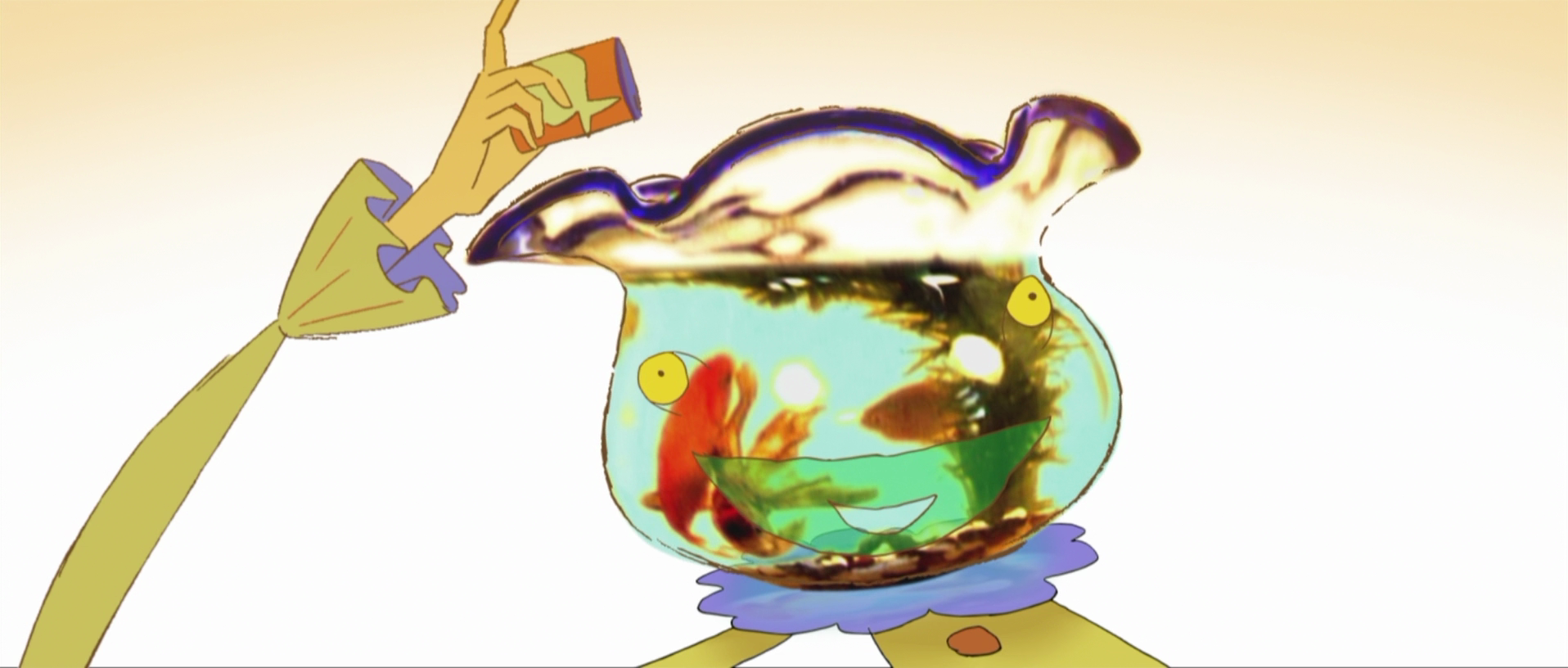
Mind Game portrays a young broke mangaka named Nishi who nurses a jealous crush on his childhood sweetheart Myon. They nearly went on a date once in high school, but got too shy to ever pursue it. When they reunite at the start of the film, she’s engaged to a nice, successful young man – and is being pursued by two yakuza seeking revenge on her womanizing father. When Nishi comes between Myon and the temperamental Atsu, he’s shot dead. Seeking to humiliate him, God shows him this death on a giant screen, on a hundred giant screens, looped, represented in 3D models, in slow motion, even in text. Then God tells him to surrender to oblivion – the afterlife is nothingness.

One vision of God in Mind Game’s afterlife.

When I’m faced with anxiety about a hypothetical risky situation, I maybe too quickly default to “the worst thing that happens is we die, and then we don’t have to worry about it anymore.” It’s a coping mechanism I’ve learned after a lot of unwelcome surprises in my young adult life. It keeps me from getting bogged down in the “but what happens ifs” and leading me toward the “so what do we do about its.” It maybe makes me complacent sometimes. Those pain points can be dealt with later, because pain isn’t fatal.

When I was still dating, this made it easy to ask people out, as getting a “no” back doesn’t leave me dead or in jail. Just asking to spend time together and then being pleasant to be around is, it turns out, also the secret to adult friendships – who knew? When it came time to uproot from Buffalo Grove and move to Nashville, this mentality kept me from considering cold feet. When it came time to leave Nashville and come back to Madison, it kept losing our apartment from creating total despair. When I think about somehow turning writing and media analysis into a career, this mentality turns waiting another few years until I’m in a “better place to write” into a pain point rather than an existential crisis. When jobs previous to the one I’m in now burdened me with overwork and too much responsibility with no increase in pay, I would say, “this too shall pass.” When I think about addressing my nonbinary identity, I have said “I don’t really want to get into all that right now” – that, at least, is starting to change.

This philosophy creates a tapestry of decisions and indecisions. Some are healthy and fun.  Others are stupid and painful. There are decisions that have no especially value-based consequence. Some people I’ve known react to it as optimism – that I refuse to give into despair. Others sense that it might be a form of nihilistic despair itself, that there’s a feeling that there’s no way to improve things beyond “at least we’re not dead.” I feel it both ways. I’m not convinced it’s healthy. I’m not convinced it isn’t, either.

After sharing this mentality with my therapist a few times, I was thinking about how this mentality relates to the compartmentalization of gaming. In video games, if you fail, you can always just start the game over. And you haven’t lost until you actually hit “game over,” in Tetris or in a Halo lobby. Losing the battle doesn’t mean losing the war. Any pain is only temporary (and, in a game, only “real” in the emotional sense.) Learning to accept the risk of defeat will make you a way better gamer – it makes it easier to learn from your mistakes in the moment, not give in to the anxiety of losing, and allows you to take greater risks without being so protective. Once you’ve learned enough mastery, you can recognize what’s actually worth protecting.

“The worst thing that happens is we die.”

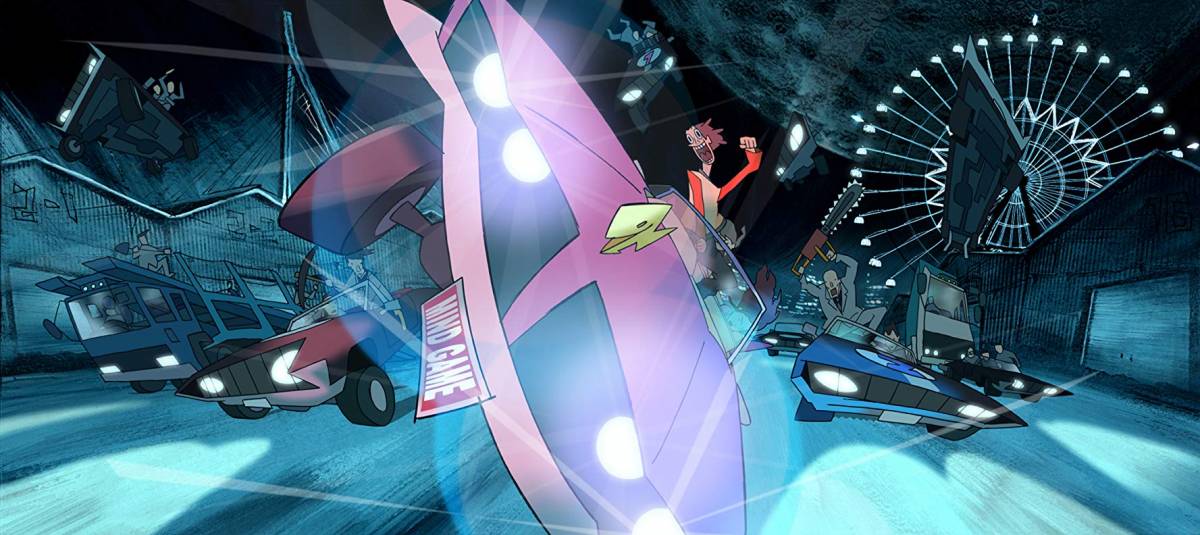
Nishiki sobs at first, but then he realizes that God is headed back toward life itself. He decides he’s not going to give in, that he’s not going to let it end this way. He sprints back to life and takes the second chance he’s been given in a manic stride, killing Atsu, stealing the other older officer’s car, and kidnapping Myon (and her sister, Yan.) They end up in a violent car chase, driving off a bridge, and being saved only by the grace of a blue whale swallowing the car whole. So begins the true movie of Mind Game – a modern riff on Jonah and the Whale.

Inside this whale, our trio meets a nameless hermit – he’s survived at least thirty years inside the belly of the beast, himself escaping a criminal past. He’s collected an incredible wealth of treasures within his shelter and made friends with a Jurassic pal. Inside the whale, Nishi, Myon, and Yan find new life. It’s a place for play without commerce, without social expectation beyond the family, without the concept of competition. In a lot of ways, this becomes a sex comedy for a while. It’s a mess, and the way it handles one character’s sexual exploration is even messier.

I love Yan!!!

The way this sequence is filmed is unbelievable – it is so colorful, so fantastical, so lively. Masaaki Yuasa is largely known as a master of setting animation to vibrant color and danceable music. You can go back to his earliest credits on Crayon Shin Chan and Chibi Maruko-Chan, to his first animated sequences, and see the kind of blissed out work he does in that setting. To me, it’s ecstatic. Some people would describe it as “trippy,” others synesthetic. I see also Merrie Melodies and Looney Toons, the origins of character cartooning. This film enters development shortly after the Superflat exhibition opens in Japan and begins to tour internationally. Mind Game isn’t coherent with the philosophical cynicism of Superflat as a movement (that distinction goes to Tamala 2010: A Punk Cat In Space,) but I can see a line between their postmodern visions of color and iconography.

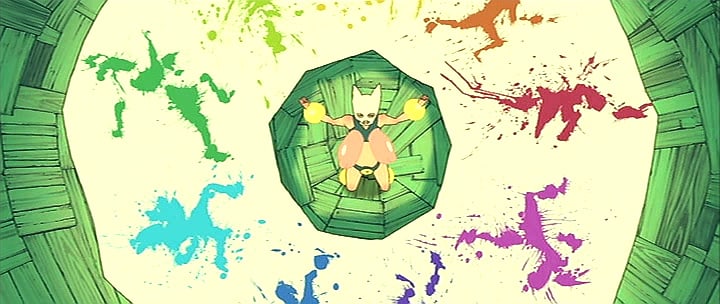
The end of the time in the whale comes and we head toward the film’s climax. Our heroes hatch their escape plan. After their race back to life, a montage plays of these characters’ entire 20th century ancestry. Every small decision in their lives is played in sequence, creating an apparent butterfly effect chain of every choice and non-choice made by our characters. Nishi’s high school heartbreak, the hermit leaving home for the last time, Atsu’s yakuza boss being raised as the patriarch. It is a tapestry of decisions followed by a final epitaph affirming life.

Just before their climactic attempt at escape, Nishi deflects the fear the hermit expresses about trying to escape the whale. Nishiki declares: 

“So what! I wanna get out! ‘Cos there’s so much out there! So many different people, living different lives! Incredibly good guys, bad guys… Folks completely different from us! It’s one huge melting pot! See, it’s not about success, dying in the streets, who’s better, who’s not! I just want to be a part of it! I realized that even if I’ve no connections, no talent, even if I’m one big loser, I want to use my hands and feet to think and move, to shape my own life! We can just die here or we can try, see what we’ve got!”

This movie is my heart. It’s my favorite.

DRUG WARS

Drug Wars
John Dell
1984
PC/DOS, ripped off as Dope Wars

Animal Crossing players are likely familiar with the turnip stalk market. Each Sunday morning, a traveler named Sow Joan (or her also-punned granddaughter, Daisy Mae) comes to your little Animal Crossing town selling turnips. You’re expected to buy them in bulk for roughly 100 bells (the standard currency of Animal Crossing.) Over the course of the next week, your local shop will buy turnips for anywhere from 30 bells to 600. Should you fail to sell them over the course of the week, they will rot.

It’s a fairly basic market speculation simulator, and the way to “game” the system is to have enough friends playing the game that one of them can call everyone over to their market when their turnip prices are favorable. Successfully taking advantage of the market is what allows Animal Crossing players to go from struggling to maintain a balance of $60k to swimming in billions over the course of a year. Because you’re not paying rent or buying groceries, failed investments rarely ruin lives.

This basic concept – buy low and shop around till you can sell high – is the core of 1984’s Drug Wars, programmed by a solo developer named John E. Dell. You have 30 days to make as much money as possible – you start with $2000 and a debt of $5500 owed to loan sharks. You buy and sell cocaine, heroin, acid, weed, speed, and ludes. You can also buy guns for fighting off Officer Hardass and his fellow cops, or trenchcoats for holding more drugs. The interest on your debt to the loan sharks grows quickly and can end your game entirely, but taking out a bigger loan is the only way to get a decent score.

The original DOS Drug Wars.

That arcade infrastructure of the “high score” is an interesting one for a PC game released during the video game crash of ‘83-’86. PC games held strong during this time, but arcades and consoles were on the way out, meaning it was not especially likely people would see that high score. But Drug Wars offers no other ways to celebrate your success – there’s no nominal “buy a nice car” or “buy a Scarface mansion” money goal you’re meant to reach. It’s all measured by that score. Shut out all conception of material reward, material harm, material wealth. You grind drugs and kill cops to be the best drug dealer you can be.

There are other multiplayer games that evolved around the buying and trading of materials to establish market values around this time – Taipan! and StarTrader were cited as direct inspirations for Dell. Like StarTrader, M.U.L.E. uses a similar space colonization theme and multiplayer competitive concept. The difference that leads to Dell’s choice in subject matter and eschewing multiplayer is that Dell was an edgy sophomore in high school. Drug Wars was an assignment for his computer lab. As the story goes, the game was later rewritten and rereleased so many times that even the shareware retitling “Dope Wars” has its own classic nostalgia.

Drug Wars on a TI-83 graphing calculator.

The simplicity of Drug Wars is an accident shaped by its creator trying to get a decent grade. That simplicity is what makes it endure. Games go through cycles of simplicity and hypercomplexity. Right now, I think we’re on a wane, coming down from a peak of percentile modifiers to subsurface microstats and arcane board games and RPGs that seek to simulate the walking balance of a mech’s hydraulic limb system. There is a desire to just get back to skill being built around risk management, with any math being relatively basic.

In that sense, Drug Wars is important to me as a central reminder of how a small game you made in a couple weeks can endure forty full years. Of course, John E. Dell never made a dime off Drug Wars, and according to him, he rarely gets work off its reputation either. Ideas are just as easy to find cheap and sell high.  If you’re clever, mechanics can be reshaped from colonial exploration to sophomoric crime cartoons by a literal sophomore – and then back into cute animal cottagecore by the biggest game developer in the world.

RUMOURS

RUMOURS
Fleetwood Mac
1977

For as long as I’ve moved to rating things out of 5, Rumours was my go-to example of a commonly accepted 5 star masterpiece. It’s a perfect cultural object, and it’s been rediscovered repeatedly my entire life. My friends and I found it through Rock Band 2’s inclusion of “Go Your Own Way” – then another generation through “The Chain” in Guardians of the Galaxy Vol. 2 – then another through the “Dreams” longboarding cranberry juice TikTok. Part of the reason this album can keep being rediscovered is that every one of its eleven songs could be the song of a generation. I guarantee “Second Hand News” will get its day in the sun.

Of course, when you bring up Rumours, the instant association is with its mythology. A web of infidelity and broken hearts. If you’re a lyric-first listener, this is a vulnerable, rich text, and its legacy would be secured by that alone. But what makes Rumours such a consensus masterpiece is that you can just as easily zone out the lyrics’ meaning and purely enjoy the sound. Lindsey Buckingham, Stevie Nicks, and McVie sing almost every song with an impressive degree of remove, delightful break-up pop in the same vein as The Beatles’ White Album.

The exceptions, where I feel the weight of pain is really allowed to break the mask, are “The Chain” and “Oh Daddy.” The former’s blues intensity is shaped around Mick Fleetwood’s drum kick, but it’s the Buckingham/Nicks vocals that ascend the song into a ritual of divorce. Christine McVie provides backing vocals on the song as well, but “Oh Daddy” is really her chance to turn her back on the brave face of “You Make Lovin’ Fun.” It’s a more traditional pop ballad of the era, but the plaintive lead goes perfectly with Buckingham’s slinky guitar line.

Pop is mastered by the interplay of John McVie’s bass lines, Christine McVie’s keys, Buckingham’s guitar parts, and Fleetwood’s percussion. Everyone is so thoughtfully building every perfect structure with so many delightful musical details and fills. It makes every listen an opportunity for rediscovery. That interplay is really what makes Rumours so special to me. Its legacy as metatext is fun to talk about, but I think more than anything, the band poured their newfound independence into embellishing sonic opportunities with solid gold.

KEY TRACKS: “Dreams,” “The Chain,” “You Make Lovin’ Fun,” but also all of them!

CATALOG CHOICE: Buckingham/Nicks, Fleetwood Mac (1975,) Tusk

NEXT STOP: Heart Like A Wheel, Linda Ronstadt

AFTER THAT: Ask Rufus, Rufus & Chaka Khan