I SAW THE TV GLOW
Dir. Jane Schoenbrun
2024
PVOD, may still be in theaters near you!
This piece alludes to spoilers for the film I Saw The TV Glow – CW for intense depictions of gender dysphoria.
I Saw The TV Glow is a horror fantasy film about two teenagers, Owen (Justice Smith) and Mattie (Brigette Lundy-Paine,) who bond over their love of a monster of the week TV show The Pink Opaque. Owen isn’t allowed to watch it because the show is broadcast past his bedtime, dictated not by overprotectiveness (this stays true into high school) but by a distant, controlling father. So Mattie leaves Owen VHS tapes of the show – the film plays the development of their relationship in gorgeous lighting and on-screen marker-work while a great original Caroline Polachek song plays. It is not the first or last great original song in the film. One night, Owen asks if he can stay up and watch the season finale himself. Owen’s dad asks him upon hearing the request, “Isn’t that a girls’ show?”
When I was growing up, I was introduced to anime somewhere around the age of six or seven. I don’t actually remember which came first between Sailor Moon and Pokemon – they came roughly together. My parents applied zero “isn’t that a girl’s show” pressure around me watching Sailor Moon, they bought me the tapes. If anything, Mom’s shared with me that her attitude was always that they actively encouraged us to engage with entertainment in an ungendered way, to enjoy what I enjoyed so long as it was age appropriate. But by third grade, the boys in my cul-de-sac who would introduce me to internet porn a year later called it a girls’ show, and those tapes never came back out again.
Owen and Mattie first meet when Owen is in the seventh grade, played by Ian Foreman. The central three performances in this film by Justice Smith as Owen, Brigette Lundy-Paine as Maddy, and Ian Foreman as Owen in the first twenty minutes, are all astonishing. There’s an astonishing degree of trust and immersion in the day-to-day awkwardness of being a teenager that comes along with the deadly suffering of repression. Lundy-Paine gets to transform this over the runtime of the movie into a confidence, their final monologue one of the film’s few empowering and energizing scenes.
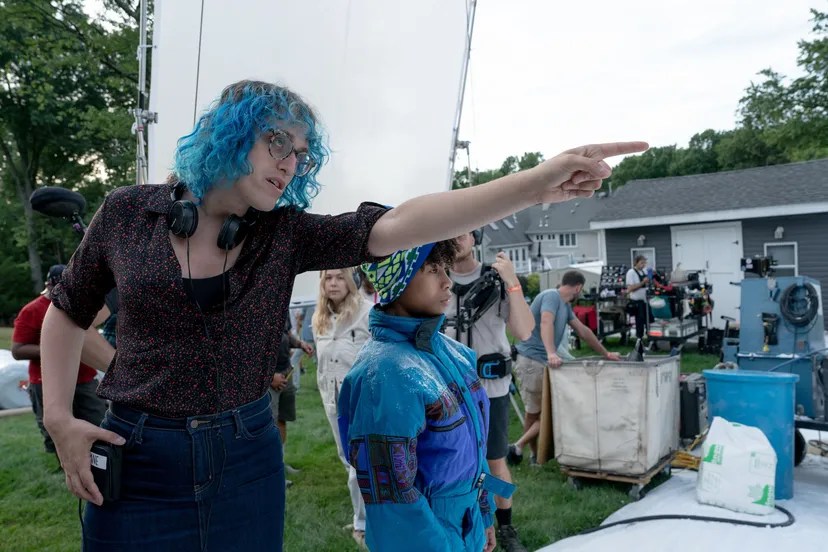
I Saw The TV Glow is a film about gender dysphoria. It is about an oppressive world that hates you for who you may not even yet know yourself to be. This hatred plays out in Small Horror Ways, microaggressions and hard stares, and in Big Horror Ways, in makeup and special effects and blood and ooze. It is also about trying to find community over the smallest of connections and finding a friendship that feels like a home. It’s not all oppression and despair, but I would not call it a “fun watch” or “inspiring representation!”
Inspiration is still happening, though – director Jane Schoenbrun, talking to Jordan Raup, said “I’d say at about a third––if not half––of the screenings that I’ve been to with the film, some shy person has sauntered up to me afterwards and been like, “That was it.”
There are
now
many reviews that
are equal part film criticism
and processing
coming out.
I kind of can’t stop reading about this film, interviews with critics like Willow Maclay, Juan Barquin, and Charles Pulliam-Moore informing the writing of this piece. Alongside them, a chorus of trans viewers feel I Saw The TV Glow will save lives. When I tried to say those words to friends after my screening, I started breaking down crying again.
Justice Smith gives a performance I can’t stop thinking about. One of the most painful scenes in the movie is a scene where Smith gets to perform full slapstick comedy. He manages to make his body move like Scooby Doo at a moment where you desperately want him to face his fears. Another early scene, his first confession of his sense of difference, is an astonishing performance of vulnerability of evil thoughts directed at the self, presented like it’s normal because he’s only sort of sure that it isn’t normal and he’s not just being dramatic. This performance carries trauma the way Sheryl Lee carries trauma in Twin Peaks: Fire Walk With Me. It is in the body as much as the voice and the mind, but it is also normalized, casual, and deeply painful. The feelings he is carrying are so private that he is compartmentalizing them from himself, repressing as much as possible.
I came out as nonbinary to myself and close family and friends shortly after the election of Donald Trump. That night, the terror and overriding anger it made me feel, made me realize that the relationship I had to that man, and all men, was not one of shared identity and shame. It was a question I’d had lingering in the back of my mind for years as I found myself gravitating toward trans artists, writers, and style icons, and that pushed me over the edge. I tried using they/them pronouns briefly and found it hard to recognize people were talking about me – I moved back to he/him pronouns and, for the most part, I’ve talked about my identity a few times a year before putting it back on the shelf to deal with later.

The overriding feeling of pain and the panic attack I had when the film cut to credits confused me. I didn’t have an egg to crack – what was happening? After taking a week to process, I’ve accepted that what I’ve been doing was grieving all the time I’ve lost. If this film had existed a decade ago, I might have confronted some of my insecurity, anger, and repression a lot sooner, before it led to lashing out at myself and loved ones. I might not have put my identity on a shelf rather than owning it, talking about it often, taking pride in who I am rather than regarding it like car repairs I’m putting off.
Schoenbrun’s previous film, We’re All Going to The World’s Fair, was in my roundup of the best films of 2022. I described the film foremost as about feeling small and childish in a room (the internet) where you suddenly realize everyone else thinks you’re acting out. That feeling of the judgment of others looms over huge swaths of I Saw The TV Glow, and it results in Owen losing weeks or years of time to a passive sense of “trans time,” as Schoenbrun calls it. There is a disconnection from everything because Owen’s own role in that life feels wrong. Like the sense of online immaturity in World’s Fair, I relate to this feeling of time slipping.
I can’t stress enough that this film is immaculate, gorgeous and inventive in cinematic language, funny and scary and beautifully acted. I also accept that I’m not going to be normal about this movie. This is the most impactful a new release has been on me in a decade. I can’t and don’t expect people to have the same reaction to it. The enormity of this film makes me feel small and childish, and maybe I will look back on this version of myself the way I have looked at the smaller, more childish versions of myself over the years. As Maddy insists, I will not apologize for it. We are always becoming new versions of ourselves – the film’s signature line is a chalk scrawl which reads, ”There is still time.”
 All My Friends